Christopher Manning is a Stanford computer scientist and linguist who helped develop statistical and neural NLP, coauthored GloVe, and contributed to Universal Dependencies and foundation-model research. — Laying the Foundation for Generative AI.
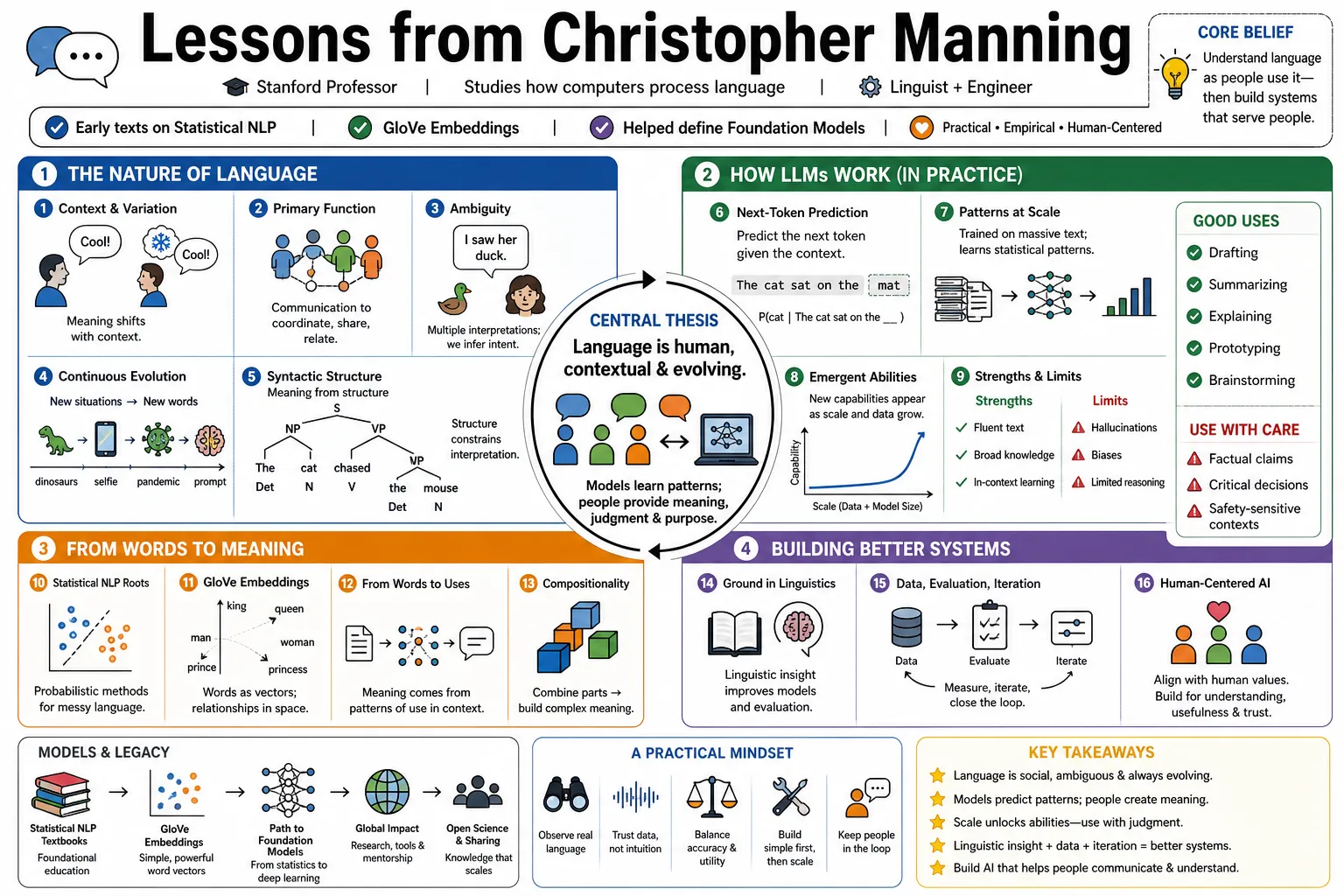
Part 1: The Nature of Language
- On context and variation: Manning describes language as a changing social creation whose interpretation depends on context; new expressions continually test standard rules. — Stanford Engineering Q&A.
- On the primary function of language: Manning emphasizes that language lets people communicate and share knowledge across a society, extending the intelligence of individuals. — Human Language Understanding & Reasoning.
- On ambiguity: Even a simple word can require different translations according to context, intended meaning, word order, and syntax. — Stanford Engineering Q&A.
- On syntactic structure: Manning argues that understanding complex sentences requires composing meanings from smaller words and multiword expressions. — Computational Linguistics and Deep Learning.
- On pragmatic meaning: For Manning, choosing a translation requires more than matching words: the surrounding context and intended meaning matter. — Stanford Engineering Q&A.
- On the difficulty of parsing: Manning traces the shift from hand-built rule systems to empirical models that learn from text, while noting the difficulty of learning language structure from counts alone. — Human Language Understanding & Reasoning.
- On language acquisition: Training on many examples helps computers discover complex language patterns; Manning offers child language learning only as a qualified analogy. — Stanford Engineering Q&A.
- On linguistic diversity: Manning and collaborators sought a common dependency representation that remained usable and linguistically faithful across languages. — Computational Linguistics and Deep Learning.
Part 2: The Evolution of Natural Language Processing
- On the shift from rules to statistics: Manning describes a major reorientation from hand-built systems toward empirical machine-learning models as digital text became widely available. — Human Language Understanding & Reasoning.
- On early deep learning skepticism: In 2015 Manning welcomed deep learning’s gains while arguing that higher-level language tasks had not yet seen the dramatic improvements seen in speech and vision. — Computational Linguistics and Deep Learning.
- On the empirical victory of neural nets: Manning explains how dense word vectors and end-to-end neural learning improved language models and machine translation. — Computational Linguistics and Deep Learning.
- On the consolidation of tasks: Manning contrasts traditional NLP pipelines of separately built components with large pretrained models adapted to individual tasks. — Human Language Understanding & Reasoning.
- On model scale: Manning attributes recent NLP gains to simple neural computations repeated at very large scale and trained on enormous text collections. — Human Language Understanding & Reasoning.
- On the speed of progress: Manning says the strong capabilities that emerged as neural language models scaled were surprising even to field experts. — Future of Computational Linguistics.
- On the fading of feature engineering: Manning describes end-to-end learning in which researchers set an architecture and objective while the model learns parameters and representations. — Computational Linguistics and Deep Learning.
- On the persistence of statistical principles: Manning traces today’s transformer language models to earlier next-word prediction models and later neural language models, while emphasizing their unexpected capabilities. — Future of Computational Linguistics.
Part 3: Deep Learning and Neural Architecture
- On the limitation of black boxes: Manning does not endorse the blanket rejection of data-rich black-box learning; he argues instead that linguistic domain questions, problems, and architectures remain important. — Computational Linguistics and Deep Learning.
- On distributed representations: Dense multidimensional word representations encode degrees of similarity and let models generalize beyond exact word identities. — Computational Linguistics and Deep Learning.
- On the transformer architecture: Transformer attention forms a representation at one position from weighted information at other positions in the text. — Human Language Understanding & Reasoning.
- On tree-recursive models: Manning’s earlier neural-NLP research included tree-recursive models intended to represent the structure and meaning of sentences. — Laying the Foundation for Generative AI.
- On soft versus hard constraints: Manning argues that continuous representations can capture graded linguistic categories that are awkward to model as hard, discrete labels. — Computational Linguistics and Deep Learning.
- On the necessity of understanding: He urges computational linguists to investigate substantive linguistic and cognitive questions rather than use word vectors only for small benchmark gains. — Computational Linguistics and Deep Learning.
- On backpropagation: Manning explains that neural language models learn vector representations by back-propagating prediction errors through the network. — Human Language Understanding & Reasoning.
- On the shift away from recurrence: Manning describes transformers as the dominant NLP architecture after earlier neural models for word sequences; attention combines information across positions. — Human Language Understanding & Reasoning.
- On architectural convergence: Manning points to extending self-supervised foundation models beyond text to vision, robotics, and other sensory data. — Human Language Understanding & Reasoning.
Part 4: Foundation Models and Scale
- On the term Foundation Model: Manning says the researchers proposed “foundation models” for broadly trained, adaptable systems that extend beyond language-only models. — Human Language Understanding & Reasoning.
- On the training objective: A large language model can learn from text by repeatedly predicting a next word or filling a masked phrase and adjusting to its errors. — Human Language Understanding & Reasoning.
- On the paradigm shift: The foundation-model report defines a paradigm of training on broad data and adapting the resulting model to many downstream tasks. — Opportunities and Risks of Foundation Models.
- On emergent capabilities: Manning says scaling word-prediction models brought translation, summarization, and world knowledge that researchers had not expected. — Future of Computational Linguistics.
- On data constraints: Manning notes that pretrained models can be adapted to a task with a comparatively small amount of labeled task data. — Human Language Understanding & Reasoning.
- On self-supervised learning: Self-supervised language learning creates prediction challenges from unlabeled text itself, reducing dependence on human task annotations. — Human Language Understanding & Reasoning.
- On the homogenization of AI: The report warns that broad reuse of a small set of foundation models can propagate their defects across many applications. — Opportunities and Risks of Foundation Models.
- On sociotechnical systems: The report treats foundation models as a sociotechnical subject requiring research beyond computer science alone. — Opportunities and Risks of Foundation Models.
- On the limits of scale: Manning expected widely deployed foundation models to remain limited in careful logical and causal reasoning even as scale improved many tasks. — Human Language Understanding & Reasoning.
- On partial model understanding: Manning argues that pretrained language models learn some meaning and world knowledge, while their understanding remains incomplete and would benefit from sensory grounding. — Human Language Understanding & Reasoning.
Part 5: The Role of Linguistics in AI
- On defining linguistics: Manning describes computational linguistics as the domain science of language technology: its linguistic problems remain important whatever learning method is fashionable. — Computational Linguistics and Deep Learning.
- On syntax in neural networks: Hewitt and Manning found evidence that parse-tree structure is represented implicitly in the vector geometry of ELMo and BERT. — A Structural Probe for Finding Syntax.
- On the necessity of grammar: Manning argues that evaluating language systems requires attention to compositional meaning: whether they combine words into meanings for novel, complex sentences. — Computational Linguistics and Deep Learning.
- On Universal Dependencies: Universal Dependencies aims to provide shared dependency and grammatical labels that are usable across languages without abandoning linguistic fidelity. — Computational Linguistics and Deep Learning.
- On morphology: Manning notes that even early translation systems had to address inflectional word forms and word order; language-specific morphology is not a trivial lookup problem. — Human Language Understanding & Reasoning.
- On cognitive plausibility: Manning finds it striking that children learn effective language use from far fewer words than the trillions shown to leading language models. — Laying the Foundation for Generative AI.
- On the tension between fields: Manning argued that formal linguistic theories and research on messy real-world language had become too separate, and proposed probabilistic grammar as a bridge. — StatNLP Models: Combining Linguistic and Statistical Sophistication.
- On linguistic probing: A structural probe can test whether learned word representations encode whole syntax trees, rather than only isolated linguistic features. — A Structural Probe for Finding Syntax.
- On semantics versus form: Manning rejects an all-or-nothing view of semantics: language models learn some meaning through connections in text, but their knowledge remains incomplete without wider grounding. — Human Language Understanding & Reasoning.
- On the scientific role of linguistics: Manning urges the field to investigate language problems and model architectures, not merely chase small benchmark improvements. — Computational Linguistics and Deep Learning.
Part 6: Representation and Semantics
- On Firth's principle: Distributional approaches represent part of a word’s meaning through the contexts in which it appears. — Human Language Understanding & Reasoning.
- On the GloVe motivation: GloVe uses global word–word co-occurrence statistics to train word vectors with meaningful linear relationships. — GloVe Project.
- On vector arithmetic: GloVe illustrates how vector differences can represent analogical relationships between words, though a single distance cannot capture every nuance. — GloVe Project.
- On word similarity: The GloVe project compares word vectors with cosine similarity or Euclidean distance to surface related words. — GloVe Project.
- On the limits of text-derived meaning: Manning treats text-derived word meaning as partial: linguistic contexts provide connections, but other sensory and worldly connections can add meaning. — Human Language Understanding & Reasoning.
- On structure in contextual embeddings: Hewitt and Manning show that contextual word representations in ELMo and BERT can encode syntactic structure absent from their baselines. — A Structural Probe for Finding Syntax.
- On capturing world knowledge: Manning warns that widely reused foundation models can pass their biases on to many downstream users. — Human Language Understanding & Reasoning.
- On aligning representations: Manning calls integrated multimodal learning from text and sensory data a promising direction for richer model meaning. — Human Language Understanding & Reasoning.
Part 7: Limitations and Reasoning
- On models and truth: Manning explains that next-token prediction can produce confident-looking claims even when the model lacks facts needed to answer truthfully. — Future of Computational Linguistics.
- On careful reasoning: Manning expects foundation models to remain weaker than humans at careful logical and causal reasoning, despite strong performance on many tasks. — Human Language Understanding & Reasoning.
- On physical grounding: Text-trained models learn substantial world knowledge, but Manning argues that additional sensory grounding would enrich their incomplete representations. — Human Language Understanding & Reasoning.
- On hallucination: Manning links fabricated facts to a model objective that favors plausible continuation, and says it can present guesses with unwarranted confidence. — Future of Computational Linguistics.
- On maintaining world models: Manning identifies the need for better reflection and maintenance of world models across generation, rather than assuming present systems sustain such state well. — Future of Computational Linguistics.
- On common sense: Manning contrasts children’s effective language learning from relatively little input with the huge text exposure required by current leading models. — Laying the Foundation for Generative AI.
- On reasoning limits: Strong performance on individual NLP tasks does not establish human-level careful logical or causal reasoning. — Human Language Understanding & Reasoning.
- On useful models: Invoking George Box’s aphorism, Manning says that both machine and human world models can be wrong yet remain useful for exploring possible outcomes and connections. — World Models Need Causality, Not Pretty Pixels.
- On the gap to general intelligence: Manning suggests deeper architectural advances may help models check factuality and maintain better world models; he does not claim that a particular new component is proven necessary for general intelligence. — Future of Computational Linguistics.
Part 8: Academia, Teaching, and Societal Impact
- On learning linguistic structure: Manning says work on language models benefits from knowing linguistic structure as well as machine-learning engineering. — Future of Computational Linguistics.
- On open NLP software: Manning and his lab made NLP software publicly available well before open-source NLP tooling became routine. — Laying the Foundation for Generative AI.
- On the democratization of AI: Manning warns that a small number of groups able to train large foundation models may acquire excessive power and influence. — Human Language Understanding & Reasoning.
- On academic research: Manning argues that linguistic researchers contribute by defining hard language problems and developing model approaches and architectures. — Computational Linguistics and Deep Learning.
- On interdisciplinary collaboration: The multi-author foundation-model report calls for interdisciplinary study of the technical and social effects of broadly deployed models. — Opportunities and Risks of Foundation Models.
- On algorithmic bias: Manning warns that biases in a foundation model can affect many users when the same model is adapted across applications. — Human Language Understanding & Reasoning.
- On low-resource languages: Manning notes that progress for well-resourced languages does not automatically extend to languages with much less training data. — Future of Computational Linguistics.
- On the responsibility of developers: Manning argues that model deployment has social consequences and requires more deliberate decisions about acceptable uses and regulation. — Future of Computational Linguistics.
- On the future of the field: Manning says human language remains only partly understood, and computer models offer one way to investigate how people and machines learn it. — Laying the Foundation for Generative AI.