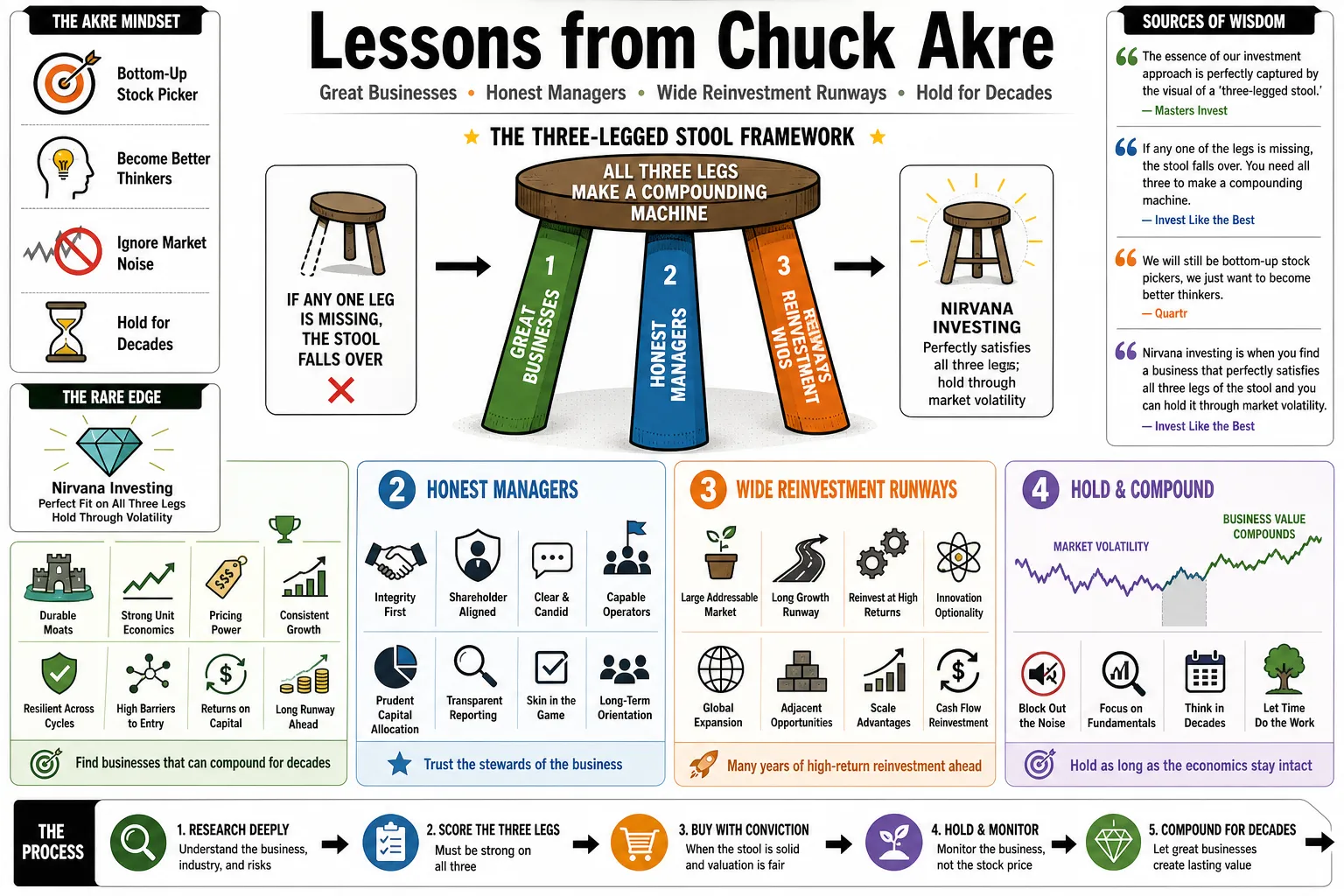
Lessons from Chuck Akre
Chuck Akre describes his investment approach as a three-legged stool: an extraordinary business, talented management, and attractive reinvestment opportunities. He looks to own such businesses for years, reassessing them when one of those qualities deteriorates. — Akre Investment Philosophy.
Part 1: The Three-Legged Stool Framework
- On the visual metaphor: Akre uses a three-legged stool to represent the three qualities he seeks together: an extraordinary business, talented management, and a strong record and runway for reinvestment. — Akre Investment Philosophy.
- On finding balance: The stool metaphor requires all three qualities; Akre says a broken or injured leg is a reason to discuss selling. — Akre Investment Philosophy.
- On the goal of the framework: The framework narrows Akre’s search to superior businesses, capable and honest managers, and opportunities to reinvest cash at attractive rates. — Akre 1988 Shareholder Letter.
- On finding nirvana: Akre’s ideal investment combines a superior business, strong management and reinvestment potential, bought at a reasonable price and held while those qualities persist. — Akre 1988 Shareholder Letter.
- On the rarity of these companies: Akre says truly superior businesses are scarce, so finding them can justify a concentrated search and fewer decisions. — Akre 1988 Shareholder Letter.
- On valuation vs. quality: Quality does not eliminate price discipline: Akre looks for an attractive valuation at entry, though he does not set a sell-price target. — Akre Investment Philosophy.
- On the origin of the stool: Akre says he keeps an old three-legged milking stool in the conference room as a physical reminder of the framework. — Akre Investment Philosophy.
- On classifying his style: Akre Capital frames the strategy as investing in compounding businesses rather than fitting a simple value-versus-growth label. — Akre Capital on Compounding.
- On the business model: Akre contrasts owning businesses for growth in economic value with a brokerage model that benefits from frequent transactions. — Talks at Google.
- On long-termism: Akre judges growth in underlying economic value over five to ten years, not by short-term price fluctuations or quarterly earnings surprises. — Akre Investment Philosophy.
Part 2: Leg One — The Extraordinary Business
- On return on equity: Akre argues that, absent distributions and assuming unchanged valuation, an investor’s return should approximate the business’s return on owners’ capital over time. — Akre Investment Philosophy.
- On the pond to fish in: Akre deliberately searches among businesses earning unusually high returns on capital. — Talks at Google.
- On defining a moat: For Akre, pricing freedom and resistance to competition are signs that a business may have a durable advantage. — Akre 1988 Shareholder Letter.
- On widening the moat: Akre examines whether a business can sustain high returns despite competitors drawn to its profits; a strong historical return alone is not enough. — Akre 1988 Shareholder Letter.
- On simplicity of operations: Akre’s superior-business criteria include operations he can understand and that do not require a genius to run. — Akre 1988 Shareholder Letter.
- On cash vs. accounting: Akre favors businesses whose reported profits appear in cash and whose economics do not naturally invite successful competition. — Akre 1988 Shareholder Letter.
- On Mastercard's business model: In a 2017 talk, Akre used Mastercard’s unusually high margins to illustrate why he searches for the economic cause of a superior return. — Talks at Google.
- On the power of incumbency: Akre asks what allows a high-return business to defend its economics when competitors want a share of the opportunity. — Talks at Google.
- On analyzing special circumstances: Rather than stopping at a high return-on-capital figure, Akre tries to identify the business feature that produces it. — Talks at Google.
- On judging success: Akre measures investment progress through growth in real economic value per unit of ownership, not price movement alone. — Akre on Rate of Return.
Part 3: Leg Two — Talented Management & Integrity
- On the nature of theft: Akre tests whether skilled managers also have the integrity to treat outside shareholders as partners. — Talks at Google.
- On stock price obsession: Akre says buy and sell decisions should turn on business fundamentals, not a manager’s fixation on daily share-price movements. — Akre Investment Philosophy.
- On treating shareholders as partners: Akre wants managers with demonstrated operating ability who treat outside owners fairly. — Talks at Google.
- On skin in the game: Akre examines whether managers’ own interests are aligned with outside shareholders; he offered owner-operator holdings as an example. — Talks at Google.
- On qualitative judgment: Akre forms judgments about managers by gathering evidence from their behavior, conversations, speeches and writing. — GuruFocus Q&A with Akre.
- On executive compensation: Akre judges managers by whether they treat outside shareholders fairly, not only by their operating skill. — Talks at Google.
- On tracking capital allocation: Akre evaluates how management has used cash historically and whether reinvestment can continue at attractive returns. — Akre on Reinvestment.
- On trust: Management integrity is a necessary part of Akre’s three-legged-stool test, not a substitute that a cheap share price can simply offset. — Talks at Google.
- On evaluating CEOs: In 2002, Akre met American Tower founder Steve Dodge amid concern about convertible debt and potential dilution, then judged that management could address the problem. — Talks at Google.
Part 4: Leg Three — The Runway for Reinvestment
- On the most crucial leg: The third leg asks whether a company can reinvest internally generated cash at attractive incremental returns for a long period. — Akre on Reinvestment.
- On dividends vs. reinvestment: Akre prefers a high-return business to reinvest its free cash at similarly high rates when the opportunity exists, rather than distribute it automatically. — Talks at Google.
- On the runway: A high-return business compounds most powerfully when it can repeatedly redeploy earnings into attractive new opportunities. — Akre on Reinvestment.
- On American Tower's model: Akre used American Tower’s economics to show why adding tenants to an existing tower could create unusually high incremental returns. — GuruFocus Q&A with Akre.
- On identifying bottlenecks: For American Tower, Akre emphasized the unusually high return on incremental capital once an existing tower served additional tenants. — GuruFocus Q&A with Akre.
- On the limits of compounding: Without enough attractive places to reinvest cash, a business cannot keep compounding retained earnings at the same rate. — Akre on Reinvestment.
- On cash generation: Akre looks past reported earnings to whether business profits are realized in cash. — Akre 1988 Shareholder Letter.
- On capital redeployment: The third leg depends on both management’s allocation skill and the availability of high-return reinvestment opportunities. — Akre on Reinvestment.
- On book value growth: Book value per share can help measure growth in economic value for some businesses, but Akre warns that buybacks and accounting rules make it misleading for others. — Akre on Rate of Return.
Part 5: The Math and Magic of Compounding
- On the Thomas Phelps influence: Akre says Thomas Phelps’s 100 to 1 in the Stock Market helped turn his attention to the power of compounding. — Talks at Google.
- On seeking 100-baggers: Phelps’s examples of companies that grew 100-fold prompted Akre to study the rates at which capital can compound. — Talks at Google.
- On the math of a penny: Akre’s penny example illustrates compounding: doubling one cent 30 times produces about $10.7 million. — Talks at Google.
- On basis points: Akre focuses on the expected rate of growth in economic value because even modest differences in compound returns matter over a long horizon. — Akre on Rate of Return.
- On driver of returns: Akre uses expected rate of return as the common measure for comparing investment opportunities. — Akre on Rate of Return.
- On setting realistic expectations: Akre’s aim is to buy a high-return business at a reasonable price so growth in its economic value can benefit shareholders over time. — Akre 1988 Shareholder Letter.
- On time as an ally: Long holding periods can preserve the benefit of compounding and avoid some costs and taxes of repeated trading, provided the business remains attractive. — Akre Capital on Compounding.
- On the coffee can portfolio: Akre Capital’s approach favors holding an exceptional business while the investment case remains intact rather than trading around short-term price moves. — Akre Capital on Compounding.
- On obsession with compounding: Akre describes a sustained search for businesses with exceptional returns and an identifiable reason those returns can persist. — Talks at Google.
Part 6: The Art of Not Selling (And When to Sell)
- On holding through temptation: Akre does not set price targets on entry; a deterioration in the business, management or reinvestment leg prompts a sell discussion. — Akre Investment Philosophy.
- On buy and hold vs exceptionalism: This is not unconditional buy-and-hold: Akre wants to own a business while its three underlying qualities remain exceptional. — Akre Investment Philosophy.
- On resisting the urge to trim: Akre does not automatically sell because a stock reaches a predetermined price; he revisits the underlying business case when a stool leg weakens. — Akre Investment Philosophy.
- On business reality vs. stock quotes: For a multiyear owner, Akre pays more attention to growth in the business’s economic value per share than to the latest stock quote. — Akre Investment Philosophy.
- On the hardest thing in investing: Akre’s discipline is to avoid selling solely on price movement while remaining willing to sell when the investment thesis deteriorates. — Akre Investment Philosophy.
- On valid reasons to sell: Akre begins a sell discussion when a key business, management or reinvestment condition is damaged. — Akre Investment Philosophy.
- On losing exceptionalism: Akre is prepared to part with a company once it no longer meets the exceptional-business framework. — Akre Investment Philosophy.
- On quarterly misses: Akre says quarterly misses may create opportunities because his investment horizon is five to ten years. — Akre Investment Philosophy.
Part 7: Mental Models and Simplicity
- On keeping it simple: Akre uses the three-legged stool as a deliberately simple way to organize a complex investment judgment. — Talks at Google.
- On the power of an English degree: Akre says he entered investing as an English major without formal business coursework, then learned by reading widely and studying businesses. — Talks at Google.
- On relying on intuition: Akre combines observation, reading and judgment to assess businesses and the people running them. — GuruFocus Q&A with Akre.
- On defining risk: Akre distinguishes temporary price volatility from the risk of lasting economic loss, while acknowledging that near-term cash needs change the relevance of volatility. — Talks at Google.
- On preventing losses: Akre argues that selecting superior, durable businesses is central to reducing investment risk. — Akre 1988 Shareholder Letter.
- On true risk management: Akre looks for strong underlying businesses and balance sheets rather than relying on broad diversification or low volatility alone. — Talks at Google.
- On the core heuristic: Akre’s simple three-part test gives his team a repeatable way to decide what deserves deeper investment work. — Akre Investment Philosophy.
- On learning from experience: Akre says his understanding of compounding and investing deepened through his own experience and mistakes. — Talks at Google.
Part 8: Market Noise and Independent Thinking
- On geographical isolation: Akre says working in Middleburg, away from Wall Street, helps the firm avoid distractions from its investment approach. — Talks at Google.
- On market predictions: Akre says he has had little success timing portfolio purchases and sales around macroeconomic events, preferring to understand the business and buy at an attractive valuation. — GuruFocus Q&A with Akre.
- On turning off the TV: Akre warns that financial television and daily earnings reactions can encourage transactions instead of attention to business value. — Talks at Google.
- On contrarianism: Akre regards short-term market disappointment as a potential buying opportunity when the underlying business remains strong and the price is attractive. — Akre Investment Philosophy.
- On exploiting false expectations: Akre recalled buying Mastercard in 2010 amid regulatory worries at roughly 13–14 times earnings, an example of exploiting short-term market fears about a durable business. — Talks at Google.
- On true stability: Akre associates lower long-term risk with business quality, growth, returns on capital and balance-sheet strength, rather than with a smooth share-price path. — Talks at Google.
- On ignoring price targets: Akre does not use preset exit prices; his sell discussions begin when a business, management or reinvestment leg is impaired. — Akre Investment Philosophy.
- On the limits of spreadsheets: Financial filings matter, but Akre also studies managers’ words and conduct to judge whether the business’s economics can endure. — GuruFocus Q&A with Akre.
- On doing the hard work: Because superior businesses are rare, Akre emphasizes careful selection and patience over frequent activity. — Akre 1988 Shareholder Letter.