Clara Ma founded Ask a Chief of Staff after serving in Chief of Staff roles at Hugging Face and AngelList. Her own essays and interviews explore the role’s variable scope, principal relationship, career paths and operating practices. — Clara Ma — My Chief of Staff Journey.
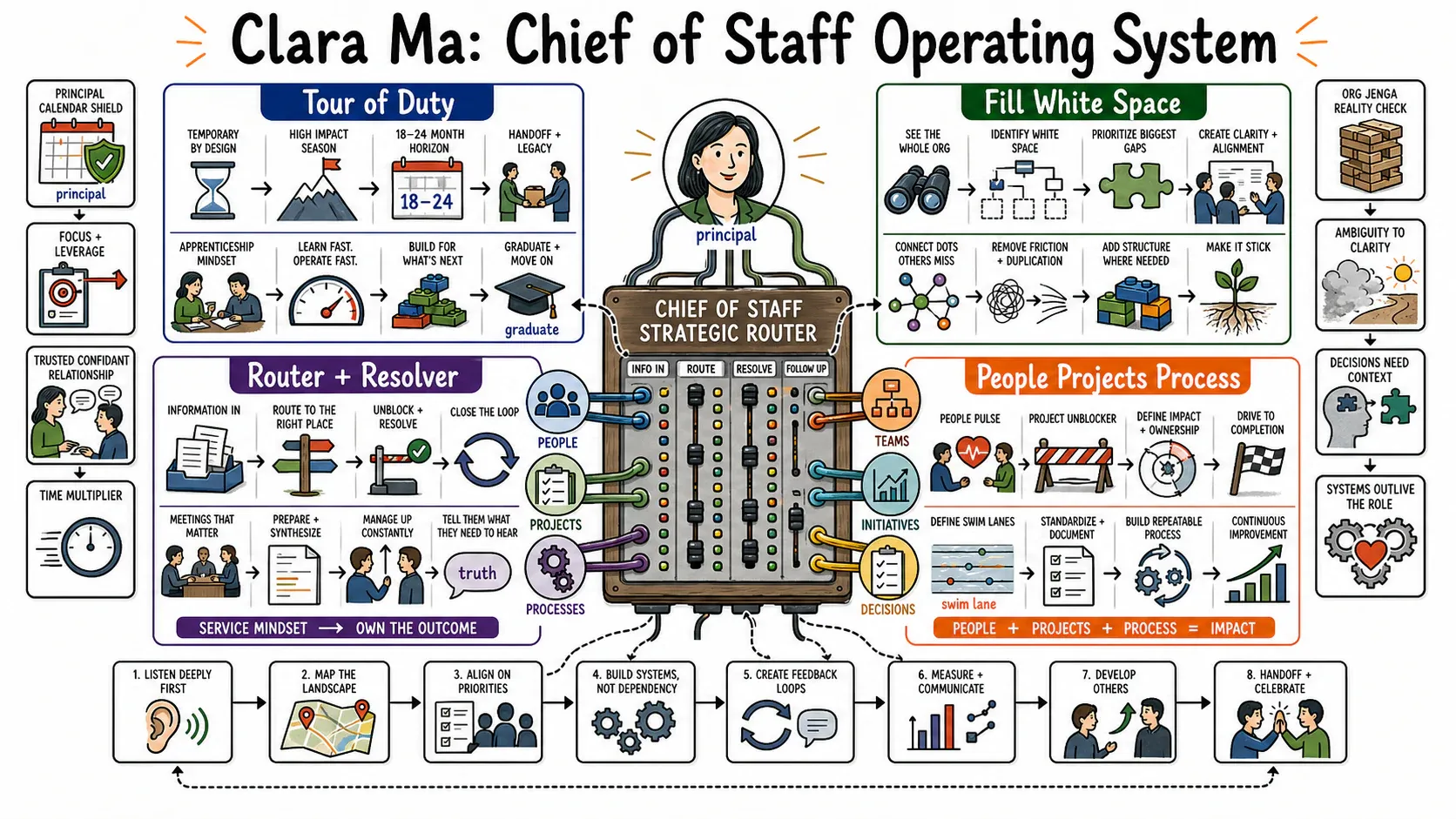
On the Chief of Staff Role & Responsibilities
Principles:
- Serve the Principal and Organization: A CoS adds value by helping the leader and the wider organization work more effectively; the role is not a platform for personal credit. — Clara Ma — My Chief of Staff Journey.
- Work in the White Space: Ma describes taking on cross-functional gaps whose ownership is unclear, adapting the role to what the company actually needs. — Clara Ma — My Chief of Staff Journey.
- Connect Teams and Context: A CoS can link people and information across functions so leaders can act on a fuller picture. — Clara Ma — My Chief of Staff Journey.
- Offer Candid Feedback: Trust includes raising hard information and giving upward feedback rather than merely echoing the principal. — Clara Ma — Common CoS Pitfalls.
- Distinguish the Strategic Lane: CoS, executive-assistant and COO roles have different scopes; the CoS role should be defined by strategic partnership and organization-level work, not by disparaging adjacent roles. — Clara Ma — CoS vs COO vs EA.
- Let Responsibilities Fit the Context: There is no universal people-projects-process formula: the work varies by principal, company stage and organizational need. — Clara Ma — Issue 100.
- Learn from Executive Proximity: Ma’s CoS experience gave her a close view of leadership decisions and a chance to build broad operating judgment. — Clara Ma — My Chief of Staff Journey.
Applications:
- Define Decision Rights and Scope: At the start, clarify the CoS’s responsibilities, relationships and boundaries with the principal as the role takes shape. — Clara Ma — Issue 100.
- Align with the Principal Regularly: Use a recurring priority sync to identify the principal’s most important concerns and keep time and follow-through aligned. — Speak Easy — Clara Ma Interview Transcript.
- Accept Invisible Impact: Much of a CoS’s contribution is indirect: making other people and systems more effective without necessarily taking public credit. — Clara Ma — Issue 100.
- Clarify Issues Before Escalation: Use cross-functional context to synthesize concerns and bring decision-ready issues to the principal, without assuming the CoS must personally absorb every problem. — Clara Ma — My Chief of Staff Journey.
- A CoS Career Can Be Long-Term: Ma revised her earlier stepping-stone view: some people build lasting careers as a CoS, with one principal or across organizations. — Clara Ma — Issue 100.
- Build AI Literacy: Ma now sees AI literacy as an important CoS capability, including judgment about which work should be automated and which requires human attention. — Clara Ma — Issue 100.
- Be a Thought Partner: The CoS should help shape answers to ambiguous questions, not simply transcribe a principal’s decisions. — Clara Ma — Issue 100.
On Career Strategy and Finding the Role
Principles:
- Choose the Work, Not Only the Title: Assess the specific problems, principal and organization to decide whether a CoS opportunity builds the experience you want. — Clara Ma — Landing a Chief of Staff Role.
- Combine Breadth with Useful Depth: Broad cross-functional judgment matters, but Ma’s newer hiring guidance says relevant functional or industry expertise can distinguish candidates. — Clara Ma — Landing a Chief of Staff Role.
- Come from Different Backgrounds: Ma’s path and hiring guidance show that operational and cross-functional experience can prepare someone for CoS work; no single banking or consulting pedigree is required. — Clara Ma — My Chief of Staff Journey.
- Test Mutual Trust and Fit: The principal-CoS relationship needs trust, communication and aligned working styles; candidates should evaluate the organization’s needs too. — Clara Ma — Skills for Chiefs of Staff.
- Ask About Real Priorities: In interviews and early principal check-ins, ask what outcomes and unresolved problems matter most rather than relying on a generic job description. — Speak Easy — Clara Ma Interview Transcript.
- Use Relationships Thoughtfully: Ma lists warm introductions and sustained networking as paths into CoS roles, alongside internal and external applications. — Clara Ma — So You Want to Be a Chief of Staff.
- Lead with a Relevant Problem: A strong pitch shows how your experience could solve a particular company-stage or principal problem, rather than selling the CoS title alone. — Clara Ma — Landing a Chief of Staff Role.
Applications:
- Show Evidence of Operating Ability: Use specific cross-functional examples or case studies to demonstrate how you solve ambiguous problems and influence outcomes. — Clara Ma — Landing a Chief of Staff Role.
- Consider an Internal Path: One path into a CoS role is to pitch it from inside a company, where existing relationships and organizational context may help. — Clara Ma — So You Want to Be a Chief of Staff.
- Pitch a Role Around a Need: Ma explicitly names pitching a CoS position internally or externally as options; tie the proposed remit to genuine organizational gaps. — Clara Ma — So You Want to Be a Chief of Staff.
- Discuss Career Direction Without an Exit Clock: Explore how a CoS role can evolve with the principal and your goals, without assuming every CoS must leave after a fixed tour of duty. — Clara Ma — Issue 100.
- Measure Brand by Outcomes: For her executive-brand work, Ma favors meaningful conversion, community and business outcomes over surface metrics such as likes. — Authority Magazine — Clara Ma Interview.
- Share Specific Operating Moments: Ma says small, honest examples of everyday work can connect more deeply than polished, generic leadership claims. — Authority Magazine — Clara Ma Interview.
- Let Brand Create Opportunities: Ma connects a credible executive brand to business, partnership and speaking opportunities beyond conventional outreach. — Authority Magazine — Clara Ma Interview.
- Make Values Consistent: Define core values and make them visible in content and interactions so the brand has a coherent purpose. — Authority Magazine — Clara Ma Interview.
On Operational Excellence and Getting Things Done
Principles:
- Design Meetings Around Outcomes: In her original interview, Ma describes setting a clear purpose for meetings and using a regular cadence to keep work moving. — Speak Easy — Clara Ma Interview Transcript.
- Capture Decisions and Ownership: Turn meetings into clear decisions, owners and follow-up rather than merely producing a transcript. — Clara Ma — Issue 100.
- Do Necessary Unseen Work: Ma describes taking on the unglamorous cross-functional work required to make the organization function. — Clara Ma — My Chief of Staff Journey.
- Translate Strategy into Execution: The role can connect leadership priorities with the people, projects and practical follow-through needed across teams. — Clara Ma — My Chief of Staff Journey.
- Create Structure Where It Is Missing: Ma’s account emphasizes establishing processes and operating clarity as the organization scales. — Clara Ma — My Chief of Staff Journey.
- Share Context Deliberately: Clear communication across stakeholders reduces gaps in understanding and helps decisions travel through the organization. — Clara Ma — Skills for Chiefs of Staff.
Applications:
- Make Time Reflect Priorities: The principal’s calendar and regular check-ins are useful tools for testing whether the team’s time matches its priorities. — Speak Easy — Clara Ma Interview Transcript.
- Document for Alignment: Ma emphasizes documentation that carries decisions and context forward rather than leaving the organization dependent on one person’s memory. — Clara Ma — Issue 100.
- Build Repeatable Systems: Rather than repeatedly patching the same operating problem, establish a process that lets others handle it reliably. — Clara Ma — My Chief of Staff Journey.
- Influence Beyond Formal Authority: A CoS depends on cross-functional relationships and credibility to coordinate people who do not report to them. — Clara Ma — My Chief of Staff Journey.
- Listen Before Claiming Quick Wins: Ma recommends a listening tour with stakeholders, pattern-finding and prioritization before rushing to prove impact in the first weeks. — Clara Ma — Listening Tours.
- Delegate Bounded Outcomes to AI: Ma contrasts isolated prompts with describing a multi-step result and letting an AI assistant carry out parts of the workflow under human judgment. — Clara Ma — Using Claude Beyond Search.
On Mindset and Personal Growth
Principles:
- Stay Curious About the Business: Broad listening and learning help a CoS understand needs across functions instead of seeing only the principal’s perspective. — Clara Ma — Skills for Chiefs of Staff.
- Recognize Your Limits: Self-awareness about strengths and gaps helps a CoS ask for help, delegate and adapt rather than pretend to know everything. — Clara Ma — Skills for Chiefs of Staff.
- Set Sustainable Boundaries: Ma’s retrospective notes the role’s variable scope and need for boundaries; being useful does not require absorbing every organizational demand. — Clara Ma — Issue 100.
- Use Cross-Functional Context: A CoS’s broad organizational view can reveal connections and tensions that siloed teams may not see. — Clara Ma — My Chief of Staff Journey.
Applications:
- Start with a Listening Tour: Early conversations with stakeholders help reveal recurring pain points before a new CoS chooses priorities. — Clara Ma — Listening Tours.
- Build Trust for Honest Conversations: Maintain a relationship in which concerns and feedback can reach the principal candidly and constructively. — Clara Ma — Principal 1:1s.
- Treat Self-Doubt as a Prompt to Learn: Ma recounts uncertainty as she took on a demanding role; the supported lesson is to keep learning, not that every CoS experiences imposter syndrome. — Clara Ma — My Chief of Staff Journey.
- Hand Off Mature Work: Document and delegate repeatable responsibilities so the CoS can address new organizational needs; this need not mean leaving the profession. — Clara Ma — My Chief of Staff Journey.
- Use Self-Awareness to Delegate: Ma links self-awareness with choosing when to delegate, when to step in and how to course-correct. — Authority Magazine — Clara Ma Interview.
- Seek Peers for an Isolating Role: Ma describes the structural loneliness of confidential, in-between CoS work and the value of a peer community. — Clara Ma — Issue 100.