Colin Bryar joined Amazon in 1998 and spent 12 years on its senior leadership team, including two years as Jeff Bezos’s chief of staff, or ‘Jeff’s shadow.’ He is a co-author, with Bill Carr, of Working Backwards: Insights, Stories, and Secrets from Inside Amazon, and co-founder of Working Backwards LLC, where he coaches executives on implementing management practices developed at Amazon. [1] [2]
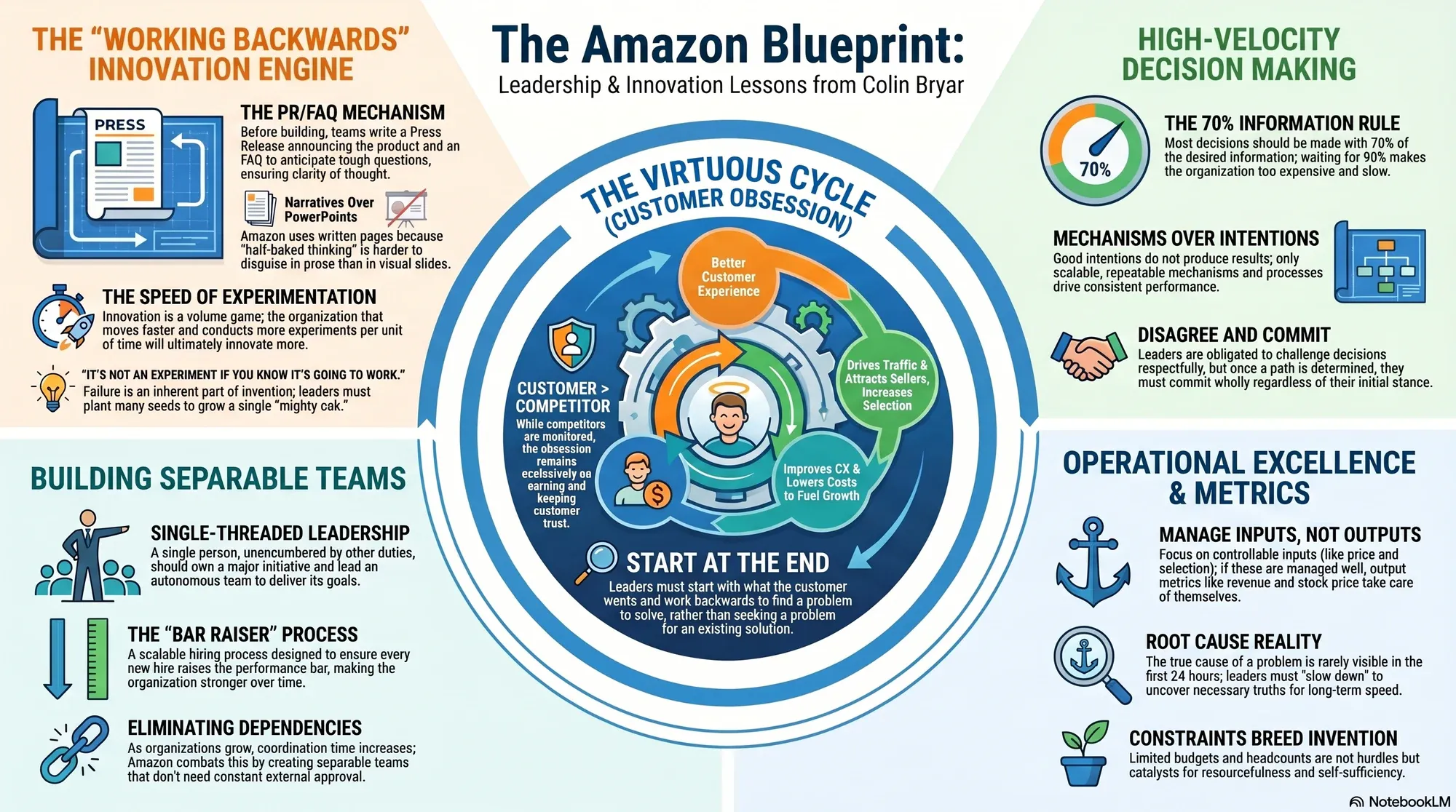
On Customer Obsession
- On Customer Obsession: Bryar describes starting with the customer problem and designing backwards from the experience people should have, rather than beginning with current capabilities. — Jason & Scot Show — Colin Bryar.
- On Customer-Facing Inputs: Bryar and Carr distinguish actions a team can control that improve customers’ experience from output measures such as sales and profit. — Working Backwards — Input Metrics.
- On Amazon’s Flywheel: The Working Backwards account identifies selection, lower prices and customer experience as controllable inputs in Amazon’s flywheel. — Working Backwards — Input Metrics.
- On Four Cultural Pillars: Bryar and Carr describe Amazon’s culture through customer obsession, long-term thinking, invention and operational excellence. — First Round — Invention Machine.
On Innovation and the "Working Backwards" Process
- On Dedicated Teams: A single-threaded initiative has a leader working on it full time, the necessary resources and a team dedicated to that initiative. — Working Backwards — Single-Threaded Teams.
- On Working Backwards: Bryar says product design should define the desired customer experience first, then work backwards to determine what to build. — Jason & Scot Show — Colin Bryar.
- On the PR/FAQ Origin: Bryar and Carr recount arriving at a proposed press release and FAQs through trial and error, to force a clearer account of a product before building it. — Working Backwards — PR/FAQ Process.
- On Written Narratives: The Working Backwards approach uses precise prose to expose weak reasoning and give decision-makers a common factual basis for discussion. — Working Backwards — Narratives.
- On Focus and Speed: Bryar and Carr argue that dedicated teams can spend less time negotiating resources and more time building, while acknowledging the model has tradeoffs. — Working Backwards — Single-Threaded Teams.
- On Experimentation: Bryar treats uncertain product bets as experiments: teams may stop after a failed attempt or revise the idea when evidence warrants. — First Round — Invention Machine.
- On Screening Many Ideas: Bryar favors drafting many inexpensive PR/FAQs so stronger customer ideas can emerge before the company commits major engineering resources. — First Round — Invention Machine.
On Leadership and Decision-Making
- On Imperfect Information: Bryar says many decisions must be made before every desired fact is available; a team should preserve the ability to adapt as evidence arrives. — Jason & Scot Show — Colin Bryar.
- On Course Correction: Bryar describes planning as a tool for choosing a direction, with room to revise the plan when new information makes the original path worse. — Jason & Scot Show — Colin Bryar.
- On Principles as Mechanisms: Bryar and Carr argue that leadership principles matter when they are built into repeatable practices such as hiring, narratives and product decisions, rather than left as slogans. — First Round — Invention Machine.
- On Daily Decisions: Bryar explains that Amazon’s leadership principles give employees a shared framework for difficult decisions across the company. — The Boardroom — Colin Bryar.
- On Ownership: Bryar and Carr present clear ownership as a way to give a leader authority and accountability for an initiative rather than dispersing responsibility across teams. — Working Backwards — Single-Threaded Teams.
- On Raising the Hiring Bar: Bryar says a deliberate hiring process should evaluate people against the organization’s own values so new hires reinforce the culture it intends to build. — Jason & Scot Show — Colin Bryar.
- On High Standards in Hiring: The Bar Raiser process uses independent assessments and a trained interviewer to check whether a candidate meets the company’s defined performance standards. — Working Backwards — Bar Raiser Hiring.
- On Disagreement and Commitment: Bryar and Carr describe Amazon’s practice of surfacing objections before a decision, then aligning execution after a decision is made. — Working Backwards — Leadership Principles.
- On the Work of Hiring: Bryar argues that leaders must spend real time defining and assessing hires; an improvised process can change a company’s culture as it grows. — Jason & Scot Show — Colin Bryar.
- On Choosing What Not to Build: Bryar recommends inexpensive PR/FAQ reviews that allow teams to reject weak ideas before they consume scarce product and engineering resources. — First Round — Invention Machine.
- On Principles Under Time Pressure: Bryar argues that codified leadership principles provide a decision framework when a team must move before all desired information is available. — The Boardroom — Colin Bryar.
- On Decisions Without the Founder: Bryar advises founders to write down their organization’s own principles so colleagues can make consistent decisions when the founder is not in the room. — The Boardroom — Colin Bryar.
On Building a High-Performing Culture and Teams
- On Coordination Costs: Bryar recalls Amazon adding engineers without commensurate speed because teams spent growing time coordinating with one another. — Jason & Scot Show — Colin Bryar.
- On Cross-Team Dependencies: Bryar describes projects stalling while their owners waited for other teams; assigning a dedicated leader was one response to that drag. — Jason & Scot Show — Colin Bryar.
- On Structured Hiring: The Bar Raiser process combines common criteria, written independent assessments and a trained interviewer outside the hiring manager’s reporting line. — Working Backwards — Bar Raiser Hiring.
- On Stretch Goals: The Working Backwards account says Amazon’s S-Team did not expect every annual goal to be met; it reports roughly 70% achieved on average. — Working Backwards — S-Team Goal Review.
- On Hiring Feedback Loops: Bryar and Carr describe Bar Raiser hiring as a repeatable process whose interviewers and debriefs can improve with practice and feedback. — Working Backwards — Bar Raiser Hiring.
- On Resource Ownership: Bryar’s single-threaded-team example gives one leader ownership of a risky initiative and the resources to pursue it rather than leaving it as part-time work. — Jason & Scot Show — Colin Bryar.
- On Deliberate Culture: Bryar warns that a growing organization develops a culture either way, so leaders should define the values and hiring practices that shape it. — Jason & Scot Show — Colin Bryar.
- On Writing Leadership Principles: Working Backwards recommends identifying behaviors of existing role-model leaders when drafting a company’s own leadership principles. — Working Backwards — Developing Principles.
On Operational Excellence and Problem-Solving
- On Repeated Why Questions: Bryar describes using repeated why questions in error reviews to uncover several underlying causes rather than stopping at a surface symptom. — First Round — Invention Machine.
- On Correction of Errors: Bryar says teams should document significant failures, identify contributing causes and own corrective actions so the same failure is less likely to recur. — First Round — Invention Machine.
- On Managing Inputs: Bryar and Carr emphasize tracking controllable input measures that teams can act on, while treating revenue and profit as lagging outputs. — Working Backwards — Input Metrics.
- On Defects as Systems Problems: Bryar says a serious customer-facing defect should prompt a process review and a mechanism to prevent recurrence, not merely a call for good intentions. — First Round — Invention Machine.
- On Acting on Inputs: Bryar and Carr argue that teams should allocate resources to controllable inputs and monitor whether those actions improve customer experience, rather than trying to directly manipulate lagging outputs. — Working Backwards — Input Metrics.
- On Resource Constraints: Bryar notes that even at Amazon, scarce resources forced teams to choose where to invest; dedicated ownership and planning made those tradeoffs explicit. — Jason & Scot Show — Colin Bryar.
On Long-Term Thinking
- On Long-Term Product Value: Bryar asks teams to judge a proposed product by whether it solves a meaningful customer problem and could matter over the long term, not just next quarter. — First Round — Invention Machine.
- On Long-Term Ownership: Bryar presents long-term thinking as part of the operating principles that keep teams focused on durable customer value rather than the next immediate result. — Guy Kawasaki — Colin Bryar.
- On Customer and Shareholder Interests: Bryar says Bezos held a conviction that serving customers over the long run would also serve shareholders; Bryar uses that belief to explain Amazon’s customer-trust decisions. — Guy Kawasaki — Colin Bryar.
Learn more:
- About Colin Bryar — Working Backwards
- Working Backwards — Macmillan
- Amazon Leadership Principles
- Input Metrics — Working Backwards
- Jeff Bezos on Amazon Management — GeekWire Transcript
- Working Backwards PR/FAQ Process — Working Backwards
- Amazon Single-Threaded Teams — Working Backwards
- Narratives and Decision-Making — Working Backwards
- Amazon 2015 Shareholder Letter — SEC
- Amazon 2016 Letter to Shareholders
- Leadership Principles — Working Backwards
- Amazon’s Original 1997 Letter to Shareholders
- An Insider Look at Amazon’s Culture and Processes — About Amazon
- Colin Bryar on Leadership Principles (23:52) — Startup Grind
- Minimizing Coordination Tax to Maximize Team Ownership — Working Backwards
- How Amazon Overcomes Dependencies to Accelerate Execution — Working Backwards
- Bar Raiser Hiring — Working Backwards
- Amazon’s S-Team Execution-Focused Goal Review Process — Working Backwards
- Colin Bryar on Leadership Principles and Jeff Bezos — What Got You There
- How Amazon Uses the Five Whys for Operational Excellence — Working Backwards
- Correction of Errors (CoE) — Working Backwards
- Colin Bryar on Long-Term Thinking (10:03) — Startup Grind
- Amazon 2010 Shareholder Letter — SEC