Curtis Yarvin, who wrote as Mencius Moldbug, publishes political essays criticizing democracy and analyzing institutions he calls the Cathedral. — Gray Mirror — The Cathedral.
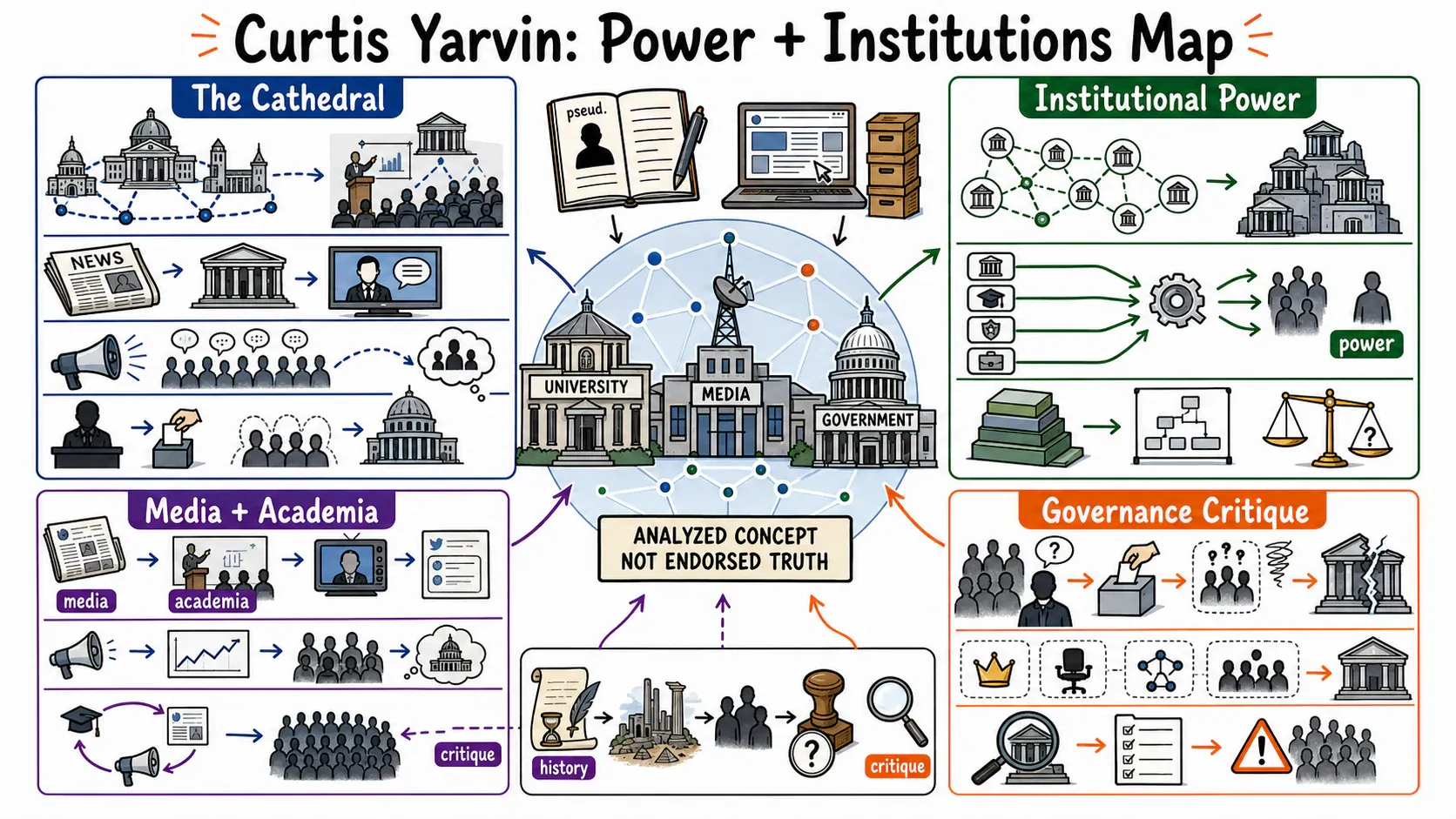
The Cathedral and the Media
Yarvin uses “the Cathedral” for his claim that journalism and academia converge in outlook despite lacking a central organizational connection. — Gray Mirror — The Cathedral.
Quotes:
- Define the Cathedral: Yarvin uses the Cathedral as shorthand for journalism and academia's role in shaping mainstream ideas. — Gray Mirror — The Cathedral.
- Convergence Without a Command Center: He argues that prestigious institutions can behave as though they share one intellectual direction despite no central organizational link. — Gray Mirror — The Cathedral.
- Press and Public Opinion: Yarvin argues that a free press can shape public opinion and therefore wield political influence; the claim is his interpretation, not a settled description of democracy. — Unqualified Reservations — Why There’s No Such Thing as Liberal Media Bias.
- Question Institutional Consensus: In his Open Letter, Yarvin argues that mainstream universities and the New York Times tend to reinforce a progressive outlook; this is his critique of institutional consensus. — Open Letter — Dr. Johnson’s Hypothesis.
Learnings:
- A Theory of Distributed Power: Yarvin argues that influential intellectual institutions exercise power beyond what elected offices alone reveal. — Gray Mirror — The Cathedral.
- Institutional Convergence: He claims elite media and universities move together ideologically over time, even without formal coordination. — Gray Mirror — The Cathedral.
- Press as Part of Power: In Yarvin's account, journalism can shape public priorities and government tactics rather than merely report on them. — Gray Mirror — The Cathedral.
- A Secular-Church Analogy: He compares the intellectual prestige of journalism and academia with the historic role of a church; this is an analogy, not a claim of literal religion. — Gray Mirror — The Cathedral.
- Selection of Power-Justifying Ideas: Yarvin argues that ideas legitimizing the use of state power gain an advantage in the institutional discourse he calls the Cathedral. — Gray Mirror — The Cathedral.
On Democracy and Governance
Yarvin criticizes democratic governance as a source of political friction and proposes a corporate-style sovereign structure as an alternative; these are his arguments, not established findings about how such a system would perform. — Unqualified Reservations — A Formalist Manifesto.
Quotes:
- Democracy as Political Friction: Yarvin argues that recurring electoral competition can create a continuing struggle for political power; this is his critique, not a verified judgment that democracy has failed. — Unqualified Reservations — Democracy as an Adaptive Fiction.
- The Voting-Lottery Analogy: He likens the feeling of influence from casting a vote to the feeling of possible wealth from playing a lottery, while acknowledging that a vote might matter. — Unqualified Reservations — Democracy as a Historical Phenomenon.
- A Small Share of Political Power: Yarvin argues that giving voters a small sense of political authority helps a democratic system reward and retain their support. — Unqualified Reservations — Democracy as a Historical Phenomenon.
- Government as an Organization: Yarvin rejects the phrase “self-government” and uses Starbucks as an analogy to argue that a government should be judged by what its organization does; the analogy is his argument, not a literal equivalence. — Unqualified Reservations — Political Sanity in One Easy Step.
- Judge Government by Effectiveness and Lawfulness: Yarvin argues that residents should evaluate a government by its effectiveness and lawfulness, rather than by the identity of its rulers. — Unqualified Reservations — Democracy as an Adaptive Fiction.
Learnings:
- Democracy as Political Friction: Yarvin argues that continual electoral competition can create friction within government; he proposes corporate-style ownership as an alternative, but does not demonstrate that it would be more efficient in practice. — Unqualified Reservations — Democracy as an Adaptive Fiction.
- Neocameralism: He proposes a sovereign corporation owned by subscribers or shareholders, with agents managing it and residents receiving its services; profitability is a design aim, not an observed outcome. — Unqualified Reservations — Neocameralism.
- Question the Feeling of Voter Control: Yarvin argues that voting can give individuals a feeling of influence disproportionate to any one ballot's effect, while acknowledging that a ballot may matter. — Unqualified Reservations — Democracy as a Historical Phenomenon.
- Centralized Executive Authority: Yarvin proposes making sovereign control explicit and concentrated rather than dispersing responsibility across competing institutions; the claimed advantages remain his proposal. — Unqualified Reservations — A Formalist Manifesto.
- Government as a Service Organization: In Yarvin's analogy, a government is an organization whose actions residents can evaluate as customers; he treats the best form of governance as a difficult empirical question, not a proven business formula. — Unqualified Reservations — Political Sanity in One Easy Step.
- Formalize Actual Power: Yarvin's formalism calls for identifying who exercises power and making ownership and control explicit, including his proposal to allocate shares to reflect the existing power structure. — Unqualified Reservations — A Formalist Manifesto.
- RAGE as a Transition Proposal: Yarvin calls a proposed large-scale civil-service retirement RAGE; his essay discusses severance and exceptions for units that still operate by command. — Gray Mirror — Coriolanus and the Conservatives.
On Power and Responsibility
Yarvin argues that political power and responsibility are closely linked, and that actors with influence often describe it as a duty to do good. — Unqualified Reservations — The Mystery of the Gray Government.
Quotes:
- Power and Responsibility: Yarvin writes that power and responsibility are the same thing in his account of modern government. — Unqualified Reservations — The Mystery of the Gray Government.
- Power Described as Duty: Yarvin argues that influential people commonly understand their authority as a responsibility to improve public life, rather than as a pursuit of power. — Unqualified Reservations — The Iron Polygon.
- Finding Institutional Power: Yarvin suggests looking for people who are described as especially responsible when trying to identify where he thinks U.S. institutional power lies. — Unqualified Reservations — The Iron Polygon.
- Seduction as Power Distortion: Yarvin argues that power can distort thought through seduction as well as coercion; he applies the former to political movements that come to identify with power. — Unqualified Reservations — The Lost Theory of Government.
- Power and the Dissident: Yarvin argues that confronting power head-on tends to reinforce it, and recommends that dissidents focus on surviving and flourishing outside its center. — Gray Mirror — A Speech Code for Dissidents.
Learnings:
- Power and Responsibility: In Yarvin's account, winning followers' trust and exercising political influence depend on appearing responsible; he proposes treating power and responsibility as closely related concepts. — Unqualified Reservations — The Mystery of the Gray Government.
- Sincerity of Powerful Actors: Yarvin contends that influential institutional actors usually believe they are doing good, even while he argues that they exercise power they do not call power. — Unqualified Reservations — The Iron Polygon.
- The Iron Polygon: Yarvin describes U.S. power as distributed among institutions such as the press, universities, civil service, and judiciary; he contrasts this model with the idea of one central ruler. — Unqualified Reservations — The Iron Polygon.
- Outlive Rather Than Confront: Yarvin recommends that dissidents avoid direct confrontation with the current regime and instead build an independent culture capable of flourishing over time. — Gray Mirror — A Speech Code for Dissidents.
On Ideology and Truth
Yarvin examines how political power can shape belief, questioning whether the ideas a society rewards are necessarily the most accurate. — Unqualified Reservations — Dr. Johnson’s Hypothesis.
Quotes:
- Belief as a Loyalty Signal: Yarvin argues that shared belief in a claim he regards as nonsensical can demonstrate group loyalty more strongly than agreement on an obvious truth. — Unqualified Reservations — Dr. Johnson’s Hypothesis.
- Cthulhu Swims Left: Yarvin uses the metaphor of Cthulhu swimming left to describe what he sees as a long-term leftward shift in American public opinion and institutions. — Unqualified Reservations — The Red Pill.
- Reality as an Adversary: Yarvin argues that political movements can expend great effort resisting conditions he regards as stubborn features of reality; this is his critique of progressivism, not a neutral description of it. — Unqualified Reservations — A Reset Is Not a Revolution.
- Avoid Political Pretense: Yarvin warns that habitual political pretense can weaken a movement by rewarding performances of commitment over the real work he thinks is needed. — Gray Mirror — Acorns for the Culture War.
- Designing Formalism: Yarvin opens his formalist manifesto by describing the deliberate construction of a new ideology, then uses the essay to set out his proposed alternative to prevailing political frameworks. — Unqualified Reservations — A Formalist Manifesto.
- Build Strength through Practice: Yarvin advises his political allies to avoid habitual pretense and practice actions he considers genuinely strong, rather than merely perform strength. — Gray Mirror — Acorns for the Culture War.
Learnings:
- The Red Pill as a Framing Device: Yarvin uses the red-pill metaphor to invite readers to question conventional accounts of political power and consider his alternative interpretation. — Unqualified Reservations — The Red Pill.
- A Claimed Leftward Drift: Yarvin argues that American political norms tend to move leftward over long periods, using his Cthulhu metaphor to describe the pattern; the essay offers examples rather than establishing a universal law. — Unqualified Reservations — The Red Pill.
- Question Politically Useful Beliefs: Yarvin urges readers to ask whether an idea has spread because it is true or because it helps an institution or coalition organize and hold power. — Unqualified Reservations — Dr. Johnson’s Hypothesis.
- Construct an Alternative Framework: In his early formalist manifesto, Yarvin proposes a new political framework centered on making actual control and ownership of government explicit. — Unqualified Reservations — A Formalist Manifesto.
On History and the Present
Yarvin uses a controversial periodization of American history to explain his account of where political power resides today. — Unqualified Reservations — The Iron Polygon.
Quotes:
- Five Claimed Regimes: Yarvin divides U.S. history into successive legal regimes and labels the New Deal order the fourth; this is his interpretation of constitutional change, not an established legal classification. — Unqualified Reservations — The Iron Polygon.
- Universities in the Cathedral Model: Yarvin argues that universities and journalists help form a shared governing outlook without a single central coordinator; his Cathedral model is a claim about institutional influence, not proof that postwar peace required suppression of dissent. — Unqualified Reservations — Dr. Johnson’s Hypothesis.
- Problem-Solution Critique: Yarvin accuses the Progressive movement of creating problems and then claiming authority to solve them; this is his polemical account, not a demonstrated general history of that movement. — Unqualified Reservations — The Democrats: Party of Lies.
- Critique of Conservatism: Yarvin argues that conservatism is shaped by opposition to progressivism and therefore often reacts to its agenda rather than offering a coherent alternative. — Unqualified Reservations — A Formalist Manifesto.
- Government by Scholars: Yarvin describes rule by scholars or intellectuals as the core idea of leftism; the claim is his political classification, not a universal finding about every historical society. — Unqualified Reservations — The Essential Idea of Leftism.
Learn more: