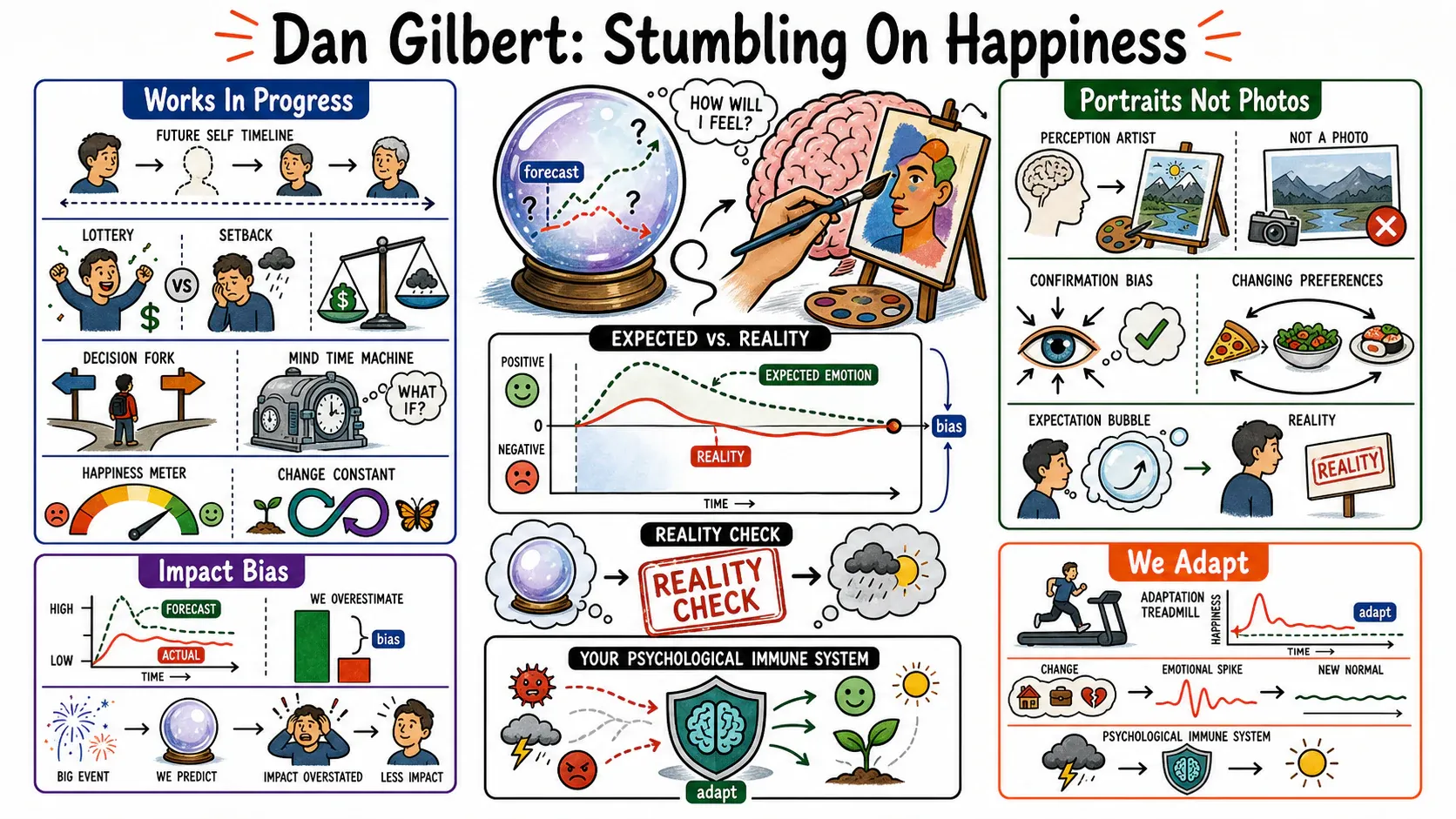
Daniel Gilbert is a psychologist whose work with Timothy Wilson examines how people forecast future feelings and why those predictions can miss the mark. His research and first-person writing also explore adaptation, choice, memory and happiness. — Harvard Psychology — Daniel Gilbert.
On the Malleability of Happiness and the Mind
- On the end-of-history illusion: In a large set of studies, people at many ages reported substantial change in the past but expected less change in their own values, preferences and personality over the next decade. — End of History Illusion Study.
- On future preferences: The end-of-history studies found a practical cost: participants overvalued future opportunities to indulge tastes they held at the time of the study. — End of History Illusion Study.
- On systematic perception errors: Gilbert uses optical illusions to illustrate that some mistakes in perception and imagined futures follow regular patterns rather than random lapses. — Stumbling on Happiness — Foreword.
- On overpredicting emotional impact: In direct studies, people often predicted that adverse events would affect them longer than the reactions later observed; this does not mean the events are harmless. — Immune Neglect Study.
- On psychological coping: Gilbert and coauthors describe how people may psychologically reinterpret a bad outcome, a coping response forecasters often overlook. — Immune Neglect Study.
- On consumption and happiness: Gilbert argues that people’s tendency to overvalue getting what they want helps sustain consumption, while the ability to adjust after disappointment is real; this is his argument, not an established economy-wide causal finding. — Daniel Gilbert — The Surprising Science of Happiness.
- On useful negative emotions: Gilbert argues that fear and anxiety can prompt protective action, so permanent happiness would remove information emotions normally provide. — Daniel Gilbert — The Science of Happiness.
- On social relationships: Gilbert describes time with family and friends as a major source of happiness in both the broader evidence and his own life. — APA Interview with Daniel Gilbert.
On Predicting Future Feelings (Affective Forecasting)
- On affective forecasting: Affective forecasting is predicting how future events will feel; Wilson and Gilbert’s review describes recurring errors in predicted intensity and duration. — Wilson and Gilbert — Affective Forecasting.
- On imagining the future: In his book excerpt, Gilbert emphasizes the human capacity to simulate future situations and asks how reliable those simulations are. — Stumbling on Happiness — Chapter 1.
- On the present leaking into forecasts: Wilson and Gilbert explain that current feelings and mental representations can shape forecasts about a different future state. — Wilson and Gilbert — Affective Forecasting.
- On the impact bias: The impact bias is overestimating the emotional force or duration of an event; the original immune-neglect studies found a stronger duration bias for negative than positive events in the examined settings. — Immune Neglect Study.
- On anticipation: A coauthored spending review identifies delaying consumption as one way people can enjoy anticipation rather than collapsing purchase and experience into the same moment. — If Money Does Not Make You Happy Study.
- On caring for a future self: Gilbert notes that everyday choices often aim to benefit our future selves, whose preferences may differ from what we now expect. — Stumbling on Happiness — Foreword.
- On using other people’s experience: In tested scenarios, knowing how another person felt during an event sometimes produced more accurate forecasts than knowing details of the event itself. — The Surprising Power of Neighborly Advice.
- On the uniqueness objection: Gilbert says people often discount others’ experience because they think their own response will be unusually different, even when the experimental forecasts suggest otherwise. — NPR Interview with Daniel Gilbert.
- On treating imagination as a forecast: Gilbert cautions that imagining a future event is not the same as accurately knowing how one will feel when it occurs. — Stumbling on Happiness — Foreword.
On Choice and Regret
- On the cost of extra choice: Gilbert’s own variety commentary notes that choosing among more options takes time and that variety is not always worth pursuing; it does not establish the broader paradox-of-choice thesis as his discovery. — NPR — Sharing One Secret to Happiness.
- On remembered endings: In their research review, Wilson and Gilbert discuss earlier findings by Kahneman and colleagues that retrospective emotion reports can disproportionately reflect peaks and endings. — Wilson and Gilbert — Affective Forecasting.
- On reversible decisions: In Gilbert and Ebert’s photography and poster studies, participants with an irreversible choice later liked their choice more than those who could still change it. — Decisions and Revisions Study.
- On shifting comparisons: Gilbert illustrates how a comparison that influences a purchase can cease to matter when the item is later used, distorting predicted value. — Daniel Gilbert — Why We Make Bad Decisions.
- On experiences versus objects: A coauthored research review recommends buying more experiences and fewer material goods as one potential way to improve the happiness derived from spending. — If Money Does Not Make You Happy Study.
- On habituation: Gilbert explains that repeated pleasures can lose impact over time, so the first experience may feel different from the tenth. — Stumbling on Happiness — Chapter 7.
- On variety at the right interval: Gilbert says variety can renew closely spaced pleasures but may lower enjoyment when favored experiences are already separated by enough time. — NPR — Sharing One Secret to Happiness.
- On distant threats: In a signed essay about climate risk, Gilbert argues that gradual and distant harms can fail to elicit the immediate alarm triggered by visible threats. — Gilbert — If Only Gay Sex Caused Global Warming.
On Self-Perception and Social Life
- On edited memories: Gilbert describes memory as reconstructing selected pieces of an experience, which can make past feelings a shaky guide to future choices. — Stumbling on Happiness — Chapter 10.
- On hedonic aims: In a direct interview, Gilbert argues that people generally value other things partly because of the experiences they expect those things to bring. — Daniel Gilbert — The Science of Happiness.
- On defending unwelcome speech: In a signed opinion, Gilbert defends the tolerance of offensive and foolish remarks as part of a free society; this is a political view, not an empirical happiness result. — Gilbert — What Is Your Dangerous Idea?.
On the Nature of Time and Experience
- On prospection: Gilbert’s book frames the ability to imagine possible futures as central to planning, while questioning the accuracy of those imagined scenes. — Stumbling on Happiness — Chapter 1.
- On the prefrontal cortex: Gilbert identifies the prefrontal cortex as part of the machinery for imagining future events; the inherited claims about evolutionary order and deterioration are omitted. — Smithsonian Interview with Daniel Gilbert.
- On spatial metaphors for time: Gilbert explains how people use spatial images and language to reason about the abstract passage of time. — Stumbling on Happiness — Chapter 7.
- On present-bound imagination: Wilson and Gilbert describe how mental simulations can omit important features of future experience or import features of the present. — Wilson and Gilbert — Affective Forecasting.
- On experience changing memory: Gilbert’s book explains that remembering an event is a reconstructive act, making it difficult to recover how we would have viewed the world before it occurred. — Stumbling on Happiness — Chapter 10.
- On income and happiness: Gilbert’s coauthored review describes a positive but modest association between income and happiness and stresses that how money is spent also matters. — If Money Does Not Make You Happy Study.
- On using disciplined reasoning: In a first-hand Harvard Law School report, Gilbert recommends using evidence and deliberate calculation to counter errors in judging odds and value. — Harvard Law School — Dan Gilbert on Decisions.
- On the role of fear: Gilbert argues that anxiety and fear can motivate protective behavior, while acknowledging that excessive anxiety can be debilitating. — Daniel Gilbert — The Science of Happiness.
- On optimism about odds: Gilbert’s Harvard Law School talk describes optimism bias as one reason people can overestimate the odds of getting the outcome they want. — Harvard Law School — Dan Gilbert on Decisions.
- On mind-wandering: In a coauthored experience-sampling study, participants reported lower happiness during many mind-wandering moments; this is narrower than advice to stop thinking about the future. — A Wandering Mind Is an Unhappy Mind.
Learn more:
- Quoidbach, Gilbert & Wilson — The End of History Illusion
- TED — Daniel Gilbert: The Psychology of Your Future Self
- Gilbert et al. — Immune Neglect: A Source of Durability Bias
- Wilson & Gilbert — Affective Forecasting
- Gilbert et al. — The Surprising Power of Neighborly Advice
- Gilbert & Ebert — Decisions and Revisions
- TED — Daniel Gilbert: The Surprising Science of Happiness
- Edge — Daniel Gilbert: The Science of Happiness
- Random House — Stumbling on Happiness, Foreword
- Random House — Stumbling on Happiness, Chapter 7: Time Bombs
- Random House — Stumbling on Happiness, Chapter 10: Once Bitten
- NPR — Daniel Gilbert: Sharing One Secret to Happiness
- Dunn, Gilbert & Wilson — If Money Does Not Make You Happy
- APA — Interview with Daniel Gilbert on Happiness
- Harvard Law School — Dan Gilbert on Making Decisions
- Daniel Gilbert — If Only Gay Sex Caused Global Warming