Dan Rasmussen founded Verdad Advisers after studying history and literature and working in private equity. He applies historical data and an awareness of forecasting limits to questions about value investing, crises, private markets and portfolio construction. The lessons below distinguish his documented arguments from guarantees about future returns. — Morningstar — The Long View.
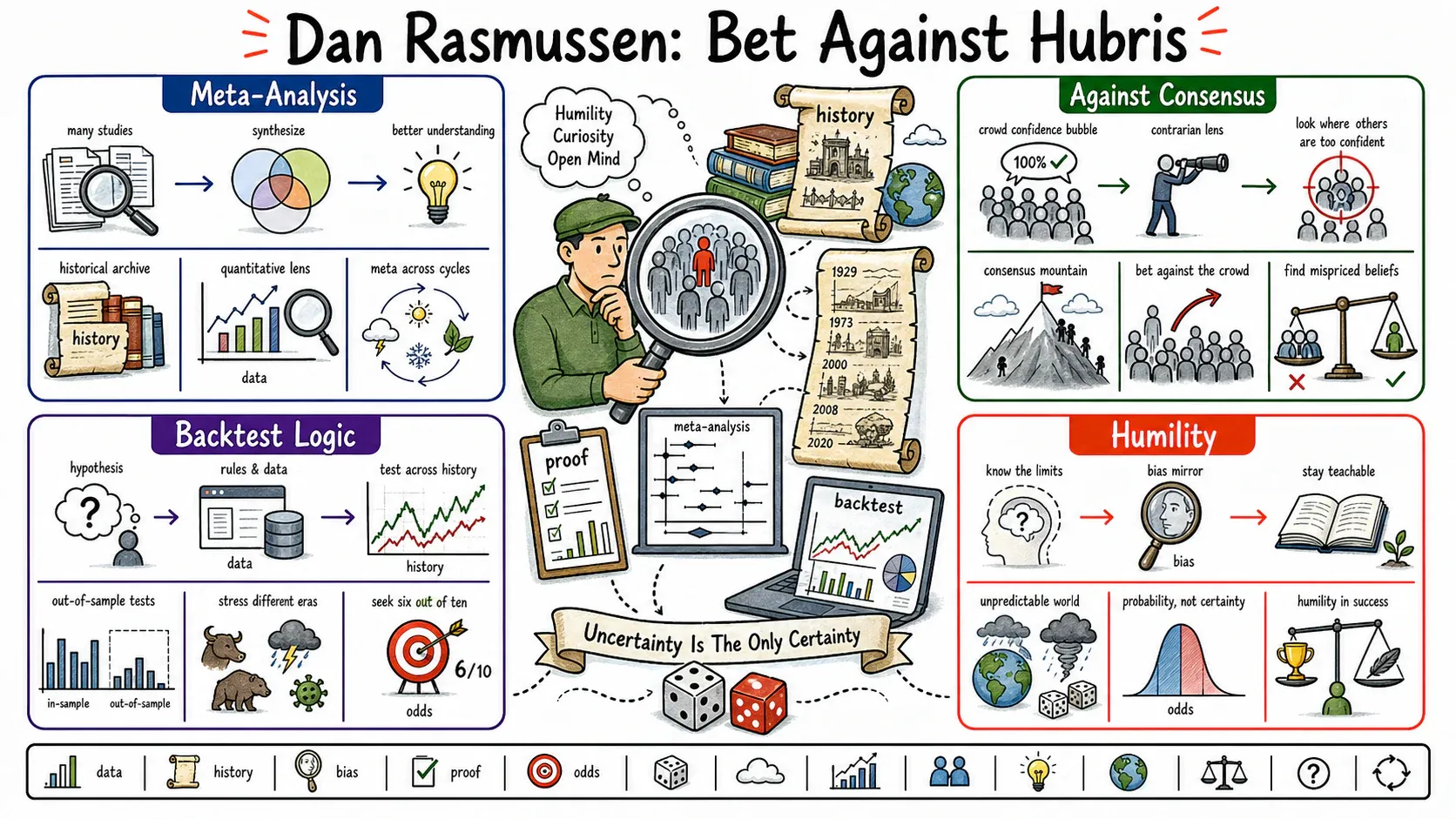
On Investment Philosophy and Humility
- On meta-analysis: Rasmussen argues that an investment view matters in relation to what other investors already believe; a good analysis alone is not an edge if competitors share it. — Morningstar — The Long View.
- On betting against overconfidence: Rasmussen looks for investments where prevailing forecasts appear too confident, while acknowledging that the future can surprise both consensus and contrarians. — Morningstar — The Long View.
- On humility about prediction: Rasmussen says the future is less predictable than many investors assume, so his book advocates betting against hubris and consensus forecasts rather than claiming precise foresight. — The Power of Humility Interview.
- On testing investment logic: Rasmussen says a strategy should have a coherent rationale and be tested against historical data rather than accepted because a market story sounds plausible. — The Investor’s Podcast MI161.
- On being wrong often: Rasmussen cautions that even a skilled investor can make many wrong calls, making humility and diversified decision-making important. — WealthWise Interview.
- On overestimating one’s skill: Rasmussen warns that investing can quickly reveal gaps between an investor’s confidence and actual ability. — WealthWise Interview.
- On falsifying narratives: Rasmussen says his work requires separating evidence from narrative and testing investment theories for confirmation or falsification. — Harvard History & Literature Alumni Profile.
- On living with a principle: Rasmussen says choosing an investment principle can be easier than enduring the periods when following it feels uncomfortable or underperforms. — The Power of Humility Interview.
On Value Investing
- On value and forecast hubris: Rasmussen describes value investing as a wager that pessimistic prices may be less wrong than the confident growth forecasts embedded in expensive stocks. — Morningstar — The Long View.
- On value beyond the United States: Rasmussen said in 2025 that value investing had disappointed in the US but performed better relative to local markets in Japan and Europe. — Morningstar — The Long View.
- On unpredictability and value: Rasmussen argues that value investing can benefit when optimistic forecasts embedded in high-priced stocks fail to materialize. — VALUE: After Hours S06 E03.
- On value and company size: Rasmussen observes that many of the cheapest public stocks are small companies, so a deep-value screen tends to create small-cap exposure and its accompanying risks. — VALUE: After Hours S06 E03.
- On crisis timing for small value: Rasmussen’s historical work suggests small-cap value has tended to do particularly well from the middle of a recession into the early recovery, making crisis preparation central to that strategy. — The Acquirers Podcast Ep. 112.
- On value and moderate leverage: Rasmussen says leverage can amplify returns to a cheap small company when debt is manageable, but the same leverage adds default and drawdown risk. — VALUE: After Hours S06 E03.
On Crisis Investing
- On recognizing a crisis: Rasmussen contrasts hard-to-identify bubbles with observable market crises, which allow investors to prepare a conditional response in advance. — Morningstar — The Long View.
- On preparing before panic: Verdad’s crisis research recommends studying prior market panics and deciding in advance how to deploy capital, since fear and forced selling can impair decisions in real time. — Verdad — Crisis Investing.
- On small value after high-yield stress: Rasmussen’s historical analysis found stronger small-cap value returns after high-yield spreads widened and the economy moved from recession toward recovery. — The Meb Faber Show Ep. 294.
- On factors in crises: Rasmussen says size and value factors have been more predictive in historical crises, when liquidity withdrawal and behavioral errors become pronounced. — Morningstar — The Long View.
- On developed and emerging crises: Rasmussen says his crisis research found developed markets recovered more often than emerging markets, where political and institutional risks can make losses more permanent. — Morningstar — The Long View.
- On what crisis research favored: Rasmussen argues that the cheapest small-cap value stocks historically offered opportunity during recessions, but emphasizes that these illiquid companies are volatile and risky. — The Investor’s Podcast MI161.
On Private Equity
- On private equity’s historic appeal: Rasmussen says private equity produced strong historical returns before 2010, then questions whether the same drivers and returns can be repeated at later valuations. — The Meb Faber Show Ep. 90.
- On the mechanics of buyouts: Rasmussen characterizes much private equity as applying financial leverage to relatively small companies, a risk exposure he thinks allocators should recognize. — WealthWise Interview.
- On trapped private capital: Rasmussen warns that a large allocation to private equity can become hard to rebalance or exit when distributions slow, despite valuations shown on paper. — Excess Returns — Private Equity Interview.
- On comparing private valuations: Rasmussen argued in a 2025 interview that private-equity valuations may exceed public-market valuations once differences in leverage and company size are considered. — Morningstar — The Long View Video.
- On portfolio concentration in buyouts: Rasmussen argues that putting roughly 40% of a portfolio into small, highly levered private companies concentrates risk and illiquidity. — Morningstar — The Long View.
- On explanations for private-equity returns: Rasmussen questions whether operational improvement alone explains private equity’s historical returns; his analysis emphasizes the combined effects of small company size, low purchase valuations and leverage. — The Meb Faber Show Ep. 90.
On International Investing & Japan
- On searching internationally for value: Rasmussen said his value opportunity set increasingly drew him outside the United States, where he saw cheaper stocks in some developed markets. — VALUE: After Hours S07 E01.
- On cheap Japanese stocks: Rasmussen pointed to Japan as a market with numerous inexpensive small public companies, while recognizing that cheapness alone does not establish quality. — VALUE: After Hours S06 E03.
- On Japanese corporate reform: Rasmussen argued that Japanese policy and exchange pressure were encouraging listed companies to address persistently low valuations and capital allocation. — VALUE: After Hours S06 E03.
- On unpopular markets: Rasmussen said broad investor pessimism about Japan could leave bargains, but he also examined growth and capital-allocation problems rather than assuming every cheap stock was attractive. — TIP565 — Rasmussen on Japan.
- On Japanese balance sheets: In a 2025 interview Rasmussen estimated that more than a thousand Japanese public companies traded near or below half of tangible book value. — WealthWise Interview.
- On quality in Europe: Rasmussen said he saw some high-quality European businesses available at valuations he regarded as attractive relative to comparable opportunities elsewhere. — VALUE: After Hours S07 E01 Video.
- On emerging-market caution: Rasmussen is skeptical of long-term emerging-market exposure because his crisis research found more frequent crises and a lower likelihood of recovery than in developed markets. — Morningstar — The Long View.
On Markets, Cycles, and Forecasting
- On credit and liquidity: Rasmussen uses the availability and cost of credit, especially high-yield spreads, as a framework for assessing the market environment. — The Investor’s Podcast MI161.
- On high-yield spreads: Rasmussen favors high-yield spreads as an observable gauge of borrowing conditions because they reflect actual bond pricing and the cost of credit to riskier firms. — The Acquirers Podcast Ep. 112.
- On regime changes around recessions: Rasmussen says shifts in the economic regime around recessions can change when small-cap value and other factors have historically performed best. — The Meb Faber Show Ep. 294.
- On discontinuous futures: Rasmussen warns that the future can depart sharply from historical patterns, so past data should guide probabilities without creating false certainty. — The Power of Humility Interview.
- On short forecasting horizons: Rasmussen has questioned whether company forecasts have useful precision far beyond the near term, an uncertainty that limits confident long-range valuation stories. — Excess Returns — Private Equity Interview.
- On revising a cycle framework: Rasmussen said his view of business and market cycles continued to evolve as he learned, and expected he might hold a different view a year later. — WealthWise Interview.
- On excess market volatility: Rasmussen argues that changes in fundamentals explain only a minority of observed market-price volatility, leaving a large role for changing expectations and forecast errors. — WealthWise Interview.
On Strategy and Portfolio Construction
- On a simple default portfolio: Rasmussen says most investors should keep the majority of their investments in diversified, low-cost passive equity funds rather than assume they can reliably beat the market. — The Investor’s Podcast MI161.
- On the size factor: Rasmussen is not convinced that small size alone ensures superior returns; he values the larger opportunity set of small companies when seeking unusually cheap or underfollowed stocks. — Morningstar — The Long View.
- On inflation hedges: Rasmussen argues that gold and oil can serve tactical inflation views but have not been attractive long-term buy-and-hold investments in his historical assessment. — The Investor’s Podcast MI161.
- On illiquid assets: Rasmussen urges investors to demand a clear reason for paying higher fees and accepting lockups in private markets, rather than assuming illiquidity by itself creates an edge. — Morningstar — The Long View.
- On consistency through value cycles: Rasmussen warns that repeatedly changing the core strategy after short periods of underperformance can prevent investors from realizing a long-horizon value thesis. — VALUE: After Hours S06 E03.
- On tolerating relative underperformance: Rasmussen says a diversified long-term approach requires accepting periods when fashionable assets outperform and the disciplined investor feels behind. — The Power of Humility Interview.
- On the fool’s yield of private credit: Rasmussen warns that a high stated yield can be offset by defaults and fees, and says private-credit investors should assess borrower quality rather than reach for headline income. — Excess Returns — Investing Myths.
- On holding risky value exposure: Rasmussen says investors who choose volatile, risky value exposures need a long horizon and enough tolerance to hold them through uncomfortable periods. — The Humble Investor Interview.
- On competition neglect: Rasmussen uses “competition neglect” to describe investors overlooking that peers may act on the same information and forecasts, erasing an apparent edge. — The Power of Humility Interview.
Learn more:
- The Humble Investor: How to Find a Winning Edge in a Surprising World — Harriman House
- Dan Rasmussen on Investing Lessons from Ray Dalio — The Acquirer’s Multiple
- Building a Balanced Portfolio with Daniel Rasmussen (MI161) — The Investor’s Podcast Network
- Dan Rasmussen on Market Outlook, International Value and Fool’s Yield — WealthWise
- Crisis Investing: How to Maximize Return During Market Panics — Verdad Advisers
- The Power of Humility in Investing with Dan Rasmussen — Peter Lazaroff
- Daniel Rasmussen: Be Very Wary of Illiquid Asset Classes — Morningstar’s The Long View
- VALUE: After Hours S06 E03 — Dan Rasmussen on Small, Cheap, Levered Stocks
- The Acquirers Podcast Ep. 112 — Dan Rasmussen on Countercyclical Investing
- The Meb Faber Show Ep. 294 — Dan Rasmussen on Regime Changes and Crises
- The Meb Faber Show Ep. 90 — Dan Rasmussen on Private Equity
- The Bubble No One Can Sell — Excess Returns Interview with Dan Rasmussen
- Invest Like the Best Ep. 78 — Dan Rasmussen on Private Equity Returns in Public Markets
- VALUE: After Hours S07 E01 — Dan Rasmussen on Europe, Japan and Small Value
- Why Buffett Is Doubling Down on Japan with Dan Rasmussen (TIP565)
- The Humble Investor — Interview with Daniel Rasmussen