Daniel Goleman is a psychologist and science journalist who transformed our understanding of human intelligence and leadership with his groundbreaking work on emotional intelligence (EQ).
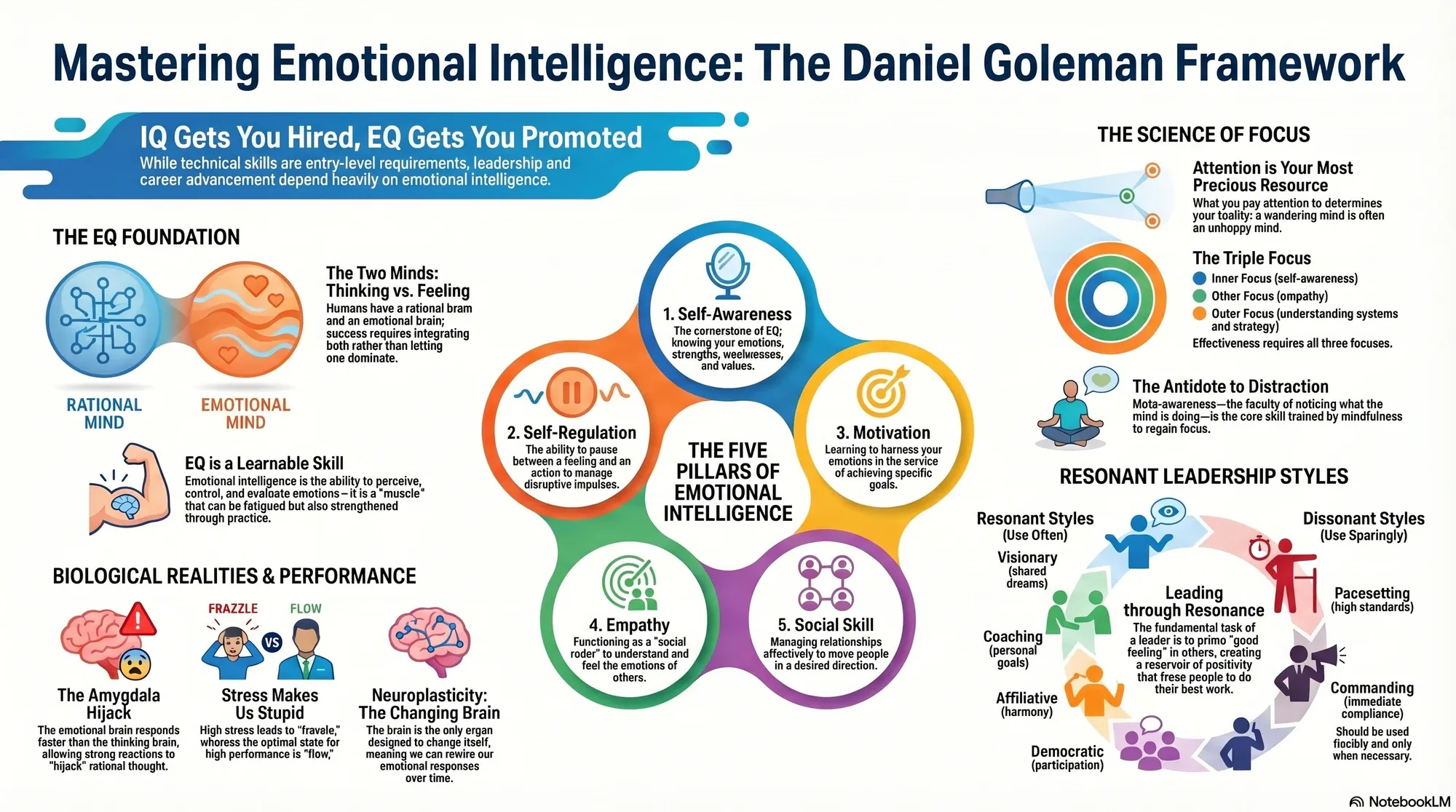
The Core of Emotional Intelligence (EQ)
- "If your emotional abilities aren't in hand, if you don't have self-awareness, if you are not able to manage your distressing emotions, if you can't have empathy and have effective relationships, then no matter how smart you are, you are not going to get very far."
- Source: A summary of his core thesis, often stated in interviews.
- Learning: EQ is the foundation upon which other skills, including intellect, are effectively applied.
- "In a very real sense we have two minds, one that thinks and one that feels." [1]
- "IQ gets you hired, but EQ gets you promoted."
- Source: A widely attributed quote summarizing his research on workplace success.
- Learning: Technical skills and intellect are entry-level requirements, but leadership and advancement depend on emotional intelligence.
- "Emotional intelligence is the ability to perceive, control, and evaluate emotions."
- Source: A concise definition of EQ.
- Learning: EQ is not about suppressing emotions, but about understanding and managing them skillfully in oneself and others.
- Learning: The Five Components of Emotional Intelligence. Goleman's model is built on five key pillars:
- 1. Self-Awareness: Knowing your emotions, strengths, weaknesses, and values.
- 2. Self-Regulation: Managing or redirecting your disruptive emotions and impulses.
- 3. Motivation: Harnessing your emotions in the service of a goal.
- 4. Empathy: Understanding and feeling the emotions of others.
- 5. Social Skill: Managing relationships to move people in the desired direction.
- Source: Emotional Intelligence: Why It Can Matter More Than IQ
- Link: MindTools
- Goleman's own EI education platform frames self-regulation in competency terms rather than brain-architecture terms: emotional self-control means recognizing disruptive emotions, like high anxiety, intense fear, or quick anger, that get in the way, and finding ways to manage your emotions and impulses so you stay calm and clear-headed under stress. [5]
- "The emotional brain responds to an event more quickly than the thinking brain."
- Source: Emotional Intelligence
On Self-Awareness and Self-Regulation
- Goleman's own emotional intelligence education platform states this almost identically: self-awareness lies at the heart of emotional intelligence, defined as the ability to understand your own emotions and their effects on your performance. [3]
- "If you are tuned out of your own emotions, you will be poor at reading them in other people."
- Source: Working with Emotional Intelligence
- The original HBR article defines it in a table: self-regulation is the ability to control or redirect disruptive impulses and moods, and the propensity to suspend judgment, to think before acting. [2]
- "Feelings are not facts."
- Source: A core concept in managing emotions.
- Learning: A crucial part of self-regulation is recognizing that just because you feel something strongly (e.g., anger, fear) doesn't mean it accurately reflects the objective reality of the situation.
- "The ability to manage our emotions is a finite resource, like a muscle that can be fatigued."
- Source: Focus: The Hidden Driver of Excellence
- Learning: This explains why we are more likely to have emotional outbursts when we are tired or stressed. Willpower and self-control need to be strategically managed and replenished.
On Empathy and Social Skill
- Goleman's own EI education platform defines it less metaphorically than a radar image: the empathy competence is the ability to sense what others are feeling and how they see things, taking an active interest in their concerns and picking up on cues to what is being felt but not said. [4]
- Learning: The Three Types of Empathy.
- 1. Cognitive Empathy: Understanding someone's perspective.
- 2. Emotional Empathy: Feeling what someone else feels.
- 3. Empathic Concern (Compassion): Not just feeling with someone, but also wanting to help them.
- Source: His later work on empathy and compassion.
- Link: Daniel Goleman's Blog
- "Simple mindfulness practices can create a space in our minds to notice our own emotions and to see them in others."
- Source: His advocacy for mindfulness as a tool for building EQ.
- Goleman's own EI platform frames effective leadership in terms of influence rather than an in-charge-versus-in-touch contrast: leadership is described as the art of getting work done well through other people, with influence named as the most powerful way to do that. [7]
- "The social brain is the sum of the neural mechanisms that orchestrate our interactions as well as our thoughts and feelings about people and our relationships."
- Source: Social Intelligence
- "A prerequisite to empathy is simply paying attention to the person in pain."
- Source: Social Intelligence
On Focus and Attention
- "Your attention is your most precious resource."
- Source: Focus: The Hidden Driver of Excellence
- Learning: What you pay attention to determines your reality and your effectiveness. Managing your focus is a critical meta-skill.
- Learning: The Three Types of Focus.
- 1. Inner Focus: Tuning in to your own feelings, values, and intuition (Self-Awareness).
- 2. Other Focus: Paying attention to other people (Empathy).
- 3. Outer Focus: Understanding the larger systems at play, like an organization or the environment (Strategy).
- Source: Focus: The Hidden Driver of Excellence
- "A wandering mind is an unhappy mind."
- Source: Focus
- Learning: Citing research, he notes that people are happiest when their minds are fully engaged in the present task, not drifting to worries or distractions.
- "The antidote for mind-wandering is meta-awareness, a faculty of the mind that can notice what the mind is doing."
- Source: Focus
- Learning: This is the core skill trained by mindfulness meditation—noticing that your mind has wandered and gently bringing it back.
- "Our ability to focus is constantly under siege."
- Source: Focus
- Learning: He highlights the modern challenges of digital distractions and the need for intentional "attention restoration."
- "The art of leadership is to direct attention to the right things."
- Source: Focus
On Leadership
- "The fundamental task of leaders is to prime good feeling in those they lead. That occurs when a leader creates resonance – a reservoir of positivity that frees the best in people."
- Source: Primal Leadership
- Link: Harvard Business Review
- "Great leaders move us. They ignite our passion and inspire the best in us."
- Source: Primal Leadership
- "Emotions are contagious. Leaders who manage their own emotions effectively are more likely to create a positive and productive work environment."
- Source: Primal Leadership
- Learning: The Six Leadership Styles. A resonant leader uses different styles flexibly:
- Visionary: Inspires with a shared dream.
- Coaching: Connects personal goals with organizational goals.
- Affiliative: Creates harmony and emotional bonds.
- Democratic: Builds consensus through participation.
- (Dissonant styles to be used sparingly)
- Pacesetting: Sets high standards and expects excellence.
- Commanding: Demands immediate compliance.
- Source: Primal Leadership
- "The best leaders don't know just one way to lead – they're flexible and switch their style to match the situation."
- Source: Primal Leadership
- Goleman's own EI platform frames the executive-failure risk around a specific trap rather than a hire-fire aphorism: pushing achievement drive into overdrive and expecting others to match that pace is exactly what turns a results-oriented leader into a toxic one. [6]
Additional Key Quotes and Learnings
- "The ability to delay gratification is a master skill, a triumph of the reasoning brain over the impulsive one."
- "True compassion is not just an emotional response but a firm commitment founded on reason."
- "Mindfulness is a practice that trains the mind to be more aware and less reactive."
- "Our brains are wired for connection, but our relationships are what build the wiring."
- "Stress makes us stupid. The optimal state for performance is 'flow,' not frazzle."
- "Every interaction is a chance to have a positive emotional impact on someone else."
- "What we don't notice, we can't act on." - On the importance of self-awareness and focus.
- "The more we can notice the thoughts that are running through our minds, the less they control us."
- "Creativity is a function of the brain's ability to make novel connections, which is enhanced by a relaxed, positive state of mind."
- "Data can be the enemy of wisdom." - On the need for intuition and empathy alongside analytics.
- "People with well-developed emotional skills are also more likely to be content and effective in their lives."
- "Practice is the key to developing emotional intelligence. It's not something you're just born with."
- "Trust is built on a foundation of empathy and reliability."
- "A single-minded focus on the bottom line is a recipe for mediocrity."
- "The ecological crisis is a crisis of awareness." - Applying his principles to global issues.
- "The brain is the only organ that is designed to change itself." - On the potential for neuroplasticity and growth.
- "When I say 'control emotions,' I mean the emotions that are disruptive. I don't mean suppress all emotions."
- "Hope, in a psychological sense, is the belief that you have the will and the way to accomplish your goals."
- "Authenticity requires self-awareness."
- "The rules for work are changing. We're being judged by a new yardstick: not just by how smart we are, or by our training and expertise, but also by how well we handle ourselves and each other."
Learn more:
- The Critical Importance of Emotional Intelligence (The Examined Life)
- What Makes a Leader? (Harvard Business Review)
- Daniel Goleman Emotional Intelligence, "EI Overview: The Four Domains and Twelve Competencies"
- Daniel Goleman Emotional Intelligence, "EI Overview: The Four Domains and Twelve Competencies"
- Daniel Goleman Emotional Intelligence, "EI Overview: The Four Domains and Twelve Competencies"
- Daniel Goleman Emotional Intelligence, "EI Overview: The Four Domains and Twelve Competencies"
- Daniel Goleman Emotional Intelligence, "EI Overview: The Four Domains and Twelve Competencies"