Danny Meyer founded Union Square Hospitality Group and helped build Shake Shack. His approach to enlightened hospitality puts employees first in a five-stakeholder cycle and treats hospitality as the way people feel in an interaction. — HBR IdeaCast.
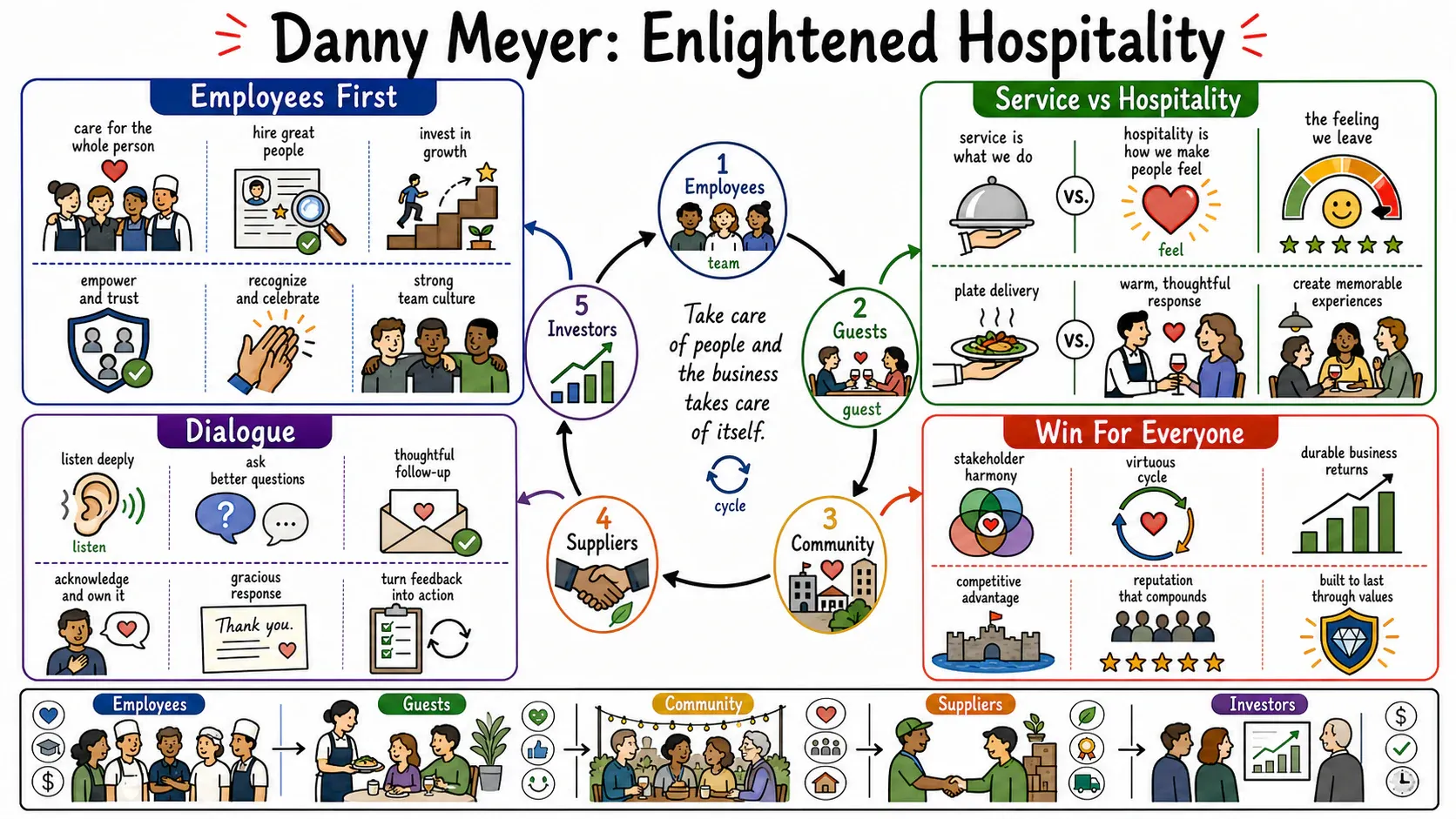
On Enlightened Hospitality
Meyer orders the stakeholders in his enlightened-hospitality cycle as employees, guests, community, suppliers, and investors; he says neglecting one part weakens the whole. — HBR IdeaCast.
Principles:
- Hospitality and Reciprocity: Meyer connects generous hospitality with reciprocity: giving care to another person can itself be rewarding. — Esquire Interview.
- Hire for Team Impact: Meyer learned that hiring solely for credentials or technical skill missed people who would care for guests and teammates. — Danny Meyer in TIME.
- Employees Shape the Guest Experience: Meyer puts care for employees first because their treatment of one another shapes how guests feel. — HBR IdeaCast.
- Make Hospitality Personal: Meyer describes hospitality as an individualized interaction: observe the guest, understand what matters to them, and respond thoughtfully. — Inc. Video Interview.
- Service Versus Hospitality: Meyer distinguishes technical service from hospitality, which is how a person feels when that service is delivered. — Global Leadership Summit Q&A.
Learnings:
- The Five-Stakeholder Cycle: Meyer describes a reinforcing cycle: employees care for one another, then guests, community, suppliers, and investors, with each group affected by the preceding relationships. — HBR IdeaCast.
- Hospitality Is a Team Sport: Meyer calls hospitality a team sport; during hiring he asks whether a candidate will help teammates as well as guests. — Inc. Video Interview.
On Hiring and the "51 Percent" Solution
Meyer says hiring needs both hospitality skills and sufficient technical competence; neither alone makes a reliable employee. — Danny Meyer in TIME.
Principles:
- The 49/51 Hiring Model: Meyer uses a 49/51 model: technical prowess matters, but the larger share of his hiring recipe concerns hospitality and emotional skills. — HBR IdeaCast.
- The Original Five Grouped Skills: In the original Setting the Table chapter excerpt, Meyer grouped the 51-percenters’ emotional skills into five categories: optimistic warmth, curiosity, work ethic, empathy, and self-awareness with integrity. Later interviews group these traits differently. — Setting the Table Excerpt.
- Keep a Technical Baseline: Ask candidates for examples of when they used empathy at work rather than asking closed yes-or-no questions about whether they possess it. — Inc. Video Interview.
- Look Beyond Credentials: When judging an employee’s problem, distinguish a missing technical skill from unwillingness to care about doing the job well. — Setting the Table Excerpt.
- Observe Warmth and Curiosity: Meyer looks for warmth and curiosity in people, including their questions and behavior, rather than treating technical credentials as the whole assessment. — Setting the Table Excerpt.
- Hire for Learning: Meyer values curiosity because employees who want to learn across roles help a restaurant keep improving. — Setting the Table Excerpt.
Learnings:
- Balance Character and Skill: Hire for emotional hospitality skills while requiring enough technical competence for the role; Meyer says the remaining technical polish is more teachable. — Danny Meyer in TIME.
- Name the Emotional Skills: Define the emotional skills sought in hiring and promotions. In a later interview Meyer names kindness and optimism, curiosity, work ethic, empathy, self-awareness, and integrity. — HBR IdeaCast.
- Observe Candidates at Work: Spend meaningful time observing candidates, often in a work setting, because emotional fit is harder to judge than a technical task. The excerpt does not prescribe a fixed number of trial shifts. — Setting the Table Excerpt.
- Protect the Culture: Protect culture by weighing a candidate’s effect on teammates alongside technical performance, and promote people who embody both. — HBR IdeaCast.
On Making Mistakes and "Turning Up the Lights"
Meyer treats honest mistakes as opportunities to make amends, learn, and sometimes build a stronger guest relationship. — Global Leadership Summit Q&A.
Principles:
- Handle Mistakes Well: Meyer argues that success depends less on avoiding every mistake than on handling mistakes well. — Global Leadership Summit Q&A.
- Correct Errors Openly: Meyer distinguishes honest mistakes, which deserve patient recovery and learning, from failures of integrity. — Global Leadership Summit Q&A.
- Notice Problems Early: Meyer invites specific feedback from restaurant teams so that missed standards surface and can be corrected. — HBR IdeaCast.
- Recover Generously: Meyer says a generous, timely recovery can leave a guest with a better ending than an unaddressed error. — Global Leadership Summit Q&A.
- The Five As: Meyer’s five-step recovery sequence is awareness, acknowledgement, apology, action, and additional generosity. — Global Leadership Summit Q&A.
Learnings:
- Write a Better Next Chapter: Meyer says a business cannot erase a guest’s bad experience, but can shape the next chapter through a thoughtful recovery. — Global Leadership Summit Q&A.
- Connect the Dots: Meyer urges managers to gather details about guests, then connect that information to make hospitality more personal. This is about knowing guests, not detecting repeated operational errors. — Setting the Table Chapter 4 Excerpt.
On Leadership and Management
Principles:
- Reinforce Better Behaviors: Meyer favors specific, repeated reinforcement of expected behaviors so teams continue improving as the company scales. — HBR IdeaCast.
- Communicate the Vision: Meyer says leaders must explain the behaviors they expect instead of asking teams to guess what matters. — HBR IdeaCast.
- Catch Good Work: Meyer reinforces culture by catching employees doing the right thing and naming the particular behavior that mattered. — HBR IdeaCast.
- Listen to the Front Line: Meyer wants frontline colleagues to surface approaching problems because the leader cannot steer well without hearing their observations. — Global Leadership Summit Q&A.
- Promote Culture Carriers: Meyer says promotion choices must embody the values and performance a leader asks the team to practice; otherwise the stated culture loses credibility. — HBR IdeaCast.
Learnings:
- Manage Your Personal Weather: Meyer calls it “skunking” when someone projects a bad mood into a team; his point is to notice and manage one’s own emotional state, not to disrupt meetings with dissent. — Setting the Table Excerpt.
- Make Expectations Clear: Translate values into specific expected behaviors and communicate them clearly, rather than asking staff to infer the culture from slogans. — HBR IdeaCast.
On Business and Life Philosophy
Principles:
- How People Feel: Meyer’s hospitality rule is to consider what the other person would want, rather than assume everyone wants to be treated as he does. — HBR IdeaCast.
- Center the Salt Shaker: For Meyer, “center the salt shaker” means returning to agreed standards of excellence when a detail drifts—not serving a guest salt. — HBR IdeaCast.
- Make the Customer Feel Heard: Meyer rejects the literal “customer is always right” rule; his lesson is that the customer should feel heard even when a factual disagreement remains. — Global Leadership Summit Q&A.
- Ride the Next Wave: Meyer likens recurring business problems to waves: instead of spending energy resenting them, decide how to respond to the next one. — Esquire Interview.
Sources
These selected direct sources include Meyer’s original book, a speaker-labeled leadership interview, and a later conversation about scaling hospitality culture. — HarperCollins Book Page.
- Setting the Table: The Transforming Power of Hospitality in Business: Original publisher page for Meyer’s book on hospitality and business. — HarperCollins Book Page.
- GLS18 Session Notes: The Transforming Power of Hospitality: Original event Q&A with Meyer on hospitality, customer listening, and mistake recovery. — Global Leadership Summit Q&A.
- A Leading Restaurateur on What It Takes to Scale a Winning Culture: Speaker-labeled interview with Meyer on stakeholder order, hiring, culture, and standards. — HBR IdeaCast.