Dave Asprey founded Bulletproof and built a career around biohacking, self-experimentation and measurement. His books, companies and podcast advocate changing diet, environment and routines to influence how he feels and performs; those are his views, not proof of universal health or longevity benefits. — Dave Asprey — About.
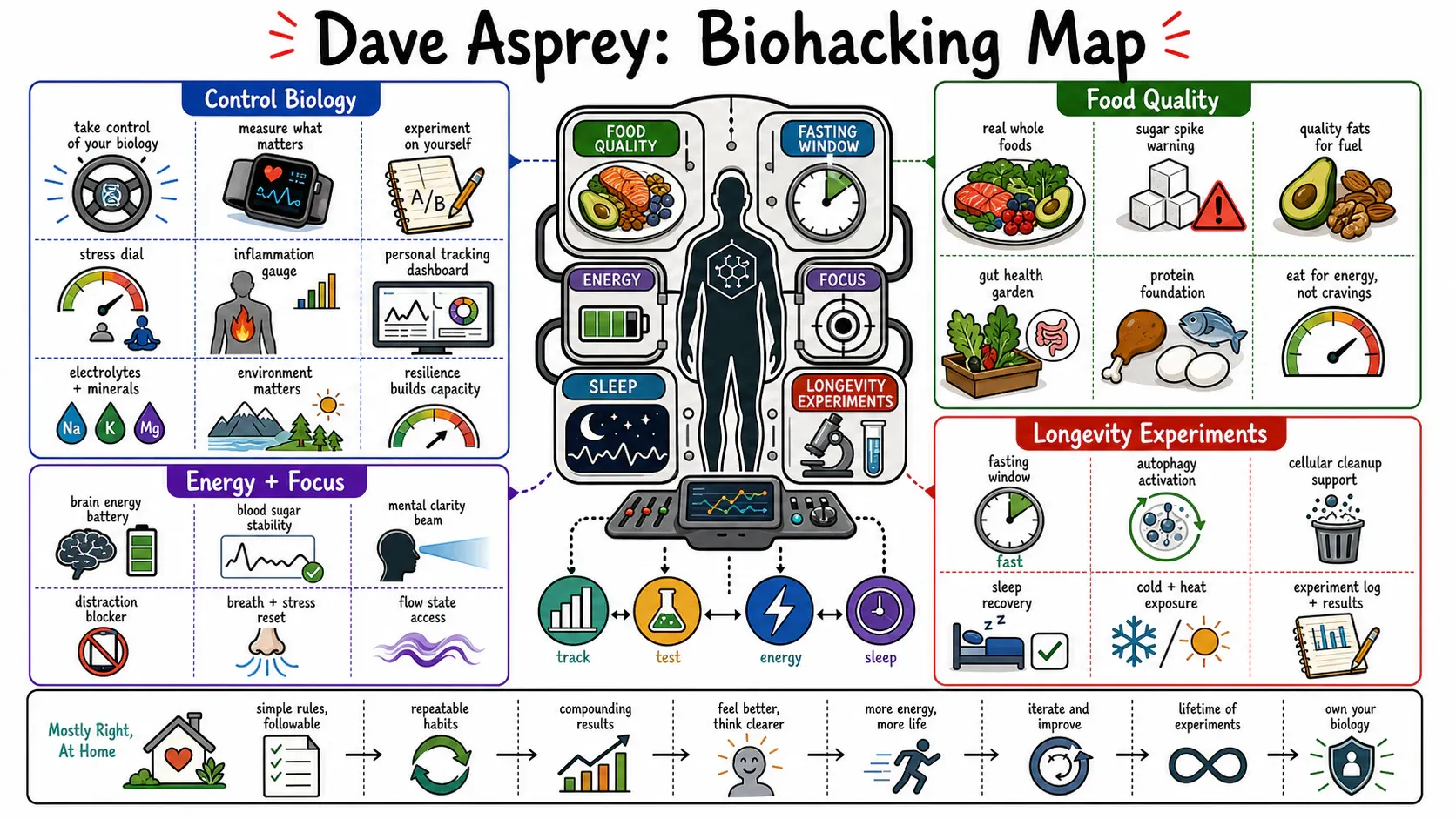
On Diet and Nutrition
- Limit added sugar: Asprey advises limiting added sugar as part of his Bulletproof Diet. — Dave Asprey — Bulletproof Your Diet.
- Focus on food quality: Asprey says his eating approach prioritizes nutrient-dense foods and considers food quality alongside macronutrients. — Dave Asprey — Bulletproof Your Diet.
- Leave room for variation: Asprey describes his food spectrum as allowing experimentation and variation rather than a rigid pass-or-fail diet. — Dave Asprey — Bulletproof Your Diet.
- Avoid heavily fried food: Asprey advises against fried food as part of his preferred eating approach. — The Human Upgrade — Fast This Way.
- Experiment rather than assume: Asprey presents the Bulletproof Diet as the result of his own self-experimentation and says he revises it as new information arrives. — Dave Asprey — Bulletproof Your Diet.
- Describe the personal diet experiment: Asprey says switching to his preferred diet and reducing grains and sugar changed how he felt and performed; this is his personal report, not a demonstrated result for everyone. — Dave Asprey — Bulletproof Your Diet.
- The Bulletproof Diet as a personal framework: Asprey describes the Bulletproof Diet as a food-choice spectrum he developed through self-experimentation, with an emphasis on nutrients and foods he personally favors. — Dave Asprey — Bulletproof Your Diet.
- Minerals as a product-design choice: Asprey markets Danger Coffee as coffee with added trace minerals and electrolytes. — Dave Asprey — Partner Brands.
- Fasting is a research topic, not a youth guarantee: Asprey discusses fasting as one way to explore metabolic health, but research into human aging does not establish that fasting keeps cells young. — The Human Upgrade — Fast This Way.
- Fasting and food stories: Asprey’s discussion of fasting emphasizes noticing the difference between hunger and the stories or habits he attaches to food. — The Human Upgrade — Fast This Way.
- A good day as a reference point: In his Joe Rogan interview, Asprey described wanting people to experience a day of unusually clear energy and focus so they know what they are trying to improve. This is an aspiration, not a promised result. — Joe Rogan Experience #274 Transcript.
- Why his diet favors fats: Asprey says he favors certain fats in his eating framework and argues they are useful for energy. That is a description of his diet, not proof that it improves cognition for everyone. — Dave Asprey — Bulletproof Your Diet.
On Biohacking and Performance
- Biohacking as systems thinking: Asprey describes biohacking as adjusting inputs, including food and environment, to observe changes in how he feels and performs. — Dave Asprey — About.
- Reintroduce natural cues: Asprey argues for adding more outdoor time and sensory contact with natural settings to an otherwise highly domesticated daily routine. — Dave Asprey — Make Your Environment Less Like a Farm.
- Reduce avoidable workspace distractions: Asprey recommends adjusting a distracting work environment to make sustained attention easier. — Dave Asprey — Hack Your Workspace.
- Pay attention to sleep: Asprey treats sleep as a core variable to track when experimenting with performance and daily routines. — Bulletproof Radio — Art and Science of Sleeping.
- Use sleep tracking as feedback: Asprey discusses sleep apps as a way to observe sleep patterns and test routine changes. He does not establish that a tracker is a high-return anti-aging device. — Bulletproof Radio — Art and Science of Sleeping.
- Practice tolerating discomfort: Asprey suggests doing manageable uncomfortable things, such as a cold shower or risking rejection, as exercises in resilience. — Dave Asprey — Build Resilience.
- Simplify recurring choices: Asprey advises reducing low-value everyday choices so attention is available for more important ones. — Dave Asprey — Avoid Decision Fatigue.
- Energy as a variable to investigate: Asprey encourages tracking sleep, food and routines when energy changes with age; he does not establish that everyone can reverse an age-related energy decline. — Dave Asprey — Improve Focus and Brain Power.
- Sort activities by their energy cost: In a podcast conversation, Asprey described a three-bucket approach he learned from Dan Sullivan: activities that drain energy, feel neutral, or give energy. It is an attributed organizing tool, not Asprey’s invention. — The Human Upgrade #794 — James Altucher Transcript.
- Prioritize cognitive well-being: Asprey treats attention and brain health as important performance concerns, though no single intervention guarantees better cognition. — Dave Asprey — Improve Focus and Brain Power.
- A personal observation about inflammation: Asprey reported that he personally felt more irritable when he believed he was inflamed; his experience should not be treated as a diagnosis or a universal brain-inflammation rule. — Bulletproof Radio — Gordon Marr Transcript.
- A hacker’s systems lens: Asprey traces his biohacking approach to his computer-hacking background: change inputs in a system and observe the resulting output. — Joe Rogan Experience #274 Transcript.
- Measure responses to changes: Asprey combines self-tracking with changes to food, environment and routines to learn what seems to work for him. Personal observations should not be treated as clinical proof. — Dave Asprey — About.
- Cold exposure as a resilience exercise: Asprey presents a brief cold shower as a way to practice tolerating discomfort; broad physical or mental health benefits require separate evidence. — Dave Asprey — Build Resilience.
On Mindset and Consciousness
- Practice gratitude deliberately: Asprey includes a short gratitude practice among his suggested exercises for resilience. — Dave Asprey — Build Resilience.
- Notice fear without surrendering every decision to it: Asprey recommends deliberate, manageable encounters with discomfort and fear as part of his resilience practice. — Dave Asprey — Build Resilience.
- Create a sense of safety through practice: Asprey links mindfulness and resilience exercises to feeling more at ease with ordinary discomfort. — Dave Asprey — Build Resilience.
- Entrepreneurial setbacks can feel personal: In a direct interview, Asprey identifies betrayal and perceived injustice as especially difficult experiences for founders. This is his observation, not a measured prevalence claim. — SUCCESS — The Future of Entrepreneurship Starts with Your Biology.
- Work through unresolved setbacks: Asprey advises founders to process betrayals and setbacks rather than carrying resentment into future decisions. — SUCCESS — The Future of Entrepreneurship Starts with Your Biology.
- Build products around process choices: Asprey describes changing each step of a product’s production process to create a differentiated version. That is his product strategy, not proof that the result is objectively better. — Joe Rogan Experience #274 Transcript.
- Meditation as self-observation: Asprey recommends meditation as a way to notice reactions and cultivate steadiness rather than to eliminate difficult thoughts. — Dave Asprey — Build Resilience.
On Health and Longevity
- Reduce unnecessary stress where possible: Asprey advocates small resilience practices and environmental changes to handle stress; the original equation between less stress and slower aging is too broad. — Dave Asprey — Build Resilience.
- Spend time outdoors: Asprey recommends walks in natural settings as a low-effort practice that may feel restorative; the original immune-cell benefit is not established as an individual guarantee. — Dave Asprey — Forest Bathing.
- Practice low-stakes social interaction: Asprey suggests talking to a stranger or asking for a small favor as manageable ways to practice handling possible rejection. — Dave Asprey — Build Resilience.
- Share tools for self-experimentation: Asprey presents his books and podcast as ways to help people observe and change their routines. — Dave Asprey — About.
- Treat biology as partly changeable: Asprey argues that sleep, diet and surroundings are inputs people can alter and observe; doing so does not guarantee a particular medical or performance result. — Dave Asprey — About.
Sources:
- Dave Asprey — About
- Dave Asprey — Bulletproof Your Diet
- The Human Upgrade #782 — Fast This Way
- Dave Asprey — Partner Brands
- Joe Rogan Experience #274 Transcript
- Dave Asprey — Make Your Environment Less Like a Farm
- Bulletproof Radio #188 — Art and Science of Sleeping
- Dave Asprey — Avoid Decision Fatigue
- Dave Asprey — Unexpected Ways to Build Resilience
- SUCCESS — The Future of Entrepreneurship Starts with Your Biology
- Dave Asprey — Forest Bathing
- Bulletproof Radio — Gordon Marr Transcript
- Dave Asprey — Improve Focus and Brain Power
- The Human Upgrade #794 — James Altucher Transcript
- Dave Asprey — Hack Your Workspace