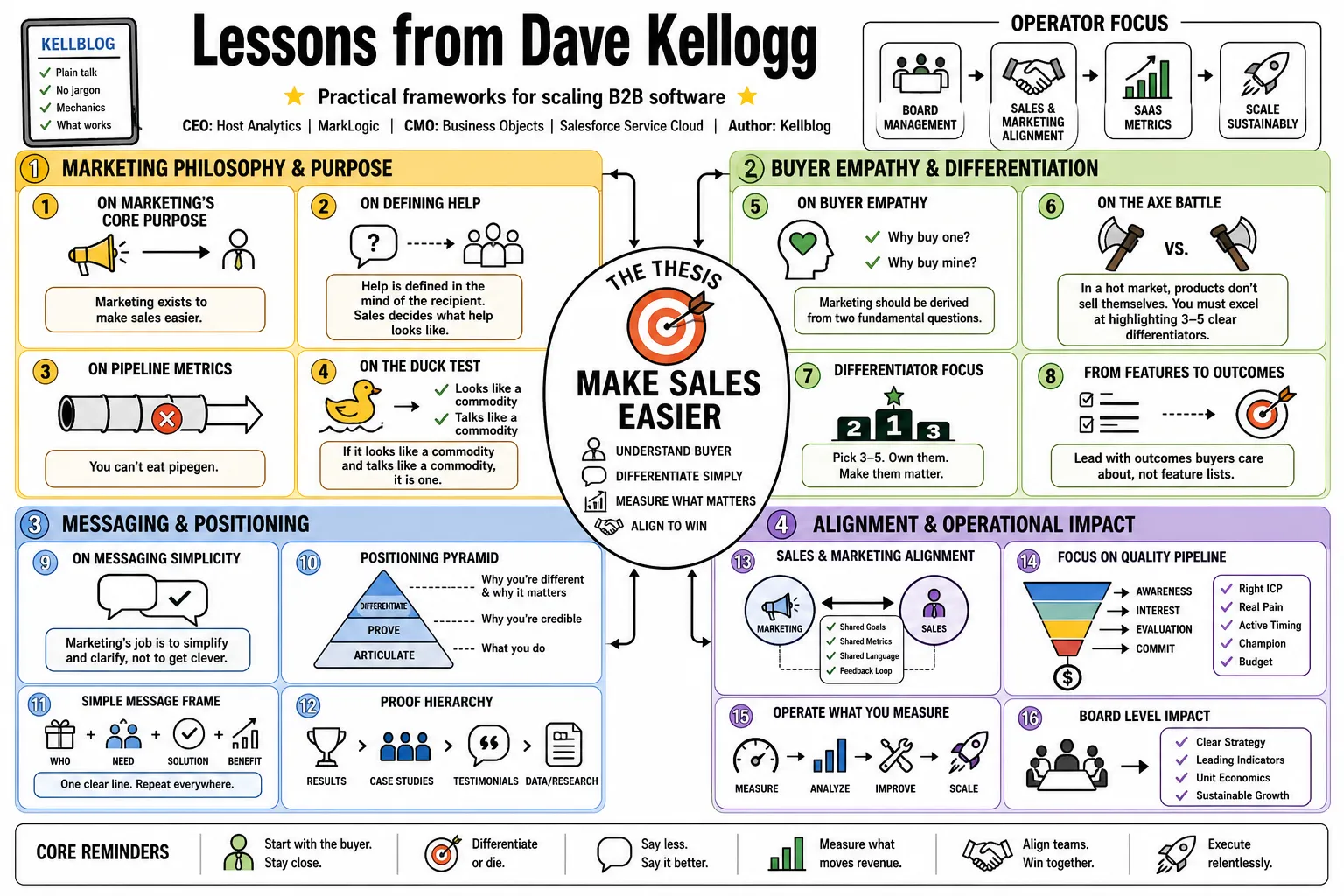
Lessons from Dave Kellogg
Dave Kellogg is an enterprise-software operator, writer and advisor. He led Host Analytics and MarkLogic as CEO, served as SVP/GM of Salesforce Service Cloud, and was CMO of Business Objects. On Kellblog he writes about sales, marketing, board management and SaaS metrics. — About Dave Kellogg.
Part 1: Marketing Philosophy and Positioning
- Marketing's service mandate: Kellogg adopted Chris Greendale's maxim that enterprise-software marketing should make sales easier; he defines that help broadly, from leads to strategy. — Marketing Exists to Make Sales Easier.
- Let the recipient define help: He argues sales should judge whether marketing's support is useful, while marketers may still push back on requests that do not serve the business. — Marketing Exists to Make Sales Easier.
- Pipeline generation is not the finish line: He warns that pipeline generation alone is not enough if opportunities do not convert into revenue. — You Can't Eat Pipegen.
- Pass the buyer's duck test: When a product looks like a familiar category, Kellogg says explain it clearly rather than obscure it with fashionable labels. — Does Your Marketing Pass the Duck Test?.
- Answer the two buyer questions: He distinguishes the market-creation message of why to buy the category from the competitive message of why to buy this vendor. — The Two Archetypal Marketing Messages.
- Differentiate in a hot market: When buyers are already committed to a category, Kellogg says marketing must show why its offer wins against alternatives. — The Two Archetypal Marketing Messages.
- Impose useful simplicity: He urges marketers to simplify complex markets without oversimplifying them beyond credibility. — A Missive to Marketing.
- Ask sales for feedback: Kellogg used sales-satisfaction surveys to learn where marketing helped and where its investment should change. — Marketing Exists to Make Sales Easier.
Part 2: Sales and Pipeline Execution
- Quarterback the whole pipeline: He recommends giving the CMO responsibility for forecasting next-quarter pipeline and coordinating remedial work across four pipeline sources. — The Four Sources of Pipeline.
- Count opportunities as well as dollars: Kellogg favors opportunity-count goals where deal values can be speculative or easily inflated. — The Four Sources of Pipeline.
- Keep sales meetings distinct: His sales framework separates forecast calls, pipeline cleanup and deal strategy so each meeting answers a different question. — A Ten-Point Sales Management Framework.
- Cut forecasts decisively: His always-be-upsloping rule asks reps to cut a weak forecast sufficiently that subsequent adjustments can move upward. — A Ten-Point Sales Management Framework.
- Discover the buyer's problem: He urges customer conversations to establish the buyer's problems before leading with product features. — How to Develop a Marketing Message.
- Do not invert win rate: Kellogg argues pipeline coverage targets cannot be set by simply taking the inverse of win rate because timing and cohort dynamics matter. — Target Pipeline Coverage Is Not Inverse Win Rate.
- Bring customer reality into messaging: He recommends grounding product messaging in the reasons customers actually buy and value a product, rather than only the founder's vision. — Bottle the Love.
- Partner beyond nominal alignment: Kellogg says CMO–CRO alignment is too low a bar and advocates a much closer working partnership. — Exit Five — Kellogg Interview.
- Ask two questions about sales: He reduces sales-health diagnosis to whether the team has enough opportunity to hit the number and whether it converts that opportunity. — The Top Two Sales Questions.
- Stop the blame cycle: When plans are unrealistic and sales and marketing miss together, Kellogg urges the CEO to reset goals and hold a joint diagnostic rather than let teams blame one another. — Stopping Sales–Marketing Double Drowning.
Part 3: Management and Career Growth
- Distinguish managerial scope: He defines managers as executing with support, directors as operating with little supervision, and VPs as designing and owning the plan. — Manager, Director, or VP.
- VPs own plan quality: Kellogg argues a VP cannot use prior approval as an excuse when their plan fails; plan design is part of the role. — Manager, Director, or VP.
- Answer the question first: He tells people dealing with senior executives to answer the question asked before adding explanation or context. — Answer the Question.
- Think like the next level: Career advancement requires learning the judgment and scope of the role above one's current one, not only doing today's tasks well. — Six Principles for Career Results.
- Simplify without dumbing down: Kellogg distinguishes simplifiers, who make complex issues actionable, from complexifiers, who make simple ones harder. — Simplifiers Go Far.
- Know your in-memory metrics: He recommends knowing the business numbers an executive should recall without looking them up; leaders often use this as a competency test. — Six Principles for Career Results.
- Write an actionable proposal: When emailing a decision-maker, state a concrete proposal, cost and alternatives so the recipient can respond. — Write Actionable Emails.
- Make feedback honest, kind and timely: Kellogg's three feedback rules are honesty, kindness and timeliness, with kindness requiring deliberate care. — The Three Golden Rules of Feedback.
Part 4: Board Dynamics and Meetings
- Do no demotivation: Kellogg proposes that boards challenge teams without leaving them demoralized. — The Startup Board's Hippocratic Oath.
- Avoid false surprise: He lists expressions of surprise about already-known information among the board behaviors that demotivate executives. — The Startup Board's Hippocratic Oath.
- Open with a balanced summary: After the agenda, he recommends a first slide summarizing both good and bad news, followed by metrics and operating context. — The First Three Slides of a SaaS Board Deck.
- Ask three real discussion questions: To make strategic board discussion substantive, he recommends three question-only slides and time for each. — How to Lead a Strategic Board Discussion.
- Leave board PTSD behind: Kellogg advises executives to approach board presentations without prior-meeting baggage or defensive tone. — Six Tips on Presenting to the Board.
- Build a board-specific deck: He cautions against reusing internal operational slides; the board needs a purpose-built deck that enables discussion. — Six Tips on Presenting to the Board.
- Do not humor board ideas you reject: He argues founders should not implement a board member's suggestion merely as a gesture when they do not believe it will work. — The Startup Board's Hippocratic Oath.
- Baseline the least-informed participant: For strategic discussion, he recommends three to five context-setting slides for the board member least familiar with the issue. — How to Lead a Strategic Board Discussion.
Part 5: SaaS Metrics and Financial Health
- Use metrics to discuss the business: Kellogg warns against debating metric definitions instead of using numbers to diagnose what is happening in the company. — Talking About the Numbers vs. Business.
- Examine net retention: Kellogg emphasizes NDR as a way to see how an existing customer cohort's recurring revenue changes, alongside gross retention. — 20VC — Dave Kellogg Transcript.
- Diagnose CAC's underlying drivers: He treats CAC payback as a compound risk metric; poor results require examining acquisition cost, margin and contract terms rather than treating the ratio as a single lever. — CAC Payback Period.
- Plan a Rule-of-40 trajectory: He argues early startups should plan a gradual Rule-of-40 glideslope rather than force immediate compliance at the expense of growth. — Rule of 40 Glideslope Planning.
- Use CAC ratio for acquisition efficiency: Kellogg distinguishes CAC ratio, an acquisition-efficiency measure, from CAC payback, a risk-duration measure. — The CAC Ratio.
- Value expansion, but qualify the benchmark: Kellogg treats expansion of existing accounts as a distinct, potentially efficient component of recurring-revenue growth; the original 40% CAC figure is not retained. — The Leaky Bucket.
- Choose a lead ARR metric deliberately: He explains that new, net-new, committed, terminal and contracted ARR express different operating priorities; contracted ARR is not universally the truest sales signal. — Units on Your Lead SaaS Metric.
- Distinguish cash risk from formula payback: In an annual-prepaid example, Kellogg says acquisition cash can be recovered in a day despite a 12-month calculated payback; the claim is conditional on payment timing. — CAC Payback Period.
- Show the ARR leaky bucket: Kellogg puts starting ARR plus new ARR minus churn ARR on the operating-metrics slide, after a first-slide summary of good and bad news. — The First Three Slides of a SaaS Board Deck.
Part 6: Go-to-Market Strategy and Scaling
- Adapt to the destination market: Kellogg warns that international expansion requires deliberate attention to local buyers, hiring, support, norms and competition. — Top Five Mistakes in US Expansion.
- Diagnose churn before dismantling CS: He urges companies to identify why customers churn before eliminating or radically restructuring customer success. — Before You Blow Up Customer Success.
- Match strategy to the business situation: Kellogg contrasts a category-dominance play with a plan-driven model and warns against applying one playbook to the other. — Playing to Win vs. Making Plan.
- Be cautious with multi-year prepayment: For venture-backed startups anticipating fundraising or exit, he warns multi-year prepaid contracts can distort SaaS metrics and complicate valuation. — My Verdict on Multi-Year Prepaid Deals.
- Diagnose the pipeline crisis: He describes weaker acquisition efficiency and harder pipeline creation as problems that require examining channels, conversion and coverage. — How to Navigate the Pipeline Crisis.
- Use services to support ARR: He frames professional services as helping customers get value while seeking to maximize recurring revenue without losing money on services. — Role of Professional Services in SaaS.
- Change the message with market temperature: He separates the job of making buyers want the category in a cold market from differentiating one vendor in a hot market. — The Two Archetypal Marketing Messages.
- Focus strategic effort: He warns that spreading a startup across too many spaces can leave it without the concentrated effort to win any of them. — Strategic Focus.
- Be explicit about ARR units: He says a company's unspoken lead metric reveals its operating priorities; ask whether a forecast means new, net-new or another form of ARR. — Units on Your Lead SaaS Metric.
Part 7: Leadership and The CEO Role
- Use metrics as diagnostic tools: Kellogg cautions against using compound metrics to bludgeon executives; examine the underlying operating levers and business situation. — A CEO's GTM Troubleshooting Guide.
- Keep conflict productive: He distinguishes healthy sales–marketing tension from infighting and says the CEO must set the standard for collaboration. — Stopping Sales–Marketing Double Drowning.
- Balance board participation: For strategic board discussions, he warns against letting the CEO and an alpha board member become the only two voices. — How to Lead a Strategic Board Discussion.
- Build a repeatable GTM model: He cautions founders against assuming founder-led sales success can scale simply by hiring more copies of the original seller. — Transitioning from Founder-Led Sales.
Part 8: Navigating the B2B Software Market
- Respond to changing capital conditions: His SaaSacre analysis explains how a shift in valuation or funding conditions can make efficiency and cash runway more salient than raw growth. — Are We Due for a SaaSacre?.
- Track customer and employee signals: His sample board dashboard includes both buyer NPS and employee NPS or engagement as signals alongside financial and operating metrics. — The First Three Slides of a SaaS Board Deck.
- Recognize growth's valuation weight: Kellogg notes that the externally proposed Rule of X gives a point of growth more weight than a point of profit; it does not replace context-specific analysis. — Why Rule of 40 Is Becoming Rule of 60.
- Define ARR measures before debating them: He warns that terms such as contracted ARR can mean different things; teams should make the unit and definition explicit. — Units on Your Lead SaaS Metric.
- Challenge the sea-of-sameness story: Kellogg argues many products are genuinely different and that marketers should identify meaningful differences instead of accepting a generic sameness narrative. — Navigating the Mythical Sea of Sameness.
- Prove ongoing value at renewal: Kellogg says renewal is not automatic even with switching costs; vendors must monitor usage and show the customer continuing value. — 20VC — Dave Kellogg Transcript.