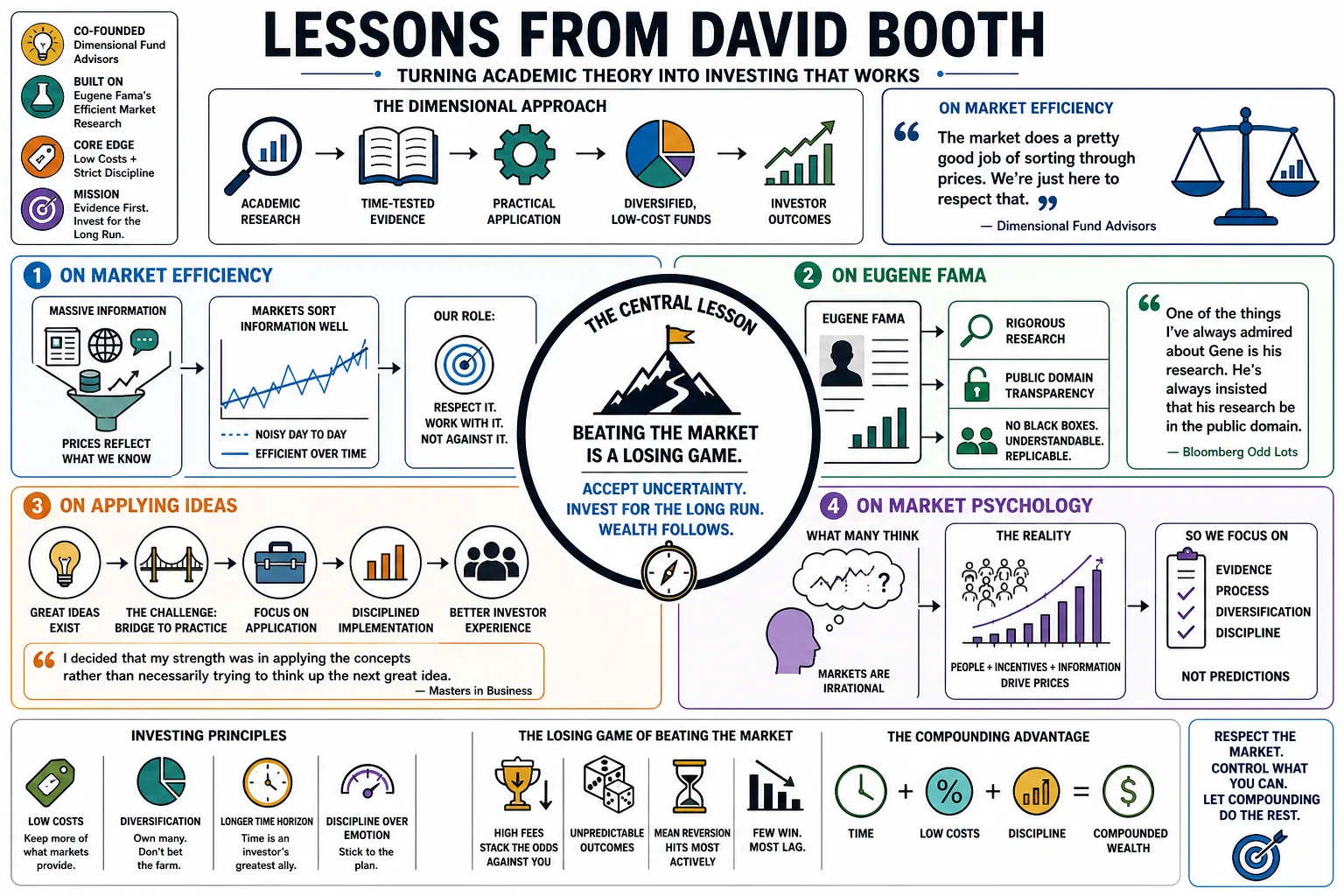
Lessons from David Booth
David Booth co-founded Dimensional Fund Advisors in 1981 to put financial research into practice. Building on Eugene Fama’s work, he emphasized broad diversification, attention to costs and disciplined implementation. His investing essays distinguish long-term participation from short-term market timing while acknowledging that returns remain uncertain. — Dimensional at 40.
Part 1: The Foundations of Efficient Markets
- Market Efficiency: Booth argues that market prices incorporate new information quickly, making repeated attempts to outguess them an unreliable investing strategy. — People Have Memories. Markets Don’t..
- Public Research: Booth said Dimensional expects new investment research to be vetted publicly rather than relying on an opaque stock-picking model. — Rational Reminder #131.
- Applying Academic Ideas: After studying with Eugene Fama, Booth concluded that his comparative advantage lay in putting finance research into practice rather than originating the next theory. — Chicago Booth Interview.
- A Rational View of Markets: Booth cautioned against explaining market movements only through investor psychology; he preferred to reason from prices, expected returns and evidence while recognizing uncertainty. — Rational Reminder #131.
- Chicago as a Turning Point: Booth described studying at the University of Chicago and working with Fama as transformative experiences that redirected him from academic research toward investment implementation. — Chicago Booth Interview.
- Human Ingenuity: Booth describes broad-market investing as a way to participate in companies’ efforts to solve problems and create value, without needing to identify every future winner. — Dimensional at 40.
- Respecting Prices: Booth advises investors to treat market prices as a rapid synthesis of available information rather than assuming they have an easy informational edge. — 10 Obstacles to Investing.
- Launching Dimensional: Booth says Dimensional was founded to implement research-based investing more effectively than traditional stock picking and rigid indexing. — Dimensional at 40.
- The Limits of Models: Booth valued academic models but warned that research models are not reality and should be tested against practical investment outcomes. — Rational Reminder #131.
Part 2: Dimensional's Approach: Flexibility and Science
- Implementation Matters: Booth argues that sound financial theory creates value only when managers execute it well in real markets. — Dimensional at 40.
- Flexible Execution: Booth says implementing investment research requires judgment and trading flexibility rather than rigidly buying securities at any price. — Dimensional at 40.
- The Small-Cap Dimension: Booth recalled using research on company size to develop Dimensional’s early small-company strategy and argued that portfolios should include both large and small firms. — Rational Reminder #131.
- Fighting for Basis Points: Booth wrote that small implementation costs matter because clients’ savings represent years of work. — Dimensional at 40.
- Changing a Strategy: Booth said Dimensional would reconsider a strategy if robust evidence and a sensible economic explanation undermined its original research basis; short disappointing periods alone were insufficient. — Rational Reminder #131.
- Value and Price: Booth saw a common-sense rationale for higher expected returns from lower-priced stocks, while stressing that any style can suffer long disappointing periods. — Rational Reminder #131.
- Control the Controllable: Booth urges investors to focus on savings, risk taken and disciplined implementation rather than trying to control market returns. — Dimensional at 40.
- Participate Without Outguessing: Booth argues that a diversified, low-cost portfolio can give investors access to expected market returns without finding every winning stock. — Dimensional at 40.
Part 3: The Philosophy of Investing
- A Philosophy You Can Keep: Booth stresses that an investment philosophy must be credible enough to follow through volatile periods, not just attractive in a backtest. — Dimensional at 40.
- Investing Versus Gambling: Booth distinguishes a long-term diversified plan from stock picking and timing that require repeated short-term calls. — Think Investing Is a Game? Stop..
- Own Broadly for the Long Term: Booth’s preferred investing approach is to own small stakes in many companies and hold them over a long horizon. — Dimensional at 40.
- Spend Time on What Matters: Booth argues that a researched, diversified investment plan can free people from constant market watching and leave more time for loved ones. — People Have Memories. Markets Don’t..
- After-Cost and Tax Outcomes: Booth discussed both fund fees and tax treatment as implementation details that affect what clients retain, while noting that products must deliver fair value. — Rational Reminder #131.
- Simple Personal Allocation: Booth said he favors a simple stock-and-bond portfolio and does not monitor its short-term results closely, while recognizing that allocation depends on circumstances. — Rational Reminder #131.
- Compounding Requires Time: Booth explains that diversified long-term investing gives compounding time to work, but its path is uneven and returns are not guaranteed. — Think Investing Is a Game? Stop..
- Historical Returns Aren’t a Forecast: Booth cited roughly 10% as the U.S. stock market’s long-run historical average since 1926, while stressing that individual years are usually far above or below it. — Dimensional at 40.
- Positive Expected Return: Booth says investors generally expect stock prices to rise over time; that expectation does not imply every day or year will be positive. — 10 Obstacles to Investing.
Part 4: Understanding Risk and Uncertainty
- Risk as Goal Shortfall: Booth defined risk in practical terms as falling short of a client’s goals, which can require saving more or delaying retirement. — Rational Reminder #131.
- Prepare for Uncertainty: Booth argues that uncertainty cannot be removed, so investors should prepare for a range of outcomes and adjust plans when necessary. — Dimensional at 40.
- Expected and Unexpected Returns: Booth distinguished long-run expected returns from short-term surprises, using unusually large individual-stock gains as examples of unexpected outcomes. — Rational Reminder #131.
- Markets Have No Memory: Booth says prices reflect current information and expectations, not a memory of last year’s gains or losses. — People Have Memories. Markets Don’t..
- Risk Premiums Require Uncertainty: Booth argues that investors could not expect a premium over relatively low-risk cash investments without accepting uncertainty. — Dimensional at 40.
- Stay Invested Through Shocks: Booth used the 2020 market fall and subsequent rebound to show why a long-term plan can be undermined by exiting during a crisis. — The Next Normal.
- Plans Must Adapt to Life: Booth said financial goals are often fuzzy and may change with family circumstances or setbacks, so a good plan should be revisited rather than treated as fixed. — Rational Reminder #424.
- Concentration Can Mean Total Loss: Booth warned that an individual stock can go to zero, whereas broad diversification reduces single-company exposure without eliminating market risk. — 10 Obstacles to Investing.
Part 5: The Flaws of Market Timing and Stock Picking
- The Limits of Market Timing: Booth argues that short-term market moves cannot be predicted reliably enough to build a durable plan around repeated entries and exits. — People Have Memories. Markets Don’t..
- The Cost of Missing a Rebound: Booth warned that leaving the market during a decline can mean missing a sudden recovery and creates a second difficult decision about when to return. — The Next Normal.
- Hard Work Is Not a Stock Edge: Booth says working harder than other investors does not by itself establish an ability to find repeatedly mispriced stocks. — Dimensional at 40.
- “Different” Is Not a Forecast: Booth noted that every market period differs in its details, but that alone does not overturn long-run asset-pricing evidence. — Rational Reminder #131.
- The Appeal of Complexity: Booth said investors can be attracted to complex products despite a lack of evidence that complexity itself improves outcomes. — Rational Reminder #131.
Part 6: Behavior, Emotion, and "Tuning Out the Noise"
- Tune Out Stock-Tip Noise: Booth treats pundit tips and investment fads as distractions from a researched long-term approach. — Dimensional at 40.
- Avoid Fear-and-Greed Decisions: Booth says chasing recent winners or selling during a frightening decline can damage a long-term plan; discipline matters most when outcomes are uncomfortable. — Dimensional at 40.
- Stay With a Sound Process: Booth recalled that early small-cap and later value strategies endured long disappointing periods, making investor understanding and discipline crucial. — Rational Reminder #131.
- Make Saving a Habit: Booth urged people to begin with regular saving, even in small amounts, before expecting compounding to help meet future needs. — 10 Obstacles to Investing.
Part 7: The Role of the Advisor and the Industry
- Advice Built on Trust: Booth said clients benefit from an advisor whose incentives are aligned with their interests and whose recommendations they can understand and trust. — Rational Reminder #424.
- Finance Is About People: Booth recalled learning that financial products should help people solve real problems, not merely showcase the provider’s cleverness. — Rational Reminder #131.
- Help Clients Stay the Course: Booth said advisors help clients maintain a sensible long-term plan during periods of disappointing results, when even sound research can be hard to follow. — Rational Reminder #131.
- Making Research Usable: Booth said Dimensional initially served institutions, then opened its funds to advisors who could help individual clients use diversified strategies without frequent trading. — Rational Reminder #131.
- Start With Client Goals: Booth framed portfolio risk against whether a client can meet personal goals, not solely against an index or abstract volatility measure. — Rational Reminder #131.
- Explain the Evidence: Booth urged investment professionals to tell clients what they believe and back their recommendations with robust research rather than hunches. — Rational Reminder #131.
Part 8: Philanthropy, Luck, and Giving Back
- Giving Back: Booth described giving back to the people and places that shaped him as a privilege. — University of Kansas Gift Announcement.
- Philanthropy’s Long Horizon: Booth likened philanthropic gifts to investments that can create opportunities across generations. — University of Kansas Gift Announcement.
- Support Enduring Institutions: Booth said his Chicago education changed his career and that strong universities and faculty can influence generations. — Chicago Booth Interview.
- Remembering Lawrence: Booth connected his later gift to the University of Kansas and Lawrence with gratitude for the community that invested in him. — University of Kansas Gift Announcement.
- A Lucky Near-Miss: Booth reflected that an early proposed leveraged index fund might have launched into the 1973 bear market and badly damaged acceptance of indexing. — Rational Reminder #131.
- Research Outlasts a Name: Booth said his large Chicago gift was motivated partly by supporting faculty and the university’s long-lived research culture. — Chicago Booth Interview.
- Gratitude for Colleagues: Booth credited the academic collaborators and clients he worked with as central to a career he considered worthwhile. — Rational Reminder #131.
- Measure Success by Client Impact: Looking back, Booth said lower fees, better diversification and risk controls helped investors, and that positive impact was part of what made his career worthwhile. — Rational Reminder #131.