David Graeber was an anthropologist and activist and the author of Debt: The First 5,000 Years and Bullshit Jobs. This collection gathers his own words from an essay and several interviews. — “We Are the 99%”: David Graeber in His Own Words (Democracy Now!).
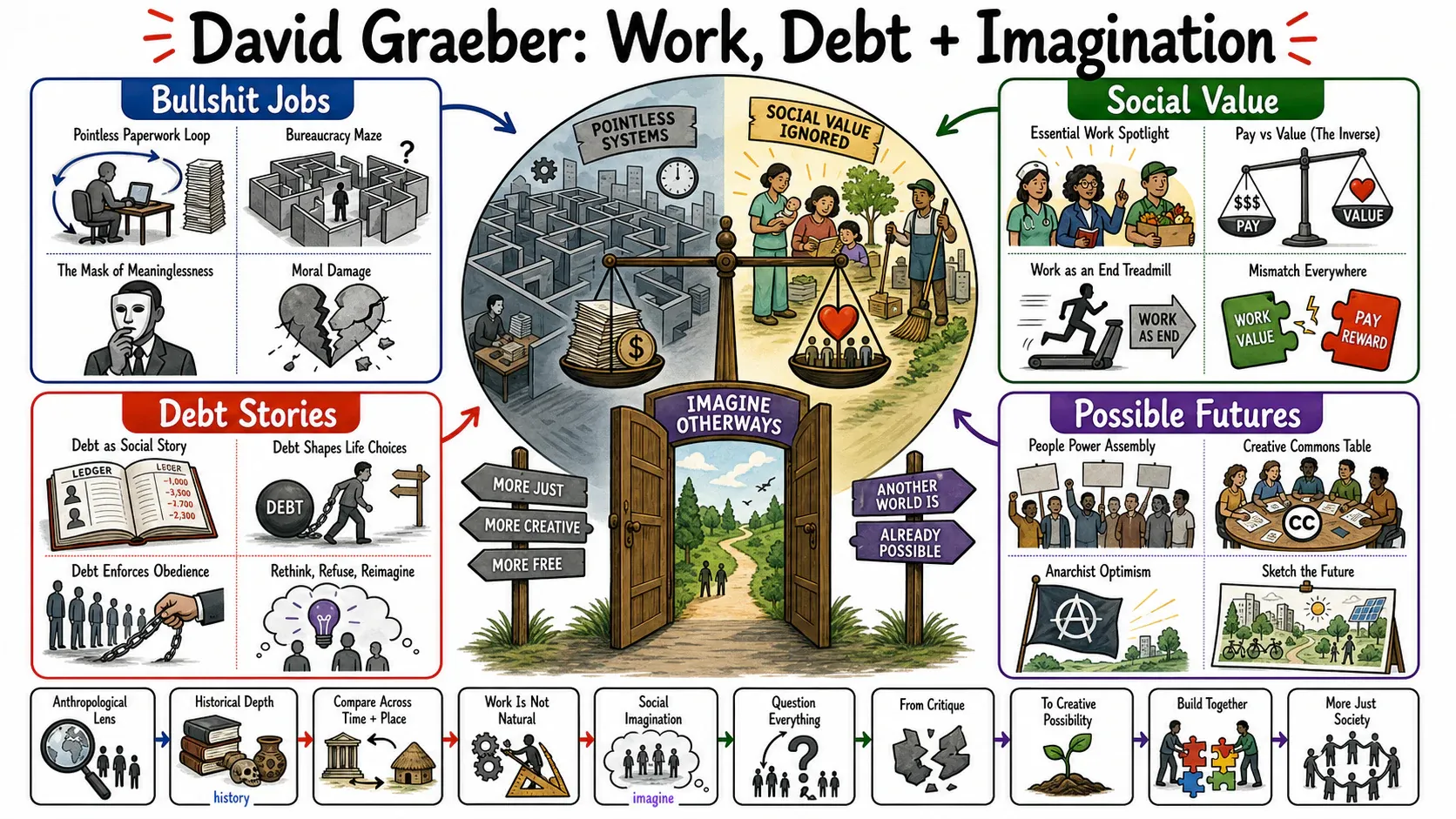
On the Nature of Work and "Bullshit Jobs"
- On tasks nobody believes need doing: David Graeber: "Huge swathes of people, in Europe and North America in particular, spend their entire working lives performing tasks they secretly believe do not really need to be performed." — On the Phenomenon of Bullshit Jobs (STRIKE! Magazine, 2013, David Graeber).
- On the more obviously useful the less paid: David Graeber: "For instance: in our society, there seems a general rule that, the more obviously one's work benefits other people, the less one is likely to be paid for it." — On the Phenomenon of Bullshit Jobs (STRIKE! Magazine, 2013, David Graeber).
- On a population with free time: David Graeber: "The ruling class has figured out that a happy and productive population with free time on their hands is a mortal danger (think of what started to happen when this even began to be approximated in the '60s)." — On the Phenomenon of Bullshit Jobs (STRIKE! Magazine, 2013, David Graeber).
- On profit-seeking firms and unneeded workers: David Graeber: "According to economic theory, at least, the last thing a profit-seeking firm is going to do is shell out money to workers they don't really need to employ." — On the Phenomenon of Bullshit Jobs (STRIKE! Magazine, 2013, David Graeber).
- On shit jobs: David Graeber: "Let’s take the cleaning staff at LSE: they wake up at 5am, wear stupid uniforms and literally clean up shit." — David Graeber on capitalism’s best kept secret (Philonomist interview; his answers).
- On jobs that would be missed: David Graeber: "Say what you like about nurses, garbage collectors, or mechanics, it's obvious that were they to vanish in a puff of smoke, the results would be immediate and catastrophic." — On the Phenomenon of Bullshit Jobs (STRIKE! Magazine, 2013, David Graeber).
- On a work regime for finance capital: David Graeber: "If someone had designed a work regime perfectly suited to maintaining the power of finance capital, it's hard to see how they could have done a better job." — On the Phenomenon of Bullshit Jobs (STRIKE! Magazine, 2013, David Graeber).
- On Keynes's prediction: David Graeber: "In the year 1930, John Maynard Keynes predicted that, by century's end, technology would have advanced sufficiently that countries like Great Britain or the United States would have achieved a 15-hour work week." — On the Phenomenon of Bullshit Jobs (STRIKE! Magazine, 2013, David Graeber).
- On work that must frustrate: David Graeber: "On a deep, cultural level, people actually believe that if you don’t do something that at least mildly frustrates you, then your work is not valuable, that you’re not contributing." — Anarchism, work and bureaucracy (Eurozine interview, 2017; his answers).
- On executives and headcount: David Graeber: "In large corporations, there is no incentive to get rid of unnecessary employees because the prestige and power of the executives is largely based on how many people they have working under them." — David Graeber on capitalism’s best kept secret (Philonomist interview; his answers).
On Debt, Money, and the Economy
- On clean slates: David Graeber: "In the ancient Middle East, often new kings would simply declare a clean slate and cancel all debts, or all consumer debts, commercial debts, between merchants were often left alone." — “We Are the 99%”: David Graeber in His Own Words (Democracy Now!, 2011 interview excerpts; his turns).
- On what finance takes from income: David Graeber: "I tried to find out what percentage of people's income in America gets sucked up by the finance sector (which part of your salary goes to mortgages, student loans, or credit card payments… ) and I couldn’t find any statistics." — David Graeber on capitalism’s best kept secret (Philonomist interview; his answers).
- On work and debt as impediments: David Graeber: "When I look at work and debt, I look at them because I think they are the greatest impediments to mobilizing people." — Anarchism, work and bureaucracy (Eurozine interview, 2017; his answers).
- On turning extortion into a moral relation: David Graeber: "If you want to take a relation of violent extortion, sheer power, and turn it into something moral, and most of all, make it seem like the victims are to blame, you turn it into a relation of debt." — What is Debt? An Interview with Economic Anthropologist David Graeber (Philip Pilkington; his answers).
- On debt as a perverted promise: David Graeber: "Debt is the perversion of a promise, a promise that has been perverted through mathematics and violence." — Interview with David Graeber (The White Review, 2011; his answers).
- On what we imagine capitalist firms are: David Graeber: "When we think of capitalist enterprises, we assume that we're talking about small or medium sized firms who are competing with each other in a market environment." — David Graeber on capitalism’s best kept secret (Philonomist interview; his answers).
- On oligopolies and regulation: David Graeber: "Most firms are very big, they’re actually oligopolies, they have relationships with governments, and they actually like regulations because it drives out competition, as small companies cannot afford to hire all the bureaucrats." — Anarchism, work and bureaucracy (Eurozine interview, 2017; his answers).
- On capitalism and feudalism: David Graeber: "In capitalism, you get your profits from hiring people to make stuff and then sell it, whereas feudalism is direct appropriation." — David Graeber on capitalism’s best kept secret (Philonomist interview; his answers).
- On protecting creditors against debtors: David Graeber: "Instead, we set up the IMF and institutions like that which are designed to do the exact opposite: to protect creditors against debtors." — "Is This Even Capitalism Anymore?" (Chuck Mertz, This is Hell; his turns).
- On debt running the world: David Graeber: "International relations are all about debt, modern nation-states run on deficit financing, and consumer debt drives the economy—yet no one has, to my knowledge, ever written a history of the phenomenon." — An Interview with David Graeber: Debt's History, Implications, and Critical Perspective (Alex Bradshaw; his answers).
On Anarchism, Freedom, and Direct Action
- On a community of people who care: David Graeber: "The carnival made sense for the first round, but the most potent thing we could possibly create as a symbol against Wall Street specifically was a community of people who care about one another." — Finance Is Just Another Word for Other People's Debts (Hannah Chadeayne Appel interview, Radical History Review 2014; his answers).
- On mechanisms in times of crisis: David Graeber: "In the past, though, there have been mechanisms, when things get to a point of real social crisis, that have always existed." — “We Are the 99%”: David Graeber in His Own Words (Democracy Now!, 2011 interview excerpts; his turns).
- On the belief in a police state: David Graeber: "Everybody in America was convinced they literally lived in a police state, that if you go out to the streets and demand change, even if you non-violently sit in a park, RoboCops will come and beat you up." — Anarchism, work and bureaucracy (Eurozine interview, 2017; his answers).
- On a corrupt political system: David Graeber: "Most people in America think that the political system is fundamentally and totally corrupt, and they have good reasons for thinking that." — Anarchism, work and bureaucracy (Eurozine interview, 2017; his answers).
- On caring for each other so that we are more free: David Graeber: "Maybe we should have that as a paradigm for social value: we take care of each other so that we can be more free, enjoy life, experience freedom and playful activities." — David Graeber on capitalism’s best kept secret (Philonomist interview; his answers).
- On the domain of necessity: David Graeber: "Marx says at some point that you only achieve true freedom when you leave the domain of necessity and work becomes its own end." — David Graeber on capitalism’s best kept secret (Philonomist interview; his answers).
- On people who think the system is rigged: David Graeber: "If all the people who think that they’ve figured out that the system is rigged, met all the other people who also believed that, they would probably change their mind." — Anarchism, work and bureaucracy (Eurozine interview, 2017; his answers).
- On carrying on without the politicians: David Graeber: "Essentially, what they were doing was exactly what we were doing with Occupy, which was daring the politicians to prove to us they were in any way relevant to our real problems, and carrying on without them." — "Is This Even Capitalism Anymore?" (Chuck Mertz, This is Hell; his turns).
- On experiencing consensus and direct action: David Graeber: "I learned about consensus, process, direct democracy, and direct action – all these things I knew a little bit about in principle but had never experienced." — Interview with David Graeber (The White Review, 2011; his answers).
- On not joining the bribery system: David Graeber: "If our main complaint was that the US political system had turned into a system of legalized bribery, no, we weren’t going to join the system and try to see if we could raise enough bribes ourselves to run candidates and change that from within." — Debt, Inequality and the Logic of Financial Violence (ROAR interview, 2016; his answers).
On Bureaucracy, Rules, and Stupidity
- On why we deal with bureaucrats: David Graeber: "After all, the reason we are required to deal with bureaucrats is because, if we don’t, then we’ll be politely asked to leave, and if we don’t, then the ‘decision-makers’ call the security and they throw you out." — Anarchism, work and bureaucracy (Eurozine interview, 2017; his answers).
- On paperwork replacing the work: David Graeber: "People complain that they have to fill in so much paperwork describing how the job is being done that they never get round to doing it at all." — David Graeber on capitalism’s best kept secret (Philonomist interview; his answers).
- On local bank branches: David Graeber: "Over the course of the last twenty to thirty years there’s been this proliferation of local bank branches, which don’t seem to serve any obvious function." — Anarchism, work and bureaucracy (Eurozine interview, 2017; his answers).
- On the ATM: David Graeber: "Yet at the same time every single one of us goes every single day to an ATM machine, so there are 200 million transactions done every day with a zero per cent error rate!" — Anarchism, work and bureaucracy (Eurozine interview, 2017; his answers).
- On the kitchen test: David Graeber: "People have pointed it out using the ‘kitchen test’, where up until the 1950s about every decade you had an invention that would totally transform the way you cooked and cleaned." — Anarchism, work and bureaucracy (Eurozine interview, 2017; his answers).
- On a vision of hell: David Graeber: "Once, when contemplating the apparently endless growth of administrative responsibilities in British academic departments, I came up with one possible vision of hell." — On the Phenomenon of Bullshit Jobs (STRIKE! Magazine, 2013, David Graeber).
- On acting like an idiot in a bureaucracy: David Graeber: "Why is it that when we are in a bureaucratic environment, not only is the whole thing set up to make us feel like an idiot, but we actually start to act like an idiot?" — "Is This Even Capitalism Anymore?" (Chuck Mertz, This is Hell; his turns).
- On public and private bureaucracy: David Graeber: "The moment I mention the word “bureaucracy,” people start talking about the government." — "Is This Even Capitalism Anymore?" (Chuck Mertz, This is Hell; his turns).
On Human History and Social Possibility
- On why peasants thought they might win: David Graeber: "I don’t think you need to ask why the peasants were angry, you need to ask, why did these peasants think that unlike all other peasants who have risen up, they might not get completely massacred?" — Anarchism, work and bureaucracy (Eurozine interview, 2017; his answers).
- On what democracy is: David Graeber: "Democracy is the idea that people, if left alone, can govern their affairs collectively in a reasonable and relatively egalitarian fashion." — "Is This Even Capitalism Anymore?" (Chuck Mertz, This is Hell; his turns).
- On revolts being about debt: David Graeber: "Similarly, most uprisings, revolts, insurrections, mass political mobilizations in human history have been about debt—for instance, Athenian democracy or the Roman Republic largely emerged as a way of settling debt crises of one sort or another." — An Interview with David Graeber: Debt's History, Implications, and Critical Perspective (Alex Bradshaw; his answers).
- On how old radical movements are: David Graeber: "Radical social movements, revolutionaries, reactionaries and all those things we’re familiar with in contemporary politics weren’t invented two hundred years ago." — Interview with David Graeber (The White Review, 2011; his answers).
On Morality, Society, and Human Nature
- On work as punishment: David Graeber: "We live in the Christian idea that work is basically punishment for the original sin, and an imitation of the Christian God who created the universe out of nothing." — David Graeber on capitalism’s best kept secret (Philonomist interview; his answers).
- On useful work and low pay: David Graeber: "Our society is set up in such a way that if you want to do something useful, for example, be a teacher, they will pay you so little that you can’t even take care of your own children." — David Graeber on capitalism’s best kept secret (Philonomist interview; his answers).
- On moral envy: David Graeber: "Moral envy means resenting people for trying to indicate to the world that they're morally superior to you by acting in a way that is actually morally superior to you." — David Graeber on capitalism’s best kept secret (Philonomist interview; his answers).
- On unpaid labor: David Graeber: "Marxism overlooks the fact that most labor just vanishes when we only talk about production, and of course, the fact that most of this labor is typically done by women, sometimes not paid at all." — David Graeber on capitalism’s best kept secret (Philonomist interview; his answers).
- On where rage is directed: David Graeber: "Yet it is the peculiar genius of our society that its rulers have figured out a way, as in the case of the fish-fryers, to ensure that rage is directed precisely against those who actually do get to do meaningful work." — On the Phenomenon of Bullshit Jobs (STRIKE! Magazine, 2013, David Graeber).
Learn more: