David M. Cote is the Executive Chairman of Vertiv, GPGI, and Resolute Holdings, and the former Chairman and CEO of Honeywell. He is a highly respected business leader known for his transformative impact during his tenure at Honeywell from 2002 to 2017, where he grew the company's market capitalization from $20 billion to $120 billion, delivering returns of 800 percent. His leadership philosophy and key learnings, many of which are detailed in his book "Winning Now, Winning Later," offer valuable insights into achieving sustained success.
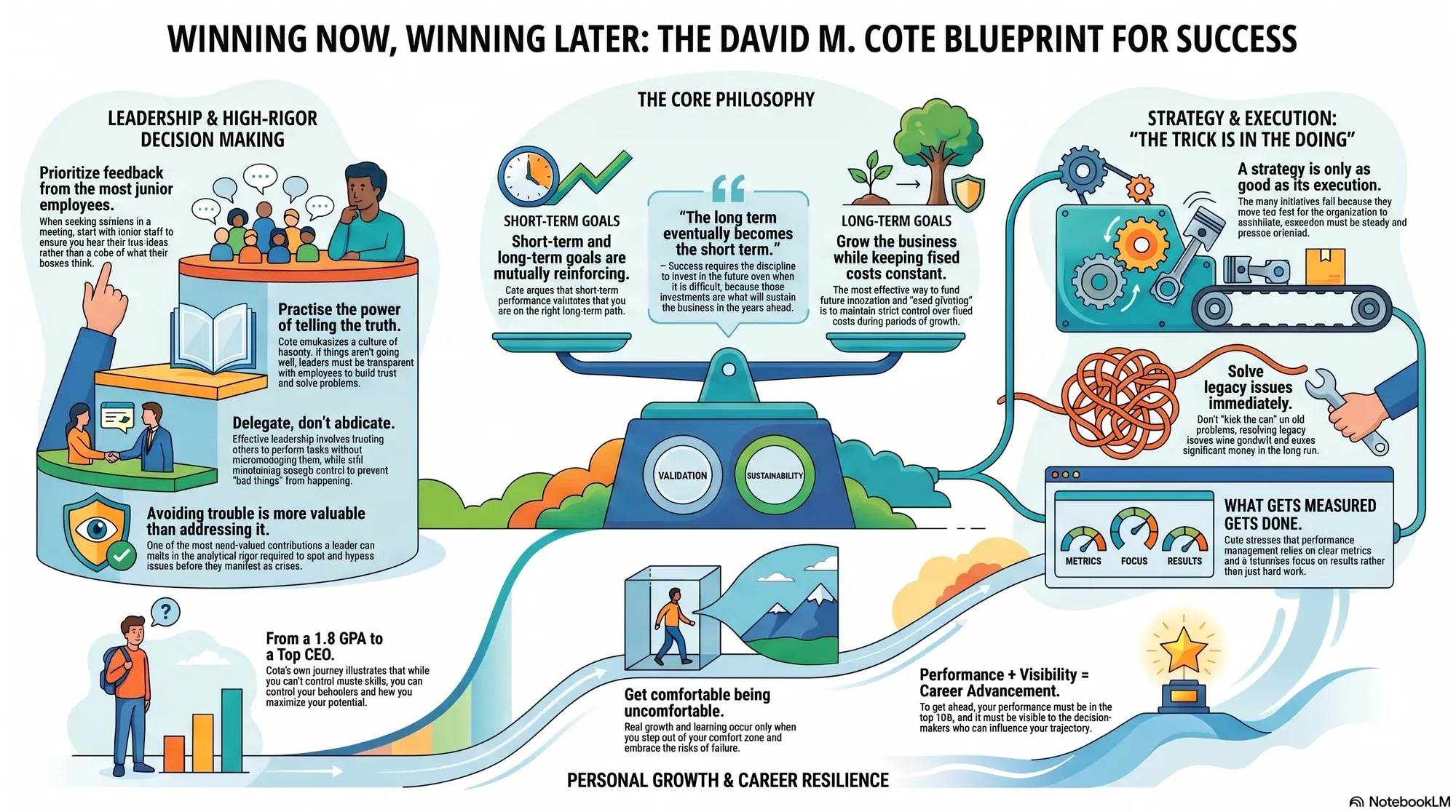
On Balancing Short-Term and Long-Term Goals
A cornerstone of Cote's philosophy is the imperative to manage for both the present and the future simultaneously. He argues that these are not mutually exclusive objectives but are, in fact, mutually reinforcing. [3]
- Achieving success requires handling competing priorities at once, whereas concentrating on a single objective is simpler. [1]
- Simultaneously pursuing immediate goals and future objectives supports rather than undermines each effort. [1]
- Long-term investment is needed because the long term eventually becomes the short term; without seed-planting, you run out of gas. [1]
- Immediate results help confirm whether broader future direction is appropriate. [1]
- Achieving strong short- and long-term performance does not require genius or a magic formula; it requires believing both can be achieved at the same time. [2]
- Balancing long-term investments with near-term performance is far more demanding than focusing on only one goal. [3]
- Future growth is best funded by growing the business while keeping fixed costs constant. [2]
- Do not cut all growth investments solely to maximize shareholder returns. [4]
- Balancing immediate requirements with future objectives is critical during difficult periods. [2]
- Enduring in the immediate period offers little benefit without also enduring over the future. [5]
On Leadership and Decision-Making
Cote emphasizes the importance of intellectual rigor, independent thinking, and creating a culture of honesty and transparency.
- It is valuable to tell employees the truth when things are not going well. [6]
- Repeatedly communicating a consistent message helps ensure people hear and absorb it. [6]
- Leadership matters, and the trick is in doing. [2]
- Intelligent leaders are numerous, but individuals who practice autonomous thinking are uncommon. [4]
- Your job is to be right at the end of the meeting. [7]
- Asking challenging questions helps foster analytical rigor and attentiveness to detail. [8]
- Ask junior team members first to hear their true views rather than repeats of their bosses' views. [8]
- A leader provides great benefit by preventing difficulties rather than reacting to problems after they happen, even if prevention receives less appreciation. [4]
- Set aside time to reflect on your business or organization and think independently. [3]
- Empower people while maintaining good controls so nothing bad happens. [5]
- Achieving outcomes must be done through appropriate means. [9]
- Advancement requires achieving results in the proper manner without damaging future outcomes. [9]
- Transitioning from individual work to managing others requires learning how to balance trust, delegation, and supervision. [10]
- Leadership is not about having all the answers or control of everything, but about bringing out the best in employees, creating paths that work for the business, and building a presence in small and big moments. [11]
On Strategy and Execution
For Cote, a brilliant strategy is worthless without flawless execution. He stresses the importance of process, performance management, and a focus on results.
- The trick is in execution: moving too quickly on too many initiatives prevents an organization from assimilating change. [1]
- Tracking performance helps ensure tasks are completed. [1]
- Addressing inherited problems directly fosters goodwill and reduces costs over time. [8]
- Enhancing operational processes is important, but the effort should not be hurried. [8]
- Create a plan aligned with long-term goals and ensure everyone understands it. [8]
- Establish organizational culture and use it to guide processes. [8]
- Operational practices will not transform unless the underlying perspective shifts. [4]
- Focus on outcomes and objectives while understanding that diligence alone does not guarantee success. [12]
- Diligence is valuable provided that effort is applied toward appropriate priorities. [12]
- Striving toward incorrect objectives will fail to produce results regardless of the effort exerted. [12]
On Personal Growth and Career
Cote's own journey from a student with a 1.8 GPA to a celebrated CEO informs his advice on self-awareness, continuous learning, and resilience. [9]
- Be self-aware: focus on behaviors, outlook, and maximizing the skills you have rather than the skills you were born with. [13]
- Move beyond your comfort zone and become comfortable doing so. [12]
- Be a learner and embrace discomfort in learning. [12]
- Successful people can have failures, sometimes embarrassingly, but learn from them and move on to the next success. [12]
- Take action without always waiting for approval or perfect knowledge, with confidence to take a chance. [12]
- Meeting basic performance standards is not enough; one must perform among the very best. [14]
- Good performance must be visible to people who can affect your career for anything to happen. [14]
- Having drive without clear guidance makes it difficult to recognize success or envision potential career paths. [7]
- One should listen to the input of close relations without feeling compelled to follow it, as one must direct their own life. [7]
On Life and Perspective
Cote also offers broader wisdom on enjoying life, maintaining perspective, and the importance of relationships.
- Enjoy life and live it on your own terms. [12]
- Keep problems in perspective, stay level-headed during crises, and prioritize family and friends. [12]
- Society would be better if each person took care of their own family. [4]
- Individuals should value personal relationships and recognize the importance of family and friends. [12]
- Individuals should avoid fixating on negative circumstances and steer clear of companions who do so. [13]
- Risks may not all work out, yet one can have no regrets. [13]
Learn more: