David Neeleman founded five commercial airlines, including JetBlue and Azul, proving that low-cost carriers don't have to provide miserable customer service. He credits his ADHD for the operational ideas that helped him scale companies and survive industry crises. This profile covers his practical mechanics for finding structural advantages in a notoriously difficult market.
Part 1: Strategy and Market Positioning
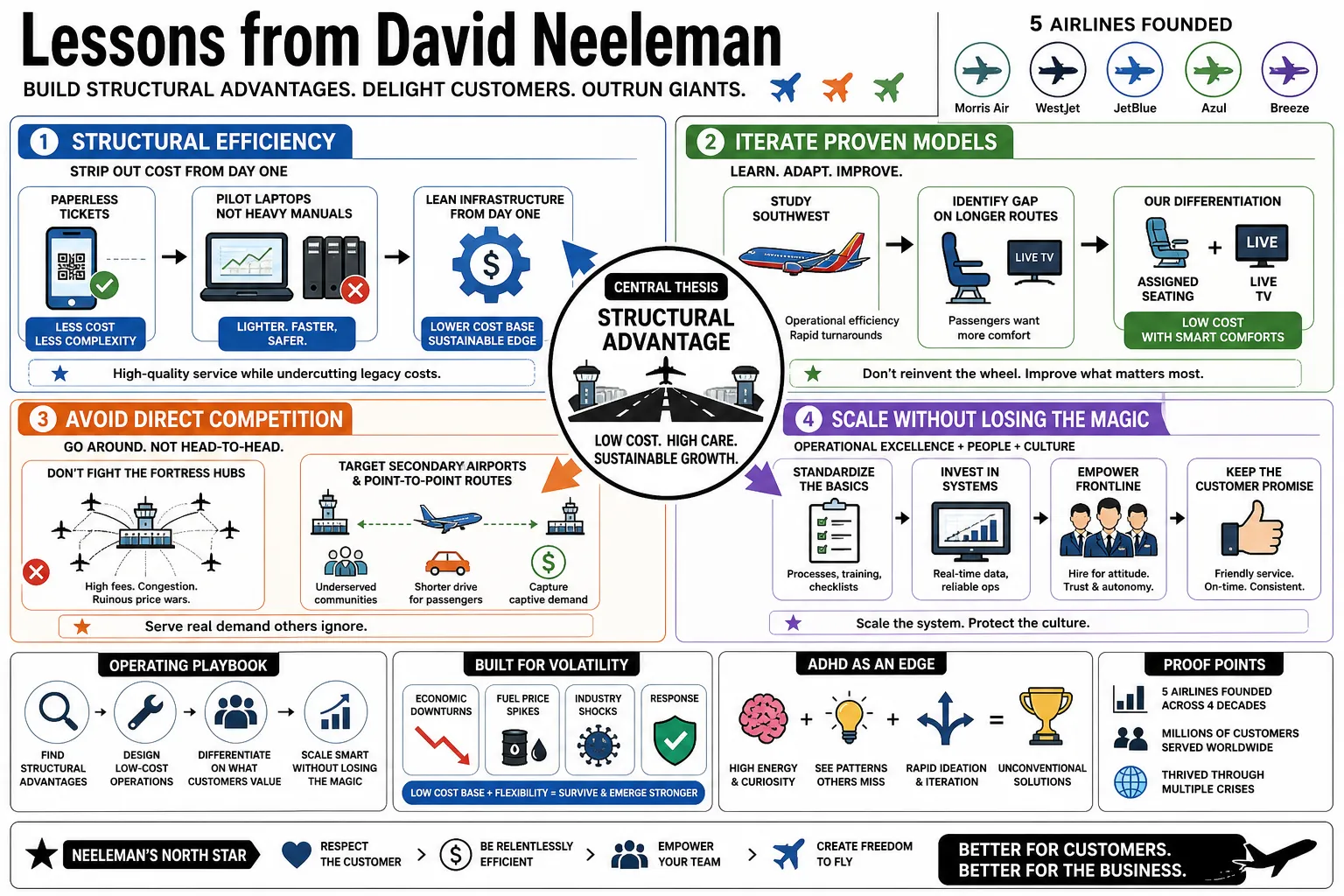
- On structural efficiency: A competitive advantage comes from building a structural foundation that strips out unnecessary costs from day one. By adopting paperless tickets and replacing heavy flight manuals with pilot laptops, an organization can maintain high-quality service while undercutting competitors who are trapped by legacy infrastructure. — Reference: SFGate Interview
- On iterating proven models: You do not have to reinvent the entire wheel to capture market share. By studying Southwest Airlines' operational efficiency and rapid turnaround times, it became clear that the low-cost model worked; the breakthrough came from realizing that passengers on longer routes still craved comforts like assigned seating and live television, which the incumbent model lacked. — Reference: SFGate Interview
- On avoiding direct competition: Rather than fighting massive legacy carriers at their fortress hubs, a smarter growth strategy involves targeting secondary airports and underserved point-to-point routes. This approach serves passengers who are otherwise forced to endure long drives or expensive layovers, capturing a captive market without triggering a ruinous price war. — Reference: Deseret News Profile
- On scaling without losing the magic: Rapid growth can easily destroy a boutique brand's reputation if the operational side fails to keep up. The key to sustainable expansion is ensuring that the infrastructure and operational teams are built for scalability, so that the customer experience remains consistent whether the company is flying ten routes or a hundred. — Reference: SFGate Interview
- On mitigating labor costs through growth: As an airline ages, its workforce naturally commands higher salaries through seniority. A practical strategy to balance these rising costs is to maintain a steady trajectory of growth, consistently bringing in newer, entry-level employees to income-average the overall payroll expenses. — Reference: SFGate Interview
Part 2: Culture and Leadership
- On maintaining intimacy at scale: You cannot personally know thousands of employees, but you can build a management structure that guarantees every worker is known by someone. By maintaining a strict ratio, such as one supervisor for every eighty people, you ensure that managers understand the families and personal challenges of their direct reports, preserving a small-company feel. — Reference: SFGate Interview
- On aligning incentives: If you want employees to care about the company's success, you have to let them share in the financial upside. Implementing broad profit-sharing programs and stock purchase plans creates an ownership mentality that translates directly into better morale and operational efficiency. — Reference: SFGate Interview
- On servant leadership: The core function of a leader is to serve their employees so that those employees are freed up to serve the customers. This means avoiding the temptation to manage from an isolated office and instead engaging directly in the day-to-day operations, up to and including cleaning the cabins. — Reference: Inc. Magazine Q&A
- On the nature of work: Every employee should understand that their role ultimately connects to the passenger. A clear organizational philosophy is that you are either directly serving a customer, or you are serving someone who is serving a customer. — Reference: SFGate Interview
Part 3: Hiring and Customer Experience
- On filtering for empathy: You cannot train someone to genuinely care about others; you have to hire for it. During interviews, asking candidates to describe a specific instance where they stepped outside their assigned duties to help someone else quickly reveals whether they possess the innate empathy required for a service-centric business. — Reference: NPR How I Built This
- On technical skill versus attitude: Highly experienced professionals can be a liability if their focus is too narrow. A pilot with thousands of hours of flight time who cannot provide a single example of contributing to the broader team or customer experience is ultimately the wrong fit for a company built on hospitality. — Reference: SFGate Interview
- On the baseline of kindness: Consistency in customer service is notoriously difficult in the airline industry. The simplest, most effective mandate a company can issue is to treat people nice, recognizing that while some customers may be difficult, maintaining a baseline of kindness is the cheapest and most reliable way to differentiate the brand. — Reference: SFGate Interview
- On exceeding expectations: Building a brand requires delivering a positive shock that passengers do not anticipate. Whether it is adding live television or premium leather seats on a low-cost ticket, the goal is to make sure every customer steps off the plane feeling they just experienced the best flight of their life. — Reference: NPR How I Built This
Part 4: Harnessing Neurodiversity
- On ADHD as a superpower: While ADHD can make traditional academic environments torturous and basic administrative tasks difficult, it can also be an entrepreneurial asset. The ability to rapidly distill complicated facts and see simple solutions to complex problems is a direct byproduct of a neurodivergent brain. — Reference: TIME for Kids Interview
- On innovating around personal deficits: Many business innovations are born out of a founder's attempt to solve their own limitations. The implementation of electronic ticketing in the airline industry was heavily driven by the personal frustration of constantly forgetting paper tickets at home due to an ADHD brain. — Reference: Deseret News Profile
- On forcing focus: When dealing with attention deficits, traditional methods of reading and writing can be exhausting. Survival in business requires developing strict personal coping mechanisms, such as forcing intense periods of concentration and relying on rigorous checklists to execute daily goals. — Reference: SFGate Interview
- On rejecting the desire to be normal: Understanding your own cognitive profile is essential. Despite the challenges it presents with mundane tasks, retaining an atypical perspective is a competitive advantage; if given the choice, it is better to keep the creativity and chaos of ADHD than to trade it for conventional normalcy. — Reference: Deseret News Profile
Part 5: Resilience and Crisis Management
- On being fired: Getting ousted from a company you helped build is devastating, but it can provide an operational education. Being let go from Southwest Airlines because a disruptive, rapid-innovation style clashed with their established culture provided the exact motivation needed to eventually launch a superior competitor. — Reference: NPR How I Built This
- On taking ultimate responsibility: When a major operational failure occurs, such as an ice storm stranding thousands of passengers on the tarmac, a practical leadership response is strict accountability. Refusing to blame the weather or lower-level employees, and instead publicly apologizing and introducing a Customer Bill of Rights, is how you begin to rebuild shattered trust. — Reference: NPR How I Built This
- On surviving industry downturns: External shocks like fuel price spikes will inevitably damage profitability, and the broader market will often refuse to absorb the cost through higher fares due to overcapacity. Survival requires proactive measures like hedging fuel costs well in advance and operating aircraft that are significantly more fuel-efficient than the industry average. — Reference: SFGate Interview
- On continuous reinvention: A true entrepreneur does not stop after a single success or a high-profile exit. The process of building Morris Air, JetBlue, and Azul demonstrates that the mechanics of building a business can be applied repeatedly across different markets, provided you remain attuned to the specific gaps in the current landscape. — Reference: Deseret News Profile