Lessons from David Ogilvy
David Ogilvy founded the advertising agency Ogilvy & Mather. This collection gathers his own words from his memos, early writings and a 1982 television interview. — David Ogilvy's 1982 Memo 'How to Write' Offers 10 Pieces of Timeless Advice (Open Culture).
Part 1: Copywriting and the Written Word
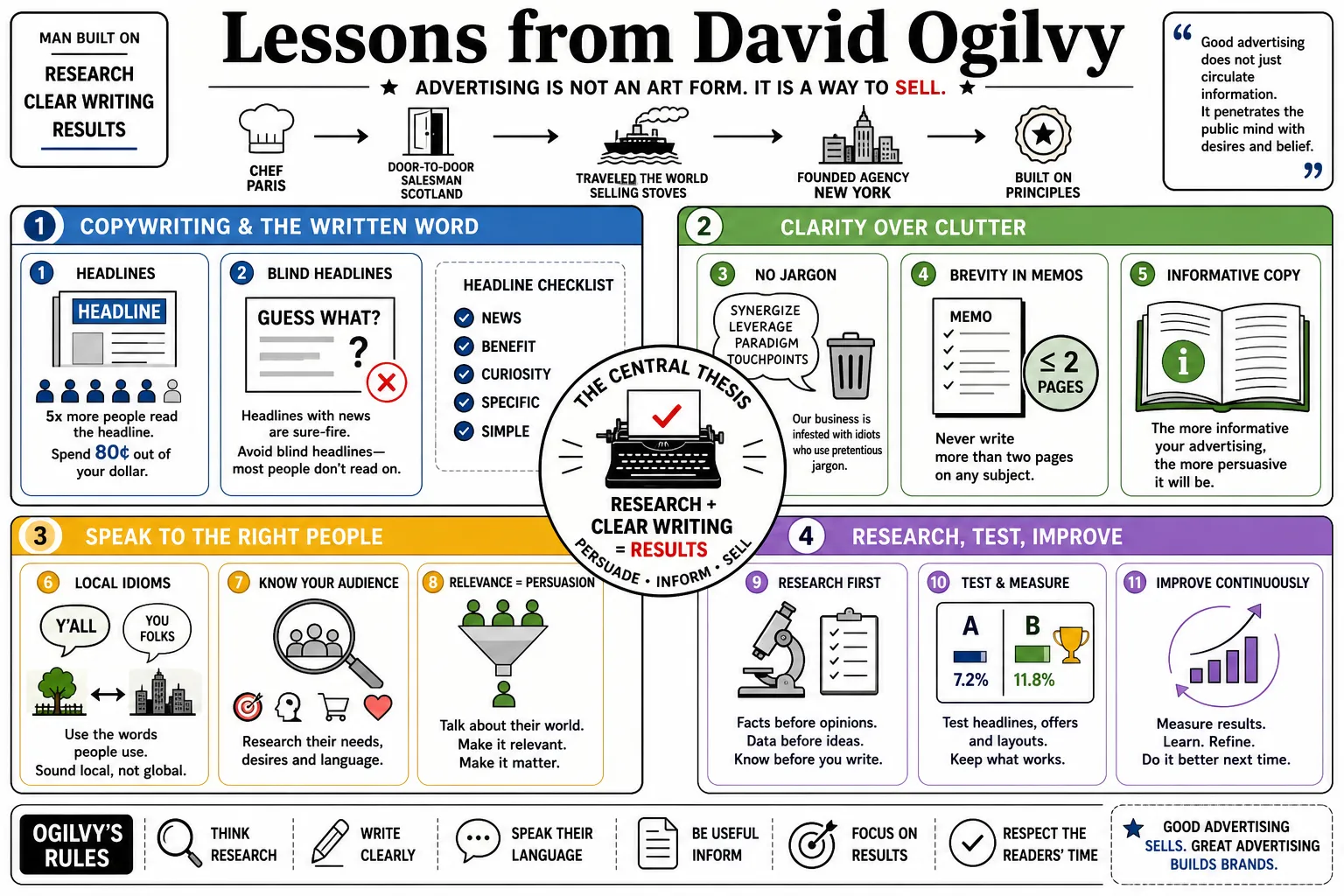
- On short words: David Ogilvy: "Use short words, short sentences and short paragraphs." — How to Write, internal memo of 7 September 1982 (David Ogilvy, in The Unpublished David Ogilvy; text via The Marginalian).
- On writing the way you talk: David Ogilvy: "Write the way you talk." — How to Write, internal memo of 7 September 1982 (David Ogilvy, in The Unpublished David Ogilvy; text via The Marginalian).
- On jargon: David Ogilvy: "Never use jargon words like reconceptualize, demassification, attitudinally, judgmentally." — How to Write, internal memo of 7 September 1982 (David Ogilvy, in The Unpublished David Ogilvy; text via The Marginalian).
- On two pages: David Ogilvy: "Never write more than two pages on any subject." — How to Write, internal memo of 7 September 1982 (David Ogilvy, in The Unpublished David Ogilvy; text via The Marginalian).
- On the whole sales story: David Ogilvy: "Every advertisement must tell the whole sales story, because the public does not read advertisements in series." — Early writings excerpted in The Unpublished David Ogilvy (1936 advertising credo and 1935 Aga Cooker sales manual; David Ogilvy).
- On human and simple copy: David Ogilvy: "The copy must be human and very simple, keyed right down to its market – a market in which self-conscious artwork and fine language serve only to make buyers wary." — Early writings excerpted in The Unpublished David Ogilvy (1936 advertising credo and 1935 Aga Cooker sales manual; David Ogilvy).
- On sleeping on a letter: David Ogilvy: "Never send a letter or a memo on the day you write it." — How to Write, internal memo of 7 September 1982 (David Ogilvy, in The Unpublished David Ogilvy; text via The Marginalian).
- On every word counting: David Ogilvy: "Every word in the copy must count." — Early writings excerpted in The Unpublished David Ogilvy (1936 advertising credo and 1935 Aga Cooker sales manual; David Ogilvy).
- On concrete figures: David Ogilvy: "Concrete figures must be substituted for atmospheric claims; clichés must give way to facts, and empty exhortations to alluring offers." — Early writings excerpted in The Unpublished David Ogilvy (1936 advertising credo and 1935 Aga Cooker sales manual; David Ogilvy).
- On apparent monotony: David Ogilvy: "Apparent monotony of treatment must be tolerated, because only the manufacturer reads all his own advertisements." — Early writings excerpted in The Unpublished David Ogilvy (1936 advertising credo and 1935 Aga Cooker sales manual; David Ogilvy).
Part 2: Research and Testing
- On researching prospects: David Ogilvy: "Find out all you can about your prospects before you call on them; their general living conditions, wealth, profession, hobbies, friends and so on." — Early writings excerpted in The Unpublished David Ogilvy (1936 advertising credo and 1935 Aga Cooker sales manual; David Ogilvy).
- On talking to more prospects: David Ogilvy: "The more prospects you talk to, the more sales you expose yourself to, the more orders you will get." — Early writings excerpted in The Unpublished David Ogilvy (1936 advertising credo and 1935 Aga Cooker sales manual; David Ogilvy).
- On campaigns made without long-term thinking: David Ogilvy: "It is my guess that 95 percent of all the campaigns now in circulation are being created without any real reference to such long-term considerations." — The Image of the Brand (talk by David Ogilvy, 1955).
- On writing as a learned skill: David Ogilvy: "Good writing is not a natural gift." — How to Write, internal memo of 7 September 1982 (David Ogilvy, in The Unpublished David Ogilvy; text via The Marginalian).
- On guesswork in advertising: David Ogilvy: "But most advertising all over today is guess work, even here in these United States." — About Advertising (The Open Mind with Richard Heffner, June 11, 1982; Ogilvy's answers, excerpted).
- On building a corpus of knowledge: David Ogilvy: "I’ve been trying for some years now to build a corpus of knowledge as to what works in advertising and what doesn’t work." — About Advertising (The Open Mind with Richard Heffner, June 11, 1982; Ogilvy's answers, excerpted).
- On using research: David Ogilvy: "And they use research as a drunk man uses a lamppost - for support, rather than illumination.) During the last six months, we have seen a remarkable demonstration of image-building for a new brand." — The Image of the Brand (talk by David Ogilvy, 1955).
- On similar products: David Ogilvy: "The greater the similarity between products, the less part reason really plays in brand selection." — The Image of the Brand (talk by David Ogilvy, 1955).
- On being guided by research: David Ogilvy: "And I’ve written as much advertisement as almost any man alive…I’ve done an incredible number of advertising campaigns…and I’ve always been guided by this research, and it’s been extremely helpful to me." — About Advertising (The Open Mind with Richard Heffner, June 11, 1982; Ogilvy's answers, excerpted).
Part 3: Management and Leadership
- On sticking to one policy: David Ogilvy: "What guts it takes, what obstinate determination, to stick to one coherent creative policy, year after year, in the face of all the pressures to 'come up with something new' every six months." — The Image of the Brand (talk by David Ogilvy, 1955).
- On thinking and writing: David Ogilvy: "People who think well, write well." — How to Write, internal memo of 7 September 1982 (David Ogilvy, in The Unpublished David Ogilvy; text via The Marginalian).
- On woolly minds: David Ogilvy: "Woolly minded people write woolly memos, woolly letters and woolly speeches." — How to Write, internal memo of 7 September 1982 (David Ogilvy, in The Unpublished David Ogilvy; text via The Marginalian).
- On improving important work: David Ogilvy: "If it is something important, get a colleague to improve it." — How to Write, internal memo of 7 September 1982 (David Ogilvy, in The Unpublished David Ogilvy; text via The Marginalian).
- On being crystal clear: David Ogilvy: "Before you send your letter or your memo, make sure it is crystal clear what you want the recipient to do." — How to Write, internal memo of 7 September 1982 (David Ogilvy, in The Unpublished David Ogilvy; text via The Marginalian).
- On the brand image: David Ogilvy: "Today, I have come to believe, with Garner and Levy, that every advertisement must be considered as a contribution to the complex symbol, which is the brand image." — The Image of the Brand (talk by David Ogilvy, 1955).
- On going to tell the guy: David Ogilvy: "If you want ACTION, don’t write." — How to Write, internal memo of 7 September 1982 (David Ogilvy, in The Unpublished David Ogilvy; text via The Marginalian).
Part 4: The Consumer's Mind
- On not insulting the consumer’s intelligence: David Ogilvy: "The consumer’s not a moron, you know…she’s your wife, and you must try not to insult her intelligence." — About Advertising (The Open Mind with Richard Heffner, June 11, 1982; Ogilvy's answers, excerpted).
- On celebrity commercials: David Ogilvy: "The celebrity commercials sell us celebrities, but not the product." — About Advertising (The Open Mind with Richard Heffner, June 11, 1982; Ogilvy's answers, excerpted).
- On being a bore: David Ogilvy: "The worst fault a salesman can commit is to be a bore." — Early writings excerpted in The Unpublished David Ogilvy (1936 advertising credo and 1935 Aga Cooker sales manual; David Ogilvy).
- On doing the opposite of competitors: David Ogilvy: "In general, study the methods of your competitors and do the exact opposite." — Early writings excerpted in The Unpublished David Ogilvy (1936 advertising credo and 1935 Aga Cooker sales manual; David Ogilvy).
- On trying to be all things to all people: David Ogilvy: "And in their greed, they almost always end up with a brand which has not any personality of a kind - a wishy-washy neuter brand." — The Image of the Brand (talk by David Ogilvy, 1955).
- On not clowning: David Ogilvy: "Facetiousness in advertising is a device dear to the amateur but anathema to the advertising agent, who knows that permanent success has rarely been built on frivolity and that people do not buy from clowns." — Early writings excerpted in The Unpublished David Ogilvy (1936 advertising credo and 1935 Aga Cooker sales manual; David Ogilvy).
- On superlatives: David Ogilvy: "Superlatives belong to the marketplace and have no place in a serious advertisement; they lead readers to discount the realism of every claim." — Early writings excerpted in The Unpublished David Ogilvy (1936 advertising credo and 1935 Aga Cooker sales manual; David Ogilvy).
- On slinging mud: David Ogilvy: "On no account sling mud – it can carry very little weight, coming from you, and it will make the prospect distrust your integrity and dislike you." — Early writings excerpted in The Unpublished David Ogilvy (1936 advertising credo and 1935 Aga Cooker sales manual; David Ogilvy).
- On wheeling and dealing: David Ogilvy: "By the same token, the manufacturers who will find themselves up the creek are the short-sighted opportunists who use too much of their advertising funds for wheeling and dealing." — The Image of the Brand (talk by David Ogilvy, 1955).
- On not discussing competitors: David Ogilvy: "Try and avoid being drawn into discussing competitive makes of cooker, as it introduces a negative and defensive atmosphere." — Early writings excerpted in The Unpublished David Ogilvy (1936 advertising credo and 1935 Aga Cooker sales manual; David Ogilvy).
Part 5: Big Ideas and Creativity
- On checking quotations: David Ogilvy: "Check your quotations." — How to Write, internal memo of 7 September 1982 (David Ogilvy, in The Unpublished David Ogilvy; text via The Marginalian).
- On the courage to be different: David Ogilvy: "I wonder when one detergent will summon up the courage to be a little different." — The Image of the Brand (talk by David Ogilvy, 1955).
- On sustaining one voice: David Ogilvy: "Imagine one man creating all the Listerine advertising for more than thirty years!" — The Image of the Brand (talk by David Ogilvy, 1955).
Part 6: Career and Ambition
- On the alibi of long-term effect: David Ogilvy: "I used to say that they used long-term effect as an alibi - to conceal their inability to make any single advertisement profitable." — The Image of the Brand (talk by David Ogilvy, 1955).
- On planning ahead: David Ogilvy: "Let us plan ten years ahead, on the assumption that our clients intend to stay in business forever." — The Image of the Brand (talk by David Ogilvy, 1955).
- On being a technician: David Ogilvy: "I’m not a philosopher, I’m an advertising technician, that’s all I am." — About Advertising (The Open Mind with Richard Heffner, June 11, 1982; Ogilvy's answers, excerpted).
- On what I first believed: David Ogilvy: "When I first arrived in this country eighteen years ago, I bought the wicked old Chicago philosophy, as practiced by Claude Hopkins." — The Image of the Brand (talk by David Ogilvy, 1955).
Part 7: Agency Culture and Habits
- On who sustains a brand image: David Ogilvy: "In the past, it has only happened when one strong man, either at the client end or at the agency end, has dominated all the advertising output over a long period." — The Image of the Brand (talk by David Ogilvy, 1955).
- On forces that change a brand: David Ogilvy: "Think of all the forces that work to change the personality and image of the brand, from season to season." — The Image of the Brand (talk by David Ogilvy, 1955).
- On writing down the image: David Ogilvy: "Once you have a definition of this kind, it will be less easy for changing ad-managers and changing agencies to muddy the image." — The Image of the Brand (talk by David Ogilvy, 1955).
- On making sure everyone understands: David Ogilvy: "See that everybody who works anywhere near your advertising understands it." — The Image of the Brand (talk by David Ogilvy, 1955).
- On changing an old image: David Ogilvy: "This is probably the most difficult task advertising can be called upon to do, because the present image of any brand has been created over a long period of years." — The Image of the Brand (talk by David Ogilvy, 1955).
- On compromise: David Ogilvy: "All too often, the brand image represents a compromise, a blurred, wishy-washy compromise." — The Image of the Brand (talk by David Ogilvy, 1955).
- On limiting the image: David Ogilvy: "I find that most manufacturers are reluctant to accept any such limitation on the image and personality of their brands." — The Image of the Brand (talk by David Ogilvy, 1955).
- On short-range philosophy: David Ogilvy: "This short-range philosophy was being peddled by agencies which had started out in mail-order advertising." — The Image of the Brand (talk by David Ogilvy, 1955).
Part 8: Honesty and Ethics in Advertising
- On handling political advertising: David Ogilvy: "I won’t take it. I won’t handle it." — About Advertising (The Open Mind with Richard Heffner, June 11, 1982; Ogilvy's answers, excerpted).
- On what is wrong with advertising: David Ogilvy: "What’s wrong with it really is the volume of it." — About Advertising (The Open Mind with Richard Heffner, June 11, 1982; Ogilvy's answers, excerpted).
- On brand image as reputation: David Ogilvy: "We hold that every advertisement must be considered as a contribution to the complex symbol, which is the brand image - as part of the long-term investment in the reputation of the brand." — The Image of the Brand (talk by David Ogilvy, 1955).
- On persuading honestly and decently: David Ogilvy: "No, I don’t think it has any immoral…anything immoral to it whatever provided you do it honestly and decently without offending anybody’s susceptibilities, including religious susceptibilities." — About Advertising (The Open Mind with Richard Heffner, June 11, 1982; Ogilvy's answers, excerpted).
- On creating demand: David Ogilvy: "No, I’m all for creating demand." — About Advertising (The Open Mind with Richard Heffner, June 11, 1982; Ogilvy's answers, excerpted).
- On golden rewards: David Ogilvy: "But what golden rewards await the advertiser who has the brains to create a favorable brand image - and the stability to stick with it over a long period." — The Image of the Brand (talk by David Ogilvy, 1955).
- On a longer view: David Ogilvy: "And so I say, let us try to take a longer and larger view of our creative responsibilities." — The Image of the Brand (talk by David Ogilvy, 1955).