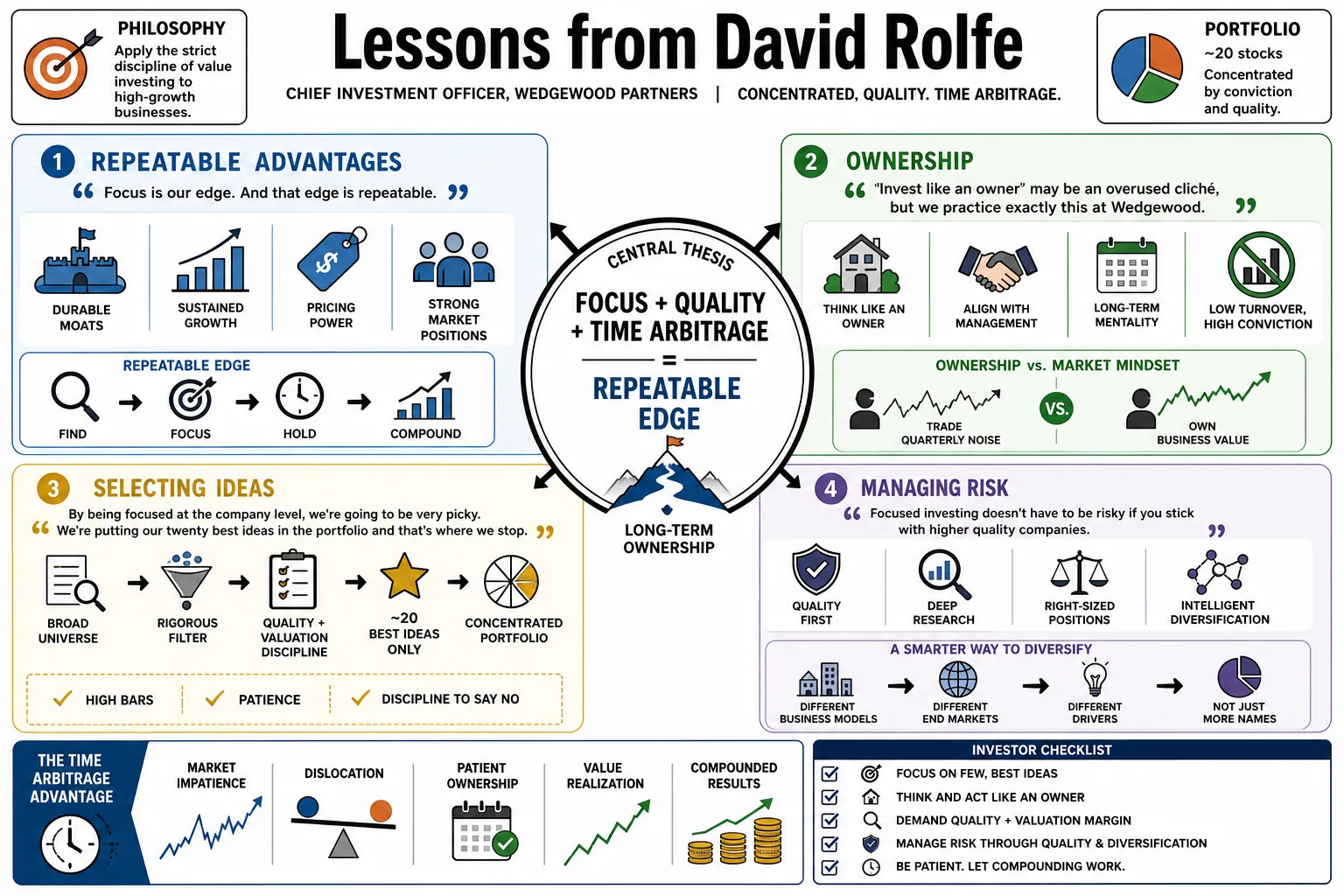
Lessons from David Rolfe
David Rolfe is the chief investment officer and portfolio manager at Wedgewood Partners. This collection gathers his own words from interviews. — Interview With David Rolfe of Wedgewood Partners (The Motley Fool).
Part 1: The Focused Growth Philosophy
- On the 1992 inception: David Rolfe: "Our strategy was incepted 30 years ago in 1992 when I joined Wedgewood as chief investment officer." — Motley Fool interview with David Rolfe (his answers).
- On investing like an owner: David Rolfe: "'Invest like an owner' may be an overused cliché, but we practice exactly this at Wedgewood." — Motley Fool interview with David Rolfe (his answers).
- On where the philosophy begins: David Rolfe: "Our investment philosophy begins where so many other non-focused managers finish." — Motley Fool interview with David Rolfe (his answers).
- On diversifying by business model: David Rolfe: "Diversifying by business model, rather than industry sectors, is key to investing in just 20 stocks." — Motley Fool interview with David Rolfe (his answers).
- On a rare investment team: David Rolfe: "Our investment team is also quite rare in the industry in that our three-decade-long track record is not a compilation of different CIOs and different senior investment professionals or different investment teams." — Motley Fool interview with David Rolfe (his answers).
- On investing with the key people: David Rolfe: "With Wedgewood, you invest with the key people who actually built the firm's leading 30 year-track record." — Motley Fool interview with David Rolfe (his answers).
- On tiny positions: David Rolfe: "It’s high conviction focus, high active share so why waste time with tiny positions that are either benchmark weight or too small to move the performance needle." — Master Series: David Rolfe (Focus Distribution; his quoted answers).
- On momentum investing: David Rolfe: "We are the antithesis of momentum investing, which is a staple in large-cap growth investing." — Motley Fool interview with David Rolfe (his answers).
- On a team of four: David Rolfe: "There’s just four of us on the Team – but if I may brag on the crew, a highly productive crew." — Master Series: David Rolfe (Focus Distribution; his quoted answers).
Part 2: Defining Best-In-Class Businesses
- On better businesses in tough times: David Rolfe: "Better businesses typically perform better in tough times and emerge even stronger after industry downturns or general recessions." — Motley Fool interview with David Rolfe (his answers).
- On growth without profits: David Rolfe: "High-quality managements understand that growth without profits is rarely a long-term plan." — Motley Fool interview with David Rolfe (his answers).
- On a craft of art and science: David Rolfe: "Investing, both security analysis and portfolio management, is a craft – a combination of art and science." — GuruFocus Interview: David Rolfe of Wedgewood Partners (his answers).
- On adapting or dying: David Rolfe: "Companies, regardless of their particular industry, must adapt, or evolve, or they will slowly die." — Motley Fool interview with David Rolfe (his answers).
- On sustainable advantages: David Rolfe: "Then assess if such competitive advantages can be sustainable for the foreseeable future." — GuruFocus Interview: David Rolfe of Wedgewood Partners (his answers).
- On risk management: David Rolfe: "The key to our investment philosophy and strategy of building a focused, 20-stock portfolio, in order to beat our benchmark and peers, is risk management." — Motley Fool interview with David Rolfe (his answers).
- On capital-light businesses: David Rolfe: "Three: Businesses that require the least amount of capital to maintain their competitive position and support future growth are inherently better businesses." — Motley Fool interview with David Rolfe (his answers).
- On the most important corporation: David Rolfe: "Taiwan Semiconductor Manufacturing is arguably the most important corporation on the planet." — Motley Fool interview with David Rolfe (his answers).
- On being independent: David Rolfe: "Lastly, being an independent firm protects our unique investment strategy from the performance ruination of institutional imperatives, which so many other active managers suffer." — Motley Fool interview with David Rolfe (his answers).
Part 3: Profitability as the North Star
- On growth and profitability: David Rolfe: "Such growth, on top of the long crawl of operating leverage is the mother's milk of ever-increasing profitability." — Motley Fool interview with David Rolfe (his answers).
- On capital allocation excellence: David Rolfe: "High-quality managements demonstrate capital allocation excellence over product, service, industry, and economic cycles." — Motley Fool interview with David Rolfe (his answers).
- On compensation tied to return on capital: David Rolfe: "We prefer compensation to be largely based on some form of return on capital metrics." — Motley Fool interview with David Rolfe (his answers).
- On the importance of capital allocation: David Rolfe: "That's why for years we have emphasized in our research the importance of capital allocation." — Motley Fool interview with David Rolfe (his answers).
- On deploying retained earnings: David Rolfe: "The deployment of this largesse into a myriad of capital allocation decisions (R&D, capex, M&A, stock buybacks) is arguably the most critical function of the C-suite." — Motley Fool interview with David Rolfe (his answers).
- On long-term ownership of growth companies: David Rolfe: "Two: We believe the best way to generate wealth is through the long-term ownership of exceptional growth companies, where intrinsic value growth compounds at least at double-digit rates over time." — Motley Fool interview with David Rolfe (his answers).
- On Zuckerberg navigating change: David Rolfe: "In our view, Zuckerberg has built and navigated the company quite well as technology and user behavior has changed." — Motley Fool interview with David Rolfe (his answers).
- On high reinvestment: David Rolfe: "Edwards' returns are still tremendous, even with this high level of reinvestment in future growth." — Motley Fool interview with David Rolfe (his answers).
- On retained earnings: David Rolfe: "Our portfolio of best-of-breed businesses generates substantial retained earnings." — Motley Fool interview with David Rolfe (his answers).
Part 4: The Discipline of Valuation
- On value never dying: David Rolfe: "“Value” never dies. Never. Price is what you pay, value is what you get." — GuruFocus Interview: David Rolfe of Wedgewood Partners (his answers).
- On expensive stocks: David Rolfe: "Buying expensive stocks is a recipe for sustained underperformance -- no matter how great the underlying business may be." — Motley Fool interview with David Rolfe (his answers).
- On misunderstood businesses: David Rolfe: "We endeavor to invest in a select few, best-of-breed businesses when the stocks of such businesses are either misunderstood by the market and/or undervalued by the market relative to their long-term growth prospects." — Motley Fool interview with David Rolfe (his answers).
- On buying a share in a business: David Rolfe: "We are buying a share in a business, but that share must be valued at a reasonable discount to what we believe that business is worth today, tomorrow, and in the future." — Motley Fool interview with David Rolfe (his answers).
- On upside versus downside: David Rolfe: "We don't employ a hard, fast ratio, but we look for a multiple of upside versus potential downside risk." — Motley Fool interview with David Rolfe (his answers).
- On zero interest rates: David Rolfe: "For example, during the zero-interest rates borne of quantitative easing, for years we avoided reducing the required return rate of our stock selections to absurdly low levels, which propelled far too many 'growth companies' to absurdly ridiculous valuations." — Motley Fool interview with David Rolfe (his answers).
- On the market serving it up: David Rolfe: "That said, over the past 30 years, we have found that if we identify a great business that we endeavor to own, the market usually will serve it up on the valuations terms we demand." — Motley Fool interview with David Rolfe (his answers).
- On waiting years: David Rolfe: "It typically takes more than a few months, sometimes years if the stock's valuation doesn't come in enough." — Motley Fool interview with David Rolfe (his answers).
Part 5: Conviction and Concentration
- On business model diversification: David Rolfe: "Business model diversification has been a staple of our risk management since our strategy's inception." — Motley Fool interview with David Rolfe (his answers).
- On position limits: David Rolfe: "While we are extremely focused relative to our benchmark and most active managers, that said, we won't let any position exceed 10% of the portfolio." — Motley Fool interview with David Rolfe (his answers).
- On not swinging large: David Rolfe: "Over the last couple of years we haven’t had much chance to swing large on new portfolio positions." — Master Series: David Rolfe (Focus Distribution; his quoted answers).
- On initiating at two or three percent: David Rolfe: "We usually initiate a position at two, two and a half, maybe three percent in the hopes that we can continue to build it." — Master Series: David Rolfe (Focus Distribution; his quoted answers).
- On weighting above the benchmark: David Rolfe: "Second, we also take care to make sure that every stock weighting in our portfolio is weighted higher than its respective constituent weighting in the benchmark." — Motley Fool interview with David Rolfe (his answers).
- On competitive advantage through cycles: David Rolfe: "Competitively advantaged businesses are best suited to ward off competitors throughout both industry cycles and economic cycles." — Motley Fool interview with David Rolfe (his answers).
- On no opinion on the market: David Rolfe: "The beauty of being invested in just 20 stocks is that you don't need to have an opinion on the valuation of the stock market." — Motley Fool interview with David Rolfe (his answers).
Part 6: Time Arbitrage and Holding Power
- On holding for many years: David Rolfe: "We endeavor to hold our investments for many years, not just for a few quarters, which is the typical fare on Wall Street." — Motley Fool interview with David Rolfe (his answers).
- On turnover tales: David Rolfe: "Such a mentality becomes very powerful when so many of our active management peers profess such, but their portfolio turnover stats tell another, much different tale." — Motley Fool interview with David Rolfe (his answers).
- On Intel and Micron: David Rolfe: "Years ago we owned Intel for a long time, from that we became familiar with Micron Technology." — Master Series: David Rolfe (Focus Distribution; his quoted answers).
- On rooting for a stock to go down: David Rolfe: "Rooting for a stock to go down runs against the grain, but some of those opportunities in hindsight have been wonderful." — Master Series: David Rolfe (Focus Distribution; his quoted answers).
- On buying when out of favor: David Rolfe: "Typically, we’re trying to buy companies when maybe the industry’s out of favor or maybe the company has hiccupeda little bit and we want to get in atdecent valuationand hope to own more." — Master Series: David Rolfe (Focus Distribution; his quoted answers).
- On a remarkable turnaround: David Rolfe: "The stock has currently staged one of the most remarkable turnarounds I have witnessed since entering the investment business way back in 1986." — Motley Fool interview with David Rolfe (his answers).
- On a three-decade record: David Rolfe: "Our firm's leaders, on both the investment and business front, have spent many years, if not decades in the investment management industry." — Motley Fool interview with David Rolfe (his answers).
- On always digging up names: David Rolfe: "Myself and our team, we’re always digging up new names." — Master Series: David Rolfe (Focus Distribution; his quoted answers).
- On starting with a whiteboard: David Rolfe: "So literally as the new CIO I had a whiteboard to start the investment management side of Wedgewood." — Master Series: David Rolfe (Focus Distribution; his quoted answers).
Part 7: Assessing Mistakes and Macro Realities
- On the worst decisions: David Rolfe: "I need to have a page in our pitch book on the top 10 worst investment decisions at Wedgewood Partners in our 29-year history." — Master Series: David Rolfe (Focus Distribution; his quoted answers).
- On Home Depot: David Rolfe: "We owned Home Depot for quite a while and we thought there were some problems, and there were for a few quarters or so, but we didn’t get back in." — Master Series: David Rolfe (Focus Distribution; his quoted answers).
- On money left on the table: David Rolfe: "When I think of the money that we left on the table in some of these stocks, it would have … well, the numbers would have been even better." — Master Series: David Rolfe (Focus Distribution; his quoted answers).
- On C-suites and buybacks: David Rolfe: "Most C-Suites are terrible at capital allocation and dreadful at value-destroying share buybacks." — Master Series: David Rolfe (Focus Distribution; his quoted answers).
- On Powell and no more QE: David Rolfe: "Of course, the catch is that we all know if Powell & Company announce on morning, ‘no more QE’ we all know what would happen to the stock market." — Master Series: David Rolfe (Focus Distribution; his quoted answers).
- On not fighting the Fed: David Rolfe: "Back in the day the phrase ‘Don’t Fight the Fed’ was stamped on rookies’ foreheads on the first day in investing boot camp." — Master Series: David Rolfe (Focus Distribution; his quoted answers).
- On wanting perfection: David Rolfe: "When I first got into this business, like many, I wanted perfection, I wanted every stock to work." — Master Series: David Rolfe (Focus Distribution; his quoted answers).
- On not having to be perfect: David Rolfe: "I didn’t have to be perfect and I stopped trying to be perfect, and if I stuck with the better businesses, even if I, in hindsight, I found out that I maybe paid a little bit too much for it, a growing, best of breed business often bails you out." — Master Series: David Rolfe (Focus Distribution; his quoted answers).
- On Powell’s whisper: David Rolfe: "We all know what happened starting in early 2021, when Fed Chairman Powell began whispering a change to a tighter monetary policy." — Motley Fool interview with David Rolfe (his answers).
Part 8: Holding Idols Accountable
- On the value mindset in tech: David Rolfe: "It wasn’t that long ago the value investing mindset was ‘there’s no such thing as value in tech, period." — Master Series: David Rolfe (Focus Distribution; his quoted answers).
- On a crutch: David Rolfe: "But for the longest time, too many in the value crowd said, ‘If Buffett can’t figure out tech, then who am I to even try?’ It became a crutch." — Master Series: David Rolfe (Focus Distribution; his quoted answers).
- On Seth Klarman: David Rolfe: "Heck, even notable ‘deep value’ guru Seth Klarman at Baupost currently has big positions in both Facebook and Google." — Master Series: David Rolfe (Focus Distribution; his quoted answers).
- On Buffett and IBM: David Rolfe: "Even Buffett took a swing at IBM building a $14 billion position in the stock by 2015." — Master Series: David Rolfe (Focus Distribution; his quoted answers).
- On a bust for Buffett: David Rolfe: "IBM was a bust for him, but not to be deterred, he immediately started building a mammoth position in Apple." — Master Series: David Rolfe (Focus Distribution; his quoted answers).
- On Apple’s cheap money: David Rolfe: "Look at how successful Apple has been, borrowing super cheap money to buy back cheap enough stock to enhance their earnings per share." — Master Series: David Rolfe (Focus Distribution; his quoted answers).
- On Munger and Alphabet: David Rolfe: "Munger has sung the praises of Alphabet (Google), one of the widest moat “advertising companies” he has ever seen." — GuruFocus Interview: David Rolfe of Wedgewood Partners (his answers).
- On Apple as hardware tech: David Rolfe: "It wasn’t that long ago obviously that Apple was mainly hardware and some software and people viewed it as classic hardware tech, maybe a bit consumer discretionary tech." — Master Series: David Rolfe (Focus Distribution; his quoted answers).