Lessons from David Rubenstein
David Rubenstein is co-founder and co-executive chairman of The Carlyle Group. This collection gathers his own words from interviews. — The Tim Ferriss Show Transcripts: David Rubenstein (#495).
Part 1: The Craft of Leadership
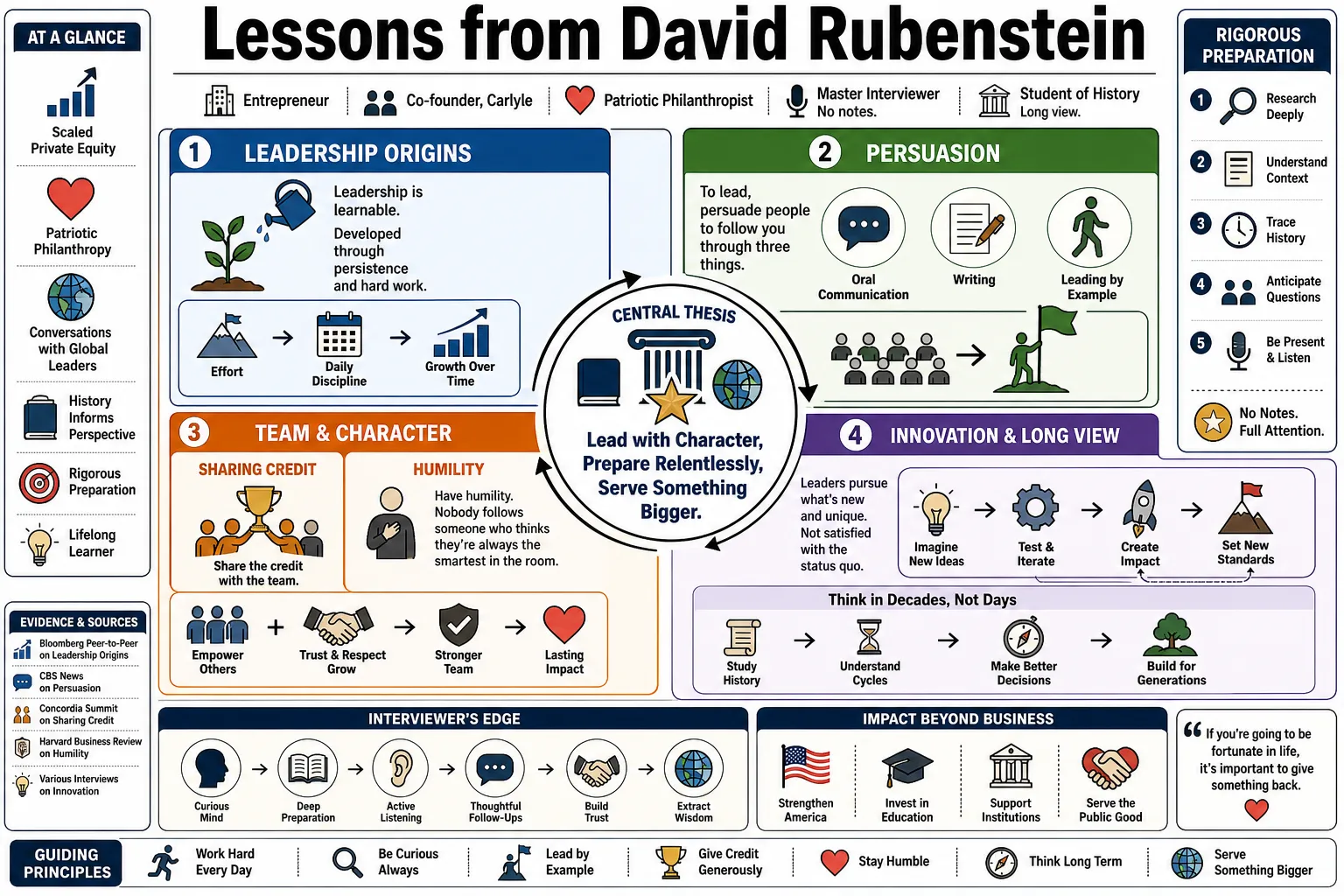
- On three ways to persuade: David Rubenstein: "There are three ways to persuade people: orally, you can write well, or you lead by example." — Transcript: David Rubenstein on "Face the Nation," September 6, 2020 (Rubenstein's turns).
- On sharing the credit: David Rubenstein: "Also, trying to share the credit, so if I did something good, I wouldn't say 'I did it' and I would try to share the credit with my partners or vice versa, they did the same with me." — Partnering Leadership podcast (his answers).
- On what leaders need: David Rubenstein: "I’d say hard work is another major factor; and the ability to lead, the ability to get people inspired, to get people to want to walk through walls for you and with you." — Freakonomics Radio Extra: David Rubenstein Full Interview (his answers).
- On what to look for in leaders: David Rubenstein: "I'm looking for their ability to focus, their ability to communicate well, their ability to have some sense of priority of what's most important to them, their ability to inspire people, their ability to rise to the occasion." — Transcript: David Rubenstein on "Face the Nation," September 6, 2020 (Rubenstein's turns).
- On persuading by speaking: David Rubenstein: "One is you persuade people by your oral communications, learning how to speak, learning how to say things that persuade people to do what you want." — Freakonomics Radio Extra: David Rubenstein Full Interview (his answers).
- On vision: David Rubenstein: "There are many different things, but the leaders are people that have a vision of where they want to go and they’re willing to take the trouble to try to get there even though it might be unpopular at times to do that." — David Rubenstein on Leading the Parade (Rubenstein's turns).
- On reputation: David Rubenstein: "It takes a lifetime to build a reputation and five minutes to destroy it." — The Tim Ferriss Show Transcripts: David Rubenstein, Co-Founder of The Carlyle Group, on Lessons Learned, Jeff Bezos, Raising Billions of Dollars, Advising Presidents, and Sprinting to the End (495) (Rubenstein's turns).
Part 2: The Master Investor's Mindset
- On assuming something bad will happen: David Rubenstein: "No, because if you're an entrepreneur, you always think something bad's gonna happen." — My First Million: David Rubenstein, We took $5M and turned it into $500B (his turns).
- On modest beginnings: David Rubenstein: "But if you come from a lower middle-class family, as maybe I did, or a blue-collar family, in hindsight it’s a great thing." — The Tim Ferriss Show Transcripts: David Rubenstein, Co-Founder of The Carlyle Group, on Lessons Learned, Jeff Bezos, Raising Billions of Dollars, Advising Presidents, and Sprinting to the End (495) (Rubenstein's turns).
- On how little people know: David Rubenstein: "I've learned how little I know, I learned how little people know generally, and that you can have a lot of influence if you write a book that people read." — Partnering Leadership podcast (his answers).
- On where private equity money goes: David Rubenstein: "Today 83 percent of all private equity dollars invested in the world every year are still invested in basically Western Europe and the United States." — Freakonomics Radio Extra: David Rubenstein Full Interview (his answers).
- On managing older companies better: David Rubenstein: "It’s different than venture capital where you’re creating something brand new, but you’re taking an older company and managing it better than people did before." — The Tim Ferriss Show Transcripts: David Rubenstein, Co-Founder of The Carlyle Group, on Lessons Learned, Jeff Bezos, Raising Billions of Dollars, Advising Presidents, and Sprinting to the End (495) (Rubenstein's turns).
- On the startups that don’t make it: David Rubenstein: "Now you read about the Silicon Valley successes, but you hear about the Ubers and the companies like that, but there’s so many that don’t make it." — Freakonomics Radio Extra: David Rubenstein Full Interview (his answers).
Part 3: The Three Thirds of Life & Success
- On when entrepreneurs start: David Rubenstein: "I was thirty-seven because I read that an entrepreneur will start his or her first company between the ages of twenty-eight and thirty-seven." — My First Million: David Rubenstein, We took $5M and turned it into $500B (his turns).
- On putting in the hours: David Rubenstein: "And ultimately, in the end, if you’re willing to do all that and put the hours in, you can get somewhere in life." — The Tim Ferriss Show Transcripts: David Rubenstein, Co-Founder of The Carlyle Group, on Lessons Learned, Jeff Bezos, Raising Billions of Dollars, Advising Presidents, and Sprinting to the End (495) (Rubenstein's turns).
- On the top of the inbox: David Rubenstein: "So when the president came in the morning, he would read my memos first, because they were on top of the inbox." — Freakonomics Radio Extra: David Rubenstein Full Interview (his answers).
- On a cloistered world and reading: David Rubenstein: "I was in a relatively cloistered blue collar Jewish world, and I was starting to read books about things outside that world and that just gave me more knowledge and appetite to learn more about the world." — Partnering Leadership podcast (his answers).
- On interviews instead of golf: David Rubenstein: "Golf is too humiliating, frustrating, time-consuming, so instead of playing golf, I do interviews." — Partnering Leadership podcast (his answers).
- On honoring your parents: David Rubenstein: "And so for everybody listening, try to think about how can you honor your parents for what they've done for you and try to not to wait till they're gone." — Partnering Leadership podcast (his answers).
- On words per day: David Rubenstein: "Some people say they work in the daytime and when they get 300 words they're done for the day." — Washington Post Live CEO Series transcript (his answers).
- On starting by thirty-seven: David Rubenstein: "If you haven't done it by thirty-seven, I read, you probably will never start a company." — My First Million: David Rubenstein, We took $5M and turned it into $500B (his turns).
- On techniques becoming well-known: David Rubenstein: "Today, they’re well-known, in fact, public companies do the same things that private equity people do in many respects, because the techniques are pretty well-known." — The Tim Ferriss Show Transcripts: David Rubenstein, Co-Founder of The Carlyle Group, on Lessons Learned, Jeff Bezos, Raising Billions of Dollars, Advising Presidents, and Sprinting to the End (495) (Rubenstein's turns).
Part 4: The Art of the Conversation (Interviewing)
- On not using notes: David Rubenstein: "So if you watch speeches I give or interviews that I do, I don’t use notes." — The Tim Ferriss Show Transcripts: David Rubenstein, Co-Founder of The Carlyle Group, on Lessons Learned, Jeff Bezos, Raising Billions of Dollars, Advising Presidents, and Sprinting to the End (495) (Rubenstein's turns).
- On interviewing people you know: David Rubenstein: "Most of the people I interviewed are people I do know, and that maybe facilitates the friendliness of the conversation." — Partnering Leadership podcast (his answers).
- On humor and humility: David Rubenstein: "And if they don't play along, I can realize that maybe they don't have a sense of humor, maybe they have no humility." — Transcript: David Rubenstein on "Face the Nation," September 6, 2020 (Rubenstein's turns).
- On memorizing questions: David Rubenstein: "And then when I, I do the interviews, I don’t use the questions in front of me because I like to memorize them and have a conversation." — David Rubenstein of The Carlyle Group - Business Podcast for Startups (Rubenstein's turns).
- On interviewing about books: David Rubenstein: "Secondly, I actually generally interview people about books I am interested in reading." — My First Million: David Rubenstein, We took $5M and turned it into $500B (his turns).
- On laughter in questions: David Rubenstein: "I often ask questions that are designed to elicit a little bit of laughter." — Transcript: David Rubenstein on "Face the Nation," September 6, 2020 (Rubenstein's turns).
- On interviewing for information: David Rubenstein: "Well, this format of interviewing people for information, and to some extent, entertainment, is a relatively new phenomenon in the grand scheme of intellectual development and civilization." — The Tim Ferriss Show Transcripts: David Rubenstein, Co-Founder of The Carlyle Group, on Lessons Learned, Jeff Bezos, Raising Billions of Dollars, Advising Presidents, and Sprinting to the End (495) (Rubenstein's turns).
- On good interviewers listening: David Rubenstein: "I've watched interviewers over the years and good interviewers are people that listen to what people say and then take the conversation where those people have begun to take it." — Partnering Leadership podcast (his answers).
- On keeping your brain active: David Rubenstein: "You gotta go back and forth, listen to what the person's saying, think of the next question while you're listening to a person, and you gotta keep your brain active." — My First Million: David Rubenstein, We took $5M and turned it into $500B (his turns).
Part 5: The American Experiment & History
- On an informed citizenry: David Rubenstein: "And the reason is this: if you want to have a good democracy, you have to have an informed citizenry." — The Tim Ferriss Show Transcripts: David Rubenstein, Co-Founder of The Carlyle Group, on Lessons Learned, Jeff Bezos, Raising Billions of Dollars, Advising Presidents, and Sprinting to the End (495) (Rubenstein's turns).
- On American history in college: David Rubenstein: "You can graduate from almost any college in the United States without having to take an American history course." — The Tim Ferriss Show Transcripts: David Rubenstein, Co-Founder of The Carlyle Group, on Lessons Learned, Jeff Bezos, Raising Billions of Dollars, Advising Presidents, and Sprinting to the End (495) (Rubenstein's turns).
- On Americans and history: David Rubenstein: "Well, I've been interested in history for some time and my concern is that Americans don't know that much about history relative to what they used to know." — Washington Post Live CEO Series transcript (his answers).
- On history majors: David Rubenstein: "You can be a history major at 80 percent of the colleges without taking an American history course." — Washington Post Live CEO Series transcript (his answers).
- On working your way up: David Rubenstein: "Now, many people at the bottom of the economic strata don't believe that they can work their way up." — Washington Post Live CEO Series transcript (his answers).
- On avoiding the mistakes of the past: David Rubenstein: "Well, the theory of history is you should learn it because you can avoid the mistakes of the past." — Washington Post Live CEO Series transcript (his answers).
- On everybody majoring in history: David Rubenstein: "Now, if everybody majored in history, it's not going to solve all of the world's problems, but I do think a better knowledge of history would be good." — Washington Post Live CEO Series transcript (his answers).
- On talking across the aisle: David Rubenstein: "And then, they have a chance to both learn about history but also to talk with people from the opposite party." — Washington Post Live CEO Series transcript (his answers).
- On members of Congress and history: David Rubenstein: "Members of Congress love coming to these events because they can see people from the opposite party, which they rarely get to do--or talk to them--but they also can learn about American history." — Washington Post Live CEO Series transcript (his answers).
Part 6: Patriotic Philanthropy & Giving Back
- On patriotic philanthropy: David Rubenstein: "And I also want to do as much as I can to give back to the country in many ways, that’s what patriotic philanthropy is about to me." — The Tim Ferriss Show Transcripts: David Rubenstein, Co-Founder of The Carlyle Group, on Lessons Learned, Jeff Bezos, Raising Billions of Dollars, Advising Presidents, and Sprinting to the End (495) (Rubenstein's turns).
- On giving away what is left: David Rubenstein: "I was an early original signer of the Giving Pledge, and I've given away a lot of money, and I intend to give away the bulk of what I have left." — My First Million: David Rubenstein, We took $5M and turned it into $500B (his turns).
- On making his mother proud: David Rubenstein: "She told me that when I started giving away money to kind of give back to the country, what I call patriotic philanthropy, she was extremely proud." — The Tim Ferriss Show Transcripts: David Rubenstein, Co-Founder of The Carlyle Group, on Lessons Learned, Jeff Bezos, Raising Billions of Dollars, Advising Presidents, and Sprinting to the End (495) (Rubenstein's turns).
- On preserving documents and monuments: David Rubenstein: "Anyway, I’ve enjoyed fixing the monuments or preserving documents like the Magna Carta or I’ve a historic book collection that is probably one of the better American book collections of historic American books." — The Tim Ferriss Show Transcripts: David Rubenstein, Co-Founder of The Carlyle Group, on Lessons Learned, Jeff Bezos, Raising Billions of Dollars, Advising Presidents, and Sprinting to the End (495) (Rubenstein's turns).
- On restoring buildings: David Rubenstein: "If they're restored, people might go visit them and learn more about American history." — My First Million: David Rubenstein, We took $5M and turned it into $500B (his turns).
- On original documents: David Rubenstein: "And if you have original documents, people may be more likely to look at them, learn more about history." — My First Million: David Rubenstein, We took $5M and turned it into $500B (his turns).
- On attention versus giving: David Rubenstein: "It's probably 5 or 10% of my philanthropic giving, but it's 99% of the attention that it gets." — Partnering Leadership podcast (his answers).
- On children as legacy: David Rubenstein: "So I’m trying to just get things done and giving away my money in an intelligent way, my children are my ultimate legacy, that’s an important thing to me." — The Tim Ferriss Show Transcripts: David Rubenstein, Co-Founder of The Carlyle Group, on Lessons Learned, Jeff Bezos, Raising Billions of Dollars, Advising Presidents, and Sprinting to the End (495) (Rubenstein's turns).
- On philanthropy with your time: David Rubenstein: "So you can be philanthropic with your time, your energy, your ideas as well as your money, but we've bastardized the word philanthropy into meaning only money, but I think the most valuable thing anybody has is their time." — Partnering Leadership podcast (his answers).
Part 7: Human Character & Resilience
- On taking criticism personally: David Rubenstein: "Well, if you take this personally and you go home and call your mother and say, look, people think I'm terrible, you're not probably going to be a great leader." — Transcript: David Rubenstein on "Face the Nation," September 6, 2020 (Rubenstein's turns).
- On starting over: David Rubenstein: "But again, the election was lost, so I had to start my life all over again." — David Rubenstein on Leading the Parade (Rubenstein's turns).
- On getting cut from the team: David Rubenstein: "I was the only person in Duke’s history who got cut from an intramural basketball team when only four other people were on the team." — Freakonomics Radio Extra: David Rubenstein Full Interview (his answers).
- On superstars: David Rubenstein: "So the people that are running the world today in the second and third third of their lives are not people that were observed at the age of 15 or 20 to be the superstars." — Transcript: David Rubenstein on "Face the Nation," September 6, 2020 (Rubenstein's turns).
- On working hard on their own: David Rubenstein: "And then I keep telling them all along, they got to work hard and they got to get there on their own." — Partnering Leadership podcast (his answers).
- On taking responsibility: David Rubenstein: "Well, as a general rule of thumb, I think it's a good idea for anybody to take responsibility, because if you say in any case, well, it wasn't my fault or I didn't do anything to deserved that bad thing happening, you know, again people hear you and they say, well, you know, who was responsible?" — Transcript: David Rubenstein on "Face the Nation," September 6, 2020 (Rubenstein's turns).
- On being told how great you are: David Rubenstein: "Well, when you work in the White House, people come to you and tell you how great you are." — My First Million: David Rubenstein, We took $5M and turned it into $500B (his turns).
- On leaving legacies: David Rubenstein: "I'm also trying to write some books and leave other things that'll be legacies maybe for my grandchildren." — Partnering Leadership podcast (his answers).
- On not being intimidated: David Rubenstein: "I'm not intimidated by the people I'm interviewing, maybe because I have some financial success myself and I have some confidence in my verbal skills so I don't really feel like I'm going to be tongue tied." — Partnering Leadership podcast (his answers).
Part 8: Rules for High Achievement
- On reading a hundred books a year: David Rubenstein: "So to read a hundred books a year that are meaningful books, you’ve got to have a system." — The Tim Ferriss Show Transcripts: David Rubenstein, Co-Founder of The Carlyle Group, on Lessons Learned, Jeff Bezos, Raising Billions of Dollars, Advising Presidents, and Sprinting to the End (495) (Rubenstein's turns).
- On reading a book: David Rubenstein: "But I would say that, for those who are listening or watching, if you want to live a long life and make a lot of money, read this book." — Washington Post Live CEO Series transcript (his answers).
- On loving to write: David Rubenstein: "In terms of writing, I love writing, though I haven’t published any books or anything." — Freakonomics Radio Extra: David Rubenstein Full Interview (his answers).
- On notes and stumbling: David Rubenstein: "I find that people who actually have notes in front of them actually stumble more than people that don’t have notes." — The Tim Ferriss Show Transcripts: David Rubenstein, Co-Founder of The Carlyle Group, on Lessons Learned, Jeff Bezos, Raising Billions of Dollars, Advising Presidents, and Sprinting to the End (495) (Rubenstein's turns).
- On not reading physics textbooks: David Rubenstein: "If I had to read physics textbooks or neurosurgery textbooks, I wouldn’t be reading two of them a week." — Freakonomics Radio Extra: David Rubenstein Full Interview (his answers).
- On Bezos doing the books himself: David Rubenstein: "He had one office, and he was doing the books himself, and he would take them to the post office every night." — My First Million: David Rubenstein, We took $5M and turned it into $500B (his turns).
- On books focusing the mind: David Rubenstein: "And I think reading books is better than reading newspaper articles or magazine articles, which I read an enormous amount as well, but books focus the mind." — The Tim Ferriss Show Transcripts: David Rubenstein, Co-Founder of The Carlyle Group, on Lessons Learned, Jeff Bezos, Raising Billions of Dollars, Advising Presidents, and Sprinting to the End (495) (Rubenstein's turns).
- On reading what you know: David Rubenstein: "If I had to read a science textbook, I'd probably get through one a year, but I'm reading books that are basically things I know something about: biographies, business, politics, history." — Partnering Leadership podcast (his answers).
- On forcing yourself to read: David Rubenstein: "But I use these devices as a way of forcing me to read books, maybe, just because if I know I have to read the book to interview the author, I will do it." — Freakonomics Radio Extra: David Rubenstein Full Interview (his answers).