David E. Shaw is a computer scientist who founded D. E. Shaw & Co. and D. E. Shaw Research. This collection gathers his own words from an interview. — A Conversation with David E. Shaw (Communications of the ACM).
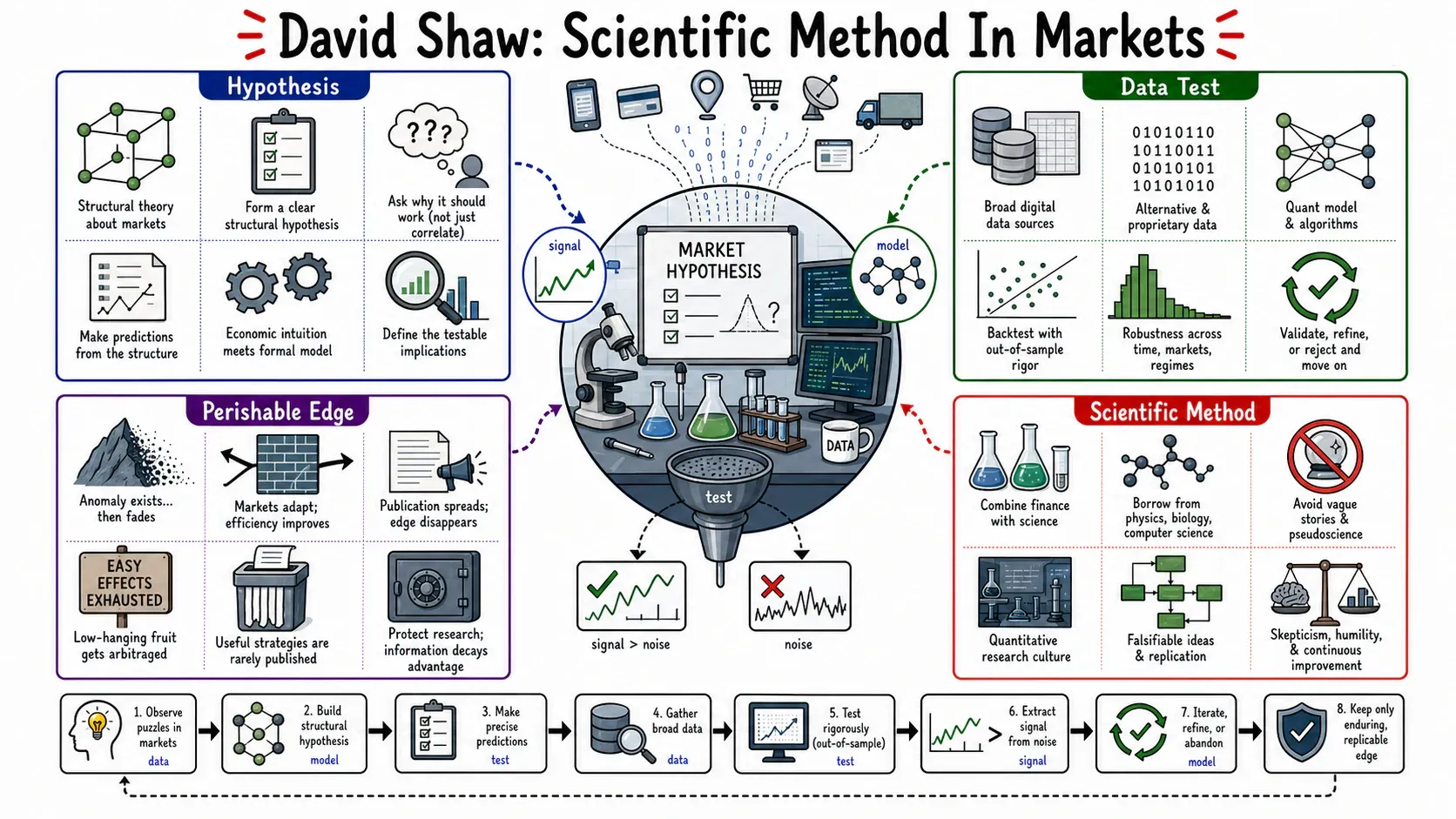
On the Intersection of Science, Technology, and Innovation
- On the computational microscope: David Shaw: "Part of the reason I like the metaphor of a computational microscope is that it emphasizes one of the key things that Anton isn’t." — Communications of the ACM: A Conversation with David E. Shaw (his answers).
- On low-hanging fruit: David Shaw: "I think there’s still a lot of juicy, low-hanging fruit in this area, and maybe even some important unifying principles that haven’t yet been discovered." — Communications of the ACM: A Conversation with David E. Shaw (his answers).
- On planning for discoveries: David Shaw: "It’s hard to plan for a discovery like that; you just have to be in the right territory with the tools and skills you think you might need in order to recognize it when you see it." — Communications of the ACM: A Conversation with David E. Shaw (his answers).
- On simulating biomolecules: David Shaw: "In biological applications like the ones that interest us, the idea is to simulate the motions of large biomolecules, such as proteins or DNA, at an atomic level of detail over a simulated time period during which biologically interesting things happen in real life." — Communications of the ACM: A Conversation with David E. Shaw (his answers).
- On Anton as a specialized tool: David Shaw: "Like the optical microscope, Anton is really no more than a specialized tool for looking at a particular class of objects that couldn’t be seen before." — Communications of the ACM: A Conversation with David E. Shaw (his answers).
- On what folding taught us: David Shaw: "We’ve already started to learn some interesting things related to folding that we wouldn’t have known if it hadn’t been for Anton, and we’re hoping to learn more over time." — Communications of the ACM: A Conversation with David E. Shaw (his answers).
- On computational thinking: David Shaw: "What’s sometimes referred to as “computational thinking” is leaving its mark on one field after another—and the night is still young." — Communications of the ACM: A Conversation with David E. Shaw (his answers).
- On co-design: David Shaw: "In our case, I don’t think we could have reached our performance goals either by implementing standard computational chemistry algorithms on new hardware or by using standard high-performance architectures to run new algorithms." — Communications of the ACM: A Conversation with David E. Shaw (his answers).
- On a long-term hope: David Shaw: "Although my long-term hope is that at least some of the things we discover might someday play a role in curing people, that’s not something I expect to happen overnight." — Communications of the ACM: A Conversation with David E. Shaw (his answers).
- On parallel architectures: David Shaw: "Since my graduate work at Stanford and my research at Columbia were focused in part on parallel architectures and algorithms, one of the things I spent some time thinking about was whether there might be some way to apply those sorts of technologies to one of the areas Rich had been teaching me about." — Communications of the ACM: A Conversation with David E. Shaw (his answers).
- On finding an application: David Shaw: "After a fair amount of reading and talking to people, I found one application—the simulation of molecular dynamics—where it seemed like a massive increase in speed could, in principle, have a major impact on our understanding of biological processes at the molecular level." — Communications of the ACM: A Conversation with David E. Shaw (his answers).
On Building a Successful Organization and Life Philosophy
- On bad ideas: David Shaw: "I tend to generate a plentiful supply of ideas, the vast majority of which turn out to be bad ones." — Communications of the ACM: A Conversation with David E. Shaw (his answers).
- On fundamental discoveries: David Shaw: "I’ve always thought it would be great to live during a period when a lot of fundamental discoveries were being made, and a single scientist could stay on top of most of the important advances being made across the full breadth of a given discipline." — Communications of the ACM: A Conversation with David E. Shaw (his answers).
- On loving hands-on research: David Shaw: "At that point, I started working seriously on the problem, and I found that I loved being involved again in hands-on research." — Communications of the ACM: A Conversation with David E. Shaw (his answers).
- On missing full-time research: David Shaw: "As time went by, I realized that I was enjoying that more and more, and that I missed doing research on a full-time basis." — Communications of the ACM: A Conversation with David E. Shaw (his answers).
- On bringing a bit of computer science: David Shaw: "It didn’t require any brilliant insight; it was just a matter of bringing a bit of computer science into a research area where there hadn’t yet been all that much of it." — Communications of the ACM: A Conversation with David E. Shaw (his answers).
- On deep principles in silico: David Shaw: "It may be that there are some deep principles out there that are waiting to be discovered in silico—ones that can tell us something fundamental about some of the mechanisms nature has evolved to do what it wants to get done." — Communications of the ACM: A Conversation with David E. Shaw (his answers).
- On a plentiful supply of bad ideas: David Shaw: "I’m not sure I deserve those very kind words, but for what it’s worth, I tend to generate a plentiful supply of ideas, the vast majority of which turn out to be bad ones." — Communications of the ACM: A Conversation with David E. Shaw (his answers).
- On delusion as motivation: David Shaw: "I also have a remarkable capacity to delude myself into thinking that each idea has a higher probability of working than it really does, which provides me with the motivation I need to keep working on it." — Communications of the ACM: A Conversation with David E. Shaw (his answers).
- On unraveling biological mysteries: David Shaw: "But I also enjoy being involved in the unraveling of biological mysteries, some of which have puzzled researchers for 40 or 50 years." — Communications of the ACM: A Conversation with David E. Shaw (his answers).
- On not resisting the impulse: David Shaw: "The time seemed ripe from a technological viewpoint, and I just couldn’t resist the impulse to see if it could be done." — Communications of the ACM: A Conversation with David E. Shaw (his answers).
- On solving problems at night: David Shaw: "I didn’t like that, so I started solving little theoretical problems at night just for fun—things I could tackle on my own, since I no longer had a research group like I did when I was on the faculty at Columbia." — Communications of the ACM: A Conversation with David E. Shaw (his answers).
- On problems the approach cannot solve: David Shaw: "On the other hand, there are a lot of scientific problems for which our approach would clearly not be effective." — Communications of the ACM: A Conversation with David E. Shaw (his answers).
- On being a tourist: David Shaw: "I love learning about new fields, but in some ways I feel like a tourist whose citizenship is computer science." — Communications of the ACM: A Conversation with David E. Shaw (his answers).
- On general management: David Shaw: "But as the years went by and the company grew, I had to spend more time on general management, and I could feel myself getting stupider with each passing year." — Communications of the ACM: A Conversation with David E. Shaw (his answers).
- On putting things under the microscope: David Shaw: "There’s a wide range of specific biological phenomena we’d like to know more about, but at this point, there’s a lot we can learn by simply putting things under the microscope and seeing what’s there." — Communications of the ACM: A Conversation with David E. Shaw (his answers).
- On a Toy Story around the corner: David Shaw: "It’s hard to tell in advance whether there’s a Toy Story around the corner, since the biggest breakthroughs in biology often turn out to be ones that would have been difficult to even characterize before they happened." — Communications of the ACM: A Conversation with David E. Shaw (his answers).
- On other demanding applications: David Shaw: "I’d be surprised if this turned out to be the only computationally demanding application that could be addressed using the general approach we’ve taken to the design of a special-purpose machine." — Communications of the ACM: A Conversation with David E. Shaw (his answers).
- On focus on basic research: David Shaw: "Important work is being done at all stages in the drug development pipeline, but our own focus is on basic scientific research with a relatively long time horizon, but a large potential payoff." — Communications of the ACM: A Conversation with David E. Shaw (his answers).
Learn more: