Lessons from David Silver
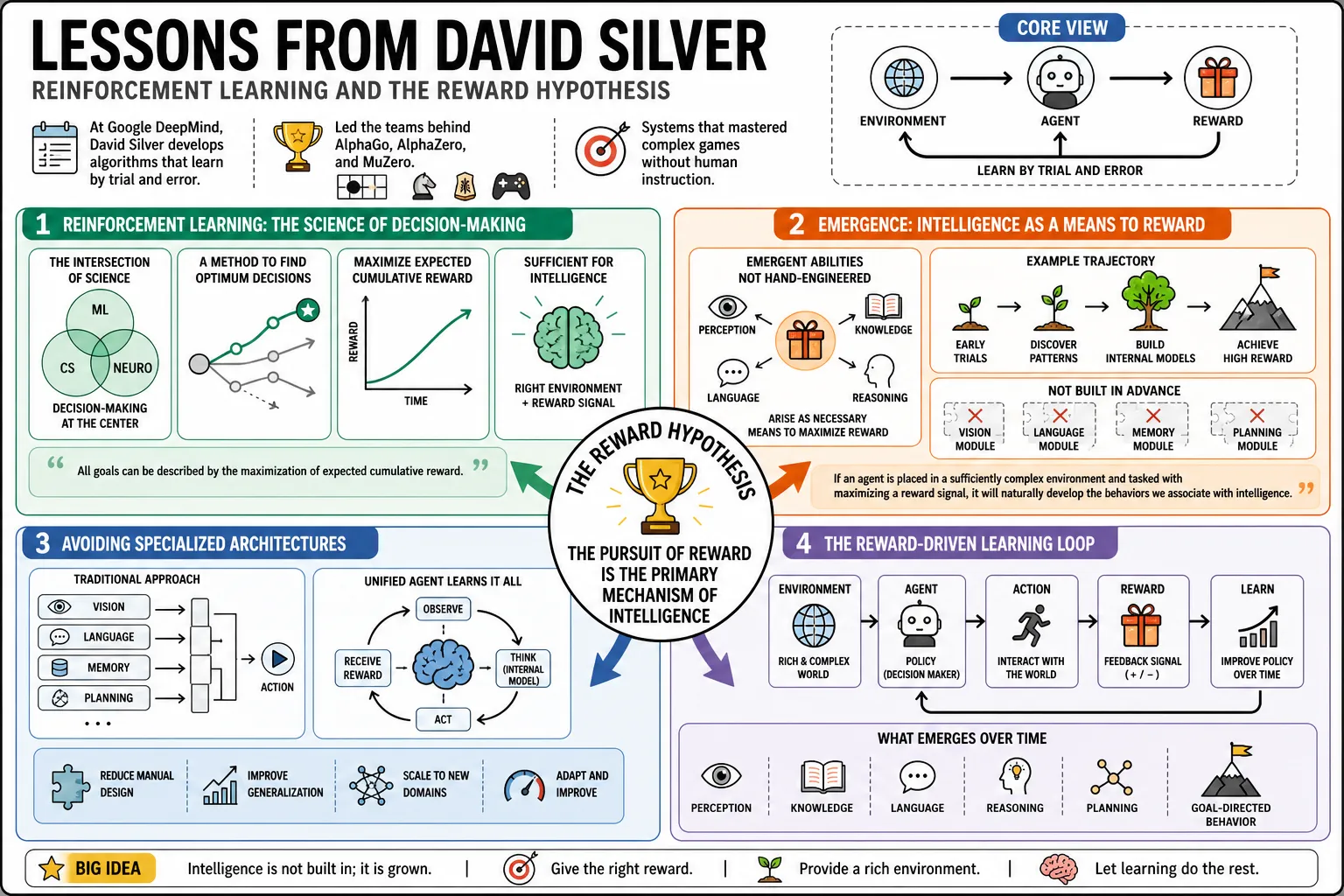
At Google DeepMind, David Silver develops algorithms that learn by trial and error. He led the teams behind AlphaGo, AlphaZero, and MuZero, systems that mastered complex games without human instruction. This profile gathers his thoughts on reinforcement learning and his argument that the pursuit of reward is the primary mechanism of intelligence.
Part 1: The Reward Hypothesis
- On reinforcement learning: "It sits at the intersection of many fields of science. It's the science of decision-making, a method to understand optimum decisions." — Source: [UCL Course on Reinforcement Learning]
- On the core premise: "All goals can be described by the maximization of expected cumulative reward." — Source: [UCL Course on Reinforcement Learning]
- On the sufficiency of reward: "If an agent is placed in a sufficiently complex environment and tasked with maximizing a reward signal, it will naturally develop the behaviors we associate with intelligence." — Source: [Artificial Intelligence Journal]
- On emergent abilities: "Traits like perception, knowledge, and language are not modules that need to be hand-engineered; they emerge as necessary means to maximize reward." — Source: [Artificial Intelligence Journal]
- On avoiding specialized architectures: "The traditional approach builds separate modules for vision, language, or reasoning, whereas reinforcement learning posits these are emergent properties of a single objective." — Source: [Lex Fridman Podcast #86]
- On algorithmic simplicity: "Reinforcement learning simplifies the intelligence problem by reducing it to a single optimization loop: trial, error, and reward." — Source: [Lex Fridman Podcast #86]
- On the agent-environment interface: "Learning is completely defined by the agent's interactions, taking actions and receiving observations and rewards." — Source: [UCL Course on Reinforcement Learning]
- On Richard Sutton's influence: "Sutton established the foundation of viewing all goal-oriented behavior as reward maximization." — Source: [Artificial Intelligence Journal]
- On the definition of state: "The state is whatever information is necessary to determine what happens next, independent of the past." — Source: [UCL Course on Reinforcement Learning]
- On long-term focus: "The objective is not immediate gratification, but the sum of all future rewards, requiring the agent to plan and sacrifice short-term gains." — Source: [UCL Course on Reinforcement Learning]
Part 2: AlphaGo and Intuition
- On human intuition: "Go was considered a game of intuition and beauty, thought to be exclusive to humans, but neural networks proved capable of representing this intuition computationally." — Source: [AlphaGo Documentary]
- On machine creativity: "Unconventional moves like Move 37 in Game 2 against Lee Sedol were not luck, but the result of the AI finding paths humans had not previously conceived." — Source: [AlphaGo Documentary]
- On value networks: "AlphaGo succeeded by combining traditional tree search with deep neural networks that evaluated the board's state without playing it out to the end." — Source: [Nature]
- On policy networks: "The system used one network to narrow down the search space to high-probability moves, mimicking human instinct." — Source: [Nature]
- On Move 78: "Lee Sedol's divine move exposed an out-of-distribution input that AlphaGo had not processed correctly, showing human creative desperation beating the model." — Source: [Lex Fridman Podcast #86]
- On machine delusions: "Even superhuman systems can suffer from delusions, remaining highly confident in a path that is objectively flawed." — Source: [Lex Fridman Podcast #86]
- On irreducible complexity: "Even with complete access to the internals of AlphaGo, we still don't know how it plays Go. There is an irreducible complexity to a deep neural net that resists comprehension." — Source: [Google DeepMind Blog]
- On playing against itself: "To get stronger than human data allowed, AlphaGo played millions of games against variants of itself to generate new data." — Source: [Nature]
- On the burden of legacy: "Human players are constrained by thousands of years of accepted theory; AlphaGo was free to test the actual mathematical truth of the board." — Source: [AlphaGo Documentary]
Part 3: AlphaZero and Tabula Rasa Learning
- On the blank slate: "Starting from a blank slate, our new program AlphaZero mastered the games of chess, shogi, and Go." — Source: [Nature]
- On removing human bias: "Human data inherently contains human errors and blind spots; learning tabula rasa removes this ceiling." — Source: [Lex Fridman Podcast #86]
- On algorithm elegance: "AlphaZero discarded the handcrafted evaluation functions of traditional engines in favor of a single neural network architecture." — Source: [Nature]
- On discovering knowledge: "The system did not just memorize variations; it organically discovered centuries of chess theory and then discarded what it found suboptimal." — Source: [Google DeepMind Blog]
- On learning speed: "Within 24 hours of self-play, AlphaZero reached a level of play that surpassed human world champions and the best existing computer engines." — Source: [Science]
- On alien playing styles: "Grandmasters described AlphaZero's chess play as alien, prioritizing mobility and piece activity over traditional material value." — Source: [Google DeepMind Blog]
- On generalization: "The exact same algorithm and network architecture, without any game-specific tuning, was used to conquer three entirely different games." — Source: [Lex Fridman Podcast #86]
- On self-play as a curriculum: "By constantly playing an opponent of precisely its own skill level, the network generated the perfect curriculum for its own improvement." — Source: [Lex Fridman Podcast #86]
- On breaking domain boundaries: "Tabula rasa reinforcement learning showed that mastery is not domain-specific but a general property of interacting with an environment." — Source: [Lex Fridman Podcast #86]
Part 4: MuZero and Internal Models
- On model-based learning: "For the first time, we actually have a system which is able to build its own understanding of how the world works, and use that understanding to do this kind of sophisticated look-ahead planning." — Source: [BBC News]
- On environment rules: "Previous iterations like AlphaZero needed the rules of the game provided; MuZero figured out the rules on its own." — Source: [Nature]
- On autonomous discovery: "It can start from nothing, and just through trial and error both discover the rules of the world and use those rules to achieve superhuman performance." — Source: [TechXplore]
- On data efficiency: "MuZero is effectively able to squeeze out more insight from less data than had been possible before." — Source: [BBC News]
- On abstract representations: "Instead of predicting every pixel of the future, MuZero predicts only what is relevant: the reward, the action policy, and the value." — Source: [Nature]
- On bridging the gap: "It successfully combined the planning capabilities of AlphaZero with the visual, rule-less environment processing of systems that play Atari." — Source: [Google DeepMind Blog]
- On planning without reality: "The system plans within a completely synthesized, hidden state space that does not directly map to the physical board or screen." — Source: [Lex Fridman Podcast #86]
- On the necessity of models: "To act intelligently in real-world scenarios, an agent cannot test every action in reality; it must simulate the outcomes internally first." — Source: [Nature]
- On visual robustness: "By ignoring irrelevant details of the environment, the internal model becomes highly robust to visual noise and complex dynamics." — Source: [Google DeepMind Blog]
Part 5: AlphaStar and Complexity
- On the next grand challenge: "The history of progress in artificial intelligence has been marked by milestone achievements in games. Ever since computers cracked Go, chess and poker, StarCraft has emerged by consensus as the next grand challenge." — Source: [Nature]
- On hidden information: "Unlike Go, StarCraft requires acting under imperfect information, managing economy, and executing long-term strategies in real-time." — Source: [Google DeepMind Blog]
- On training diverse agents: "Some of them may have preferences to play against particular opponents. Or incentives to build a particular unit type." — Source: [PCMag Interview]
- On limiting interaction: "We had the policy to just not chat. Other than wishing people good luck, and then 'good game' at the end." — Source: [The Guardian Interview]
- On population-based training: "AlphaStar used a league of agents playing against each other, ensuring that it didn't just find one strategy, but a robust set of counter-strategies." — Source: [Nature]
- On human perception: "Players noted that AlphaStar didn't win merely through superior clicking speed, but through genuine strategic macro-management." — Source: [Google DeepMind Blog]
- On real-world parallels: "The challenges of StarCraft map closely to real-world logistics and robotics due to partial observability and continuous action spaces." — Source: [Lex Fridman Podcast #86]
- On managing complexity: "It showed that reinforcement learning could scale to environments where players control hundreds of units simultaneously." — Source: [Nature]
- On exploiting weaknesses: "The league training prevented the agent from forgetting how to beat earlier, simpler strategies as it learned more complex ones." — Source: [Google DeepMind Blog]
Part 6: Trust and Human-Machine Interaction
- On having faith: "It just taught us yet again that you have to have faith in your systems when they exceed your own level of ability." — Source: [Purdue University Lecture]
- On relinquishing control: "You have to trust in them to know better than you, the designer, once you've stowed in them the ability to judge better than you can." — Source: [Purdue University Lecture]
- On the shock of the new: "The initial rejection of machine moves by human experts often turns to reverence once the depth of the machine's reading is revealed." — Source: [AlphaGo Documentary]
- On collaboration: "Rather than replacing humans, these systems act as magnifying glasses for human creativity, inspiring professionals to rethink established paradigms." — Source: [Google DeepMind Blog]
- On tool building: "AI is ultimately a tool, and the goal of building autonomous learning systems is to provide humans with better tools for solving complex scientific problems." — Source: [Lex Fridman Podcast #86]
- On evaluation: "When a system becomes superhuman, the traditional metric of comparing it to human performance breaks down; it must be evaluated by the internal consistency of its own logic." — Source: [Lex Fridman Podcast #86]
- On explainability: "The difficulty of explaining a deep neural network's decision is analogous to the difficulty a human grandmaster has explaining their intuition." — Source: [Google DeepMind Blog]
- On the designer's role: "The role of the AI researcher shifts from writing the logic of the solution to defining the architecture of the learning environment." — Source: [UCL Course on Reinforcement Learning]
- On human limitations: "Human knowledge is an incredibly useful bootstrap, but it is ultimately bounded; AI must step beyond it to find optimal solutions." — Source: [Lex Fridman Podcast #86]
Part 7: The Era of Experience
- On shifting paradigms: "We are moving from the era of human data, where models just imitate human text, to an era of experience driven by interaction." — Source: [Google DeepMind Podcast]
- On the limits of large language models: "While LLMs are powerful, their reliance on static human data means they lack the trial-and-error grounding of an interacting agent." — Source: [Google DeepMind Podcast]
- On autonomous reasoning: "We're going to need our AIs to actually figure things out for themselves." — Source: [Google DeepMind Podcast]
- On continuous learning: "An agent in the era of experience learns perpetually by taking actions, receiving feedback, and updating its policy dynamically." — Source: [Tom Rocks Maths Interview]
- On scaling laws for learning: "Just as large language models scale with data, reinforcement learning systems scale reliably with compute applied to self-play and simulation." — Source: [Lex Fridman Podcast #86]
- On synthetic data: "Experience generation creates an infinite reservoir of high-quality synthetic data, bypassing the bottleneck of human data exhaustion." — Source: [Google DeepMind Podcast]
- On active exploration: "An AI must actively probe its environment to discover edge cases, rather than passively ingesting a pre-filtered dataset." — Source: [UCL Course on Reinforcement Learning]
- On physical grounding: "The transition to experience is critical for robotics, where the physical laws of the world cannot be simply read about, but must be felt." — Source: [Tom Rocks Maths Interview]
- On moving past imitation: "Imitation learning is a floor; reinforcement learning is the ceiling that allows systems to surpass their teachers." — Source: [Lex Fridman Podcast #86]
- On breaking data limits: "Self-play creates a curriculum where the data generated is always perfectly tailored to the exact edge of the agent's current capabilities." — Source: [Google DeepMind Podcast]
Part 8: The Path to General Intelligence
- On the ultimate goal: "The sequence of algorithms from AlphaGo to MuZero represents deliberate steps on the path toward Artificial General Intelligence." — Source: [Lex Fridman Podcast #86]
- On principled progression: "True progress in AI requires building algorithms that are less reliant on domain-specific hacks and more reliant on universal learning principles." — Source: [Nature]
- On the bitter lesson: "General methods leveraging computation and search ultimately outperform human-crafted heuristics across long time horizons." — Source: [Artificial Intelligence Journal]
- On cognitive architectures: "General intelligence might not be a fragile assembly of distinct cognitive modules, but a single, massive reinforcement learning agent maximizing a complex reward." — Source: [Artificial Intelligence Journal]
- On algorithmic design: "The most beautiful algorithms are those that require the least amount of code to define but generate the maximum amount of complexity in behavior." — Source: [Lex Fridman Podcast #86]
- On the role of compute: "As compute scales, the advantage of search and self-play grows exponentially, pointing the way toward superintelligence." — Source: [Google DeepMind Podcast]
- On evaluating progress: "General intelligence will be achieved when an algorithm can be dropped into any environment, learn its rules, and optimize its behavior without human intervention." — Source: [Lex Fridman Podcast #86]
- On defining intelligence: "Intelligence is the computational part of the ability to achieve goals in the world." — Source: [UCL Course on Reinforcement Learning]
- On future benchmarks: "We must move beyond games to environments that simulate the open-ended complexity and ambiguity of human society." — Source: [Lex Fridman Podcast #86]
- On the unknown: "While we know the mathematics of how these networks update, the specific representations they build of our world remain an exciting, unexplored frontier." — Source: [Google DeepMind Blog]