Lessons from Gary Marcus
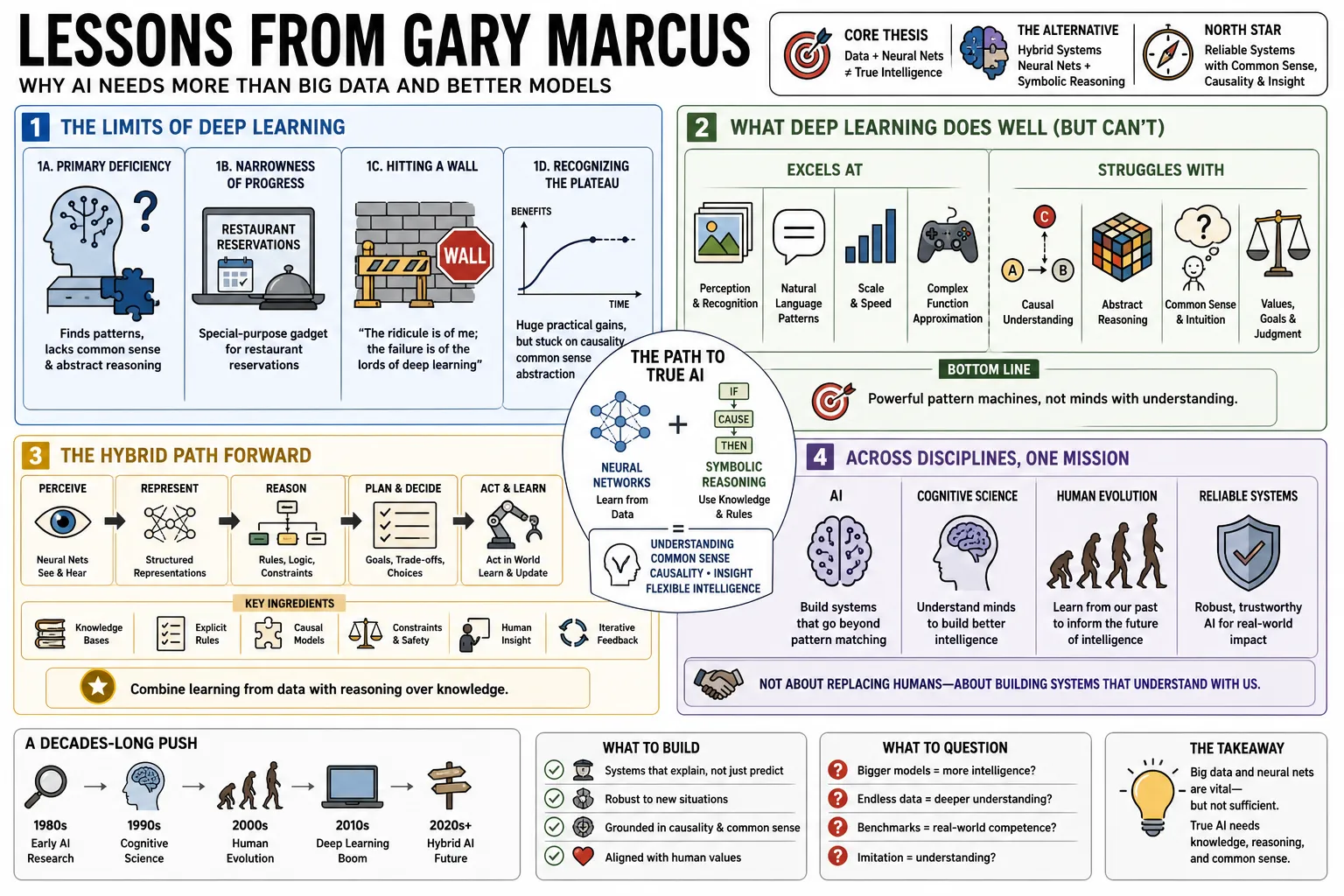
Cognitive scientist Gary Marcus argues that the tech industry's reliance on massive datasets will not produce true artificial intelligence. He insists that neural networks alone cannot reach human-level understanding, advocating instead for hybrid systems that use explicit symbolic reasoning. This collection tracks his decades-long push to build reliable systems across AI, cognitive science, and human evolution.
Part 1: The Limits of Deep Learning
- On the primary deficiency: "Deep learning systems are good at finding patterns in large datasets, but they lack innate common sense and struggle with abstract reasoning." — Source: [Deep Learning: A Critical Appraisal]
- On the narrowness of progress: "Some of the world's best minds in AI, using some of the biggest clusters of computers in the world, had produced a special-purpose gadget for making nothing but restaurant reservations. It doesn't get narrower than that." — Source: [Rebooting AI]
- On hitting a wall: "The ridicule is of me; the failure is of the lords of deep learning to resolve what ails their AI." — Source: [Marcus on AI]
- On recognizing the plateau: Deep learning has delivered massive practical breakthroughs, but its fundamental inability to handle causal understanding suggests the paradigm is plateauing rather than marching inevitably toward general intelligence. — Source: [Marcus on AI]
- On the fragility of pattern recognition: "These models are highly susceptible to adversarial examples where tiny, imperceptible changes to input can lead to drastically incorrect outputs." — Source: [Deep Learning: A Critical Appraisal]
- On tool versus solution: Deep learning is a powerful tool for perception and classification, but treating it as a universal solution blinds the field to the necessity of other cognitive mechanisms. — Source: [Medium Commentary]
- On missing the low-hanging fruit: The research community has prioritized extracting commercial value from existing algorithms over solving the foundational scientific problems required for actual machine comprehension. — Source: [ResearchGate Analysis]
- On empty promises: "All-purpose, all-powerful AI systems, capable of catering to our every intellectual need, have been promised for six decades, but thus far still not arrived." — Source: [MIT Technology Review]
- On intent and constructive criticism: "Rebooting AI is not an argument to shut the field down, but rather a diagnosis of where we are stuck and a prescription for how we might do better." — Source: [Rebooting AI]
- On the lack of world models: Without an underlying model of how the physical and social world actually operates, neural networks are merely approximating intelligence through statistical mimicry. — Source: [Marcus on AI]
Part 2: The Illusion of Scaling
- On the scaling hypothesis: "The idea that one could use massive amounts of data as a substitute for intelligence has led us all the way into the apparent AI bubble. I said it would never work. It didn't." — Source: [Marcus on AI]
- On the limits of data: Throwing more compute and more text at a transformer model does not magically generate reasoning capabilities; it only creates a more convincing database of text probabilities. — Source: [Marcus on AI]
- On financial sustainability: The massive investment in compute and data centers relies on the assumption that scaling will eventually solve reliability, an assumption that looks increasingly like an economic bubble. — Source: [Marcus on AI]
- On outlier failure: Generative models consistently fail when confronted with outliers, meaning scenarios or combinations of data that were not explicitly covered in their vast training sets. — Source: [Marcus on AI]
- On AGI timelines: The hype suggesting that Artificial General Intelligence is just a few data centers away is misleading; the timeline depends on scientific breakthroughs, not just engineering scale. — Source: [ITU AI Summit]
- On diminishing returns: We are seeing the limits of scaling laws, where exponentially more data is required to achieve only marginal improvements in actual comprehension. — Source: [Marcus on AI]
- On the proxy of databases: "I've been thinking about the technical side for a long time and the limitations of just using a big statistical database as a proxy for everything else." — Source: [Tech Policy Press]
- On the hardware arms race: The rush to hoard GPUs benefits hardware manufacturers but distracts from the algorithmic stagnation at the heart of current artificial intelligence research. — Source: [Marcus on AI]
- On biological efficiency: The human brain operates on roughly 20 watts of power and learns from relatively sparse data, proving that massive computational scaling is not the only path to intelligence. — Source: [The Algebraic Mind]
- On brute force versus elegance: The current era of AI is defined by brute force computation, which masks the lack of elegant, structurally sound cognitive architectures. — Source: [Marcus on AI]
Part 3: Hallucinations and Reliability
- On the nature of hallucinations: "I predicted the hallucination errors in 2001 in my book, The Algebraic Mind." — Source: [Tech Policy Press]
- On inherent flaws: Hallucinations are not bugs that can be easily patched; they are baked into the fundamental architecture of probabilistic algorithms. — Source: [Marcus on AI]
- On the barrier to profits: "Without world models, you cannot achieve reliability. And without reliability, profits are limited. The technical problems are not new." — Source: [Marcus on AI]
- On trust and deployment: Until models can distinguish between truth and statistical likelihood, they remain unsafe for critical deployments like medicine or autonomous driving. — Source: [Marcus on AI]
- On the illusion of competence: A large language model can produce highly articulate text that sounds authoritative while being completely detached from reality. — Source: [Rebooting AI]
- On self-correction: Because large language models lack an underlying reasoning engine, they struggle to reliably fact-check or correct their own logical inconsistencies. — Source: [Marcus on AI]
- On real-world friction: Despite billions in investment, the unreliability of current paradigms keeps true autonomy out of reach in messy, unpredictable physical environments. — Source: [Marcus on AI]
- On the definition of understanding: True understanding requires knowing the boundaries of one's own knowledge, a trait entirely absent in systems designed simply to predict the next word. — Source: [Rebooting AI]
- On fixing the unfixable: Trying to eliminate hallucinations by adding more training data is like trying to fix a leaky bucket by pouring water into it faster. — Source: [Marcus on AI]
Part 4: Neurosymbolic AI
- On the inevitable synthesis: "What I said there, completely explicitly, was that deep learning would need to be supplemented by neurosymbolic AI. And that is exactly what happened." — Source: [Digg Interview]
- On architectural vindication: "Claude Code, an impressive and possibly game-changing coding agent for programmers is NOT a pure LLM. And it's not pure deep learning. Not even close. That changes everything." — Source: [Marcus on AI]
- On the industry shift: "Anthropic, when push came to shove, went exactly where I have said for 25 years that the field needed to go: to Neurosymbolic AI." — Source: [Marcus on AI]
- On the dual requirement: "In my 2001 book, The Algebraic Mind, I argued that you need to have both connectionism, which is like Kahneman's System 1, and symbolic systems for System 2, and the field resisted this." — Source: [Newsweek Interview]
- On traditional algorithms: "What the Apple paper shows, most fundamentally, regardless of how you define AGI, is that LLMs are no substitute for good well-specified conventional algorithms." — Source: [Marcus on AI]
- On the limits of probability: "Anthropic figured out that if you really need to get your patterns right, you can't trust a pure LLM. They are too probabilistic. And too erratic." — Source: [Marcus on AI]
- On building hybrids: "Everyone actually working in neurosymbolic AI realizes that the job is not that simple. Rather, as we all realize, the whole game is to discover the right way of building hybrids." — Source: [Noema Magazine]
- On the next phase: "The next meaningful phase of AI is not about bigger standalone language models. It is about systems that combine LLMs with tools, structure, and symbolic methods." — Source: [AllegroGraph Analysis]
- On bridging the gap: "AlphaFold is actually an example of neuro-symbolic A.I. We still don't have a systematic way to do it, that's just a start, that's a stepping stone." — Source: [Observer Interview]
- On resolving the schism: The historical division between connectionist and symbolic AI camps must end; human intelligence clearly relies on both pattern recognition and explicit rule manipulation. — Source: [The Algebraic Mind]
Part 5: Cognitive Architecture and Symbols
- On mental variables: "A vital component of cognition is the ability to learn abstract relationships that are expressed over variables, analogous to what we do in algebra, when we learn an equation like x = y + 2." — Source: [Medium Essay]
- On connectionism's scope: "I am not an anti-connectionist; I am opposed only to a subset of possible connectionist models. The problem is that connectionism has become synonymous with back-propagation." — Source: [The Algebraic Mind]
- On neural implementation: True progress requires understanding how the brain's neural substrate actually implements symbol manipulation, rather than denying that symbols exist. — Source: [The Algebraic Mind]
- On human generalization: Humans can learn a rule in one context and instantly apply it to a completely novel domain, a feat of algebraic generalization that standard neural networks struggle to replicate. — Source: [The Algebraic Mind]
- On the poverty of the stimulus: Children learn complex grammar and concepts from relatively little data, suggesting that the brain is pre-wired with architectural constraints that guide learning. — Source: [The Birth of the Mind]
- On innateness: The mind is not a blank slate; evolution provides a rough draft of cognitive structures that experience then refines. — Source: [The Birth of the Mind]
- On language acquisition: The mechanisms underlying human language rely heavily on operations over variables, allowing us to generate infinite sentence structures from finite rules. — Source: [The Algebraic Mind]
- On the nature of thought: Thought is fundamentally structured and hierarchical, traits that are naturally represented in symbolic systems but must be forcefully simulated in flat neural architectures. — Source: [The Algebraic Mind]
- On moving beyond correlations: Intelligence is about building causal models that explain why correlations exist in the environment, rather than just passively observing them. — Source: [Rebooting AI]
Part 6: Evolution and the Human Kluge
- On evolutionary compromise: "With evolution, good enough is better than perfect, and if a system works well enough to give a reproductive advantage, eons of selection are not likely to be unravelled even if a future organism would do better with a fresh start." — Source: [Kluge: The Haphazard Evolution of the Human Mind]
- On defining our brains: The human mind is essentially a "kluge", meaning a clumsy, inelegant, yet functional solution pieced together by evolution from older, existing biological structures. — Source: [Kluge: The Haphazard Evolution of the Human Mind]
- On confirmation bias: "Perhaps the most dire consequence is that human beings tend to be better at remembering evidence consistent with their beliefs." — Source: [Business Insider]
- On the two systems: "Our thinking can be divided into two streams, one that is fast, automatic, and largely unconscious, and another that is slow, deliberate, and judicious." — Source: [Kluge: The Haphazard Evolution of the Human Mind]
- On biological baggage: Our physical and cognitive flaws ranging from easily strained backs to irrational fears are evidence of evolution's haphazard, additive process. — Source: [PopMatters Review]
- On memory limitations: Our memory is built on context and association rather than precise retrieval, which makes us adaptable but prone to eyewitness errors and absent-mindedness. — Source: [Kluge: The Haphazard Evolution of the Human Mind]
- On emotional override: The newer, deliberate parts of our brain frequently lose battles to the older, reflexive systems, explaining why we often act against our own long-term interests. — Source: [Kluge: The Haphazard Evolution of the Human Mind]
- On problem solving: Despite our cognitive imperfections, the combination of our reflexive and deliberate systems allows us to navigate novel situations and solve unprecedented problems. — Source: [Kluge: The Haphazard Evolution of the Human Mind]
- On the illusion of design: The brain is not an elegantly engineered machine; it is a sprawling, messy testament to survival over optimization. — Source: [Kluge: The Haphazard Evolution of the Human Mind]
Part 7: Music and Adult Learning
- On the drive to create: "Even if all our other needs are satisfied, we may still often expect that a new discontent and restlessness will soon develop, unless the individual is doing what he or she is fitted for." — Source: [Guitar Zero]
- On musical structure: "Virtually every song you've ever heard consists of exactly that: themes that recur over and over, overlaid with variations." — Source: [Guitar Zero]
- On living in the present: "We live, to a remarkable degree, in the present; what happened thirty seconds ago is already rapidly fading from our memory." — Source: [Guitar Zero]
- On the science of acquisition: "This book is about how I began to distinguish my musical derriere from my musical elbow, but it's not just about me: it's also about the psychology and brain science of how anybody can learn something as complicated as a musical instrument." — Source: [Guitar Zero]
- On infant development: "By around six or seven months, infants start to become sensitive to the shapes of melodies; they can detect when a note has changed, recognize a short melody even when it has been transposed." — Source: [Guitar Zero]
- On adult plasticity: The human brain retains the capacity to learn complex new skills like music well into adulthood, challenging the myth that neural plasticity strictly ends after childhood. — Source: [Guitar Zero]
- On deliberate practice: Mastering an instrument later in life requires bypassing the brain's fast, automatic systems through slow, conscious, and repetitive effort. — Source: [Guitar Zero]
- On music and language: While music and language share certain structural traits and neural real estate, they remain distinct cognitive faculties with different evolutionary trajectories. — Source: [Guitar Zero]
- On rhythm and coordination: Learning to play the guitar exposes the precise timing and motor coordination challenges that our nervous system must solve to produce coherent musical output. — Source: [Guitar Zero]
Part 8: AI Safety and Regulation
- On an FDA model for AI: "We need to move to something like the FDA model. If you're going to do something that you deploy on a wide scale, you have to make a safety case." — Source: [Senate Testimony]
- On cost-benefit analysis: "There should be some way of regulating that and saying, 'Hey, what are the costs? What are the benefits? Do the benefits to society really outweigh the costs?'" — Source: [GeekWire Interview]
- On self-regulation: "I still believe, absolutely, that we cannot count on the AI industry to self-regulate, and that government must look in." — Source: [Marcus on AI]
- On corporate dominance: "We shouldn't be letting the big tech companies decide everything for humanity." — Source: [ITU AI Summit]
- On necessary auditing: "We need liability laws. We need full accounting of what data is used to train models, full accounting of all AI-related incidents as they affect bias, cybercrime, election interference, market manipulation, and so forth." — Source: [ITU AI Summit]
- On the pace of lawmaking: "An oversight body, staffed with experts in the field, armed with regulatory powers, needs to be vigilant on a daily basis." — Source: [ZDNet Analysis]
- On a national agency: The United States requires a dedicated, cabinet-level artificial intelligence agency to mandate safety standards and enforce transparency before systems reach the public. — Source: [Regulating AI Initiative]
- On humanity's role: "AI should be a tool that serves humanity, not a force that operates without human oversight." — Source: [The Bright Byte]
- On ignoring the hype: The fear of imminent, god-like artificial general intelligence is a distraction propagated by the industry to draw attention away from the immediate harms of bias, misinformation, and copyright infringement. — Source: [ITU AI Summit]