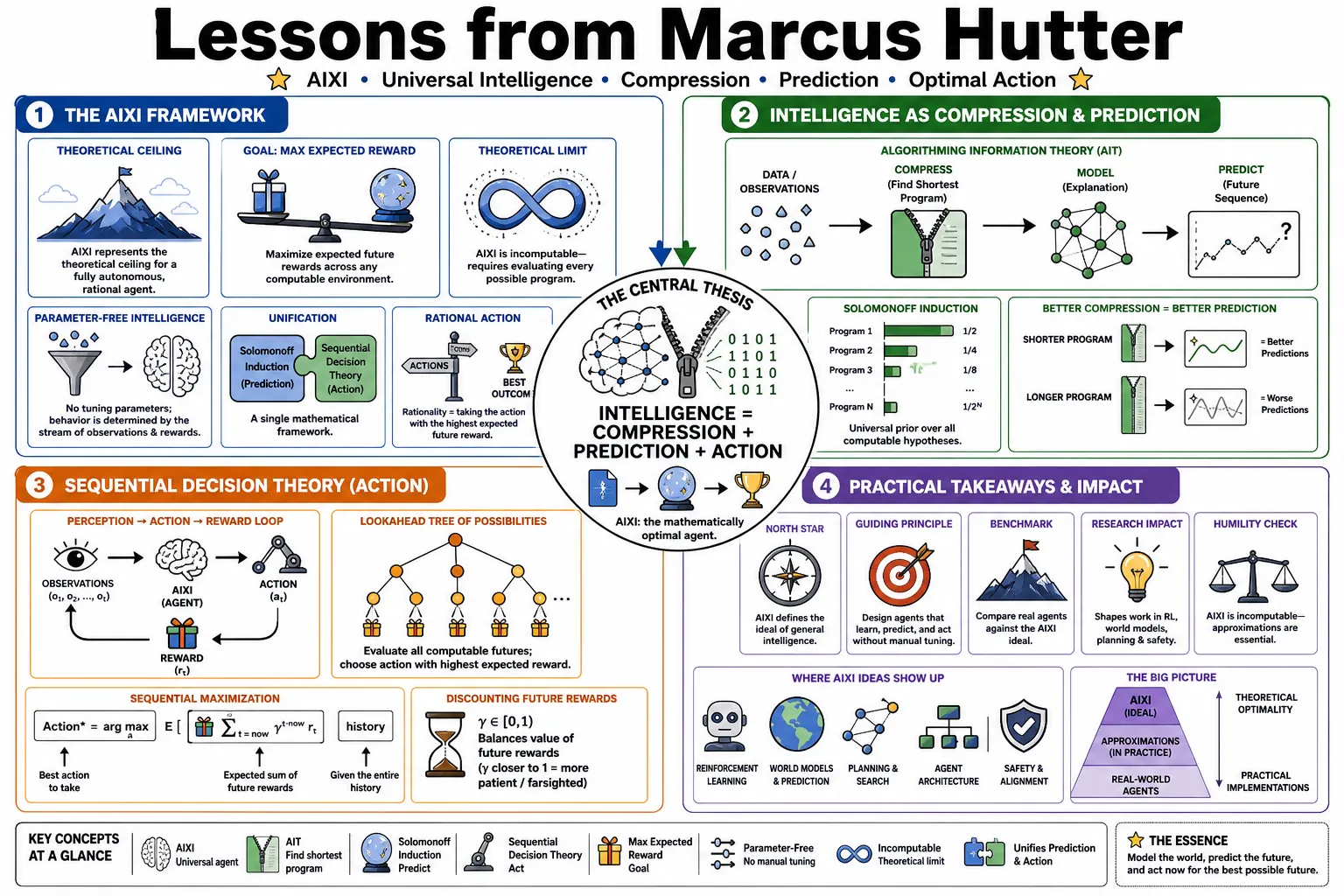
Lessons from Marcus Hutter
DeepMind senior research scientist Marcus Hutter formulated AIXI, a mathematical model of universal artificial intelligence. He grounds his work in algorithmic information theory, arguing that general intelligence is mathematically equivalent to data compression and sequence prediction. This profile collects his core ideas on building mathematically optimal agents.
Part 1: The AIXI Framework
- On the AIXI model: "AIXI represents the theoretical ceiling for a fully autonomous, rational agent." — Source: [DeepMind: Universal Artificial Intelligence]
- On optimal behavior: "The agent’s goal is to maximize expected future rewards across any computable environment." — Source: [Universal Artificial Intelligence (2005)]
- On theoretical limits: "AIXI is a mathematically optimal design that remains incomputable because it requires evaluating every possible program." — Source: [ANU Research Repository]
- On parameter-free intelligence: "A universal agent should have no tuning parameters; its behavior is entirely determined by the stream of observations and rewards." — Source: [LessWrong: AIXI Overview]
- On unification: "AIXI unifies Solomonoff induction for prediction and sequential decision theory for action into a single mathematical framework." — Source: [Explainable Startup: AIXI]
- On rational action: "Rationality is formalized as taking actions that have the highest expected utility given the probability distribution over all possible environments." — Source: [arXiv: One Decade of Universal AI]
- On prior knowledge: "The agent starts with a universal prior, meaning it does not need domain-specific knowledge baked in to learn successfully over time." — Source: [Lex Fridman Podcast #75]
- On sequence prediction: "Every interaction with an environment reduces to predicting the next sequence of bits in an observation string." — Source: [Hutter1.net: AIXI]
- On expected reward: "The optimal policy is the one that maximizes the sum of future rewards, discounted to ensure the sum converges." — Source: [Universal Artificial Intelligence (2005)]
- On foundational definitions: "Before building human-level intelligence, we need a rigorous mathematical definition of what intelligence actually is." — Source: [Marcus Hutter - Universal Artificial Intelligence and Solomonoff Induction]
Part 2: Compression and Intelligence
- On the core equivalence: "Compression is intelligence. Finding the underlying patterns in data is exactly the same task as finding a way to compress that data." — Source: [Reddit: Machine Learning Compression]
- On the Hutter Prize: "The prize motivates the development of better text compressors because losslessly compressing human knowledge requires genuine understanding." — Source: [Hutter Prize Official Site]
- On language modeling: "A language model that predicts the next word with high accuracy functions as a highly effective data compressor." — Source: [DeepMind: Language Modeling is Compression]
- On pattern recognition: "To compress a string of data maximally, an algorithm must discover every regularity and pattern hidden within it." — Source: [Hutter1.net: Compression]
- On universal sequence predictors: "A universal compressor can predict any sequence, and a perfect sequence predictor can compress any data to its theoretical limit." — Source: [Lex Fridman Podcast #75]
- On Wikipedia as a benchmark: "Wikipedia represents a broad swath of human knowledge; an algorithm that compresses it deeply must model the structure of the world it describes." — Source: [Happy Scribe: Hutter Prize Interview]
- On lossless versus lossy: "True understanding in AI requires lossless compression, because any discarded information might contain the key to a deeper, undiscovered pattern." — Source: [Marcus Hutter - Universal Artificial Intelligence and Solomonoff Induction]
- On Shannon entropy: "While Shannon entropy measures the statistical information of a source, algorithmic complexity measures the absolute information content of an individual object." — Source: [Universal Artificial Intelligence (2005)]
- On future benchmarks: "As we approach artificial general intelligence, our ability to compress vast datasets will plateau near the true Kolmogorov complexity of the data." — Source: [Marcus Hutter - Singularity Summit Australia 2012]
- On algorithmic probability: "The probability of a sequence is dominated by its shortest compressed representation." — Source: [DeepMind Research Publications]
Part 3: Kolmogorov Complexity and Occam's Razor
- On mathematical simplicity: "Occam’s razor can be formalized: the simplest hypothesis is the one that can be described by the shortest computer program." — Source: [ANU Research Repository]
- On Solomonoff induction: "Solomonoff’s theory solves the induction problem by assigning high prior probability to simple universes and low prior probability to complex ones." — Source: [arXiv: Algorithmic Information Theory]
- On penalizing complexity: "In universal induction, hypotheses are weighted by 2 to the power of negative program length, heavily penalizing unnecessary complexity." — Source: [Wikipedia: AIXI]
- On the Turing machine: "Kolmogorov complexity is defined relative to a universal Turing machine, but for long strings, the choice of machine becomes a minor constant factor." — Source: [Lex Fridman Podcast #75]
- On the limits of knowledge: "We cannot compute the Kolmogorov complexity of a string exactly, because we can never be certain a shorter program does not exist." — Source: [Marcus Hutter - Universal Artificial Intelligence and Solomonoff Induction]
- On prior probabilities: "The universal prior provides a mathematically justified way to assign probabilities to events without requiring human bias." — Source: [LessWrong: Solomonoff Induction]
- On empirical success: "Occam’s razor works in practice because the physical universe we inhabit appears to be generated by a short set of rules." — Source: [Hutter1.net: Philosophy]
- On avoiding overfitting: "By seeking the shortest program that outputs the observed data, algorithmic probability naturally avoids overfitting." — Source: [DeepMind: Universal Artificial Intelligence]
- On infinite hypotheses: "Solomonoff induction considers an infinite number of computable hypotheses simultaneously, ensuring it will eventually converge on the correct one." — Source: [ResearchGate: UAI]
- On structural bounds: "The complexity of an environment bounds how many errors an optimal agent will make before learning its structure." — Source: [Universal Artificial Intelligence (2005)]
Part 4: Universal Reinforcement Learning
- On goal specification: "In reinforcement learning, the environment provides a scalar reward signal, which is sufficient to encode any complex goal an agent might pursue." — Source: [arXiv: Universal RL]
- On the explore-exploit dilemma: "An optimal agent must balance the expected reward of known actions against the information gained by exploring unknown aspects of the environment." — Source: [DeepMind Research Publications]
- On unknown environments: "A universal agent does not know the transition probabilities of its environment; it must infer them entirely from the history of interactions." — Source: [Universal Artificial Intelligence (2005)]
- On asymptotic optimality: "An optimal reinforcement learning agent will converge to the true environment policy asymptotically." — Source: [ANU Research Repository]
- On state representation: "Traditional RL relies on Markov decision processes, but universal RL handles environments with hidden states and arbitrary historical dependencies." — Source: [Marcus Hutter - Universal Artificial Intelligence and Solomonoff Induction]
- On discounting the future: "Discount factors ensure the sum of expected future rewards remains finite, but choosing the right discount rate alters the agent's horizon." — Source: [Lex Fridman Podcast #75]
- On self-optimizing behavior: "An agent that can model its environment perfectly will naturally self-optimize its policy to achieve maximum utility." — Source: [Hutter1.net: Reinforcement Learning]
- On failure modes: "Even theoretically optimal agents can get trapped in environments where bad actions lead to unrecoverable states with permanent zero reward." — Source: [Introduction to Universal Artificial Intelligence (2024)]
- On empirical testing: "Testing universal RL algorithms requires environments that are complex enough to require deep sequence prediction, rather than simple board games." — Source: [Marcus Hutter - Singularity Summit Australia 2012]
Part 5: The Philosophy of Intelligence
- On objective definitions: "A mathematical definition of intelligence must be objective and non-anthropocentric, detached from human biological quirks." — Source: [arXiv: One Decade of Universal AI]
- On behavioral definitions: "Intelligence is fundamentally about an agent’s ability to act successfully and achieve goals across a wide range of environments." — Source: [DeepMind: Universal Artificial Intelligence]
- On consciousness: "From the perspective of universal AI, consciousness is not a requisite for intelligence; intelligent behavior is entirely about taking optimal actions." — Source: [Lex Fridman Podcast #75]
- On human intelligence limits: "Human intelligence is an existence proof of general problem solving, but it is not the theoretical ceiling of what a computable agent can achieve." — Source: [Marcus Hutter - Singularity Summit Australia 2012]
- On top-down approaches: "Instead of building AI by combining heuristic subsystems, we should start with a perfect mathematical model and carefully approximate it downward." — Source: [Hutter1.net: Research Philosophy]
- On the Turing Test: "The Turing Test measures human-likeness. A highly intelligent system might easily fail it by being too rational or too fast." — Source: [Deutschlandfunk Interview (2026)]
- On embodied cognition: "An agent does not need physical embodiment to be intelligent; a text-based environment provides sufficient complexity for general intelligence." — Source: [Lex Fridman Podcast #75]
- On artificial goals: "An agent's reward function is its sole reason for acting; philosophy of meaning is reduced to the mathematics of reward maximization." — Source: [Marcus Hutter - Universal Artificial Intelligence and Solomonoff Induction]
- On superintelligence: "Once an agent approaches the theoretical limits of sequence prediction, its ability to navigate complex environments will vastly exceed human capabilities." — Source: [Marcus Hutter: Universal Artificial Intelligence, AIXI, and AGI]
Part 6: Computability and Approximations
- On the incomputability of AIXI: "The perfect intelligence model relies on halting properties of Turing machines, making the exact calculation of its actions formally impossible." — Source: [Wikipedia: AIXI]
- On AIXI-tl: "AIXI-tl is a computable approximation that limits the search space to programs of length l and computation time t, making the theory physically realizable." — Source: [DeepMind Research Publications]
- On heuristic searches: "Practical implementations of universal AI must replace exhaustive program searches with heuristic approximations like Monte Carlo tree search." — Source: [Introduction to Universal Artificial Intelligence (2024)]
- On hardware limits: "The gap between human intelligence and AIXI is partly bounded by computational resources; better hardware allows for closer approximations of optimal policies." — Source: [Marcus Hutter - Singularity Summit Australia 2012]
- On algorithmic complexity: "Approximating Kolmogorov complexity using standard file compressors like gzip provides a surprisingly effective form of sequence prediction." — Source: [arXiv: Algorithmic Information Theory]
- On deep learning as approximation: "Large neural networks can be viewed as practical, highly parameterized approximations of universal sequence predictors." — Source: [DeepMind: Language Modeling is Compression]
- On the cost of rationality: "Perfect rationality demands infinite computation. Bounded rationality focuses on finding the highest expected reward given a strict computational budget." — Source: [Lex Fridman Podcast #75]
- On search algorithms: "To act optimally in real-time, an agent must dynamically allocate its computation time, searching deeper into more promising branches of the future." — Source: [Hutter1.net: AIXI Approximations]
- On theoretical guarantees: "When we restrict AIXI to be computable, we lose some of its absolute optimality guarantees, but we retain its general-purpose architecture." — Source: [ANU Research Repository]
Part 7: Generalization and Prediction
- On out-of-distribution events: "A universal agent handles novel situations by relying on the shortest programs it found in the past, inherently generalizing without custom heuristics." — Source: [Universal Artificial Intelligence (2005)]
- On inductive inference: "Induction is the mechanism by which an agent generalizes from past observations to predict future states." — Source: [LessWrong: Solomonoff Induction]
- On the nature of prediction: "Prediction is the construction of a precise probability distribution over all possible future observations." — Source: [Marcus Hutter - Universal Artificial Intelligence and Solomonoff Induction]
- On catastrophic forgetting: "A true universal agent maintains a probability distribution over hypotheses, protecting it from forgetting past patterns when the environment changes." — Source: [arXiv: Universal RL]
- On sequence learning: "If an agent can perfectly predict the next bit in a sequence, it has effectively learned the underlying generative process of that sequence." — Source: [DeepMind Research Publications]
- On cross-domain transfer: "Generalization across domains occurs naturally if the agent's underlying model discovers shared structural simplicity between those domains." — Source: [Hutter1.net: Generalization]
- On error bounds: "The theoretical error bounds of Solomonoff induction guarantee that the total number of prediction errors is finite for any computable environment." — Source: [Introduction to Universal Artificial Intelligence (2024)]
- On subjective priors: "Even if two agents start with different universal priors, their predictions will rapidly converge as they process the same sequence of observations." — Source: [Lex Fridman Podcast #75]
- On model complexity: "A model should only be as complex as the data requires; an overly complex model predicts noise rather than generalizing the underlying signal." — Source: [DeepMind: Universal Artificial Intelligence]
Part 8: The Path to AGI
- On measuring progress: "Progress toward AGI should be measured by an agent's ability to compress diverse data streams and act optimally in increasingly complex, unknown environments." — Source: [Lex Fridman Podcast #75]
- On theoretical foundations: "Building AGI without a formal theory of intelligence is like trying to build an airplane without understanding aerodynamics." — Source: [Marcus Hutter - Universal Artificial Intelligence and Solomonoff Induction]
- On scaling laws: "While scaling computation and parameters yields impressive results, AGI will ultimately require architectures that explicitly approximate universal induction." — Source: [DeepMind Research Publications]
- On safety and alignment: "A mathematically formal agent acts exactly according to its reward function; the safety challenge lies entirely in specifying a reward function aligned with human values." — Source: [Marcus Hutter: Universal Artificial Intelligence, AIXI, and AGI]
- On self-improvement: "An optimal agent will continually refine its own computational approximations to maximize expected reward, engaging in a form of recursive self-improvement." — Source: [Marcus Hutter - Singularity Summit Australia 2012]
- On interdisciplinary research: "Solving AGI requires merging insights from computer science, algorithmic information theory, and sequential decision making." — Source: [Hutter1.net: Research Overview]
- On the timeline to AGI: "Establishing the mathematical ceiling of intelligence gives us a clear roadmap for what practical algorithms must strive to approximate." — Source: [IJCAI 2017 Address]
- On open problems: "The remaining hurdles in AGI are practical: how to compress search spaces and efficiently approximate Kolmogorov complexity in real-time." — Source: [arXiv: One Decade of Universal AI]
- On the endgame of AI: "Once we build an agent that can universally predict and optimally act, it will possess the capacity to solve any computable problem presented to it." — Source: [Universal Artificial Intelligence (2005)]