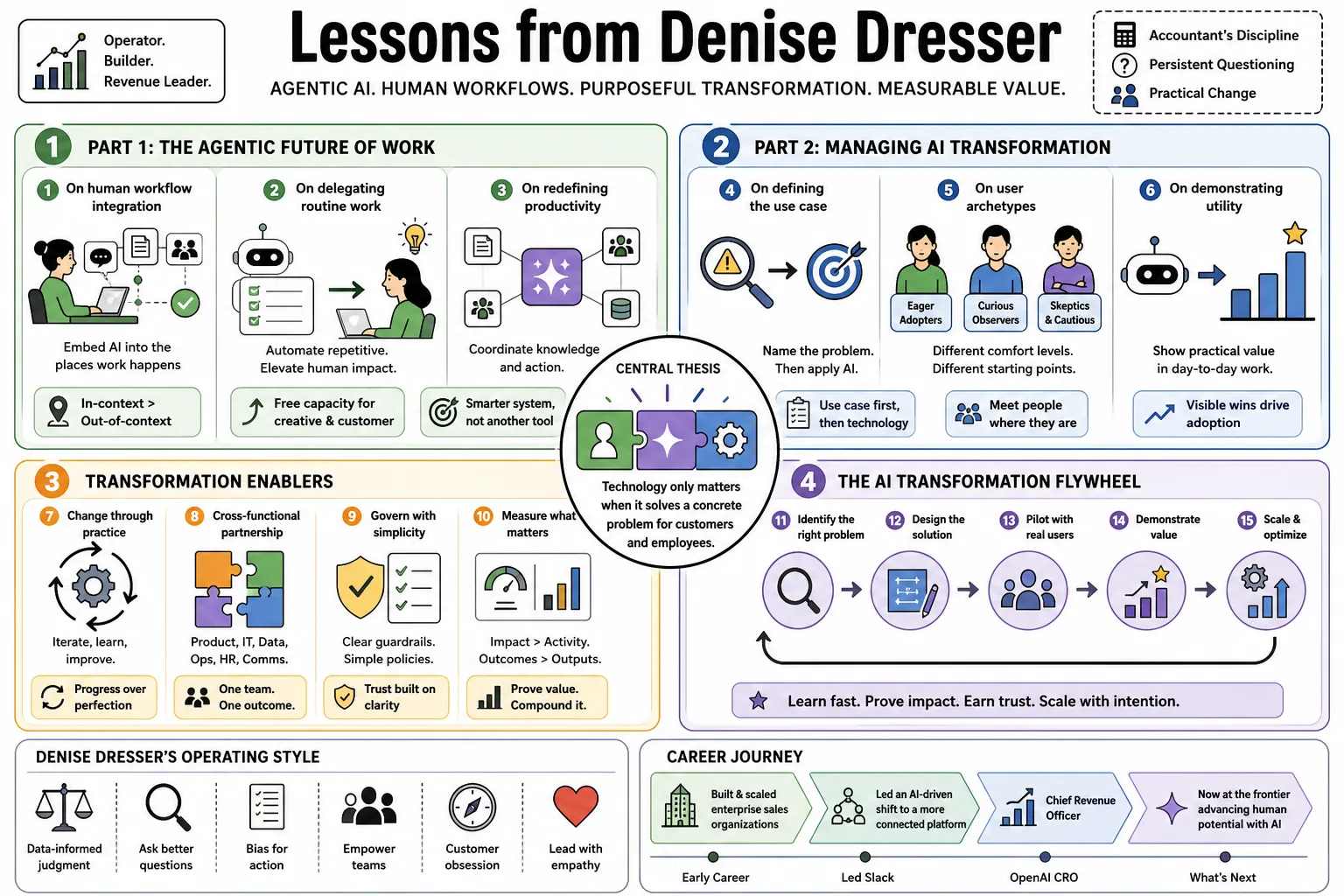
Lessons from Denise Dresser
Denise Dresser built her career scaling enterprise sales organizations at Salesforce before leading Slack through an AI-driven transition and joining OpenAI as Chief Revenue Officer. Her operating style combines an accountant's discipline with persistent questioning, practical change management, and a belief that technology only matters when it solves a concrete problem for customers and employees.
Part 1: The agentic future of work
- On human workflow integration: The success of agentic AI depends on embedding it naturally into human workflows rather than forcing people to leave the places where work already happens. — Reference: Slack expands its platform for context-aware AI apps and agents
- On delegating routine work: Agents are best deployed first against repetitive, fully automatable tasks, freeing people to focus on creative problem-solving and direct customer service. — Reference: Slack CEO: How to roll out artificial intelligence internally
- On redefining productivity: An agent-powered work operating system should help people work smarter by coordinating knowledge and action, not merely add another digital tool to manage. — Reference: Slack unveils innovations for the agentic era
Part 2: Managing AI transformation
- On defining the use case: Start every AI transformation by naming the problem to solve; adding AI without a clear use case creates hype without durable value. — Reference: Slack CEO: How to roll out artificial intelligence internally
- On user archetypes: Meet employees where they are across different comfort levels, from eager adopters to skeptics and curious observers. — Reference: Slack CEO: How to roll out artificial intelligence internally
- On demonstrating utility: Adoption grows when each user can see AI producing a practical improvement in the work they personally do. — Reference: Slack CEO: How to roll out artificial intelligence internally
- On immediate integration: Embed AI in the natural flow of work so its benefits are immediate and do not require people to rebuild their habits. — Reference: Slack CEO: How to roll out artificial intelligence internally
- On change management: Treat AI adoption as an organizational change program, with clear guardrails, training, proof points, and visible executive participation. — Reference: How Slack's CEO is embracing its evolution under Salesforce
Part 3: Harnessing organizational knowledge
- On conversational data: Slack's strategic value comes partly from the enormous body of unstructured organizational knowledge contained in everyday conversations. — Reference: Slack's new CEO looks to bring stability after a turbulent period
- On collective memory: A long-running collaboration system becomes institutional memory, preserving decisions and context that would otherwise disappear. — Reference: Slack CEO: How to roll out artificial intelligence internally
- On identifying pain points: Customer research showed that finding the right information and document at the right time was one of the steepest sources of workplace friction. — Reference: Slack CEO: How to roll out artificial intelligence internally
- On prioritizing solutions: Slack prioritized generative search because it attacked a high-frequency, high-friction problem instead of showcasing AI for its own sake. — Reference: Slack CEO: How to roll out artificial intelligence internally
- On combining data types: Bringing unstructured conversations together with structured customer records creates a more useful intelligence layer than either source can provide alone. — Reference: Slack's new CEO looks to bring stability after a turbulent period
Part 4: Product philosophy and execution
- On preserving product values: Even as the technology changes, enterprise software should keep making work simpler, more pleasant, more productive, and a little more joyful. — Reference: How Slack's CEO is embracing its evolution under Salesforce
- On moving beyond collaboration: Workplace software should connect communication to measurable business outcomes rather than stop at helping people exchange messages. — Reference: Slack unveils innovations for the agentic era
- On turning conversation into action: Product design should let users convert decisions made in conversation directly into accountable tasks and tracked work. — Reference: Announcing Slack Lists
- On AI accessibility: Natural-language interfaces make generative AI accessible to ordinary workers without requiring specialized technical training. — Reference: How Slack's CEO is embracing its evolution under Salesforce
Part 5: Leadership and career growth
- On enduring self-doubt: Experience does not eliminate imposter syndrome; leaders can acknowledge it without letting it dictate their decisions. — Reference: Career-defining lessons from trailblazing women in sales
- On reframing insecurity: A measured amount of self-doubt can keep a leader learning, preparing, and questioning assumptions. — Reference: Career-defining lessons from trailblazing women in sales
- On using your edge: Resisting insecurity can amplify it; treating it as information can turn discomfort into better preparation and performance. — Reference: Career-defining lessons from trailblazing women in sales
- On authentic leadership: People are more likely to trust a new leader when they understand the genuine conviction behind that person's decision to take responsibility. — Reference: Slack's new CEO looks to bring stability after a turbulent period
- On asking questions: Dresser's leadership approach starts with questions and organization, using an accountant's instincts to understand the system before changing it. — Reference: Slack's new CEO looks to bring stability after a turbulent period
Part 6: Building trust in AI
- On demystifying outputs: Trust grows when AI answers are grounded in familiar company information and provide clear citations people can inspect. — Reference: How Slack's CEO is embracing its evolution under Salesforce
- On responsible experimentation: Leaders should establish understandable guardrails so employees can experiment without treating every AI output as authoritative. — Reference: How Slack's CEO is embracing its evolution under Salesforce
- On empowering knowledge access: AI creates value when it helps employees retrieve collective knowledge faster and spend more time on innovation and growth. — Reference: Salesforce launches trusted generative AI for customers in Slack
Part 7: Scaling enterprise platforms
- On shifting to intelligence: Slack's evolution moves from connecting people, apps, and systems toward turning that connected context into an intelligence layer for work. — Reference: Salesforce launches trusted generative AI for customers in Slack
- On the next phase: Dresser sees OpenAI's enterprise opportunity as another category-defining platform challenge, building on her Salesforce and Slack experience. — Reference: OpenAI appoints Denise Dresser as Chief Revenue Officer
Part 8: Preserving human judgment
- On the limits of automation: High-stakes negotiations, brand representation, and ambiguous customer situations still require human judgment even when agents can handle routine work. — Reference: Slack CEO: How to roll out artificial intelligence internally
Part 9: Leading through transition and purpose
- On entering gracefully: Taking over after rapid executive turnover requires humility, coaching from the existing team, and a shared view of the organization's future. — Reference: Slack's new CEO looks to bring stability after a turbulent period
- On respecting the foundation: A new leader does not need to manufacture disruption when the organization is already well run; build on what works before imposing a personal signature. — Reference: Slack's new CEO looks to bring stability after a turbulent period
- On preserving what is special: Integration into a larger company should strengthen the acquired product's capabilities without erasing the qualities that made customers loyal to it. — Reference: Slack's new CEO looks to bring stability after a turbulent period
- On using the product yourself: Dresser used AI summaries of long product threads to accelerate her own onboarding, turning an executive transition into a practical test of the technology. — Reference: Slack's new CEO looks to bring stability after a turbulent period
- On business as a platform for change: Companies can embed social impact into their operating model through their profits, products, and employees' time rather than treating philanthropy as a side project. — Reference: Denise Dresser of Salesforce — Taking Care of Business
- On equality as an operating priority: Pursuing equality can strengthen a business and its relationships when it is treated as a central mission instead of a communications exercise. — Reference: Denise Dresser of Salesforce — Taking Care of Business
- On trust beyond transactions: Customer relationships deepen when people connect around shared values and understand who they are working with beyond the immediate commercial exchange. — Reference: Denise Dresser of Salesforce — Taking Care of Business
- On scaling the commercial system: At OpenAI, Dresser's remit joins enterprise revenue with customer success, reflecting that durable AI growth depends on adoption and operating change after the contract is signed. — Reference: OpenAI appoints Denise Dresser as Chief Revenue Officer
Part 10: From pilots to enterprise architecture
- On reading customer urgency: After meeting hundreds of OpenAI customers in her first 90 days, Dresser found unusual conviction across industries that AI will force companies to reinvent how they operate. — Reference: The next phase of enterprise AI
- On moving past experimentation: Enterprise AI strategy should assume the technology is already doing real work, shifting the conversation from whether to experiment toward where and how to deploy it. — Reference: The next phase of enterprise AI
- On framing the enterprise challenge: Companies must solve two problems together: putting capable AI to work across the business and making it useful in each employee's everyday workflow. — Reference: The next phase of enterprise AI
- On separating the intelligence layer: A company-wide agent strategy needs an underlying layer that governs agents across systems, data, permissions, and controls rather than trapping them inside individual applications. — Reference: The next phase of enterprise AI
- On unifying the employee experience: The daily interface for enterprise AI should bring agents, coding tools, browsing, and task execution together so employees can act across their existing tools from one place. — Reference: The next phase of enterprise AI
- On closing the capability gap: Models can already do more than most organizations use them for; competitive advantage comes from making that latent capability trusted, accessible, and operational. — Reference: The next phase of enterprise AI
Part 11: Building governed agent systems
- On rejecting point-solution sprawl: Disconnected AI tools that cannot communicate recreate the same fragmentation they were supposed to remove and make enterprise operations more chaotic. — Reference: The next phase of enterprise AI
- On grounding AI coworkers: Useful enterprise agents need company context, connections to internal and external data, and permissions that match the work they are expected to perform. — Reference: The next phase of enterprise AI
- On building the full stack: Enterprise advantage comes from connecting infrastructure, models, deployment tooling, and employee interfaces rather than optimizing any one layer in isolation. — Reference: The next phase of enterprise AI
- On managing teams of agents: Advanced users are moving from asking AI for help on individual tasks to orchestrating multiple agents that can complete end-to-end bodies of work. — Reference: The next phase of enterprise AI
- On using familiar interfaces: Widespread consumer experience with ChatGPT lowers training friction inside companies because employees already understand the basic interaction model. — Reference: The next phase of enterprise AI
- On proving agents in revenue work: OpenAI's own sales agent demonstrates a complete operating loop by researching inbound prospects, scoring them against a rubric, personalizing outreach, and updating the CRM. — Reference: The next phase of enterprise AI
Part 12: Deployment as operating work
- On meeting companies where they are: Enterprise adoption accelerates when AI integrates with the infrastructure and data ecosystems customers already rely on instead of demanding a clean-sheet rebuild. — Reference: The next phase of enterprise AI
- On designing the commercial path: Strong models are insufficient without deployment support, practical pricing and packaging, and a customer experience that earns long-term trust. — Reference: The next phase of enterprise AI
- On making deployment part of the product: Real impact requires embedding technical experts with business leaders, operators, and frontline teams to redesign critical workflows around AI. — Reference: OpenAI launches the OpenAI Deployment Company
- On starting with a focused diagnostic: Begin a deployment by locating the highest-value opportunities, then select a small number of priority workflows with leadership and operating teams before building. — Reference: OpenAI launches the OpenAI Deployment Company
- On building durable systems: Design production systems around where frontier capabilities are heading so customer investments improve as new models, tools, and deployment patterns arrive. — Reference: OpenAI launches the OpenAI Deployment Company
- On scaling operating change: Combining frontier-model visibility with partners experienced in complex transformation helps identify repeatable deployment patterns and spread them across companies and industries. — Reference: OpenAI launches the OpenAI Deployment Company