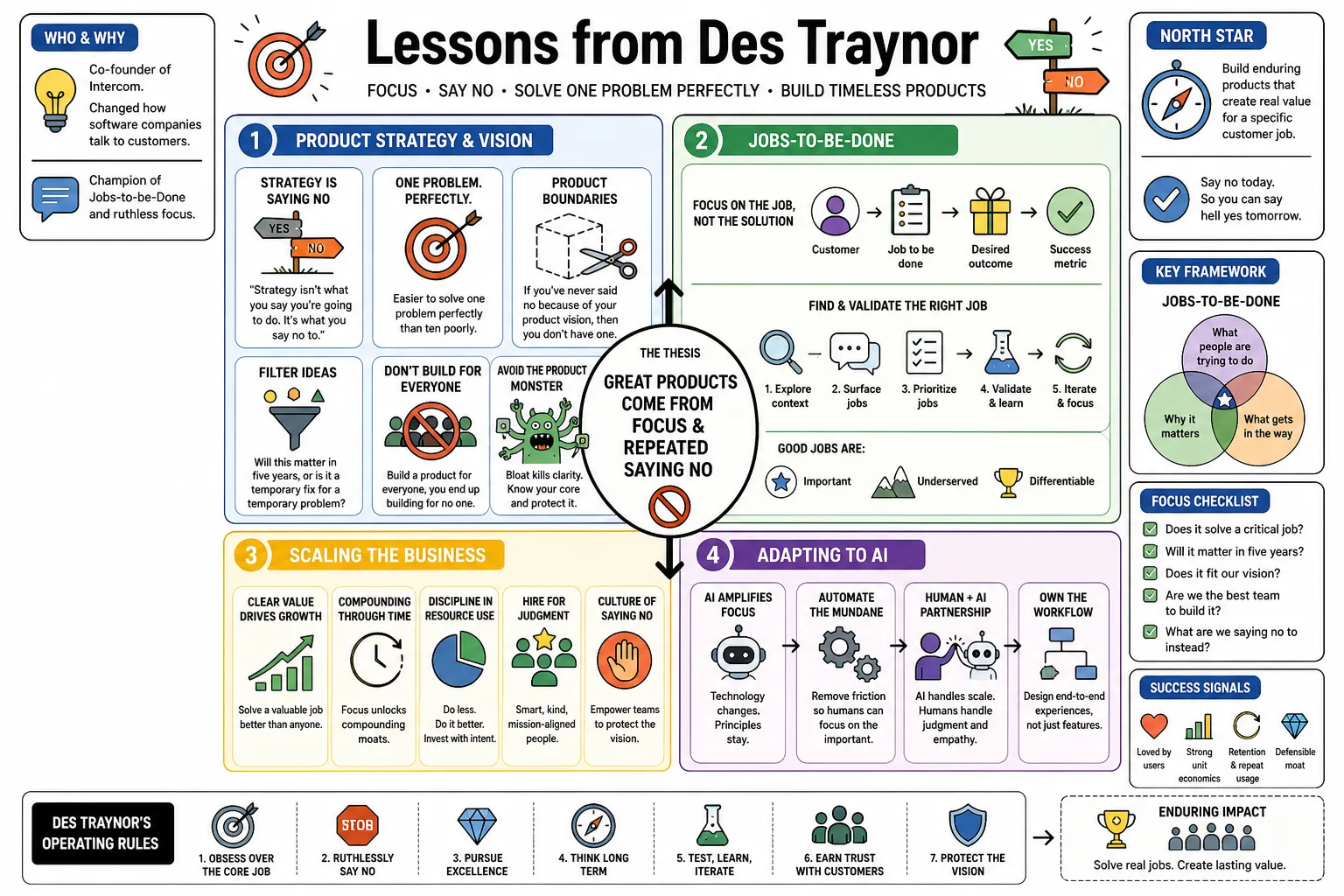
Lessons from Des Traynor
Des Traynor co-founded Intercom and helped apply Jobs-to-be-Done to its product, design and marketing. The lessons below examine his writing and interviews on product strategy, customer conversations, company building and AI customer service. — Intercom on Jobs-to-be-Done.
Part 1: Product Strategy & Vision
- Strategy requires saying no: Product strategy requires declining even useful feature ideas when they would make the product less cohesive. — Product strategy means saying no.
- Let vision create boundaries: A product vision is meaningful only if it has caused the team to reject something that does not fit. — Business of Software — Product Strategy Revisited.
- Apply the five-year test: When considering a feature, ask whether it will still matter in five years rather than chasing today’s shiny integration or interface fashion. — Business of Software — Product Strategy Revisited.
- Avoid premature breadth: A product that tries to serve every purpose from the start becomes hard to build, explain and adopt; broad platforms have to grow out of a useful simple product. — Business of Software — Product Strategy Revisited.
- Deliver a cohesive product: A pile of tangentially useful features is not a substitute for a cohesive product with clearly defined boundaries. — Product strategy means saying no.
- Protect quality after traction: The first version is easier to shape because founders can build what they want; traction brings customers, competitors, investors, staff and press whose requests make focus harder. — Business of Software — Product Strategy Is About Saying No.
- Use a feature-decision checklist: Before accepting a request, test its fit with the product vision, long-term relevance and benefit beyond a vocal minority of users. — Rarely say yes to feature requests.
Part 2: The Art of Saying No & Feature Bloat
- Resist feature blackmail: A customer threatening to leave over one feature is not, by itself, a reason to weaken the product for everyone else. — Product strategy means saying no.
- Learn to say no: In his 2013 product-strategy essay, Des urged builders to get good at saying no rather than continually deferring off-strategy requests. — Product strategy means saying no.
- Avoid short-term wins with long-term costs: A product change that creates an immediate win can leave lasting costs; review the longer-term trade-off before saying yes. — Business of Software — Product Strategy Revisited.
- Count hidden feature complexity: Even a small optional feature adds combinations, configuration and support complexity beyond the time needed to ship it. — Product strategy means saying no.
- Find the Scopi-locks scope: Choose a scope neither so broad that customers cannot adopt it nor so narrow that they dismiss it as a mere feature. — Business of Software — Product Strategy Revisited.
- Explain what you are building instead: When rejecting a good idea, acknowledge why customers might value it and explain what the team is building instead. — Product strategy means saying no.
- Budget for post-launch support: A feature that looks cheap to ship can create unexpected support work after customers begin using it. — Rarely say yes to feature requests.
Part 3: Jobs-to-be-Done Theory
- Study the job, not a customer category: Intercom found more useful common ground in the tasks customers were trying to do than in the many types of businesses using its product. — Jobs-to-be-Done Radio — Des Traynor.
- Use Intercom’s Job Story format: Intercom’s Job Stories describe the situation, a person’s motivation and the outcome they hope to achieve; Paul Adams documented the team’s format as “When … I want to … So I can …”. — Paul Adams — How We Invented Job Stories.
- Measure whether the job is still being done: A customer may stop getting value before canceling; watching actual product use can reveal that the product has effectively been replaced in the customer’s workflow. — Jobs-to-be-Done Radio — Des Traynor.
- Look beyond direct competitors: A product can compete with alternatives that look different but satisfy the same customer outcome, or with other demands on the customer’s attention. — Understanding direct and indirect competition.
- Start with what people want: Begin with a durable human or business need and improve how people achieve the outcome, rather than starting with an available technology and looking for demand. — Making things people want.
- Design for the outcome: A better product starts by understanding the outcome customers want and how they currently achieve it, then removing steps or barriers. — Making things people want.
- Observe actual behavior: Customer interviews should investigate what people actually do to solve a problem, not rely only on their surface-level descriptions of what they like. — Jobs-to-be-Done Radio — Des Traynor.
- Know the job before building a feature: A team should understand the customer activity a feature serves before designing it; vague feature labels are not a substitute for a clearly scoped job. — Rarely say yes to feature requests.
Part 4: Customer Support & Communication
- Treat support as product insight: Customer conversations can reveal how a product is used and where design, copy or reliability should improve; routine contacts also carry real staffing cost. — The right type of customer conversations.
- Make conversations valuable: A useful customer conversation should help both the customer and the company, not simply add another low-value contact to a support queue. — The right type of customer conversations.
- Route feedback into product design: When users repeatedly ask for a feature where they expect to find it, the deeper fix may be to make it discoverable there rather than send another canned support reply. — The when and where of product feedback.
- Reduce repetitive contacts: Fix the recurring issues that create low-value support contacts so the team can spend more time on meaningful customer help and learning. — The right type of customer conversations.
- Acknowledge a customer’s legitimate problem: When a customer leaves because of a real product issue, acknowledge the problem, thank them and let them go; arguing or continuing to spam them worsens the experience. — Reduce Churn by Re-engaging Your Customers.
- Describe the product in customer language: Des found that industry terms such as “behavioral targeting” and “engagement engine” obscured Intercom’s simpler value: helping businesses talk with their customers. — Open Source CEO — Des Traynor Interview.
- Get on the front foot: Once routine issues are reduced, use the freed capacity to reach customers with timely guidance that helps them get more from the product. — The right type of customer conversations.
- Apologize in context after downtime: At Intercom’s predecessor, the team replaced cumbersome broad apology emails with an in-product message acknowledging downtime to people using the service. — Intercom co-founder Des Traynor on starting up.
- Prioritize support fixes by burden: Track both how often a support issue occurs and how long it takes to resolve; together they show which recurring problem is worth fixing first. — The right type of customer conversations.
Part 5: Scaling Startups & Go-to-Market
- Do the early outreach by hand: Des recruited Intercom’s first customers through individual emails and live webinars, using each reply to improve the next conversation before scaling the process. — How Intercom Got Our First Customers.
- Price for value and ability to pay: A useful software price accounts for both the value the product delivers to an organization and that organization’s buying power; early pricing can be revised as evidence arrives. — Des Traynor on Starting Up.
- Explain a product beyond a screenshot: For complex SaaS products, a screenshot and vague one-line slogan often fail to explain the value; product marketing must show what the product does and why it matters. — Des Traynor on 20VC.
- Speak to buyers as well as users: In enterprise software, the buyer may not be the frontline user. Product marketing has to address both users’ workflow concerns and buyers’ questions about economic value. — Des Traynor on 20VC.
- Diagnose churn before messaging: Falling team activity can signal churn before cancellation; talk with customers to learn whether the product no longer fits, delivers too little recurring value, or has a fixable problem. — Reduce Churn by Re-engaging Your Customers.
- Do not mistake first mover for advantage: A startup’s early idea or launch order is not a durable competitive advantage if better-resourced rivals can copy it; it must build something competitors cannot readily replicate. — Des Traynor on 20VC.
- Make content educational: Product content and seminars should teach customers why a practice matters, not only which buttons to press; useful education can also build demand and loyalty. — All Content Is Marketing.
Part 6: Design & User Experience
- Make empty states useful: Intercom’s onboarding guidance recommends giving first-time users context and a clear next action in empty states, including sample content they can edit. — Intercom — First-Use Onboarding.
- Simplify a complex task: For an inherently complex task, break the interaction into simple steps, use plain language and examples, and supply editable defaults so users can begin. — Complex, but Not Complicated.
- Show response immediately: Intercom’s design team treats performance as part of the experience: acknowledge an action immediately and make any remaining wait understandable. — Intercom’s Interaction Design Fundamentals.
- Write the interface clearly: When users cannot tell how to do something, precise interface language can solve the clarity problem; write labels and instructions for the user’s situation and next step. — Writing an Interface.
- Design the sequence, not just screens: Consider the chain of events that brings a person to each screen, and minimize administrative tool time that interrupts the goal they came to accomplish. — Designing Sequences Not Stills.
- Onboard toward the user’s goal: Onboarding should begin with what a new customer hopes to achieve and guide them toward that outcome, rather than merely point out controls or complete the company’s setup checklist. — Harvesting the Low-Hanging Fruit of User Onboarding.
- Reach a meaningful success moment: A trial should help each new user experience a concrete successful moment for the job they came to do; completing profile fields is not the same as receiving value. — Harvesting the Low-Hanging Fruit of User Onboarding.
- Use consistent visual signals: Keep visual differences in wireframes intentional: unexplained changes in type, color or line weight make the proposed interface harder to understand. — Wireframing for Web Apps.
- Offer editable defaults: Smart defaults and ready-to-edit templates can make a daunting setup task easier than asking a new user to build everything from a blank form. — Complex, but Not Complicated.
Part 7: AI's Impact on Software
- Rethink the outcome, not just the interface: When AI can perform a customer’s desired outcome, product teams should question whether the old buttons, reports and workflows are still needed, rather than bolt an AI feature onto them. — The MAD Podcast — Des Traynor.
- Build beyond the thin wrapper: An AI customer-service product needs more than question answering: trustworthy responses, human handoff, reporting, retrieval and support across languages and channels are part of doing the whole job. — The MAD Podcast — Des Traynor.
- Recognize the AI kill zone: Des saw customer service as especially exposed to conversational AI once models could handle back-and-forth questions, and Intercom moved urgently to adapt. — The MAD Podcast — Des Traynor.
- Measure resolution, not deflection: Fin’s stated goal is to resolve as many customer-service conversations as possible while preserving a good experience, not merely divert contacts from the support team. — Fin 2: Powered by Anthropic’s Claude LLM.
- Count AI inference costs: For AI features used at large scale, model-call cost and latency become explicit product decisions; a useful feature may still be uneconomic to run for every conversation. — The MAD Podcast — Des Traynor.
- Move even when the new product disrupts the old one: Intercom chose to build Fin after realizing GPT-4 could perform some work previously done by support agents, despite the implications for its existing customer-service product. — The MAD Podcast — Des Traynor.
- Design for humans plus AI: In Des’s support model, AI fully answers some queries, hands uncertain or unsuitable ones to people, assists human agents, and learns from human corrections. — The MAD Podcast — Des Traynor.
- Automate the largest viable unit: When designing with AI, first ask whether the desired outcome can be automated; if not, step down to the workflow and only then to individual tasks. — The MAD Podcast — Des Traynor.
- Defend the best product first: Des treats having the best product as the primary defense in AI software; brand, community and integrations can grow from it, but they are not substitutes for product quality. — The MAD Podcast — Des Traynor.
Part 8: Leadership & Operating Structure
- Set clear founder responsibilities early: Des warns that ambiguous founder authority and responsibility lead to long conflicts; agreeing who owns decisions is easier before the company grows. — Why People Are Key to Scaling Your Startup.
- Put people before product and profit: Des credits Jim Barksdale with naming people, product and profit as the ingredients of a great company, then argues that the order matters: capable people build the product, which enables profit. — Why People Are Key to Scaling Your Startup.
- Build the team that builds the product: As a company scales, a founder cannot remain the direct fixer of every product problem; the leadership job becomes building and empowering the team that makes the product. — Why People Are Key to Scaling Your Startup.
- Design the organization for a realistic horizon: An organization should anticipate foreseeable product and team needs without designing so far ahead that its structure outruns the company’s strategy; avoiding a necessary reorganization is also a mistake. — Miro Interview — Des Traynor on Hypergrowth.
- Hire for a changing stage: Early hires shape a company’s direction, and a fast-growing team needs people who can adapt as roles, hierarchy and responsibilities change. — Why People Are Key to Scaling Your Startup.
- Align on what, why and how: As a company hires beyond its founders, leadership needs deliberate agreement on what the team is doing, why it matters and how work should be done; small misalignments otherwise spread through the organization. — Why People Are Key to Scaling Your Startup.
- Find the bottleneck to speed: When a growing product team slows down, leaders should ask employees what blocks progress and examine unclear priorities, staffing and decision paths rather than assuming people no longer want to move fast. — Intercom on Product — Speeding Back Up.