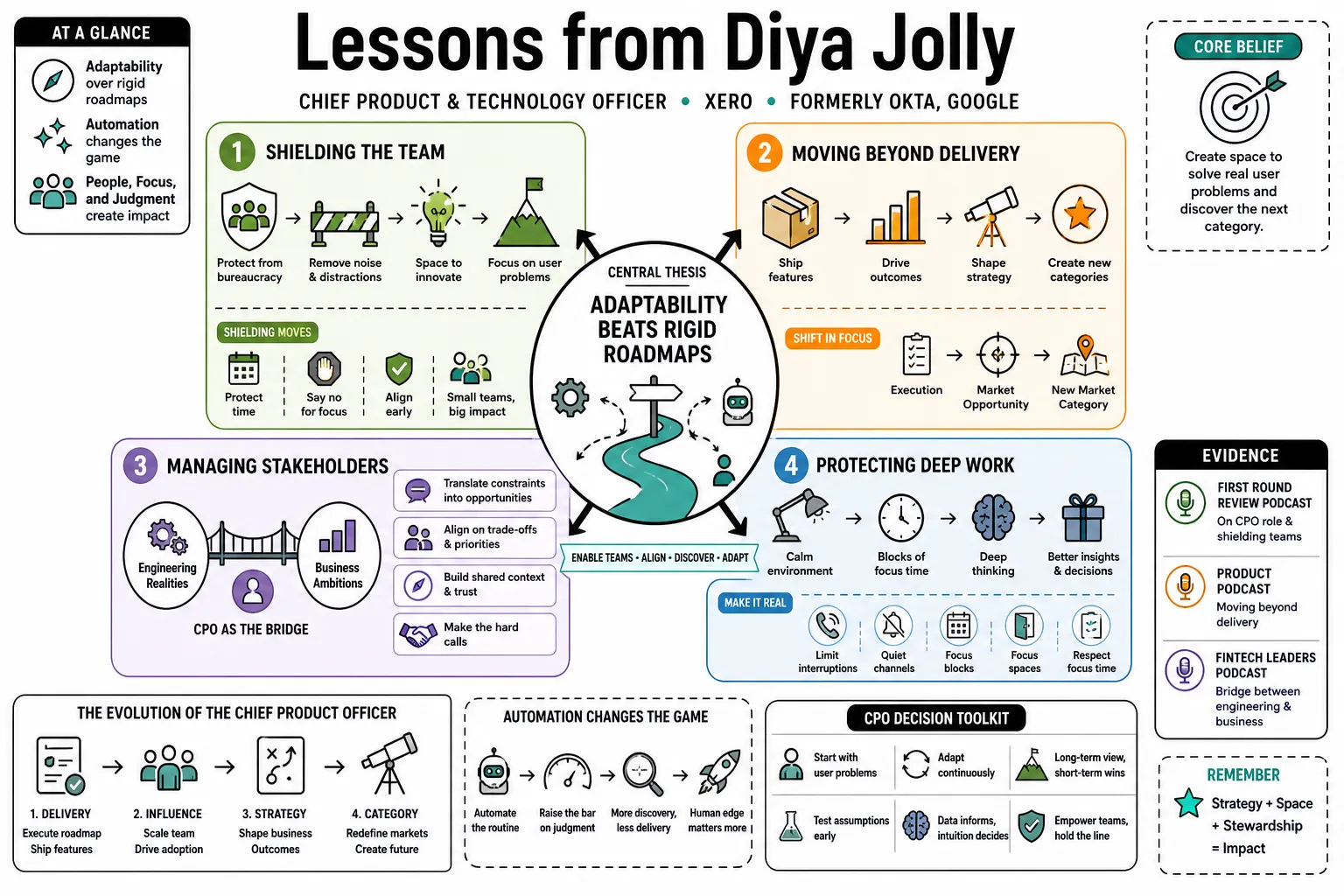
Lessons from Diya Jolly
Jolly has led product at Google and Okta and is Chief Product and Technology Officer at Xero. In direct interviews she explains how customer understanding, product direction, resource choices and AI-enabled workflows shape the role. — First Round Review — Diya Jolly.
Part 1: The Evolution of the Chief Product Officer
- the True Role of a CPO: Jolly says a CPO sets product direction, understands customers and allocates resources so a team can execute; the role is not to personally decide every feature. — First Round Review — Diya Jolly.
- Shielding the Team: When testing a new AI-native workflow, Jolly argues for giving a small innovation team space to start from the desired experience rather than inherit every constraint of the existing product. — First Round Review — Diya Jolly.
- Managing Stakeholders: A product strategy needs cross-company buy-in: Jolly says engineering builds it, support serves it, and sales sells it, so a CPO cannot develop that strategy in isolation. — The Takeoff — Diya Jolly.
- Protecting Deep Work: At senior levels, Jolly protects time for a few consequential and ambiguous decisions instead of letting tactical execution fill the calendar. — First Round Review — Diya Jolly.
- Outcome vs. Output: Jolly says product teams should define the customer value they seek, which can include satisfaction or engagement rather than only revenue, then launch and iterate toward it. — Operator Collective — Diya Jolly.
- the Engineering Partnership: Jolly organizes functional craft separately but brings product, design, engineering and analytics or machine learning into dedicated product pods with a common mission. — Product Podcast — Diya Jolly.
- Empowering PMs: Jolly delegates decisions with clear owners and outcome metrics, keeping close attention for initiatives whose business impact or uncertainty warrants it. — Product Podcast — Diya Jolly.
- Seek Breadth Across Company Stages: Jolly advises aspiring product leaders to gain experience across startups, midsize firms, large companies and domains, even if a move does not immediately advance a title. — First Round Review — Diya Jolly.
- Strategic Patience: In a fast-changing AI market, Jolly says a roadmap needs room for uncertain bets and for learning that may position the product years later. — First Round Review — Diya Jolly.
Part 2: Customer Empathy and Small Business Needs
- the Analytics Gap: Jolly says Xero acquired Syft to bring stronger reporting and visual financial insights into Xero, beginning with a limited release and gathering feedback before wider expansion. — Xero — Analytics powered by Syft.
- Designing for Small Businesses: Jolly frames automation of repetitive financial work as a way to reduce toil for small-business owners and free attention for decisions. — Operator Collective — Diya Jolly.
- Building Confidence: Jolly says visual financial insights should help small businesses see how they are performing and make better-informed decisions with their advisors. — Xero — Analytics powered by Syft.
- User Research: Jolly has had her team spend a day with an accountant or bookkeeper and says product leaders should also use their own product to understand daily workflows. — Product Podcast — Diya Jolly.
- Solving Unstated Problems: Jolly says customers’ requests can mask a different underlying pain: a request for cash-flow information may actually mean they need to be paid sooner. — Accounting Apps Podcast — Diya Jolly.
- the Value of Clarity: Xero’s Syft integration aims to make profitability, profit-and-loss and balance-sheet information easier for small businesses to visualize. — Xero — Analytics powered by Syft.
- Prioritizing Needs: Jolly says Xero focuses on a defined small-business segment because trying to serve too many customers with different needs produces an incoherent product. — Product Podcast — Diya Jolly.
- Customer Trust: For AI in accounting, Jolly pairs automation with bounded answers and a review workflow so accountants can see and correct what the system did. — Product Podcast — Diya Jolly.
- Global vs. Local Needs: Jolly recommends building shared services for common elements while allowing regional teams and APIs to handle local tax and payment requirements. — Product Podcast — Diya Jolly.
Part 3: Artificial Intelligence and the Agentic Future
- Agentic AI: Jolly describes JAX as a coordinating agent for bank reconciliation, payments and payroll agents, sharing information and preferences across tasks. — Product Podcast — Diya Jolly.
- AI as an Employee: Jolly likens JAX to a junior employee that can surface financial insights and help automate work, while the business owner remains able to review actions. — Product Podcast — Diya Jolly.
- AI in FinTech: Jolly identifies repetitive work such as data entry and bank reconciliation as important AI opportunities, alongside guardrails for accuracy. — Unite.AI — Diya Jolly Interview.
- Integrating AI: Jolly argues that AI changes the underlying workflow and interface: users may review actions and insights instead of only clicking through forms to do each step. — Product Podcast — Diya Jolly.
- Proactive Software: Jolly expects software to move toward outcomes such as helping a business get paid, with agents taking actions while customers review what happened. — First Round Review — Diya Jolly.
- Managing AI Risk: Jolly says rapid AI change calls for riskier product bets because current customer requests alone may not reveal what workflows users will accept next. — First Round Review — Diya Jolly.
- User Control in AI: Jolly says financial automation must leave users able to inspect and correct the system’s work; visibility is central to trust. — Product Podcast — Diya Jolly.
- Data Quality: Jolly says Xero’s existing transaction data helps AI applications, but accuracy also requires algorithmic guardrails and human review. — Product Podcast — Diya Jolly.
- Future Interfaces: Jolly expects conversational interaction to replace some button-and-dashboard navigation, letting users ask financial questions from surfaces outside the app. — Product Podcast — Diya Jolly.
- AI Accessibility: Jolly says Xero’s AI work should reduce repetitive toil and provide timely insights so small businesses can use capabilities that would otherwise demand more time and expertise. — Operator Collective — Diya Jolly.
Part 4: Product Strategy and Roadmapping
- Obsessing Over Roadmaps: Jolly says a CPO should set direction and place customer-informed bets rather than personally control every item on a fixed feature roadmap. — First Round Review — Diya Jolly.
- Strategic Flexibility: As AI changes what users expect, Jolly says product teams should take more uncertain bets instead of treating yesterday’s customer requests as a complete map of tomorrow. — First Round Review — Diya Jolly.
- Define the Customer Problem: Jolly says a product vision starts with deeply understanding customers’ jobs, workflows and pain points, then translating that understanding into a feasible software solution. — Product Podcast — Diya Jolly.
- Evaluating Trade-offs: Jolly says a product leader cannot make every bet; customer understanding and deliberate allocation of scarce resources determine what to pursue. — First Round Review — Diya Jolly.
- Cross-Portfolio Vision: At Okta, Jolly distinguished a feature launch from a new-product launch: a product needs a target customer, market case, cross-functional build and coordinated go-to-market. — The Takeoff — Diya Jolly.
- Resource Allocation: Jolly treats resource allocation as an ongoing CPO decision: bets differ in importance and complexity, and she revisits team design as conditions change. — First Round Review — Diya Jolly.
- Listening to the Market: Jolly reserves time to use her products, talk to customers and watch changes in the market and technology before selecting product bets. — Operator Collective — Diya Jolly.
- Iterative Planning: Jolly says organizational and resource choices cannot be made once and left alone; changing conditions require revisiting them frequently. — First Round Review — Diya Jolly.
- Communicate a Clear Direction: Jolly says a CPO needs to explain a product direction aligned with the company vision, then build a team able to execute without the CPO specifying each feature. — First Round Review — Diya Jolly.
Part 5: Navigating High-Growth and Scaling
- Scaling Empathy: Even at Xero’s scale, Jolly tries to stay close to real users through advisory councils, product use and firsthand observation of accounting work. — Product Podcast — Diya Jolly.
- Hiring Product Talent: When building product teams, Jolly looks for ownership and a focus on measurable customer value, combined with the willingness to launch and iterate. — Operator Collective — Diya Jolly.
- Breaking Silos: Jolly says AI work at Xero calls for product, design, data science, security and engineering to collaborate across former functional boundaries. — Unite.AI — Diya Jolly Interview.
- Modernize Platform Foundations: Jolly says Xero has been making parts of its platform more modular and resilient so teams can test AI and payments changes without undermining stability. — Unite.AI — Diya Jolly Interview.
- Maintaining Velocity: Jolly favors launching a reasonable product and improving it with feedback rather than waiting for perfect information before release. — Operator Collective — Diya Jolly.
- Empowering Local Teams: Jolly says regional teams need room to adapt a common platform to local financial rules and customer contexts. — Unite.AI — Diya Jolly Interview.
- the Role of Data at Scale: Jolly distinguishes product evidence over time: early customer feedback, middle-stage usage measures and later revenue help judge whether a product works. — The Takeoff — Diya Jolly.
Part 6: Making Decisions with Incomplete Information
- the Illusion of Perfect Data: Jolly recommends moving once the team has enough information to map possible outcomes, rather than waiting for complete certainty. — Fintech Leaders — Diya Jolly.
- Action as Research: For reversible decisions, Jolly says teams often learn faster by launching a bounded experiment and course-correcting from the feedback. — Product Podcast — Diya Jolly.
- Trusting Intuition: Jolly combines available data with experience when evaluating uncertain product choices, using a decision tree rather than pretending probabilities are exact. — Fintech Leaders — Diya Jolly.
- Reversible Choices: Jolly separates hard-to-reverse choices, such as initial pricing, from two-way-door decisions that can be tested and changed more quickly. — Product Podcast — Diya Jolly.
- Navigating Ambiguity: As a senior product leader, Jolly focuses on a small number of consequential ambiguous decisions and builds a team capable of handling routine execution. — First Round Review — Diya Jolly.
- Post-Decision Alignment: Jolly says leaders may revise a decision as assumptions change, but constant reversals will spin a team; they should make the conditions for reconsideration explicit. — Fintech Leaders — Diya Jolly.
- Scenario Planning: When information is incomplete, Jolly describes laying out a decision tree and assigning probabilities from available trends and team experience. — Fintech Leaders — Diya Jolly.
- Communicating Uncertainty: Jolly recommends stating which assumptions underlie a decision and when the team would revisit it if those assumptions fail. — Fintech Leaders — Diya Jolly.
Part 7: Leading Cross-Functional Teams
- Fostering Debate: For important ambiguous questions, Jolly gathers outside information, frames the issue for debate and then clarifies execution after the team has worked through it. — First Round Review — Diya Jolly.
- Aligning Incentives: Jolly says cross-team politics often signals misaligned incentives; leaders can reward collaboration and company-level outcomes, including work that helps another team. — First Round Review — Diya Jolly.
- the Value of Design: Jolly sees strong products as a blend of technical understanding and commercial judgment, with product and engineering working toward the same customer goal. — Operator Collective — Diya Jolly.
- Engineering Empathy: Jolly recommends that aspiring product managers spend time coding so they can understand engineering constraints and communicate better with engineers. — The Takeoff — Diya Jolly.
- Creating Psychological Safety: Jolly says people who feel safe are more likely to act in the organization’s interest, while leaders can combine support with demanding performance standards. — First Round Review — Diya Jolly.
- Celebrating Wins: Jolly recommends recognizing work that helps other teams even when the person’s own launch did not go well. — First Round Review — Diya Jolly.
Part 8: Career Philosophy and Following Intuition
- Chasing Impact: Jolly advises ambitious product managers to prioritize work they will be proud of for its impact and growth, rather than optimize only for the next title. — First Round Review — Diya Jolly.
- the Internal Compass: Jolly says career choices sometimes looked counterintuitive to others, but she followed her own sense of what she wanted to build and learn. — Operator Collective — Diya Jolly.
- Embracing the Now: Jolly encourages choosing roles for learning, growth, colleagues and impact rather than only brand, compensation or title. — Operator Collective — Diya Jolly.
- Professional Growth: Jolly says the most stretching roles can feel premature, but accepting them and learning through mistakes accelerated her growth. — Operator Collective — Diya Jolly.
- Building Resilience: Jolly recounts relying on persistence when a McKinsey client doubted her as a young consultant, and carrying that grit into later large role changes. — Operator Collective — Diya Jolly.
- Continuous Learning: Jolly credits curiosity and ongoing learning with helping her build products that customers value and that can succeed commercially. — Operator Collective — Diya Jolly.
- Build Successors: Jolly advises senior leaders to hire people capable of doing their jobs and eventually stepping into their roles, so the leader can focus on larger decisions. — First Round Review — Diya Jolly.