Ed Thorp is a mathematician who proved that blackjack could be beaten by counting cards, altering how casinos calculate probability. He later applied his edge-seeking logic to Wall Street, establishing the first market-neutral quantitative hedge funds and trading statistical arbitrage. This collection outlines his systems for evaluating probability, managing ruinous risk, and maintaining physical health into his nineties.
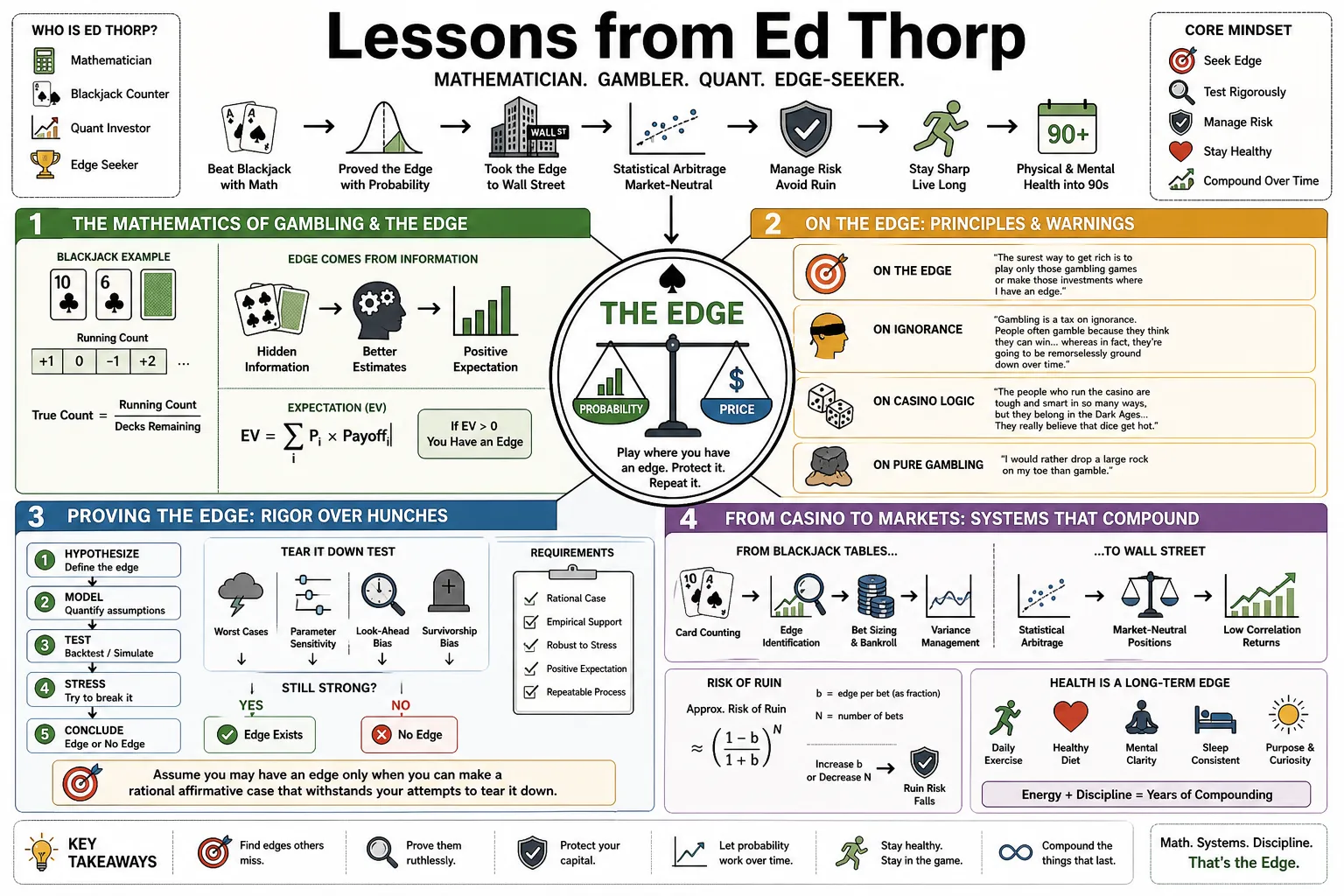
Part 1: The Mathematics of Gambling & The Edge
- On The Edge: "The surest way to get rich is to play only those gambling games or make those investments where I have an edge." — Source: [Bookey]
- On Ignorance: "Gambling is a tax on ignorance. People often gamble because they think they can win... whereas in fact, they're going to be remorselessly ground down over time." — Source: [Gracious Quotes]
- On Casino Logic: "The people who run the casino are tough and smart in so many ways, but they belong in the Dark Ages... They really believe that dice get hot." — Source: [Gracious Quotes]
- On Pure Gambling: "I would rather drop a large rock on my toe than gamble [without an edge]." — Source: [Novel Investor]
- On Proving the Edge: "Assume you may have an edge only when you can make a rational affirmative case that withstands your attempts to tear it down." — Source: [Medium]
- On Asymmetric Risk: "A small extra gain is generally not worth the substantial risk the deal will break up." — Source: [Goodreads]
- On Information Advantage: "Be aware that information flows down a 'food chain,' with those who get it first 'eating' and those who get it late being eaten." — Source: [The Cite Site]
- On Systematic Advantage: "Casino gambling with a system where you have the edge is a wonderful teacher for elementary money management." — Source: [Noteworthy Nonsense]
- On Betting Without Math: "If you do not have a logically demonstrable edge, you are the sucker at the table and should not be playing the game." — Source: [AQR]
- On Defining the Edge: "An edge is simply an excess return after adjusting for risk, net of costs, that can be mathematically defended against a devil's advocate." — Source: [Novel Investor]
Part 2: Beating the Dealer
- On The Shifting Edge: "The odds as the game progressed actually depended on which cards were still left in the deck and that the edge would shift as play continued." — Source: [Goodreads]
- On Solving Blackjack: "Blackjack is not a game of independent trials like roulette, but a mathematical puzzle where past events directly alter future probabilities." — Source: [BookHampton]
- On Information Tracking: "Tracking the ratio of high cards to low cards provides a statistical advantage over the house that can be exploited systematically." — Source: [Bookey]
- On The Wearable Computer: "By calculating the speed of the rotor and the ball, roulette transforms from a game of pure probability into a predictable physical system." — Source: [Engadget]
- On Physics vs. Probability: "You can beat roulette by analyzing it as a physics problem rather than a statistical one, generating a staggering expected gain." — Source: [UCI]
- On Psychology at the Table: "It was becoming clear that there was more to beating blackjack than counting cards and keeping cool as your bankroll went up and down." — Source: [Scribd]
- On House Rules: "When casinos change the rules to thwart a winning system, it serves as ultimate validation that the mathematics are sound." — Source: [888 Casino]
- On Technology in the Casino: "Using a hidden analog computer to predict roulette outcomes demonstrated that technological innovation could conquer traditional house advantages." — Source: [Engadget]
- On Execution: "Having the winning system in your head is useless without the discipline to execute it flawlessly under extreme pressure from casino operators." — Source: [Scribd]
- On Scientific Skepticism: "He refused to believe blackjack was unbeatable just because experts said so, choosing instead to test the math on an IBM mainframe." — Source: [Blinkist]
Part 3: Beating the Market
- On The Market as a Casino: "Betting on a hedge I had researched was like betting on a blackjack hand where I had the advantage." — Source: [Scribd]
- On Market Inefficiency: "Neither Jerry nor I believed the efficient market theory. I had overwhelming evidence of inefficiency from blackjack... We didn't ask, 'Is the market efficient?' but rather, 'In what ways and to what extent is the market inefficient?'" — Source: [Goodreads]
- On Statistical Arbitrage: "Hedging market risk by buying undervalued securities and shorting related overvalued ones eliminates market direction from the equation." — Source: [Michael Burry]
- On The Zero-Sum Game: "Active investing is a zero-sum game on net. Unless you possess a specific, proven edge, you are merely trading fees for underperformance." — Source: [Novel Investor]
- On Index Funds: "If you're a long-term investor, just buy and hold equities... unless you can prove you have a specific edge, you are better off in index funds." — Source: [Tim.blog]
- On Circle of Competence: "Focus on investments well within your knowledge and ability to evaluate; if you aren't a professional with specific skills, stick to indexing." — Source: [Masters Invest]
- On Technological Superiority: "When the Chicago Board Options Exchange opened in 1973, the only people on the floor were my traders. It was like having machine guns against bows and arrows." — Source: [Podcast Notes]
- On Wall Street vs. Casinos: "When I shifted my focus from beating gambling games to analyzing the stock market, I naively thought that I was leaving a world where cheating at cards was problematic... Instead, I learned that bigger stakes attracted bigger thieves." — Source: [Goodreads]
- On Discovering Talent: "Investing in Warren Buffett's Berkshire Hathaway early on was a lesson in recognizing superior talent when an area falls outside your own immediate expertise." — Source: [25iq]
- On Evidence-Based Trading: "There are inefficiencies in the market, but they're not easy to demonstrate, and I think that needs to be done before one shifts money in that direction." — Source: [Medium]
Part 4: Risk Management & The Kelly Criterion
- On The Lesson of Leverage: "Assume the worst imaginable outcome will occur and ask whether you can tolerate it. If the answer is no, then reduce your borrowing." — Source: [Masters Invest]
- On Bet Sizing: "Betting too much, even though each individual bet is in your favor, can be ruinous." — Source: [Bookey]
- On Risk Avoidance: "Risk: don't get taken out of the game. Great investment risks can take you out of the game altogether." — Source: [Tim.blog]
- On The Kelly Criterion: "The size of your bet must be strictly proportional to your edge; a large edge with low risk warrants a large bet, while high risk demands minimal exposure." — Source: [Eversight Wealth]
- On Surviving Ruin: "Maximizing long-term growth is meaningless if you allow the mathematical probability of going broke to rise above zero." — Source: [25iq]
- On Scaling Risk: "The bigger my edge, the more I bet and the greater the risk the more cautious I was." — Source: [Gracious Quotes]
- On Protecting the Bankroll: "Proper risk management means managing bankroll volatility so meticulously that external shocks cannot force liquidation at bad prices." — Source: [Scribd]
- On Defense First: "Minimizing the chance of truly disastrous outcomes is always the foundational step before seeking outsized returns." — Source: [J Jude]
- On Mathematical Discipline: "Risk management is not an intuitive feeling but a rigorous mathematical formula that must be followed regardless of emotional conviction." — Source: [Macro Ops]
Part 5: Life as a Game of Chance and Choice
- On The Cards You Are Dealt: "In the abstract, life is a mixture of chance and choice. Chance can be thought of as the cards you are dealt in life. Choice is how you play them." — Source: [Gracious Quotes]
- On The Journey: "Life is like reading a novel or running a marathon. It's not so much about reaching a goal but rather about the journey itself." — Source: [Tim.blog]
- On Character: "Character is destiny." — Source: [Goodreads]
- On Defining Success: "Success on Wall Street was getting the most money. Success for us was having the best life." — Source: [Deciphr]
- On Quality over Quantity: "What matters is what you do and how you do it, the quality of time you spend, and the people you share it with." — Source: [Philosophical Investor]
- On Satisficing vs. Maximizing: "Finding a great outcome and moving on to enjoy life is vastly superior to stressing indefinitely over achieving the absolute theoretical maximum." — Source: [Shortform]
- On Navigating Randomness: "We cannot control the probabilistic nature of the universe, but we retain complete agency over the algorithms we use to respond to it." — Source: [Goodreads]
- On Life Optimization: "Applying probabilistic thinking to everyday decisions ensures you consistently place yourself in situations with favorable expected values." — Source: [J Jude]
- On Action Over Paralysis: "Some is better than none. And more, up to a point, is better than less. Just start doing it." — Source: [Tim.blog]
Part 6: Education, Rationality, & Independent Thinking
- On Brain Software: "Education builds software for your brain." — Source: [Eversight Wealth]
- On Thinking for Yourself: "When you begin to think for yourself, the whole world changes and becomes much clearer." — Source: [Tim.blog]
- On Skepticism: "A trait that showed up at about this time was my tendency not to accept anything I was told until I had checked it for myself." — Source: [Scribd]
- On Conventional Wisdom: "Just because a lot of people say something is true, that doesn't carry any particular weight with me. You need to do some independent thinking." — Source: [Tim.blog]
- On Withholding Judgment: "I learned the value of withholding judgment until I could make a decision based on evidence." — Source: [Podcast Notes]
- On Learning to See: "Continuous learning upgrades your mental processing power, allowing you to recognize patterns and structural advantages that others fundamentally miss." — Source: [Eversight Wealth]
- On Data Over Dogma: "Never rely on 'common knowledge' when mathematical verification is possible through data gathering and careful experimentation." — Source: [Blinkist]
- On Evaluating Experts: "Question the underlying incentives and statistical rigor of authorities before accepting their conclusions as foundational truths." — Source: [The Cite Site]
- On The Wisdom of Crowds: "I call the flip side to the wisdom of crowds the lunacy of lemmings." — Source: [Goodreads]
Part 7: Wealth, Greed, & Human Behavior
- On Having Enough: "Enough is enough: once you get enough capital, let the money work for you—don't spend another minute doing things in life that you don't want to do." — Source: [Apple Podcasts]
- On Incentives: "I learned from my losing silver investment that when the interests of the salesmen and promoters differ from those of the client, the client had better look out for himself." — Source: [Scribd]
- On Evaluating Operators: "The most important single thing to check before investing is the honesty, ethics, and character of the operators." — Source: [Goodreads]
- On Merit vs. Politics: "I object to gain of wealth through political connections rather than earning it by merit." — Source: [Podcast Notes]
- On Greed: "People are often blinded by the promise of outsized returns, ignoring the basic mathematical impossibilities of the pitch." — Source: [AQR]
- On Negotiation: "It doesn't pay to push the other party to their absolute limit if it risks destroying a mutually beneficial arrangement." — Source: [Gracious Quotes]
- On The Ultimate Value: "As Princeton Newport Partners closed, he realized that maximizing net worth was an empty pursuit if it cost him his autonomy." — Source: [Deciphr]
- On Financial Independence: "True wealth is the structural freedom to walk away from any deal, environment, or relationship that compromises your peace of mind." — Source: [Tim.blog]
- On Avoiding Swindlers: "The financial ecosystem is filled with predators; rigorous due diligence on the human element is just as critical as the mathematical models." — Source: [Masters Invest]
Part 8: Longevity, Health, & Time
- On The Worth of Time: "The most important reason to wind down the operation was that time was worth more to me than the extra money." — Source: [Goodreads]
- On Health as an Investment: "I think of each hour spent on fitness as one day less that I'll spend in a hospital." — Source: [The Cite Site]
- On Preventative Maintenance: "Health longevity requires a defensive strategy of regular screenings and eliminating weak links before they compound into crises." — Source: [J Jude]
- On Physical Awareness: "I can look down, if I see anything that isn't flat down there, I know I weigh too much. That's another awareness: needs to change things." — Source: [Tim.blog]
- On Core Strength: "Maintaining flexibility and core strength is the ultimate defense against falls, a primary probabilistic risk for the elderly." — Source: [The Retirement Manifesto]
- On Exercise Discipline: "Allocating 6 to 8 hours a week to aerobic and resistance training is a non-negotiable fixed cost for extending the prime years of life." — Source: [Business Insider]
- On Dietary Constraints: "Avoiding the standard American diet and keeping body weight static for decades drastically reduces the probability of chronic diseases." — Source: [Business Insider]
- On Buying Back Time: "Benjamin Franklin said time is the stuff life is made of; once wealthy, the highest leverage move is to hire others to reclaim your hours." — Source: [Philosophical Investor]
- On Enjoying the Present: "Vivian and I wanted to enjoy our children and their families, and to travel, read, and learn." — Source: [Goodreads]