Lessons from Edward Rogers
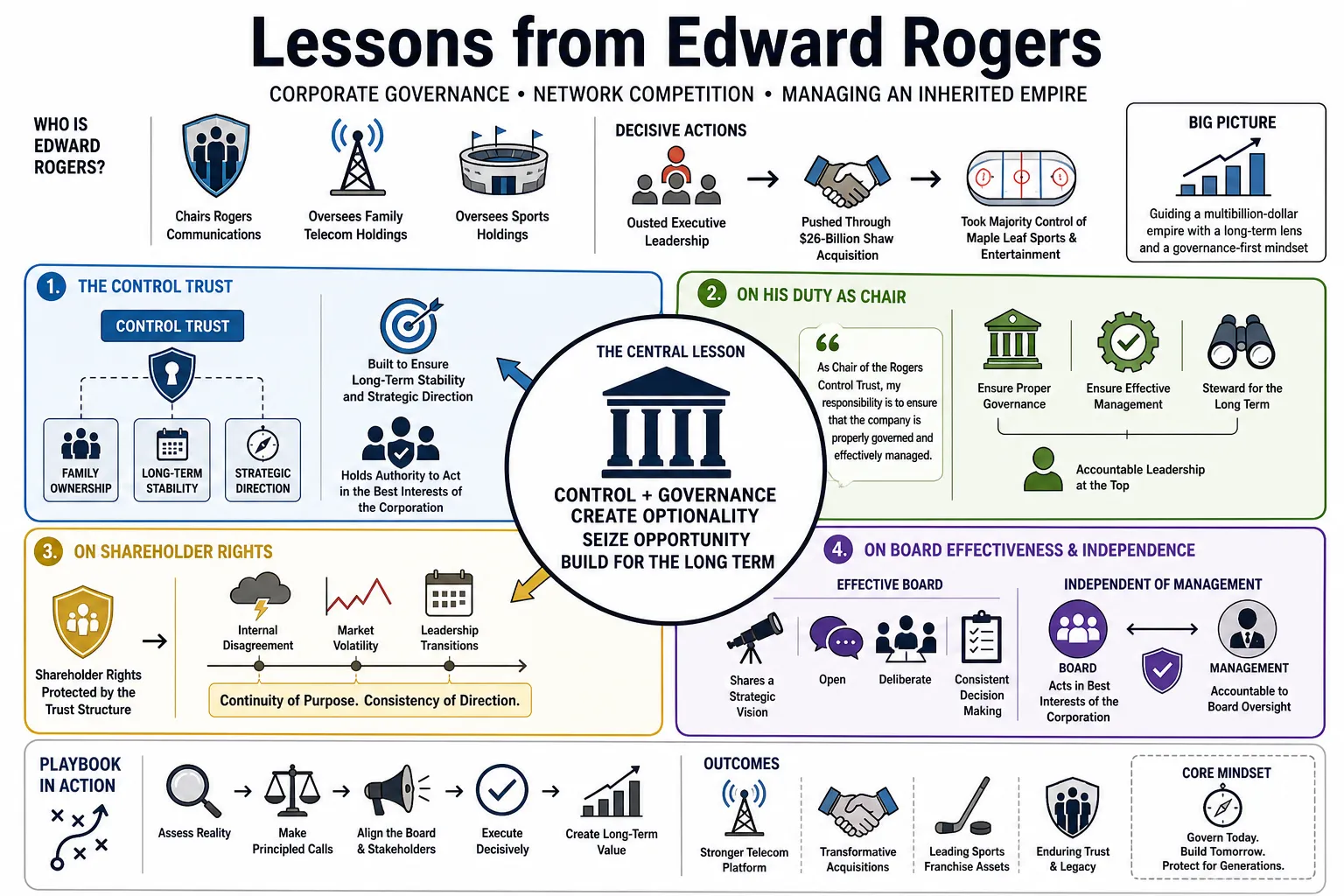
Edward Rogers chairs Rogers Communications and oversees his family's telecommunications and sports holdings. He used his authority over the family trust to oust executive leadership, push through the $26-billion Shaw Communications acquisition, and take majority control of Maple Leaf Sports & Entertainment. These notes track his approach to corporate governance, network competition, and managing a multibillion-dollar inherited empire.
Part 1: The Control Trust and Corporate Governance
- On his duty as Chair: "As Chair of the Rogers Control Trust, my responsibility is to ensure that the company is properly governed and effectively managed." — Source: [Global News]
- On shareholder rights: The trust structure exists to ensure the long-term stability and strategic direction of the company, even during periods of internal disagreement. — Source: [CBC News]
- On board effectiveness: "The company requires an effective board that shares a strategic vision for the business, is open, deliberate, consistent in its decision making." — Source: [Newswire]
- On management independence: An effective board must be "independent of management, and that always acts in the best interests of the corporation." — Source: [Newswire]
- On the stroke of a pen: Under corporate law, holding the majority of voting shares allows the Trust to decisively reconstitute the board without a shareholder meeting. — Source: [Canadian Lawyer]
- On fiduciary obligation: "I take that responsibility very seriously" when acting to protect the investments and future of the corporation. — Source: [Global News]
- On resolving governance disputes: The legal framework of the corporation supersedes informal family agreements or minority shareholder preferences when decisive action is required. — Source: [BIV]
- On the limits of shared decision-making: "My lifetime experience has been that committee and shared decision-making often leads to slow, if any, decision-making." — Source: [Sports Business Journal]
- On swift execution: Reconstituting the board via written resolution was a necessary mechanism to prevent prolonged instability during a critical acquisition window. — Source: [BNN Bloomberg]
- On corporate law precedent: The Supreme Court ruling affirmed that the legal rights of the Control Trust are absolute, regardless of the optical drama surrounding the family. — Source: [CBC News]
Part 2: Managing the Boardroom Battle
- On the public nature of the dispute: "The steps I have taken in the face of constant attacks in the media were difficult for me and my family." — Source: [Global News]
- On court victories: "I take no joy in the decision or the events of past weeks." — Source: [Straight]
- On refocusing the company post-ruling: "Our focus must be on the business, a return to stability, and closing our transformational merger with Shaw Communications." — Source: [Financial Post]
- On executive departures: He eventually cited the need for continuity, stability, and the expeditious closing of the Shaw deal as the reason for installing new leadership. — Source: [Financial Post]
- On the initial standoff: "Mr. Natale remains CEO and a director of Rogers Communications and has the Board's support." — Source: [Global News]
- On moving past the drama: "I do believe everyone did want to put Rogers, our company, first, and make sure that any of the drama and the publicity was gone." — Source: [Toronto Life]
- On media scrutiny: The relentless media coverage of the board dispute was a difficult but necessary obstacle to endure to secure the right leadership team. — Source: [Global News]
- On the necessity of change: Removing a CEO during a mega-merger is high-risk, but allowing a misalignment of vision between the board and management is a greater risk. — Source: [CBC News]
- On the end of the feud: "It got to a place where I think everyone was happy." — Source: [Toronto Life]
- On long-term vision: The immediate public fallout of the board battle was secondary to the long-term health of the acquisition strategy. — Source: [Global News]
Part 3: The Shaw Communications Merger
- On the merger's significance: "Rogers and Shaw have been connecting Canadians for more than 50 years, and we're thrilled to come together as one company." — Source: [Rogers]
- On building a shared legacy: The acquisition is built "on a shared legacy of investment, innovation, and entrepreneurship." — Source: [Rogers]
- On national scale: "At its core, our application is based on the fact that Rogers and Shaw together, with greater scale, can compete more effectively against Telus and Bell." — Source: [CRTC Hearing]
- On post-merger integration: The successful integration of Shaw was the primary mandate for the new management team following the restructuring. — Source: [Financial Post]
- On long-term investments: "As we proceed towards closing our merger with Shaw Communications, we continue making investments in our future." — Source: [Rogers]
- On future prospects: "I am certain that for Rogers Communications the best days are still ahead of us." — Source: [CRTC Hearing]
- On generational deals: "Both were historic deals to us, and if we didn't do them, we were probably passing for a generation." — Source: [Sports Business Journal]
- On regional strength: Combining the East and West creates a unified, national telecommunications infrastructure capable of massive capital deployment. — Source: [Toronto Life]
- On regulatory hurdles: Securing approval for the Shaw merger required demonstrating that the combined entity would enhance rather than stifle Canadian connectivity. — Source: [CRTC Hearing]
- On executing for customers: The ultimate goal of the Shaw acquisition is "executing well for our customers" across a broader, more robust network. — Source: [Rogers]
Part 4: Telecommunications Strategy and Competition
- On the nature of the industry: "Rogers is not a turnaround. We’re trying to grow the company from where we’ve taken it and move into the next five years." — Source: [Financial Post]
- On global competitors: "While our primary competitors are still Bell and Telus in the cable business, in this global world, our competitors are also increasingly global platforms and brands." — Source: [CRTC Hearing]
- On the necessity of scale: "Today's telecommunications networks need scale to compete on the world stage." — Source: [CRTC Hearing]
- On competitive intensity: "We think we compete well and we’re going to continue to compete very well as we go forward." — Source: [Financial Post]
- On facilities-based competition: "We believe passionately that a combination of Rogers and Shaw will help contribute to a stronger facility-based future for Canadians." — Source: [CRTC Hearing]
- On government policy: "The CRTC's misguided decision runs counter to the federal government's own agenda to drive real competition, encourage network investment, and expand connectivity." — Source: [Rogers]
- On the failure of wholesale models: Mandated wholesale access is "doubling down on a failed policy that won't create competition and will reduce capital investment." — Source: [Rogers]
- On material improvement: "I think you've seen material improvement in how we compete." — Source: [Toronto Life]
- On strategic acquisitions: "We will look for selective tuck-ins if they come up and make sense, but will be mainly focused on what we have today." — Source: [Financial Post]
Part 5: Leadership and Decision-Making
- On his father's advice: "Work hard, be paranoid about the future but continue to move forward." — Source: [Financial Post]
- On his own path: "To be honest with you, I thought that is what I was supposed to do... I grew up in the business with Ted and family time was time with the company." — Source: [Financial Post]
- On adding value as Chair: "By working with management, the family believes it can add more value and increase the chances that the company moves into the future in a stronger way." — Source: [Financial Post]
- On his personal development: "I tell people that I grew up in the States. I came back an adult." — Source: [Toronto Life]
- On the ideal CEO profile: "The job we were hiring for was a CEO that had the full stack... There aren’t a lot of those." — Source: [Sportsnet]
- On hiring externally: Replacing leadership during a crisis requires a CEO who understands the financial complexities and the strategic urgency of the moment. — Source: [Financial Post]
- On corporate real estate: "M City will be anchored by iconic design, it will prioritize public spaces and parkland, and it will offer residents the best technology available." — Source: [M City Mississauga]
- On staying grounded: You have to separate the noise of public opinion from the quiet, necessary work of steering a multibillion-dollar enterprise. — Source: [Toronto Life]
- On his ultimate role: His mandate is to ensure the right people are in the room to execute the family's long-term vision, rather than running daily operations. — Source: [Financial Post]
Part 6: Navigating Family Dynamics and Legacy
- On family disagreements: "Our family has disagreements like every other family. I am hopeful we will resolve those differences privately, as any family would." — Source: [Global News]
- On his siblings: "They’re still owners of the company. They’re still siblings." — Source: [Toronto Life]
- On Ted's visionary nature: "My dad was a visionary. He had a great way about him to see how technology would evolve and how we would use it." — Source: [Sports Business Journal]
- On building on the past: "Working together, we will build on Ted's legacy and write the next chapter in Rogers history." — Source: [Sports Business Journal]
- On his final promise to Ted: "I said, 'I'll do my best.' And so that's what I'm doing." — Source: [Sports Business Journal]
- On the Control Trust's design: Ted Rogers engineered the trust specifically so that one person, the Chair, would have the final say to prevent committee-led paralysis. — Source: [CBC News]
- On family versus business: When the interests of the business collide with the comfort of the family, the fiduciary duty to the corporation must take precedence. — Source: [BIV]
- On keeping the company whole: The overarching goal of the Control Trust is to ensure the Rogers empire remains intact and resistant to hostile takeovers. — Source: [Toronto Life]
- On the burden of succession: Inheriting a telecom monopoly comes with the intense pressure to maintain it and aggressively expand its footprint. — Source: [Financial Post]
Part 7: Sports Ownership and MLSE
- On the value of sports: "Historically, people would have seen sports as different than telecom, different than sports broadcasting. But we look at the value as one." — Source: [Toronto Life]
- On the Bell partnership: "That relationship was very effective. There were disagreements. But you’ve got to remember, Bell and Rogers are both in the same business." — Source: [Sports Business Journal]
- On unified strategy: "The desire would be to bring those assets into one company and have a unified sports and entertainment strategy." — Source: [Sports Business Journal]
- On singular control: Moving to majority ownership of MLSE allows for one hand on the steering wheel, eliminating the friction of joint governance. — Source: [Sports Business Journal]
- On sports as a telecom lever: If fans engage with the company through live games and media platforms, they may be less likely to switch their telecom providers. — Source: [Substack]
- On investing in talent: "I knew if we could do that, and invest in the payroll side, that we had a formula for something that could be very special." — Source: [Toronto Life]
- On community connection: "This is the beauty of sports. It brings us together, it brings friends and families together." — Source: [Toronto Sun]
- On sports as a unifier: "What I love the most about is, it’s the great unifier in this country." — Source: [Toronto Sun]
- On Don Cherry: "Don Cherry is an icon no one wants to mess with." — Source: [Financial Post]
Part 8: The Toronto Blue Jays and Winning
- On the process of winning: "I didn’t realize there was a whole process to this at this level." — Source: [Toronto Sun]
- On postseason success: "The whole thing was spectacular and fantastic and humbling." — Source: [Toronto Sun]
- On championship ambitions: "We thought we were building a contender. We actually thought we were close." — Source: [Toronto Sun]
- On future optimism: "We’re still very bullish on that, and this team, now and for the future." — Source: [Toronto Sun]
- On front office leadership: "We’ve been competitive over the last couple of years at being a viable option for some of the top free-agent talent and I think that’s a testament to Mark’s leadership." — Source: [Sportsnet]
- On organizational transformation: The ability to attract elite free agents to Toronto is a major shift from the reality the team faced a decade ago. — Source: [Sportsnet]
- On supporting baseball operations: "I’m there to support Mark and to support Ross and John, anything that I can do." — Source: [Sportsnet]
- On staying out of the way: "We’re only in the room for players of that calibre because of the leadership of Mark." — Source: [Sportsnet]
- On the convergence model: Owning the team, the stadium, and the broadcast network creates a fully integrated media ecosystem that justifies massive payroll investments. — Source: [Toronto Life]