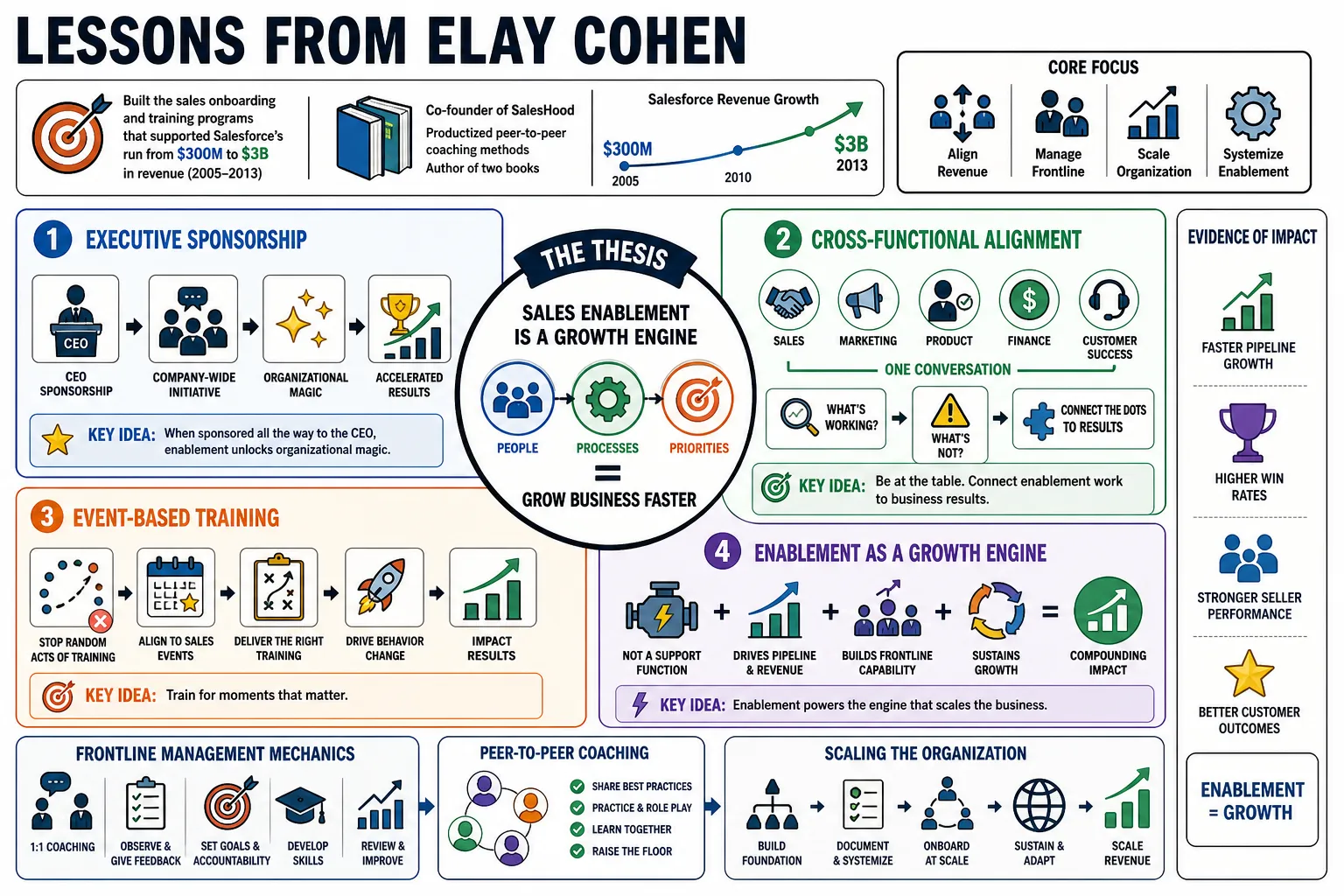
Lessons from Elay Cohen
Elay Cohen led sales productivity and enablement work at Salesforce during its growth into a multibillion-dollar business, then co-founded SalesHood. He is the author of Enablement Mastery and SalesHood, books focused on sales learning, coaching and performance. — SalesHood — Leadership.
Part 1: The Foundations of Sales Enablement
- On the Definition of Enablement: Cohen defines sales enablement as aligning people, processes and priorities to help a company grow faster. — SalesHood — What Is Sales Enablement?.
- On Executive Sponsorship: Cohen says enablement works best with top-down support from the CEO and alignment among sales, marketing and frontline teams. — SalesHood — Ten Sales Enablement Guiding Principles.
- On Growth Engines: Cohen treats enablement as a revenue-growth discipline whose success should be measured against the go-to-market outcomes it is meant to improve. — SalesHood — Ten Sales Enablement Guiding Principles.
- On Cross-Functional Alignment: Cohen argues that enablement teams need access to seller and team performance data so they can connect their programs to go-to-market results and make a fact-based case to leaders. — Enablement Mastery — Go-to-Market Alignment.
- On Event-Based Training: Treat enablement as a continuing learning program, not a one-off workshop; Cohen calls for weekly manager-led development and reinforcement. — SalesHood — Get Teams Up to Speed Faster.
- On ROI: Cohen asks leaders to compare an enablement initiative's expected return with the alternative of hiring another quota-carrying salesperson. — Enablement Mastery — Organizational Buy-In.
- On Content Utility: Build buyer-persona content that helps sellers understand the problems and priorities most important to their buyers. — Enablement Mastery — Communications.
- On Process Maps: Use an enablement process map to connect go-to-market priorities with content, learning, coaching and metrics rather than issuing disconnected programs. — Enablement Mastery — Go-to-Market Alignment.
- On Measuring Success: Translate enablement activity into measurable business outcomes and use data to make the case for what is working. — SalesHood — Sales Enablement KPIs.
- On Professional Evolution: Cohen argues that revenue enablement should operate as a strategic discipline accountable for business results, not just training completion. — SalesHood — Sales Enablement Org Design.
Part 2: The Role of First-Line Managers
- On the Organizational Backbone: Cohen calls first-line sales managers the backbone of a sales organization because they are closest to rep execution and team performance. — SalesHood — The Sales Manager Manifesto.
- On Manager Execution: Frontline managers turn sales strategy into pipeline, customer acquisition and quota performance through coaching and operating cadence. — SalesHood — The Sales Manager Manifesto.
- On the Manager's Choice: Cohen asks managers to lead by example and coach reps toward stronger performance instead of merely policing activity. — SalesHood — The Sales Manager Manifesto.
- On Ownership: Give first-line managers the content, tools and templates to run team meetings, deal reviews and coaching, while holding them accountable for execution. — Hypergrowth Sales Enablement Playbook.
- On Selecting Leaders: A sales enablement program depends on engaged first-line managers who model its practices and actively coach their teams. — SalesHood — Sales Managers, Lead By Example.
- On Matching Skill to Task: Map each manager's coaching, communication and deal-review responsibilities to clear team priorities so the program can be executed consistently. — Enablement Mastery — Communications.
- On End-of-Quarter Surprises: Use regular deal reviews and explicit next-step checks throughout the month to surface risks before the final week. — SalesHood — Monthly Cadence for Sales Teams.
- On Protecting Rep Time: Equip reps with ready-to-use content and templates so they can spend more time selling instead of assembling materials themselves. — Enablement Mastery — Communications.
- On the Transition to Management: New managers must shift from personal selling output to enabling their team's competence, confidence and quota performance. — SalesHood — The Sales Manager Manifesto.
- On Inspecting Expectations: Cohen urges sales leaders to define and review specific activity evidence, rather than treating CRM stages as proof that selling work occurred. — SalesHood — The Discipline of Sales Activity Metrics.
Part 3: Driving a Culture of Coaching
- On Creating Champions: Move beyond training completion: repeated coaching, practice and feedback are how Cohen tries to develop more capable sellers. — SalesHood — Coaching Best Practices for Sales Managers.
- On Knowledge Retention: Cohen warns that one-off workshops have limited lasting value without reinforcement, manager coaching and opportunities to practice; the profile's 95% figure is not substantiated. — SalesHood — Get Teams Up to Speed Faster.
- On the Sales Huddle: Run regular short team huddles to share best practices, revisit priorities and turn new material into discussion or role-play. — Enablement Mastery — Communications.
- On Social Learning: Make peer-to-peer best-practice sharing part of weekly team development so reps learn from one another's pitches and deal work. — SalesHood — Get Teams Up to Speed Faster.
- On Capturing Magic: Collect winning pitches, customer stories and deal examples from top performers, then make them reusable in onboarding and team coaching. — Hypergrowth Sales Enablement Playbook.
- On Authenticity: When coaching, managers should empathize, appreciate the rep's effort and give specific feedback rather than relying on generic criticism. — SalesHood — Coaching Best Practices for Sales Managers.
- On Tough Feedback: Start constructive coaching with recognition of strengths, then name the growth area clearly and offer to work on it together. — SalesHood — Coaching Best Practices for Sales Managers.
- On Building Culture: Use regular team coaching and peer review to make sales learning a shared practice rather than a manager-only task. — SalesHood — Coaching Best Practices for Sales Managers.
- On Continuous Improvement: Build coaching into one-on-ones, huddles, deal reviews and call debriefs so it becomes an ongoing workflow. — SalesHood — Coaching Best Practices for Sales Managers.
- On Psychological Safety: Let reps practice pitches and objections before high-stakes customer conversations, using repeated attempts and feedback to improve. — SalesHood — Mastering Sales Coaching.
Part 4: Process, Practice, and Pitching
- On Separation of Skill: Cohen treats sales conversations as a performance skill that improves through deliberate rehearsal of pitches, stories and objections. — SalesHood — Practice Like the Great Ones.
- On Messaging Alignment: Get the organization on message by having leaders and sellers rehearse and share short, reviewable versions of the corporate pitch. — Hypergrowth Sales Enablement Playbook.
- On Stand-and-Deliver: Replace passive viewing of pitch materials with short recorded pitches that sellers deliver, review and improve. — Hypergrowth Sales Enablement Playbook.
- On Word Patterning: Capture strong performers' pitch examples and talk tracks so teammates can study how they explain value in real conversations. — Enablement Mastery — Communications.
- On Certifications: Use pitch certifications to check whether sellers can deliver the current value proposition, rather than assuming a published deck created readiness. — Hypergrowth Sales Enablement Playbook.
- On Feedback Loops: Record short practice pitches and assess them with a shared scorecard, then use peer and manager feedback to sharpen delivery. — Hypergrowth Sales Enablement Playbook.
- On the Corporate Pitch: When the corporate pitch changes, roll it out through leader examples, seller practice and certification rather than sending slides alone. — Hypergrowth Sales Enablement Playbook.
- On Muscle Memory: Break sales conversations into short scenarios and repeat them in practice before a buyer interaction. — SalesHood — Practice Like the Great Ones.
- On Internal Briefings: Before a customer meeting, give participating executives a written account brief, clear roles, agreed agenda and time to prepare. — SalesHood — Checklist to Brief Executives Before Sales Calls.
Part 5: Buyer Engagement and Multi-Threading
- On Team Alignment: Before a buyer call, align the internal team on the agenda, roles and questions so the meeting starts with a shared purpose. — SalesHood — Checklist to Brief Executives Before Sales Calls.
- On Buying Committees: In SalesHood's analysis of its own pipeline data, multi-threaded opportunities showed seven times the buyer engagement of single-threaded deals; Cohen uses this to argue for engaging more stakeholders. — SalesHood — Signals Behind Winning Deals.
- On Digital Sales Rooms: A digital sales room can give buyers one deal-specific place to review content, ask questions and collaborate with the seller. — SalesHood — What Is a Digital Sales Room?.
- On Partnering: Use a mutual plan with buyer champions and economic buyers to agree on actions, ownership and a path to success. — Enablement Mastery — Communications.
- On Buyer Journeys: Organize pitch practice and enablement around the actual conversations buyers have across qualification, discovery, demonstrations and decision-making. — SalesHood — Sales Process and Buyer Journey.
- On Response Speed: Use buyers' actual engagement with shared materials as a signal for timely, relevant follow-up rather than assuming a single response proves purchase intent. — SalesHood — What Is a Digital Sales Room?.
- On Confirming Alignment: After answering an objection, check that the response addressed the buyer's concern and ask whether anything remains unresolved. — SalesHood — Mastering Objection Handling.
- On Self-Service: Offer buyers asynchronous access to relevant deal information so they can research and share it with their team between live conversations. — SalesHood — What Is a Digital Sales Room?.
Part 6: Curiosity, Discovery, and Objection Handling
- On the Root of Discovery: Use curiosity and open-ended questions to discover the buyer's real priorities before pitching a solution. — SalesHood — Be Curious and Listen.
- On Welcoming Objections: Treat objections as a sign the buyer is engaged enough to discuss concerns, and invite them early in the sales process. — SalesHood — Mastering Objection Handling.
- On Digging Deeper: Ask open-ended follow-up questions to uncover the concern beneath an initial objection before responding. — SalesHood — Mastering Objection Handling.
- On Building Credibility: Use an objection to show understanding, answer with evidence and build trust instead of brushing it aside. — SalesHood — Mastering Objection Handling.
- On Customer Motivation: Explain why a message matters to its audience before asking people to act; Cohen frames this as answering 'what's in it for me?' — Enablement Mastery — Communications.
- On Genuine Interest: Sustained curiosity about a customer's business problems helps a seller understand what the buyer needs and builds a stronger relationship. — SalesHood — Be Curious and Listen.
- On Meeting Agendas: Agree the agenda and desired outcome with the buyer in advance, then review them with internal attendees before the call. — SalesHood — Checklist to Brief Executives Before Sales Calls.
- On Uncovering Pain: Use discovery questions to learn the buyer's business problems and the reasons and timing behind a potential purchase. — SalesHood — Be Curious and Listen.
- On Active Listening: Listen to the buyer's account of their problems before offering a solution; ask questions that reveal priorities instead of leading with product features. — SalesHood — Be Curious and Listen.
Part 7: Scaling Revenue and the Salesforce Playbook
- On Eliminating Travel for Training: Cohen argues that on-demand video can reduce unnecessary training travel while retaining face-to-face meetings for interactions that warrant them. — SalesHood — The Business Case for Video Training.
- On Raising the Floor: Track the distribution of quota attainment so enablement improves the broader team instead of letting a small group of top performers carry results. — Enablement Mastery — Go-to-Market Alignment.
- On the Benioff Method: When Marc Benioff introduced a new corporate pitch, Cohen's Salesforce team worked to certify sellers quickly and keep messaging aligned. — Hypergrowth Sales Enablement Playbook.
- On Rapid Onboarding: Scale onboarding through staged, reusable content, manager involvement, practice and certifications rather than depending entirely on large in-person bootcamps. — SalesHood — Five Steps to Onboard Salespeople Faster.
- On Bootcamps: Treat bootcamp as a starting point and extend onboarding through a multiweek journey of practice, mentorship and manager check-ins. — SalesHood — Five Steps to Onboard Salespeople Faster.
- On Cross-Department Synergy: Product managers and product marketers should build playbooks around buyer challenges, discovery questions and customer stories, then let frontline managers coach teams on their use. — Hypergrowth Sales Enablement Playbook.
- On Startup Energy: Use bite-sized messaging, onboarding and playbooks so a growing company can stay nimble without copying the expensive training apparatus of a larger enterprise. — Hypergrowth Sales Enablement Playbook.
- On the Hawaiian Offsite: At a 2012 Hawaii leadership review, Cohen says Benioff challenged him to show how messaging certifications correlated with sales attainment; he later realigned the reporting with that priority. — Enablement Mastery — Go-to-Market Alignment.
- On Scaling Through Peers: Scale good sales habits by capturing strong reps' pitches and deal stories, then sharing them for peer review and reuse. — Hypergrowth Sales Enablement Playbook.
Part 8: Agentic AI and the Future of Go-to-Market
- On the AI Inflection Point: Cohen argues that AI is changing revenue enablement from periodic program administration toward continuous practice, coaching and content activation. — SalesHood — The Future of Revenue Enablement.
- On AI Reality: Cohen presents AI role-play and coaching as deployed tools for repeated sales practice and immediate feedback, while outcome claims should be treated as SalesHood-reported. — SalesHood — Modern Sales Onboarding with AI.
- On Competitive Survival: Sales leaders should evaluate AI assistance as a way to support seller preparation and responsiveness; the profile's 80%-by-2030 prediction is unsupported. — SalesHood — What Sales Skills Matter in Agentic AI?.
- On the AI Role-Play Opportunity: Treat AI role-play as one part of a connected enablement system that joins practice, coaching, content and buyer engagement. — SalesHood — Mastering Sales Coaching.
- On Efficiency: Use AI to automate repetitive preparation and feedback so managers can spend more time on strategic deal reviews and people development. — SalesHood — Mastering Sales Coaching.
- On Agentic Workflows: Cohen says AI can expand enablement's span of support, shifting practitioners toward executive partnership, manager effectiveness, behavior change and outcome measurement. — SalesHood — The Future of Revenue Enablement.
- On Automated Deal Reviews: Use AI-generated deal signals and call summaries to help managers spot coaching needs and risks, while retaining human judgment in deal reviews. — SalesHood — Sales Enablement for Manufacturing.
- On Real-Time Enablement: Surface relevant content and coaching in the seller's workflow, close to the moment a buyer question or deal need arises. — SalesHood — How AI Supercharges Sales Content Management.
- On the Mega-Trend: Cohen sees AI as a broad change to sales execution, but argues human judgment, context and buyer relationships remain essential. — SalesHood — What Sales Skills Matter in Agentic AI?.