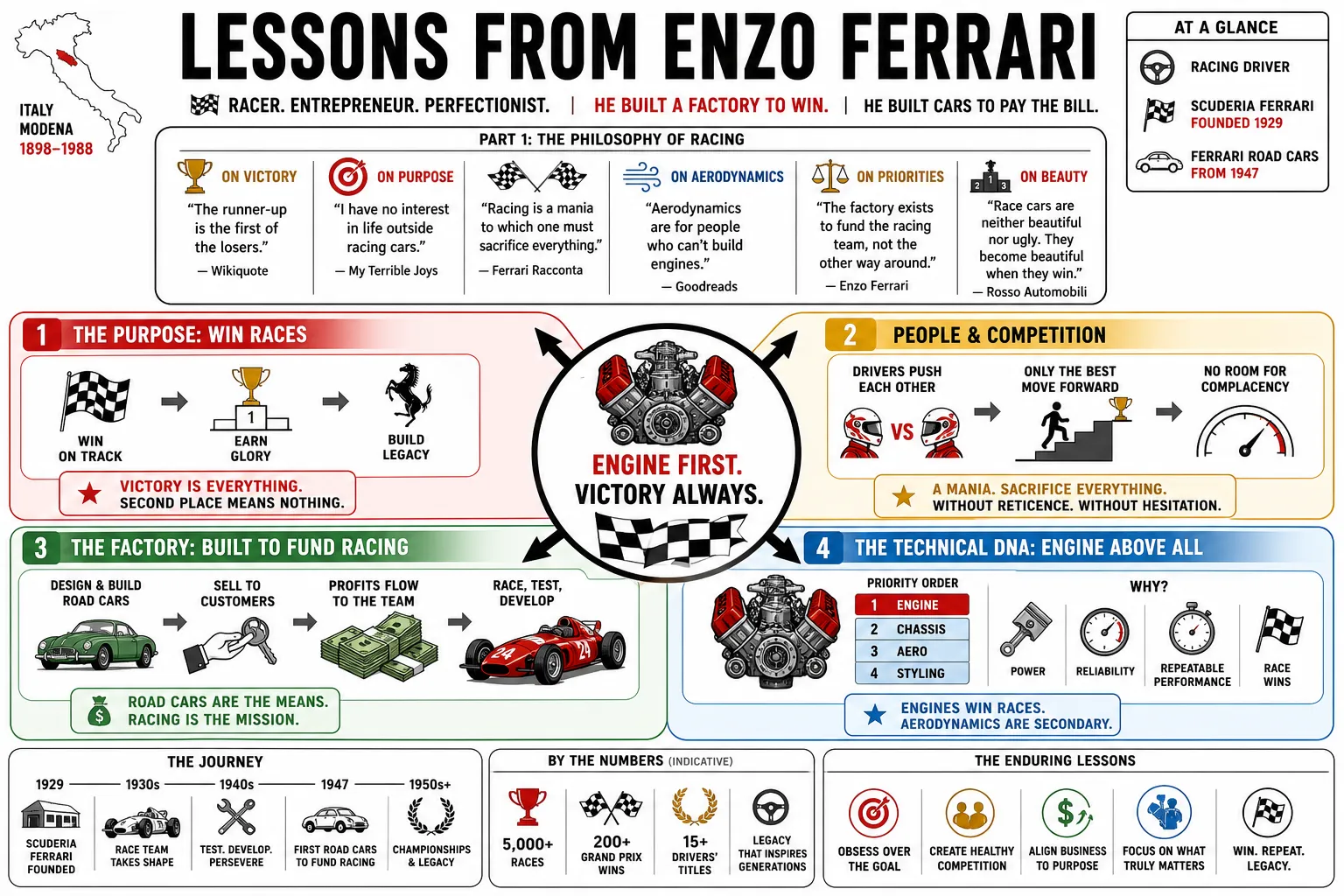
Lessons from Enzo Ferrari
Enzo Ferrari founded Scuderia Ferrari after a career with Alfa Romeo and built the car company in Maranello. This profile examines his documented ideas about racing, engineering, drivers and ambition, while distinguishing them from later slogans attributed to him. — Ferrari SEC Prospectus.
Part 1: The Philosophy of Racing
- Victory and the Next Race: In a 1986 interview, Ferrari said the most beautiful Ferrari victory was the next one. His ambition was forward-looking, not the profile’s unverified insult to runners-up. — Autosport Interview.
- Beauty Through Competition: The Design Museum’s Ferrari exhibition attributed to him the idea that a racing car gains beauty through victory. The museum’s curatorial record supports this as an attributed aesthetic view, though it does not identify the original speech or book behind the English wording. — Design Museum Exhibition.
- Racing as His Dominant Interest: Ferrari said his passion for racing cars consumed so much of his life that he had little time or inclination for other interests. This is his own account of focus, not advice that everyone should make the same sacrifice. — AISA Ferrari Monograph.
- Aerodynamics Became Part of Ferrari Design: Whatever his earlier engine-first remarks, Ferrari’s 250 GTO was refined with wind-tunnel work. The documented car shows that aerodynamics became part of the marque’s racing design rather than a principle to dismiss permanently. — Design Museum Exhibition.
- Road Cars and Racing Finance: The car business provided capital for Ferrari’s racing ambition. Ford’s company history describes Enzo’s need for capital in 1963 and the road-car activity that supported competition; that is a historical funding relationship, not an authenticated quote that customers were a burden. — Ford GT40 History.
- Judge a Car on the Clock: Ferrari praised Stirling Moss for judging a racing car by the time it could deliver on a particular circuit. This is a specific observation about Moss’s evaluation, not proof that a stopwatch is the only truth in all racing decisions. — Ferrari’s L’Europeo Account.
- Quality over Grid Size: Asked about Grand Prix participation, Ferrari said he would prefer eighteen strong entrants to twenty-six cars merely filling the grid. For him, competitive quality mattered more than a large field. — Autosport Interview.
Part 2: Engines, Engineering, and Mechanics
- The Engine’s Character: Ferrari’s company later attributed to Enzo the view that engines have a soul. That supports an emphasis on engine character, but not the popular unverified quip that he gave away the rest of each car for free. — Ferrari Monza Press Release.
- The First Ferrari V12 Was Collaborative: Ferrari recalled discussing the first 60-degree V12 with Gioachino Colombo and completing its design in 1946; the 1947 debut failed near the finish with a fuel-pump problem. His own account credits an engineer and a practical project, not an eternal rule that only twelve cylinders make a real race car. — AISA Ferrari Monograph.
- Build Critical Parts In-House: Ferrari’s 2015 prospectus says its Maranello operations included alloy casting, engine construction and mechanical machining. That documents substantial in-house capability, not a universal ban on outside suppliers. — Ferrari SEC Prospectus.
- Marry Style with Engineering: The Design Museum records Ferrari’s 250 GT partnership with Pininfarina and treats the resulting road car as both engineered and designed. Performance did not render styling irrelevant; the two disciplines were developed together. — Design Museum Exhibition.
- Protect Reliability and the Driver: In his 1962 account Ferrari admired Fangio for easing off when oil temperature threatened the engine, and criticized extreme weight reduction when it made cars dangerously fragile in an accident. Winning required mechanical judgment, not simply maximum power at any cost. — Ferrari’s L’Europeo Account.
Part 3: Leadership and Management
- Agitate People and Problems: Ferrari described himself as an organizer who stirred people and technical problems rather than the inventor or designer of every car. That is his own account of his leadership role. — AISA Ferrari Monograph.
- Make Final Technical Calls: Ferrari’s longtime secretary Valerio Stradi recalled that Enzo personally tried a revised 250 GT suspension and ordered the improved version into production despite scrapping stocked material. This shows decisive oversight in a concrete case, not a general ban on committees. — AISA Ferrari Monograph.
- Answer the Press Carefully: Ferrari described a press strategy of telling journalists the truth while letting them overinterpret it. In 1986 he also withheld comment on near-term driver and technical plans until he was ready to announce them. That is narrower than the profile’s claim that he lied or manipulated reporters. — AISA Ferrari Monograph.
- Diagnose the Real Fault: Ferrari’s account of Fangio’s Monza race shows him noticing the driver watching oil temperature, recognizing the risk, and preventing an unnecessary pit intervention. He valued understanding the mechanical signal before taking action. — Ferrari’s L’Europeo Account.
- Lead from Maranello: A 1986 factory visit found that Ferrari rarely attended races after his son’s death, while the team used the Fiorano test track and monitoring equipment. His oversight was not dependent on standing at every circuit. — Autosport Interview.
Part 4: Drivers and the Human Element
- The Driver Comes First: Asked whom he worried about first after a crash, Ferrari answered that the driver mattered more than the car: a machine could be rebuilt in months, while developing a driver took years. The existing “replaceable driver” quotation says the opposite and must be corrected. — AISA Ferrari Monograph.
- Race for Love of the Sport: Ferrari told journalists that a driver’s primary motivation should be love of racing; money and risk look different when love of the sport comes first. This is a direct, bounded statement about motivation, not the unsupported “vocation” sentence. — Autosport Interview.
- Gilles Villeneuve Was Not Just a Component: Ferrari engineer Harvey Postlethwaite remembered Enzo’s strong affection for Gilles Villeneuve. The evidence supports a specific personal attachment, not the profile’s unverified composite grief quotation. — Postlethwaite Interview.
- Risk Was Real, Not Ignored: Ferrari acknowledged that Grand Prix drivers accepted risk, but he also worried that Didier Pironi could be hurt again if he returned after a serious crash. The documented tension is love of racing alongside responsibility for injury, not a rule to stop calculating danger. — Autosport Interview.
- Listen to Honest Driver Feedback: Ferrari engineer Harvey Postlethwaite said Enzo valued Gilles Villeneuve’s blunt criticism when a car was poor, because he wanted to know the truth. Fast drivers contributed feedback as well as speed. — Postlethwaite Interview.
- Nuvolari Fought with Inferior Equipment: Ferrari wrote that Tazio Nuvolari did not assume defeat when his car was weaker and kept fighting even for lower places. His admiration was for persistence and skill, not the literal rewriting of physics. — Ferrari’s L’Europeo Account.
- Rivalry Could Have a Cost: Fangio recalled an uncomfortable 1956 Ferrari team and the need to negotiate a dedicated mechanic amid competitive teammates. This firsthand account shows that internal rivalry had human costs; it does not support the invented claim that it invariably made the car faster. — Fangio Interview.
Part 5: Business, Clients, and Compromise
- Produce for Exclusivity: Ferrari’s 2018 chairman called producing one fewer car than demand an Enzo Ferrari tenet, while allowing the company to grow gradually. Scarcity was a positioning choice, not evidence of a fixed production number. — Ferrari Chairman Address.
- Small Workshops Can Change Designs Quickly: In a 1966 factory interview, Ferrari contrasted his small workshop’s ability to make immediate design changes with the long retooling needed at mass-production plants. He said his interest was innovation, not mass production; that is narrower than a universal claim that small firms always beat corporate boards. — The New Yorker Interview.
- Protect Racing Autonomy: The proposed Ford deal broke down in 1963 after a clause would have required approval for Ferrari racing expenditures above a threshold. Ferrari’s secretary Franco Gozzi said Enzo objected because it limited his promised freedom as team director. — FIA Ford–Ferrari History.
- Take a Partner Without Ending the Marque: Ferrari’s own prospectus records Fiat’s acquisition of a 50 percent stake in 1969. The supported point is that Enzo accepted a substantial industrial partner while Ferrari continued under its own name; the claimed motive and road-car autonomy trade are not established by this filing. — Ferrari SEC Prospectus.
- Racing Became a Brand Platform: Ferrari’s prospectus says Formula One both developed technology for road cars and promoted the marque; it also says the company avoided mainstream product advertising to preserve exclusivity. This is a documented company strategy, not Enzo’s unverified “winning Sunday is the only marketing” quotation. — Ferrari SEC Prospectus.
Part 6: Passion, Sacrifice, and Obsession
- The Workshop Was His Holiday: Ferrari’s longtime secretary recalled that Enzo did not take conventional vacations. The supported lesson is his own work habit, not a requirement imposed on every employee. — AISA Ferrari Monograph.
- Turn Dreams into Machines: Ferrari’s own memoir excerpt says he dreamed of machines, built them, and continued to dream after many years. That concrete statement is better supported than the disputed generic slogan “If you can dream it, you can do it.” — AISA Ferrari Monograph.
- Evolution Rather Than Perfection: In a firsthand 1975 conversation, Ferrari described the company as an expression of his dreams and said that cars have no final perfection, only evolution. This supports an ongoing-design principle, not the inherited universal rule that exhausting pursuit of perfection is a life duty. — Griff Borgeson Interview.
- Keep New Ambitions Late in Life: At age 88 Ferrari told journalists that a person needs new ambitions to keep going. The direct interview supports continued work and curiosity late in life, not the profile’s invented claim that retirement equals death. — Autosport Interview.
Part 7: Life, Tragedy, and Resilience
- A Father’s Attachment: Ferrari said he believed a father’s love for a son was uniquely total. His words should be read in the context of Dino, without treating the statement as a general law about all families. — AISA Ferrari Monograph.
- Grief Was Part of His Story: Ferrari wrote about loneliness, his son Dino’s loss, and feeling almost guilty to have survived loved ones. That record is more honest than portraying him as emotionally invulnerable. — AISA Ferrari Monograph.
Part 8: Legacy and the Future
- Pass Progress to Successors: Ferrari said he wanted successors to preserve the will to make technical progress, while acknowledging the human cost of past racing. The source does not say that engines must always outrank every other consideration. — AISA Ferrari Monograph.
- Credit His Country and Colleagues: Ferrari wrote that his career’s achievements had brought a measure of credit to his country and collaborators, while admitting that the starting impulse was his own competitive ambition. This is narrower than the unverified red-car-national-spirit quotation. — Ferrari’s L’Europeo Account.
- Respond to New Materials: Ferrari recalled that a 750-kilogram racing formula opened opportunities for magnesium alloys and new steels. He presented technical progress as a response to concrete racing constraints, not a generic thermodynamics slogan. — Ferrari’s L’Europeo Account.
- Legacy Without a Monument: Asked how he wanted to be remembered, Ferrari said he would prefer silence and that his work began as a personal endeavor. His own answer cuts against the profile’s claim that he pursued immortality through machines. — AISA Ferrari Monograph.