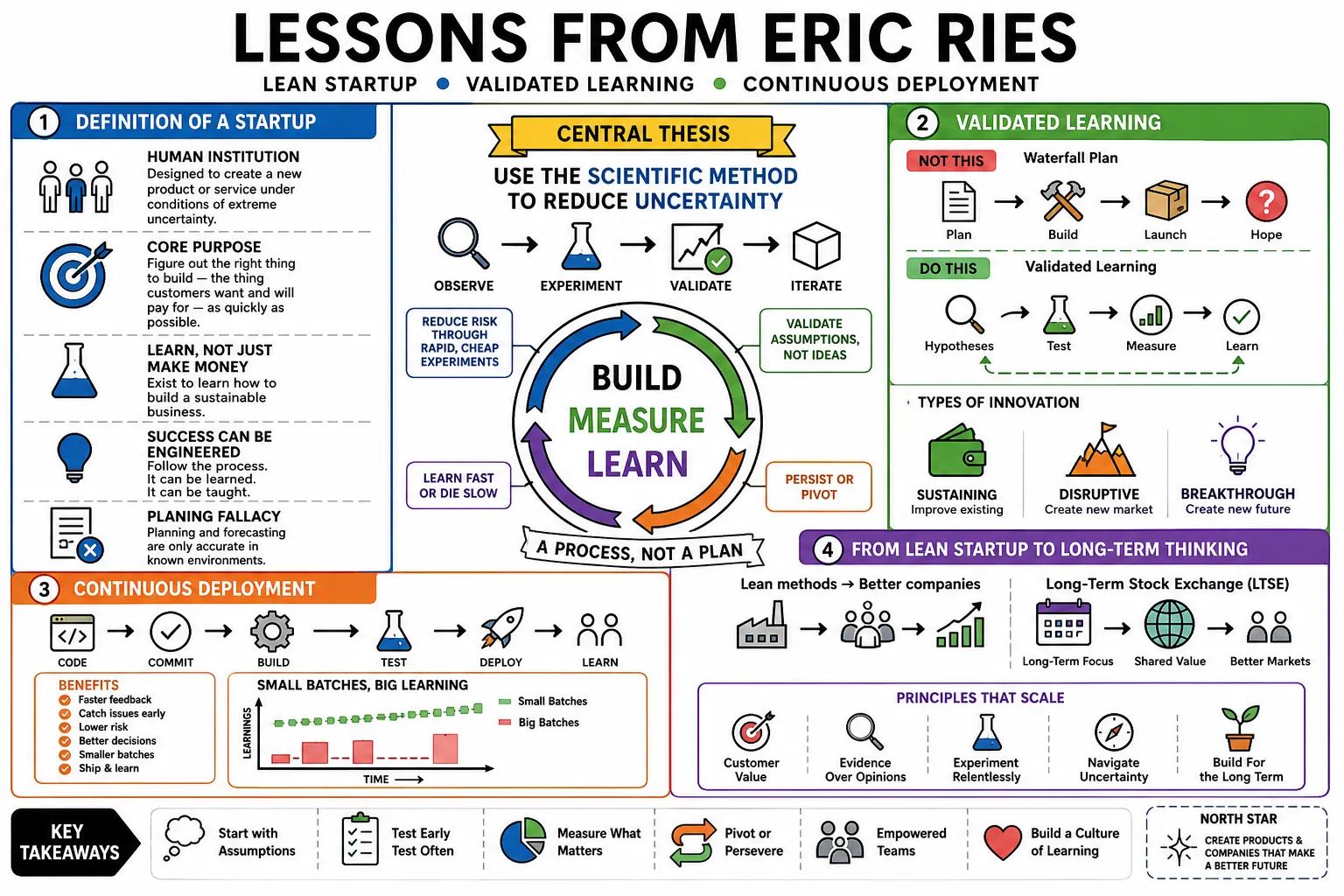
Lessons from Eric Ries
Software engineer and entrepreneur Eric Ries formalized the "Lean Startup" methodology by applying the scientific method to business creation. He pushed companies to test customer assumptions through rapid experiments rather than drafting elaborate business plans. This compilation gathers his practical advice on continuous deployment and validated learning, tracing the concepts that eventually led him to found the Long-Term Stock Exchange.
Part 1: The Definition of a Startup
- On organizational design: "A startup is a human institution designed to create a new product or service under conditions of extreme uncertainty." — Source: [Goodreads]
- On core purpose: "The goal of a startup is to figure out the right thing to build — the thing customers want and will pay for — as quickly as possible." — Source: [Medium]
- On making money vs. learning: "Startups exist not just to make stuff, make money, or even serve customers. They exist to learn how to build a sustainable business." — Source: [Lean Startup Co]
- On failure: "Startup success can be engineered by following the process, which means it can be learned, which means it can be taught." — Source: [Goodreads]
- On the fallacy of plans: "Planning and forecasting are only accurate when based on a long, stable operating history and a relatively static environment. Startups have neither." — Source: [Goodreads]
- On true north: "The true measure of a startup's progress is not how much revenue it makes in the short term, but how much it has learned about its future customers." — Source: [The Lean Startup Principles]
- On the scientific method: "Startups are an experiment. A true experiment follows the scientific method." — Source: [Goodreads]
- On waste: "Lean thinking defines value as providing benefit to the customer; anything else is waste." — Source: [Medium]
- On the management challenge: "Entrepreneurship is a kind of management. A startup is an institution, not just a product, and so it requires a new kind of management specifically geared to its context of extreme uncertainty." — Source: [The Lean Startup Principles]
- On conditions of uncertainty: "Anyone who is creating a new product or business under conditions of extreme uncertainty is an entrepreneur whether they know it or not and whether they work in a government agency, a venture-backed company, a nonprofit, or a decidedly for-profit company with financial backers." — Source: [Goodreads]
Part 2: Build-Measure-Learn & Speed
- On the primary loop: "The fundamental activity of a startup is to turn ideas into products, measure how customers respond, and then learn whether to pivot or persevere." — Source: [Goodreads]
- On competitive advantage: "The ability to learn faster from customers is the essential competitive advantage that startups must possess." — Source: [Goodreads]
- On winning: "The only way to win is to learn faster than anyone else." — Source: [AZQuotes]
- On speed as a metric: "The lean startup method is not about cost, it is about speed." — Source: [QuoteFancy]
- On iterating: "We must learn what customers really want, not what they say they want or what we think they should want." — Source: [Goodreads]
- On building backwards: "Instead of making complex plans that are based on a lot of assumptions, you can make constant adjustments with a steering wheel called the Build-Measure-Learn feedback loop." — Source: [Lean Startup Co]
- On continuous deployment: "Continuous deployment is a technical practice that enables rapid experimentation, allowing code changes to be deployed to production as soon as they are ready to shorten the feedback loop." — Source: [Medium]
- On batch sizes: "Small batch sizes allow you to discover quality problems immediately and prevent a large amount of rework." — Source: [Goodreads]
- On avoiding over-building: "If we do not know who the customer is, we do not know what quality is." — Source: [Goodreads]
Part 3: The Minimum Viable Product
- On the core definition: "The minimum viable product is that version of a new product which allows a team to collect the maximum amount of validated learning about customers with the least effort." — Source: [Startup Lessons Learned]
- On learning vs. launching: "An MVP is not a launch strategy; it is a learning tool designed to test critical hypotheses before significant resources are committed." — Source: [Venture Hacks]
- On the danger of perfection: "As you consider building your own minimum viable product, let this simple rule suffice: remove any feature, process, or effort that does not contribute directly to the learning you seek." — Source: [Goodreads]
- On early adopters: "Early adopters use their imagination to fill in what a product is missing." — Source: [Goodreads]
- On quality and the MVP: "We must be willing to set aside our traditional professional standards to start the process of validated learning as soon as possible." — Source: [Goodreads]
- On avoiding cheapness for its own sake: "MVP is not about creating the cheapest product possible, but rather the most efficient vehicle for navigating the Build-Measure-Learn loop." — Source: [Lenny's Newsletter]
- On subjective MVP forms: "Determining what constitutes an MVP requires judgment; it can take many forms—a landing page, a PowerPoint slide, an AdWords smoke test, or a functional prototype." — Source: [Startup Lessons Learned]
- On industry distortion: "The term MVP has often been simplified, then distorted, then weaponized by the tech industry to mean shipping bad products, which was never the intention." — Source: [Substack]
- On the concierge MVP: "A concierge MVP allows a startup to test a complex service by manually performing the tasks for a few early customers before writing a single line of code." — Source: [Lean Startup Co]
- On the illusion of knowledge: "The biggest risk a startup faces is building a product that nobody wants, which is why an MVP is essential to test assumptions early." — Source: [Strategyzer]
Part 4: Validated Learning & Metrics
- On the illusion of metrics: "Vanity metrics are the numbers you want to publish on TechCrunch to make your competitors feel bad." — Source: [QuoteFancy]
- On true learning: "Validated learning is not an after-the-fact rationalization or a good story designed to hide failure. It is a rigorous method for demonstrating progress when one is embedded in the soil of extreme uncertainty." — Source: [Goodreads]
- On what to measure: "Actionable metrics are data points that demonstrate a clear cause and effect relationship, helping entrepreneurs decide whether to pivot or persevere." — Source: [Effective Software Design]
- On vanity vs. reality: "The danger of vanity metrics is that they distract teams from the hard work of building a sustainable business, serving instead as a form of theater." — Source: [Supermetrics]
- On bad data: "Metrics that make you feel good but don't change how you act are dangerous." — Source: [Goodreads]
- On cohort analysis: "Cohort analysis is one of the most important tools in startup analytics because it looks at the performance of each group of customers that comes into contact with the product independently." — Source: [The Lean Startup]
- On split testing: "A/B testing is not just about optimizing conversion rates; it's a mechanism for resolving internal disputes about what customers actually want." — Source: [Startup Lessons Learned]
- On the 3 A's of metrics: "For a metric to be considered actionable, it must be actionable, accessible, and auditable." — Source: [The Lean Startup]
- On honest evaluation: "We need a new kind of accounting designed for startups—and the people who hold them accountable." — Source: [Goodreads]
Part 5: Innovation Accounting
- On traditional accounting: "Standard accounting is not helpful in evaluating a startup because it relies on forecasts and historical data that new ventures simply do not possess." — Source: [Boldare]
- On holding teams accountable: "Innovation accounting allows entrepreneurs and managers to hold themselves accountable for data-driven decision-making rather than relying on stupid wild ass guesses." — Source: [To Ground Control]
- On the baseline: "The first step of innovation accounting is to establish the baseline: build a minimum viable product and measure how customers behave right now." — Source: [The Lean Startup]
- On tuning the engine: "The second step of innovation accounting is to tune the engine: experiment to see if we can improve metrics from the baseline toward the ideal." — Source: [The Lean Startup]
- On the pivot moment: "The third step of innovation accounting is the decision point: pivot or persevere based on whether the tuned metrics show sufficient progress." — Source: [The Lean Startup]
- On moving away from guessing: "Without a formal system of innovation accounting, startups are forced to rely on intuition and unverified assumptions to justify their existence." — Source: [Praxie]
- On tracking learning: "It emphasizes tracking actionable metrics—such as user engagement and product-market fit—to understand whether a company is actually learning." — Source: [Lean Startup Co]
- On board meetings: "A good startup board meeting should be focused on the learning milestones achieved through innovation accounting, not just cash burn." — Source: [Startup Lessons Learned]
- On funding innovation: "Metered funding prevents waste and encourages true learning by giving teams budgets in small increments contingent on meeting specific innovation milestones." — Source: [The Startup Way]
Part 6: Pivoting vs. Persevering
- On making the choice: "Pivot or persevere: When you hit upon something that is not working, you have two basic choices: change direction or keep going." — Source: [Medium]
- On the true nature of a pivot: "A pivot is a structured course correction designed to test a new fundamental hypothesis about the product, strategy, and engine of growth." — Source: [Viima]
- On vision vs. strategy: "Crucially, a pivot is a change in strategy without a change in the overall vision." — Source: [UserTesting]
- On courage: "The decision to pivot often requires significant courage, as entrepreneurs must be willing to confront the reality of their metrics rather than relying on vanity metrics or intuition alone." — Source: [Startup Book]
- On the runway: "A startup's runway is not best measured in months of cash remaining, but in the number of pivots it can still afford to make." — Source: [Goodreads]
- On avoiding the living dead: "Startups that fail to pivot when the data demands it end up in the land of the living dead, neither growing enough to succeed nor dying quickly enough to free up resources." — Source: [Goodreads]
- On types of pivots: "A zoom-in pivot occurs when what previously was considered a single feature in a product becomes the whole product." — Source: [The Lean Startup]
- On customer segment pivots: "Sometimes a product solves a real problem, but for a completely different customer segment than originally anticipated—this necessitates a customer segment pivot." — Source: [The Lean Startup]
- On the frequency of pivots: "Most successful startups have pivoted at least once; recognizing the need to pivot is a sign of healthy learning, not failure." — Source: [Development That Pays]
Part 7: Corporate Innovation (The Startup Way)
- On corporate transformation: "A corporate transformation is—in every way—a true startup, with the same kind of risk, rapid growth, and profound impact that an external startup contains." — Source: [The Startup Way]
- On rewriting DNA: "All of this requires the development of a new organizational capability: the ability to rewrite the organization's DNA in response to new and diverse challenges." — Source: [The Startup Way]
- On repeating transformation: "It would be a shame to transform only once. When a company has figured out how to transform, it can—and should—be prepared to do it many more times in the future." — Source: [The Startup Way]
- On scaling: "Think big. Start small. Scale fast." — Source: [The Startup Way]
- On process vs. culture: "Process is only the foundation upon which a great company culture can develop. But without this foundation, efforts to encourage learning, creativity, and innovation will fall flat." — Source: [The Startup Way]
- On entrepreneurship as a discipline: "Entrepreneurship should be a professional discipline inside established companies. Just as companies have dedicated departments for finance or accounting, they should have dedicated paths for internal entrepreneurs." — Source: [Lean Blog]
- On continuous innovation: "A modern company is defined by its ability to engage in continuous innovation, running rapid experiments and building a portfolio of internal startups." — Source: [Business of Software]
- On grassroots testing: "Corporate transformation must start with grassroots experiments where small teams prove viability within existing systems before leadership commits to scaling them." — Source: [The Startup Way]
- On middle management: "The true heroes of corporate innovation are often middle managers who provide top-cover to entrepreneurial teams trying to run experiments against the grain of corporate policy." — Source: [Podbean Interviews]
- On entrepreneurial management: "Established companies must transition from old-fashioned management to entrepreneurial management to survive and grow in an increasingly uncertain world." — Source: [The Startup Way]
Part 8: Long-Term Thinking (LTSE)
- On short-termism: "I call this phenomenon financial gravity. This pressure that companies are feeling to always act in this extractive way... We can't ultimately build a civilization that can endure if we're constantly pushing everything into this short-term extractive mindset." — Source: [Pathwise]
- On creating a new exchange: "What is needed is a new kind of stock exchange, designed to trade in the stocks of companies organized to sustain long-term thinking." — Source: [Medium]
- On early skepticism: "People literally laughed at me and said this can't be done... it destroyed all of my hard-earned credibility from the preceding 299 pages." — Source: [Business Insider]
- On the problem with Wall Street: "Wall Street created the very problem it later showed up to solve." — Source: [Mark Graban]
- On regulatory power: "Our goal is to create a new venue for great public companies to list on, one that uses its regulatory power to incentivize long-term thinking on the part of both managers and investors." — Source: [Startup Lessons Learned]
- On the goal of LTSE: "The LTSE is designed to remove the short-term pressures that plague today's public markets and reorient companies and investors around long-term thinking." — Source: [LTSE]
- On realizing a vision: "There's nothing in this world quite like speaking an idea out loud for the first time, and then some number of years later—in this case nine years later—seeing it become a reality." — Source: [Business Insider]
- On innovation hostages: "Public company CEOs described innovation held hostage by boom-bust cycles, abrupt changes in governance, and struggles to maintain constancy of purpose due to quarterly earnings pressures." — Source: [Medium]
- On shareholder primacy: "Rewriting corporate governance is about shifting away from strict shareholder primacy and toward a model that values mission, employees, and long-term impact just as highly." — Source: [unSILOed Podcast]