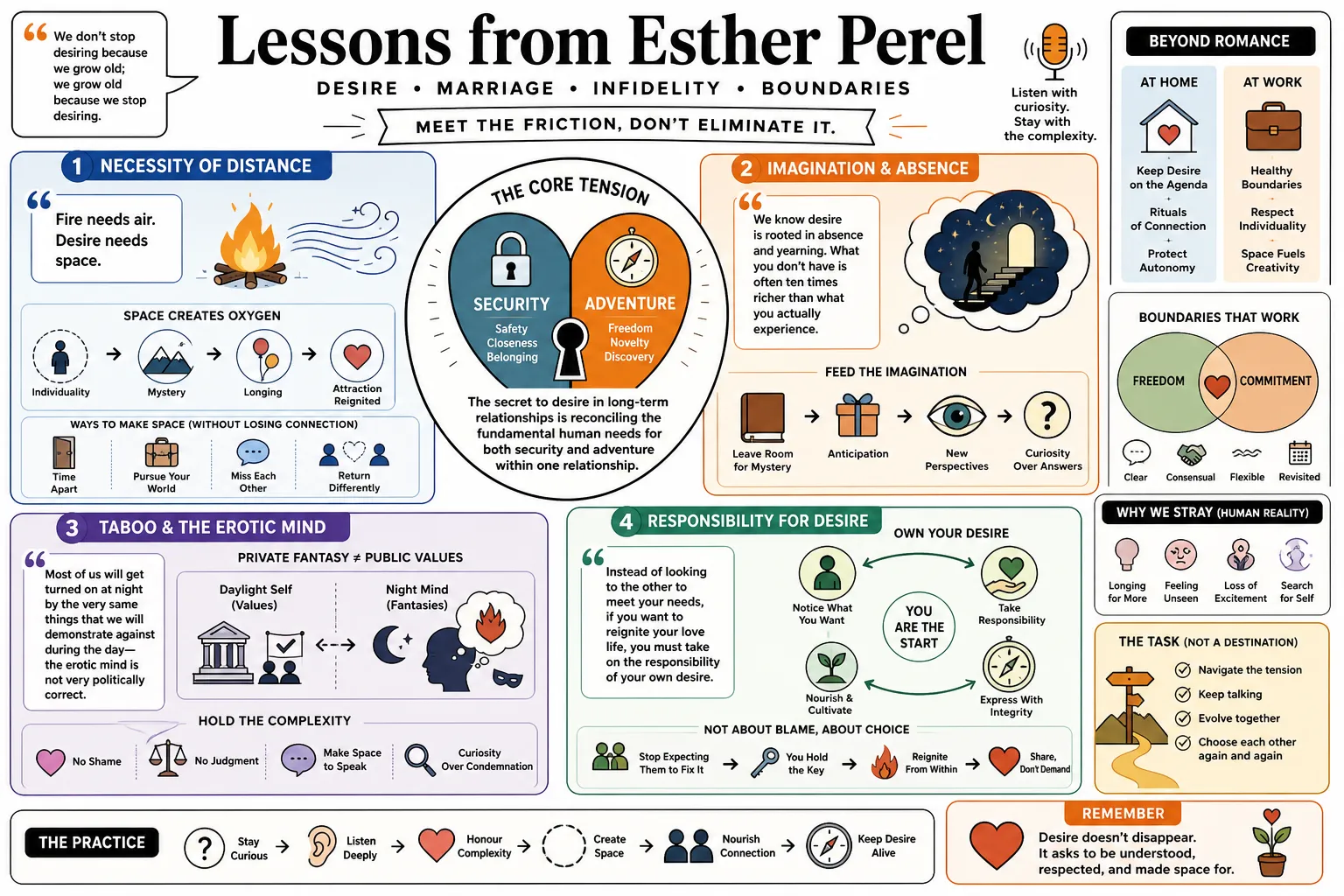
Lessons from Esther Perel
Psychotherapist and author Esther Perel studies the friction between security and freedom in long-term relationships. Her books and podcasts frame desire, marriage, and infidelity as matters of human longing and autonomy rather than strict morality. This collection outlines her observations on why we connect, why we stray, and how we manage boundaries at home and at work.
Part 1: Desire and Eroticism
- On the core tension: "The secret to desire in long-term relationships is reconciling the fundamental human needs for both security and adventure within one relationship." — Source: [TED: The Secret to Desire]
- On the necessity of distance: "Fire needs air. Desire needs space." — Source: [Mating in Captivity]
- On imagination: "We know desire is rooted in absence and yearning. What you don't have is often ten times richer than what you actually experience." — Source: [The State of Affairs]
- On taboo: "Most of us will get turned on at night by the very same things that we will demonstrate against during the day—the erotic mind is not very politically correct." — Source: [TED: The Secret to Desire]
- On responsibility: "Instead of looking to the other to meet your needs, if you want to reignite your love life, you must take on the responsibility of your own desire." — Source: [Where Should We Begin?]
- On eroticism: "Eroticism is a quality of aliveness. It is a space of freedom and play." — Source: [Mating in Captivity]
- On foreplay: "Foreplay is not what happens five minutes before sex. Foreplay starts at the end of the previous orgasm." — Source: [TED: The Secret to Desire]
- On habit: "Habit is the enemy of desire. When we do things out of habit, we are not present." — Source: [Esther Perel's Blog]
- On being seen: "Through love we imagine a new way of being. You see me as I've never seen myself. You airbrush my imperfections, and I like what you see." — Source: [Mating in Captivity]
- On emotional safety: "A sense of security doesn’t necessarily stoke the fires of desire. In fact, the very elements that nurture love can sometimes extinguish the erotic spark." — Source: [Mating in Captivity]
Part 2: The Nature of Love and Commitment
- On having and wanting: "Love enjoys knowing everything about you; desire needs mystery. Love is about having; desire is about wanting." — Source: [Mating in Captivity]
- On time: "Love is a vessel that contains both security and adventure, and commitment offers one of the great luxuries of life: time." — Source: [Mating in Captivity]
- On romance: "Marriage is not the end of romance, it is the beginning." — Source: [The State of Affairs]
- On continuous choice: "Monogamy used to be one person for life. Today, monogamy is one person at a time." — Source: [TED: Rethinking Infidelity]
- On narrative: "Every time you pick a partner, you pick a story. And then you find yourself in a play you never auditioned for." — Source: [Where Should We Begin?]
- On the illusion of ownership: "The grand illusion of committed love is that we think our partners are ours. In truth, their separateness is unassailable, and their mystery is forever ungraspable." — Source: [Mating in Captivity]
- On emotional pillars: "Love rests on two pillars: surrender and autonomy. Our need for togetherness exists alongside our need for separateness." — Source: [Mating in Captivity]
- On caretaking: "Caretaking is the most powerful anti-aphrodisiac there is." — Source: [Mating in Captivity]
- On longevity: "A long-term relationship is not one continuous relationship, but rather multiple relationships with the same person over time." — Source: [The State of Affairs]
- On emotional intelligence: "Relational intelligence is the ability to hold two opposing thoughts or feelings at the same time and not have them cancel each other out." — Source: [Esther Perel's Blog]
Part 3: The Weight of Modern Marriage
- On overwhelming expectations: "Today, we turn to one person to provide what an entire village once did: a sense of grounding, meaning, and continuity. At the same time, we expect our committed relationships to be romantic as well as emotionally and sexually fulfilling." — Source: [The State of Affairs]
- On vulnerability: "We bring to our romantic relationships an almost unbearable existential vulnerability—as if love itself weren't dangerous enough." — Source: [Mating in Captivity]
- On the pressure to be everything: "We are asking our lovers to give us what we once derived from religion and community." — Source: [The State of Affairs]
- On consumer culture: "In a consumer culture, we are taught to seek upgrades and maximize our choices. This mentality has deeply infiltrated how we view our romantic partners." — Source: [The State of Affairs]
- On certainty: "We seek certainty in relationships to soothe our anxieties, but in doing so, we often suffocate the vitality of the connection." — Source: [Mating in Captivity]
- On loneliness in coupling: "Being in a relationship doesn't cure loneliness. Sometimes the profoundest loneliness is the one you feel sitting next to someone." — Source: [Where Should We Begin?]
- On stability: "The quest for security is an illusion. We can never fully secure another person's affection or desire." — Source: [Mating in Captivity]
- On failure: "Is it any wonder that so many relationships crumble under the weight of it all? We ask one person to give us what an entire society used to provide." — Source: [The State of Affairs]
- On modern breakups: "We have created a society where leaving is easy, and staying is hard. It used to be the exact opposite." — Source: [TED: Rethinking Infidelity]
Part 4: Autonomy and Separateness
- On the otherness of the partner: "It’s hard to feel attracted to someone who has abandoned her sense of autonomy." — Source: [Mating in Captivity]
- On boundary lines: "Every couple will negotiate boundaries: what is individual, what is ours, and what is public." — Source: [Mating in Captivity]
- On closeness: "In our efforts to protect ourselves from intimate betrayal, we demand access, control, transparency. And we run the risk of unknowingly eradicating the very space between us." — Source: [The State of Affairs]
- On radiant confidence: "We are most drawn to our partners when they are in their element, doing something they are passionate about, slightly detached from us." — Source: [TED: The Secret to Desire]
- On selfhood: "You cannot be truly intimate with someone if you do not have a strong sense of self to bring to the table." — Source: [Where Should We Begin?]
- On enmeshment: "Merging with another person is a comforting fantasy, but it eventually leads to a loss of the very spark that brought you together." — Source: [Mating in Captivity]
- On observation: "When we can look at our partner from a slight distance, we allow ourselves to be surprised by them again." — Source: [TED: The Secret to Desire]
- On personal sovereignty: "Secrecy fuels erotic intensity because it makes you feel like you're doing something that is entirely yours. It gives you the sense of autonomy, the sense of freedom." — Source: [The State of Affairs]
- On fusion vs. intimacy: "Intimacy is not about fusion; it is about standing next to someone, maintaining your own boundaries, while deeply knowing them." — Source: [Mating in Captivity]
Part 5: Infidelity and Affairs
- On the meaning of cheating: "An affair simply alerts us to a preexisting condition, either a troubled relationship or a troubled person." — Source: [The State of Affairs]
- On searching for the self: "Very often we don't go elsewhere because we are looking for another person. We go elsewhere because we are looking for another self." — Source: [TED: Rethinking Infidelity]
- On feeling alive: "The one word I hear when people have affairs is that they feel alive... They describe an experience that beats back the deadness inside." — Source: [The State of Affairs]
- On secrecy: "For me, the constitutive element of an affair is the secrecy. It is the secrecy that leads to the lying, to the deception, to the duplicity." — Source: [The State of Affairs]
- On leaving the past: "It isn't so much that we want to leave the person we are with as we want to leave the person we have become." — Source: [The State of Affairs]
- On longing: "At the heart of an affair, you will often find a longing and a yearning for an emotional connection, for novelty, for freedom, for autonomy." — Source: [TED: Rethinking Infidelity]
- On the aftermath: "An affair isn't always the end of a relationship but it is always the end of the relationship as it was once known." — Source: [TED: Rethinking Infidelity]
- On affairs as catalysts: "Affairs can be powerful detonators. They can invigorate a marriage that's flat, jolt people out of years of complacency." — Source: [The State of Affairs]
- On the dual nature of affairs: "Affairs are an act of betrayal, and they are also an expression of longing and loss." — Source: [TED: Rethinking Infidelity]
- On conversation: "Most couples don't negotiate or don't even converse about any of these things until the crisis of the affair has actually forced them to." — Source: [The State of Affairs]
Part 6: Trust, Betrayal, and Healing
- On stealing time: "The essence of betrayal is that we rob somebody of the story of their lives. We make them question the reality they thought they were living." — Source: [The State of Affairs]
- On taking a leap: "Trust is the active engagement with the unknown. Trust is risky. It’s vulnerable. It’s a leap of faith." — Source: [The State of Affairs]
- On venturing out: "The more we trust, the farther we are able to venture." — Source: [Mating in Captivity]
- On the legacy of betrayal: "Every affair will redefine a relationship, and every couple will determine what the legacy of the affair will be." — Source: [TED: Rethinking Infidelity]
- On true assurance: "In relationships, trust isn’t a promise to never hurt each other. It’s the risk that we will hurt each other and the confidence that, if we do, we will come together to heal." — Source: [Esther Perel's Blog]
- On severity: "I don’t believe the degree of betrayal is always commensurate with the egregiousness of the behavior. They are two separate things." — Source: [The State of Affairs]
- On certainty versus trust: "If we accept that the certainty we long for is something we may never truly have, we can reframe the notion of trust as an active engagement with the unpredictable." — Source: [The State of Affairs]
- On forgiveness: "Healing from infidelity requires the offending partner to hold the boundaries and bear the burden of remembering, so the betrayed partner can rest." — Source: [The State of Affairs]
- On rebuilding: "To rebuild trust, the one who strayed must become the protector of the boundary, demonstrating that they are guarding the relationship." — Source: [The State of Affairs]
Part 7: Conflict and Communication
- On hidden desires: "Behind every criticism is a veiled wish." — Source: [Where Should We Begin?]
- On breaking patterns: "It takes two people to create a pattern, but only one to change it." — Source: [Where Should We Begin?]
- On resilience: "Difficult conversations don't build weakness, they build strength." — Source: [Esther Perel's Blog]
- On polarized narratives: "When a couple has a villain-victim narrative where one person is always perfect and the other is always wrong, it's helpful to dig deeper." — Source: [Where Should We Begin?]
- On apologies: "An apology isn't just about saying you are sorry; it is about acknowledging the specific impact your behavior had on the other person." — Source: [Where Should We Begin?]
- On listening: "Listening is not just waiting for your turn to speak. It is an active attempt to understand the logic of the other person's reality." — Source: [Esther Perel's Blog]
- On arguments: "The issue you are fighting about is rarely the actual issue. Most fights are about respect, recognition, and the underlying need to be valued." — Source: [Where Should We Begin?]
- On defensiveness: "Defensiveness is the number one enemy of intimacy. It blocks the possibility of connection and turns a dialogue into a debate." — Source: [Where Should We Begin?]
- On truth: "There is no single truth in a relationship. There are two subjective realities that must find a way to coexist." — Source: [Where Should We Begin?]
Part 8: Work, Identity, and Connection
- On our working reality: "The quality of our relationships at work determines the quality of our work—and our capacity to stay, to care, to thrive." — Source: [How's Work? Podcast]
- On authentic selves: "When people say you should bring your whole self to work, my response is always this: They already do." — Source: [How's Work? Podcast]
- On invisible histories: "Everybody has a relationship history and it goes with you everywhere. It doesn't leave when you walk out of the office." — Source: [How's Work? Podcast]
- On performance: "Work friendships are a unique kind of companionship. They are forged inside the structures and pressures of labor and performance." — Source: [How's Work? Podcast]
- On systemic rupture: "We are living through a profound rupture in how we relate to work and the people with whom we work. It's confusing. It's tender. And it's very, very human." — Source: [Esther Perel's Blog]
- On psychological baggage: "Your relationship history defines how you ask for help, how you trust others, how you own up to your mistakes, everything." — Source: [How's Work? Podcast]
- On permission: "Work is no longer just about the pressure to do; it has increasingly become about the permission to be." — Source: [How's Work? Podcast]
- On organizational health: "Organizations that ignore the relational aspect of work often struggle with engagement and productivity because they forget the human element." — Source: [How's Work? Podcast]
- On professional conflict: "Workplace conflict is a relational challenge that must be understood through the same emotional lens we use in our personal lives." — Source: [How's Work? Podcast]