Ethan Evans is a former Amazon vice president who now writes and teaches about career growth and leadership, drawing on his executive experience. — Archie Agrawal Interview.
On Career Ownership and Growth
- Own Your Career: You are responsible for the direction of your career. A manager can offer guidance and opportunity, but cannot choose your goals for you. — Archie Agrawal Interview.
- Seek Mentors Early: Do not rely on hope alone: Evans says he would have sought a diverse group of career mentors earlier. — Archie Agrawal Interview.
- Work Is Not a Career Strategy: Working hard in a job without explicitly planning the next step can leave career growth to chance. — Archie Agrawal Interview.
- Do Not Mistake Overwork for Progress: Evans reflects that he worked so hard that he missed parts of life, and believes he could have enjoyed more of it without losing much career success. — Archie Agrawal Interview.
- Keep Improving: Evans credits sustained self-improvement and practicing skills he cares about as a major part of his executive growth. — Relentless Self-Improvement.
- Read to Learn: Evans recommends reading or listening as a practical way to continue learning through a career. — Career Growth Reads.
- Let Learning Compound: A single book rarely changes a career, but repeated investment in learning can accumulate over time. — Career Growth Reads.
- Managers Create Opportunity: A manager can support growth by giving people opportunities, resources and guidance to demonstrate their ability. — Evans Promotion Account.
- Ask for the Chance to Grow: Employees should tell their managers what growth they want and ask for opportunities to demonstrate it. — Evans Promotion Account.
The "Magic Loop" for Career Advancement
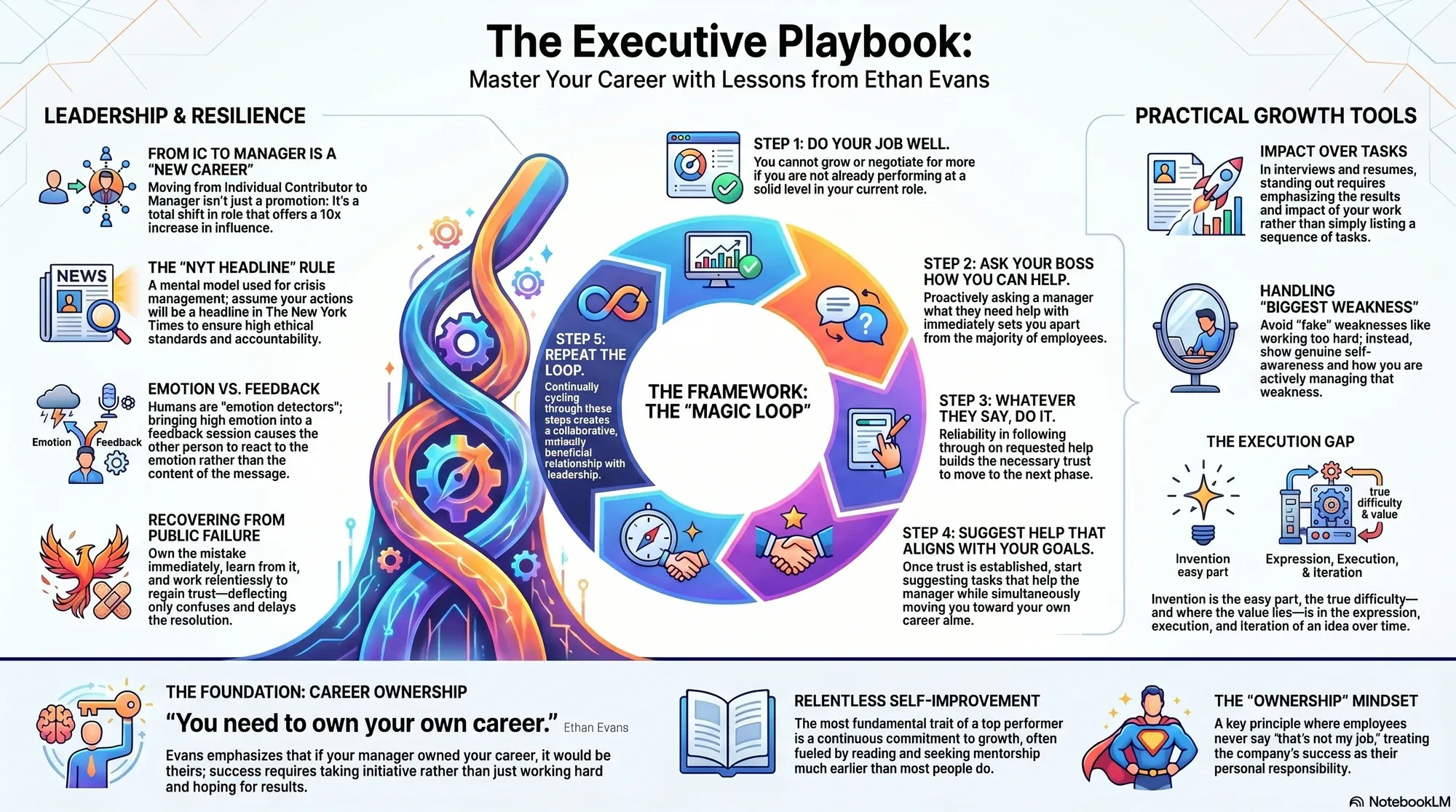
Evans calls his five-step process for reciprocal help and career growth the Magic Loop: — The Magic Loop.
- Do Your Job Well: Magic Loop step one is to perform your current work well enough to establish credibility. — The Magic Loop.
- Ask How to Help: Step two is to ask your manager what they need help with rather than waiting for extra work to be assigned. — The Magic Loop.
- Deliver the Help: Step three is to take on the requested work and complete it well, building trust through delivery. — The Magic Loop.
- Align Help with Growth: Step four is to suggest useful work that also develops the skills and scope you seek. — The Magic Loop.
- Repeat: Step five is to repeat the cycle of strong performance, useful help and growth-aligned initiative. — The Magic Loop.
On Leadership and Management
- Become a Useful Ally: Meaningful help with a manager’s priorities can relieve pressure and build a more reciprocal working relationship. — The Magic Loop.
- Management Is a New Craft: Moving from individual contribution into management requires skills such as coaching, influence, feedback and difficult conversations; prior technical performance alone is not enough. — Why There Are So Many Bad Managers.
- Grow Strong Leaders: Evans says promoting capable directors gave his organization more independent leaders able to take on substantial challenges. — Evans Promotion Account.
- Create and Advocate for Promotions: A manager must give stretch opportunities and resources, document results and advocate for a ready employee; the employee should ask for the chance to show their skills. — Evans Promotion Account.
- De-escalate Before Discussing Feedback: In a tense discussion, listen and invite collaboration before escalating; Evans says heated conflict is hard to reverse. — Evans Collaboration Account.
- Build Trust Before Correcting: Feedback is more likely to land when the manager has built trust, gives timely concrete examples and recognizes strengths as well as weaknesses. — Evans Feedback Account.
- Think at Organizational Scale: Evans says moving from a startup VP role to Amazon required a different understanding of scale and of what executive leadership entails. — Evans Executive Transition.
- Lead Through Strategy and Influence: In a large organization, executive leadership depends on strategic vision and influence across peers, not only directing one’s own team. — Evans Executive Transition.
- Own Outcomes, Discuss Tradeoffs: Evans says he wrote the “not my job” language in Amazon’s Ownership principle. He distinguishes refusing work by invoking a job description from discussing priorities, capacity and resources. — Evans on Ownership.
- Learn Even from an Imperfect Manager: A less supportive manager may slow growth, but Evans advises assessing whether uncomfortable feedback still contains a valid point while seeking a better fit. — How to Find a Great Manager.
On Failure and Resilience
- Recover by Owning the Failure: After a serious launch failure, Evans owned the problem, coordinated the response, sought help and worked over time to rebuild execution trust. — Evans Failure Account.
- Consider Public Consequences: After the Appstore failure, Evans adopted a “fear the New York Times headline” heuristic: consider whether a risky action could lead to a damaging public failure without becoming paralyzed. — Lenny’s Podcast.
- Acknowledge the Public Error: When an Amazon all-hands demo ran upside down, Evans immediately acknowledged the problem in front of the audience and stated what he would do next. — Evans Demo Account.
- Give Updates and Accept Help: During a separate Appstore launch crisis, Evans gave frequent progress updates and brought in outside experts rather than deflecting responsibility. — Evans Failure Account.
- Rebuild Trust After a Crisis: Bezos’s increasingly frustrated messages during the Appstore failure did not end Evans’s career, but Evans says rebuilding execution trust took roughly two years. — Take Risks, Handle Setbacks.
- Explain a Layoff Honestly: Prepare a truthful, concise explanation of a layoff and turn the conversation toward the contribution you can make in the next role. — Layoff Interview Advice.
On Interviews and Hiring
- Show Professionalism and Enthusiasm: For an interview, Evans recommends a professional appearance and genuine enthusiasm; on video, he emphasizes being fully present with the camera on and making eye contact. — Lenny’s Podcast.
- Describe Results, Not Task Lists: A resume is stronger when it explains the impact and measurable results of work rather than only listing responsibilities. — Resume Mistakes.
- Prepare a Conflict Story: Expect interview questions about conflict and prepare a concrete account of the situation, your actions and what happened. — Hard Interview Questions.
- Give a Genuine Weakness: When asked about a weakness, avoid a disguised strength; name a real but manageable limitation and explain what you have done to mitigate it. — Greatest Weakness.
- Recover Your Calm in Interviews: Prepare for interviews, but do not let pressure take over: Evans says calm helps you demonstrate skills and think clearly. — Evans Interview Account.
- Be Ready to Explain a Gap: If asked about a resume gap, explain honestly what happened and how you used or learned from the time instead of leaving the period unexplained. — Evans Interview FAQs.
On Innovation and Ideas
- Execution Gives Ideas Value: Evans says one good idea can take years to express; making a useful idea real requires more work than simply having it. — Lenny’s Podcast.
- Keep Improving the Idea: Evans points to Prime as an idea that continued to gain value through years of product expansion and incremental improvement. — Lenny’s Podcast.
- Make Ideas Easier to Back: To get an idea heard, build a track record, validate the idea, explain the problem and bring an implementation plan or prototype. — Get Your Ideas Heard.
General Wisdom and Mindset
- Decide and Learn Promptly: Evans argues that waiting for perfect information can be costly; make a calculated decision, contain the downside and learn from the result. — How to Take the Right Risks.
- Name Your Assumptions: Before committing to an option, write down its hidden assumptions and test them against evidence and knowledgeable people. — Decision-Making System.
- Seek Alternatives and Skeptics: Broaden a narrow choice set and invite informed skeptics so that evidence can change the direction of a decision. — Decision-Making System.
- Choose Meaningful Work Deliberately: Evans says he left Amazon to regain time and focus on helping others, after arranging the financial freedom to do so. — Evans Career Reflection.
- See More Than One Side of a Peer: Evans says early critical judgments of other leaders were sometimes based on only one aspect of their performance; he later learned to collaborate more. — Archie Agrawal Interview.
- Listen Before Being Outspoken: Evans describes losing jobs after combative behavior and learning that listening and collaboration usually leave more room for progress than immediate confrontation. — Evans Collaboration Account.
- Help an Imperfect Manager Help You: A good manager may guide growth unprompted, but when a manager is imperfect, a specific offer of help and request for opportunity can still move the relationship forward. — The Magic Loop.
- Take Initiative Within Your Control: The Magic Loop puts a concrete first move in the employee’s hands: perform well, offer help and suggest growth-aligned work. — The Magic Loop.
Learn more:
- Archie Agrawal — Interview with Ethan Evans, Former Amazon VP and Executive Coach
- Ethan Evans — The Magic Loop (Lenny’s Newsletter)
- Peter Yang — 5 Steps to Get Unstuck in Your Career: Ethan Evans Interview
- Ethan Evans — How to Survive a Bad Failure
- Ethan Evans — My Amazon All-Hands Demo Failed Spectacularly
- Ethan Evans and Jason P. Yoong — Relentless Self-Improvement
- Ethan Evans — A Review That Made an Employee Hate Me
- Ethan Evans — Promoting Two Amazon Directors
- Ethan Evans — From Startup VP to Amazon Senior Manager
- Ethan Evans — Choosing Collaboration Over Conflict
- Ethan Evans and Jason P. Yoong — Resumes: Stop Making These 3 Mistakes
- Ethan Evans and Jason P. Yoong — Get Your Ideas Heard
- Ethan Evans and Jason P. Yoong — Build Your Decision-Making System to Earn Executive Trust
- Lenny’s Podcast — Taking Control of Your Career with Ethan Evans