Galen Weston Jr. led Loblaw Companies Limited and George Weston Limited through a period of massive consolidation and public scrutiny. He is best known for acquiring Shoppers Drug Mart to merge grocery and pharmacy, expanding discount chains and private labels to manage inflation, and defending the grocery industry against accusations of price-fixing and profiteering. This profile tracks his approach to family ownership, corporate turnarounds, and retail strategy over two decades.
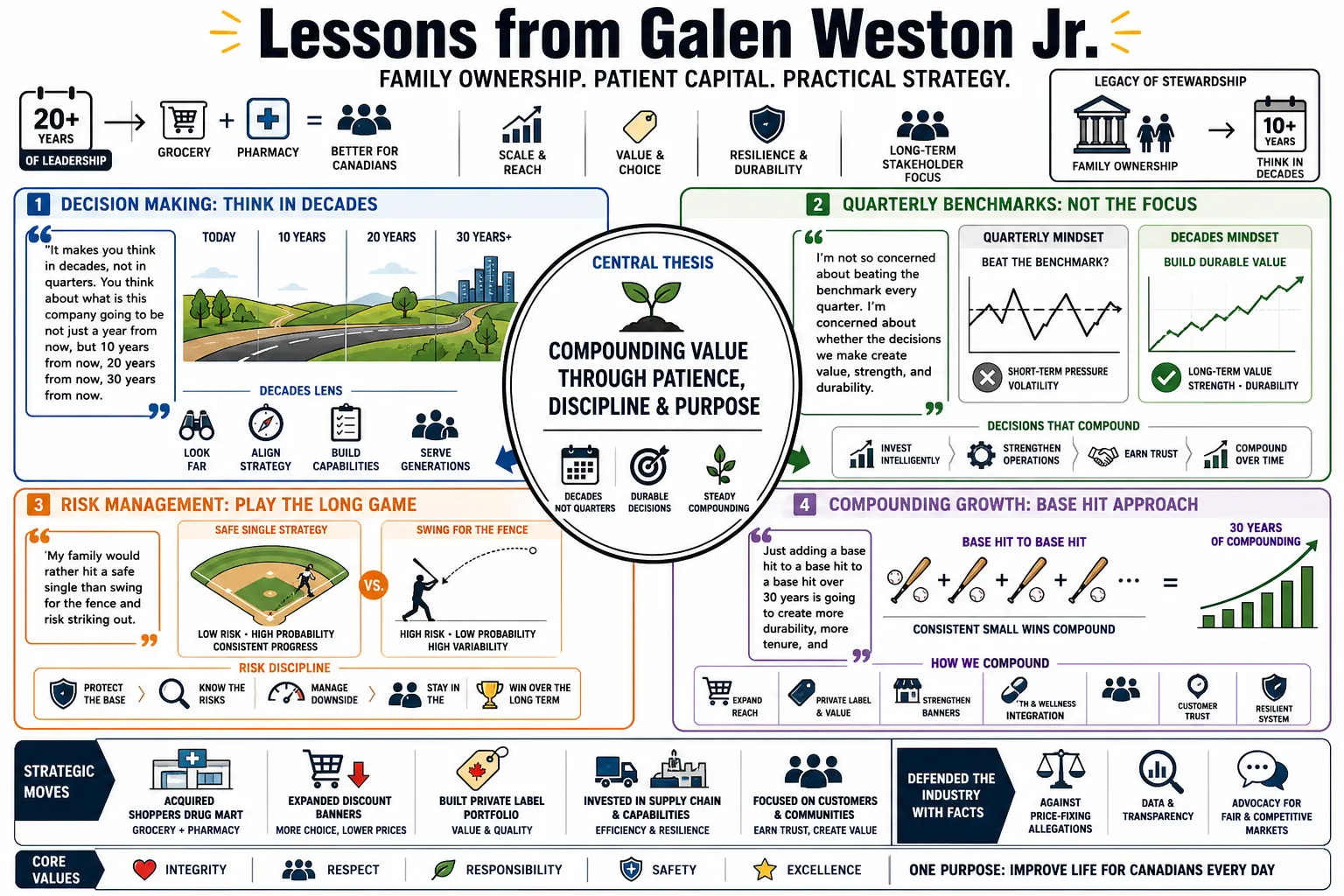
Part 1: The Family Legacy & Patient Capital
- On Decision Making: "It makes you think in decades, not in quarters. You think about what is this company going to be not just a year from now, but 10 years from now, 20 years from now, 30 years from now." — Source: [York University]
- On Quarterly Benchmarks: "I’m not so concerned about beating the benchmark every quarter. I’m concerned about whether the decisions we make create value, strength, and durability." — Source: [YouTube]
- On Risk Management: "My family would rather hit a safe single than swing for the fence and risk striking out." — Source: [York University]
- On Compounding Growth: "Just adding a base hit to a base hit to a base hit over 30 years is going to create more durability, more tenure, and more prosperity for the company." — Source: [York University]
- On Legacy: "Reaching a fourth generation represents unique longevity among family-led firms, and my father's success over four decades sets a high bar." — Source: [Financial Post]
- On Capital Preservation: Family ownership provides a predisposition for managing risk and preserving capital over long horizons rather than seeking aggressive, high-risk short-term gains. — Source: [The Business Council of Canada]
- On Failure: Long-term success is about moving from failure to failure without any loss of enthusiasm. — Source: [York University]
- On Stepping Down as President: "I’m not leaving. I’m stepping back into what I consider to be my natural role as the controlling shareholder." — Source: [Global News]
- On Corporate Evolution: "This is not a sharp left turn. This is about evolution and building on the platform that's been established." — Source: [Retail Insider]
Part 2: Operational Turnarounds & Fixing the Basics
- On Early Challenges: "Making Loblaw the Best Again" required focusing on fixing the basics by closing unprofitable stores and reducing debt. — Source: [Weston.ca]
- On Store Rationalization: "As a 200-store chain, we didn't look very good. As a 100-store chain, we looked very good indeed." — Source: [Weston.ca]
- On Retail Leadership: "You need a sense of 'controlled impatience' to run a business. And that type of impatience is really essential culturally, when you're running a retail business." — Source: [Daily Hive]
- On the Pace of Grocery: The grocery business requires leaders who are comfortable making critical operational decisions every single week. — Source: [Loblaw.ca]
- On Hiring Per Bank: "In Per we have found a world-class retail executive to help us build from that position of leadership and strength, and to continue on that journey." — Source: [YouTube]
- On Successor Qualifications: "Per is an exceptional executive with a decades-long track record of delivering retail excellence and successful growth." — Source: [Velocity Institute]
- On Working with Founders: "He has extensive experience working for a controlling family and understands what that relationship needs to be in order for a partnership to be successful." — Source: [The Packer]
- On Executive Experience: Navigating modern retail requires experience that goes above and beyond simply running retail stores. — Source: [The Packer]
- On Value Creation: The primary goal during a turnaround is ensuring the company can endure past its immediate hurdles. — Source: [York University]
Part 3: Digital Transformation & The Future of Retail
- On Software Impact: "When we push a line of code, it impacts millions of people the very next day." — Source: [Elevate Tech Fest]
- On Combining Sectors: "Imagine the power of combining the two [food and health] and linking them to your specific health goals." — Source: [Elevate Tech Fest]
- On Personalization: The ultimate goal of integrating data is bringing personalized nutrition to every customer in every aisle. — Source: [Elevate Tech Fest]
- On E-commerce: Making meals "one click away" is central to omnichannel growth via platforms like PC Express. — Source: [Loblaw.ca]
- On Loyalty Data: The PC Optimum program is a strategic cornerstone for using consumer behavior data to provide personalized, targeted offers. — Source: [Daily Hive]
- On Supply Chain Tech: Investing in supply chain automation, including partnerships with autonomous delivery firms, is necessary to improve fulfillment speed. — Source: [Global News]
- On Industry Stability: The industry has entered an era where historical stability can no longer be counted on. — Source: [YouTube]
- On Adaptability: Retailers must be capable of making real-time adjustments to supply chain disruptions and shifting consumer demands. — Source: [YouTube]
- On the Role of Technology: Technology in grocery should function primarily to solve the daily stresses of consumers. — Source: [Elevate Tech Fest]
- On the PC Ecosystem: Building a unified digital ecosystem across grocery, pharmacy, and financial services creates an unavoidable footprint in Canadian retail. — Source: [Weston.ca]
Part 4: The Shoppers Drug Mart Acquisition
- On the Vision: The acquisition was the "ultimate expression" of a vision to combine health, wellness, and nutrition. — Source: [CityNews]
- On the Deal's Nature: It was a "transformational partnership" designed to establish an innovative platform for the future of Canadian retail. — Source: [Global News]
- On Consumer Trends: The combination allowed Loblaw to capitalize on societal shifts toward convenience and smaller-format, urban stores. — Source: [CityNews]
- On Defensive Strategy: Acquiring Shoppers Drug Mart was crucial for strengthening Loblaw's position against increasing competition from massive U.S. retailers entering Canada. — Source: [Global News]
- On Operational Independence: He assured stakeholders that Shoppers Drug Mart would keep its brand name and operate as a separate division. — Source: [CityNews]
- On the Franchise Model: Preserving the unique "associate" pharmacist franchise model was a core condition of the integration. — Source: [Global News]
- On Margin Diversification: Expanding into health and beauty provided Loblaw with product categories that carry significantly higher margins than traditional food. — Source: [TVO]
- On Scale: Managing the combined enterprise requires an acute awareness of the responsibility that comes with operating Canada's largest private employer. — Source: [Apple Podcasts]
- On Cross-Selling: The true value of the merger was unlocked by integrating the loyalty programs to drive grocery shoppers into pharmacies and vice versa. — Source: [Retail Insider]
Part 5: Private Labels & Discount Strategy
- On Discount Formats: Aggressive growth of discount banners like No Frills and Maxi is essential for retaining price-sensitive consumers. — Source: [Daily Hive]
- On House Brands: Loblaw is working hard to bring more value to customers through private label brands, hard discount stores, and new promotions. — Source: [Global News]
- On Loss Leaders: The company frequently sells essential staples like milk and bananas at or below cost to drive store traffic. — Source: [TVO]
- On the Price Freeze: "Maddeningly, much of this [inflation] is out of our control... while we've challenged any unfair price increases, the truth is most are reasonable." — Source: [Global News]
- On Margin Absorption: The company strategy during inflationary periods involves absorbing certain costs to maintain the value proposition of its private labels. — Source: [TVO]
- On President's Choice: Leveraging President’s Choice offers a premium-tier alternative to national brands while maintaining controlled margins. — Source: [Weston.ca]
- On No Name: The yellow No Name branding remains the foundation of Loblaw's defense against deep-discount competitors. — Source: [Daily Hive]
- On Early Product Failures: Releasing a "No Name" wine that failed in the market served as an early, essential lesson in brand limits. — Source: [York University]
- On Vendor Negotiations: Private labels give the retailer leverage to push back against national suppliers who demand price hikes. — Source: [Global News]
Part 6: Navigating the Greedflation Debate
- On the Bottom Line: "The numbers are very large, but it still translates right down to the bottom line at $1 per $25 of groceries." — Source: [EPA]
- On Acceptable Returns: "Reasonable profitability is an important part of operating a successful business. I think $1 out of $25, that's reasonable profitability." — Source: [Global News]
- On the Source of Growth: "At Loblaw, none of those profits came from higher food margins... [they] came from pharmacy, apparel, and beauty." — Source: [Vision Times]
- On Retailer Blame: "We may be the face of food inflation but we are certainly not the cause." — Source: [Toronto Life]
- On the Mechanics of Inflation: Food prices are higher simply because the manufacturers who make the products are charging more for them. — Source: [Toronto Life]
- On Twitter Narratives: "No matter how many times you read it on Twitter, the idea that grocers are causing food inflation is not only false, it's impossible." — Source: [iPolitics]
- On Cost Proportions: "Our growth in profits in 2022 is 25 times lower than the unprecedented increases in costs that are being faced by the industry and by the world." — Source: [YouTube]
- On Capital Reinvestment: When challenged on executive compensation and corporate profit, he argued: "It doesn't go to me, it goes back into this country." — Source: [Global News]
- On Public Scrutiny: Facing parliamentary committees is part of the cost of being the largest and most visible player in the Canadian market. — Source: [TVO]
- On Financial Transparency: He maintains that the company's financial disclosures clearly separate food margins from other retail categories, disproving the gouging narrative. — Source: [iPolitics]
Part 7: Regulatory Defense & Industry Accountability
- On the Grocery Code of Conduct: "As the code is currently drafted, our strong conviction is that it will raise prices." — Source: [CBC]
- On Supplier Leverage: "A one-sided code that removes a retailer's ability to hold vendors accountable to their commitments would risk higher prices." — Source: [Global News]
- On Misplaced Blame: "We are here being held accountable for high food prices that are not the direct responsibility of the grocery industry." — Source: [CBC]
- On the Concept of a Code: "The principle is fine, but the way it's drafted is what we have an issue with." — Source: [CBC]
- On Blocking Hikes: The company claims to have actively blocked hundreds of millions of dollars in unjustified price hikes from global vendors. — Source: [Global News]
- On Fair Dealing: Defending the company's operational ethics, he stated they do business fairly "99 per cent of the time." — Source: [TVO]
- On Supply Guarantees: Implementing regulations that restrict retailer negotiations carries a significant risk of empty shelves for consumers. — Source: [Global News]
- On Global Pressures: Domestic grocers cannot absorb the compounding costs of global commodity shortages and transportation spikes indefinitely. — Source: [YouTube]
- On Government Intervention: Regulating retail margins does not solve the upstream macroeconomic factors driving the cost of goods sold. — Source: [CBC]
Part 8: Crisis Management & Corporate Responsibility
- On the Rana Plaza Collapse: "This was a senseless tragedy. It should not have happened." — Source: [CBC]
- On Factory Safety: "The top floors of the building should never have been built... workers were exposed to unacceptable risk." — Source: [PR Newswire]
- On Supply Chain Oversight: "What role does industry play in propagating a manufacturing culture that would take such risk with people's lives?" — Source: [PR Newswire]
- On Corporate Silence: "I am troubled by the 'deafening silence' from many retailers in the wake of the collapse." — Source: [Financial Post]
- On the Apparel Trade: "As the front edge of the wedge in global trade, the apparel industry can be a force for good." — Source: [Financial Post]
- On Staying in Bangladesh: "We continue to believe that the economy and manufacturing communities of Bangladesh benefit from our presence, attention and long-term commitment." — Source: [CBC]
- On the Bread Price-Fixing Scandal: "This sort of behaviour is wrong and has no place in our business or Canada's grocery industry." — Source: [CBC]
- On Admitting Fault: "On behalf of the Weston group of companies, we are sorry for the price-fixing behaviour we discovered and self-reported in 2015." — Source: [CP24]
- On Customer Trust: "We have the privilege of serving Canadians from coast to coast. That privilege needs to be earned each and every day." — Source: [CTV News]
- On Reparations: "The gift card is a direct acknowledgement of that to our customers. We hope that they'll see it as a meaningful amount that demonstrates our commitment." — Source: [CBC]