Garrett Lord is the co-founder and CEO of Handshake, the career network designed to democratize professional opportunity for all students. From his humble beginnings at Michigan Technological University to leading a multi-billion dollar platform, Lord has focused on dismantling the "pedigree" barrier in hiring.
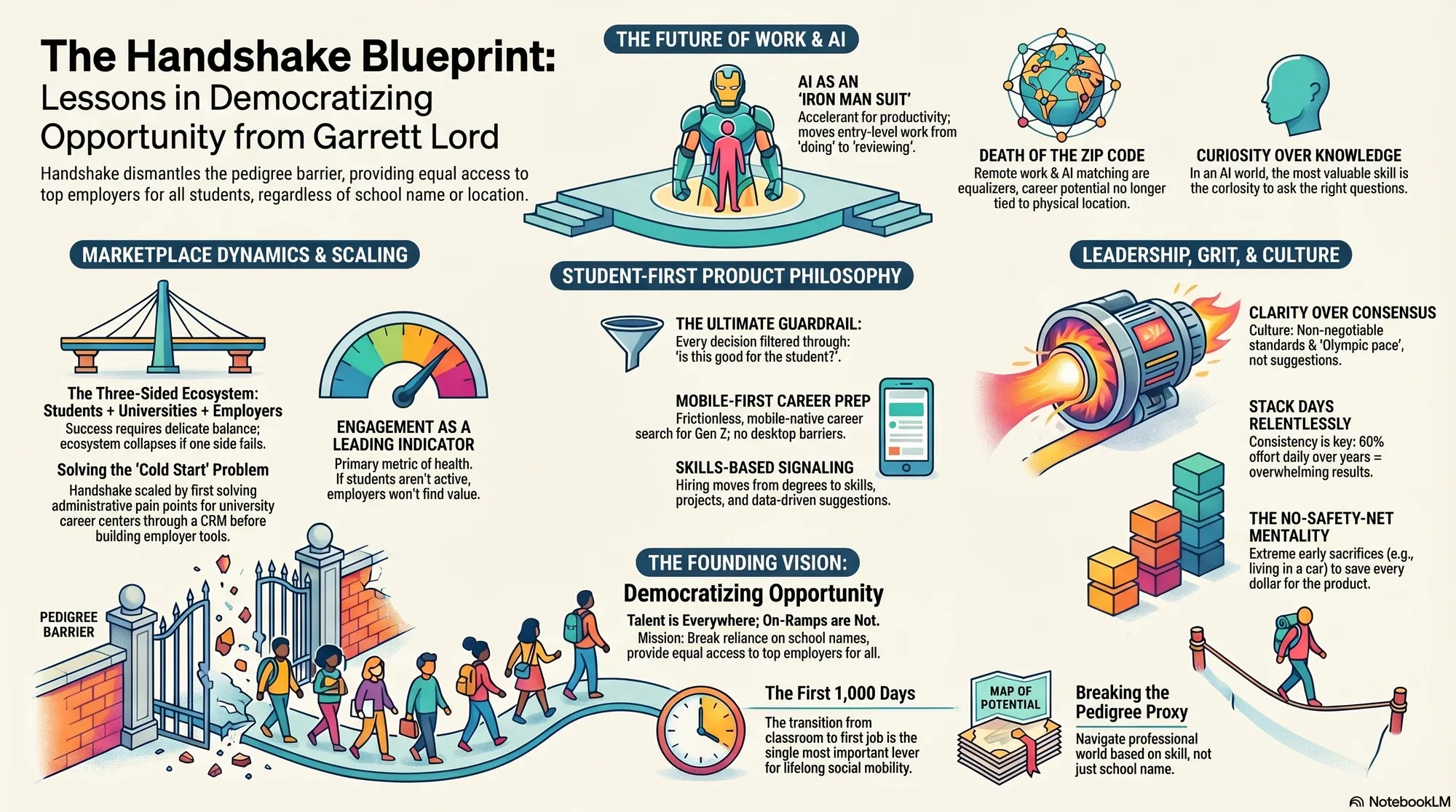
Part 1: The Founding Vision and Democratizing Opportunity
- On Geographic Bias: "If you’re a student at a school like Michigan Tech, your opportunities are often limited by your location, but talent is everywhere." — [Source: Forbes]
- On the "Billion-Dollar Question": The real story, per the episode description: after excelling in the competitive Palantir internship program, he started asking himself, How come they can't reach us -- meaning why Silicon Valley firms like Google recruited on other campuses but not his, Michigan Technical University -- and that question led him to found Handshake. [1]
- On the Mission of Equity: "Talent is evenly distributed; the on-ramps are not. Our job as founders is to pour concrete where the highway ends." — [Source: Substack]
- On Professional Discovery: "I didn’t want a better résumé. I wanted a better map to navigate the professional world." — [Source: Handshake Mission]
- On Social Mobility: "Your first job is the single most important lever for social mobility in your entire life." — [Source: Handshake Blog]
- On Breaking the Pedigree Proxy: "For too long, companies used 'elite' school names as a proxy for talent, which inherently excluded millions of qualified candidates." — [Source: Stanford eCorner]
- On Personal Stakes: "I grew up in a working-class family outside Detroit; I knew what it felt like to be on the outside looking in at the tech economy." — [Source: Medium]
- On Educational Equality: In his own words, that mission includes students earning credentials from community colleges and boot camps, not just traditional degrees: what really fuels us is this mission of bringing more equality and helping college students graduate and find meaningful opportunities and jobs. [15]
- On the Future of Connection: In this real interview he said it exactly this way: LinkedIn is generally about a lot of your history, while Handshake is a lot about your future. [2]
- On the First 1,000 Days: "The most critical time in a young person’s career is the transition from classroom to first job; that’s where the trajectory is set." — [Source: Forbes]
Part 2: Marketplace Dynamics and Scaling Strategy
- On Solving the 'Cold Start' Problem: "We didn’t start with the employers; we started by solving the administrative pain points for university career centers first." — [Source: 20VC Podcast]
- On Three-Sided Marketplaces: "You have to balance the needs of students, universities, and employers simultaneously; if one side fails, the whole ecosystem collapses." — [Source: Stanford University]
- On Scaling with Conviction: "When you find a model that works, you have to go big or risk blowing a crater in the ground by being too timid." — [Source: YouTube]
- On Building for Universities: "We built a CRM for career centers because we knew that if we controlled the data at the source, the employers would have to come to us." — [Source: Medium]
- On Strategy and Patience: "We achieved scale across a critical mass of schools for years before we even attempted to build premium tools for the employer side." — [Source: SaaStr]
- On Early Scrappiness: The real detail is a Ford Focus, not McDonald's parking lots: Garrett lived out of that car getting rejected by hundreds of universities before Handshake took off. [7]
- On Venture Capital: "Finding the right allies, like those who understand the education-to-employment gap, is more important than the valuation on the check." — [Source: 20VC]
- On Product-Market Fit: "If the students aren't engaged, the employers won't pay. Engagement is the leading indicator of marketplace health." — [Source: Lenny's Newsletter]
- On Market Gaps: "The traditional recruiting model was broken because it was analog; we moved the entire campus career fair into the cloud." — [Source: AllAmericanSpeakers]
- On Iterative Growth: "Scale happens one student at a time, one career center at a time, until suddenly you are the industry standard." — [Source: Stanford eCorner]
Part 3: Leadership, Resilience, and Culture
- On Relentless Effort: His real philosophy, from his own days getting rejected by hundreds of universities: some days you're at your best, some days just 60%, but if you stack your best effort daily over years, the results are overwhelming. [6]
- On Defining Culture: His real belief is defining culture through extreme clarity, not consensus -- he thinks watering down culture to please everyone dilutes what makes a company special, and being transparent about high standards helps the right people self-select in. [5]
- On 'Olympic' Standards: In his own words, Handshake's culture runs at an Olympic pace -- the kind of intensity that makes some people uncomfortable, and watering it down to please everyone would dilute what makes the company special. [4]
- On Overcoming Imposter Syndrome: In his own words, the real story is about cold emails, not classmates: it was very hard, he did not attend a well-known school, so he had to cold email recruiters and push for attention -- an experience that showed him how uneven access to opportunity really is. [13]
- On the 'No Safety Net' Mentality: "Operating without a safety net forces a level of focus and grit that you simply cannot simulate in a comfortable environment." — [Source: Apple Podcasts]
- On Vulnerability in Leadership: "Being honest about what you don't know is the fastest way to learn the things you need to know to scale." — [Source: CEO Insider]
- On Staying Level-Headed: "Grit is the ability to stay balanced through the extreme highs and the soul-crushing lows of building a company." — [Source: YouTube]
- On Motivation: "You have to work on something that matters. If you don't believe in the mission, you will quit when things get difficult." — [Source: Stanford University]
- On the Evolving CEO Role: In his own words, the real shift is about deciding what must remain uniquely his and what others can own -- letting go is hard, but it multiplies impact, which is what scaling himself through others actually means to him. [12]
- On Empowering the Team: "To multiply your impact as a leader, you have to let go of control and focus on setting the vision." — [Source: YouTube]
Part 4: Product, User Experience, and Student-First Philosophy
- On the 'Student-First' Guardrail: "Whenever we face a difficult business decision, we ask: Is this good for the student? If it’s not, we don’t do it." — [Source: Medium]
- On Personalization: "Every student’s career path is different. Our product must use data to suggest the next best step for that specific individual." — [Source: Handshake Blog]
- On Engagement: In his own words, that's the community he means: you can learn from peers, help network with young alumni, connect with companies, and read about what other students like you are doing -- not just browse listings. [14]
- On Removing Friction: "The easier it is for a student to apply, the more diverse the applicant pool becomes because you remove the 'insider knowledge' barrier." — [Source: Forbes]
- On Skills-Based Signals: "Degrees are important, but skills and projects are the future of how employers will filter for potential." — [Source: Business Insider]
- On Inclusivity by Design: "If your product is hard to use, you are effectively filtering for people who have the time and resources to figure it out." — [Source: Stanford eCorner]
- On Mobile-First Career Prep: "Gen Z does everything on their phones; if your career search requires a desktop, you've already lost the next generation." — [Source: Cheddar News]
- On Building a Startup within a Startup: The episode description names it exactly: the playbook for building a startup inside a startup is separate teams, separate offices, separate everything -- which is how Handshake ran its new AI data-labeling business. [8]
- On Trust: "The university’s endorsement is our greatest asset. We must protect that trust by ensuring every employer on the platform is verified." — [Source: Medium]
- On Helping the Underserved: "The students who need Handshake the most are the ones who don't have a parent to call for an intro to a recruiter." — [Source: Handshake Mission]
Part 5: The Future of Work, AI, and Career Equity
- On AI and Entry-Level Jobs: His real, repeated argument matches the first half of this closely: AI will reshape rather than erase entry-level work -- Gen Z's comfort with the tools means they can adapt quickly, but they'll need to show curiosity, faster learning, and collaboration to do it. [10]
- On Being 'AI Native': The episode's own framing captures the real idea: AI won't eliminate entry-level jobs -- it's creating Iron Man suits that make junior employees dramatically more productive. [9]
- On the Value of Curiosity: "In an AI-driven world, the most valuable skill is no longer just knowledge, but the curiosity to ask the right questions." — [Source: Gend.co]
- On Remote Work and Diversity: "Remote work is a massive equalizer for students who can't afford to move to expensive tech hubs like San Francisco or New York." — [Source: Forbes]
- On Accelerating Productivity: "AI is an accelerant that allows human beings to be even more productive and create more meaningful impact." — [Source: Business Insider]
- On the End of Geographic Bias: "We are moving to a world where your ZIP code no longer determines your career potential." — [Source: Cheddar News]
- On Micro-Internships: "Short-term, project-based work is the future of building a portfolio that proves your skills to an employer." — [Source: Gend.co]
- On AI-Supported Matching: His real framing is nearly identical: keep access front and centre, design for mobile-native behaviour, and use AI to personalise, not to gatekeep. [11]
- On Taking Risks in the AI Age: His real framing is almost identical: playing it safe means getting passed up -- this is the moment to put all your chips on the table with conviction, as AI reshapes the entire economy. [3]
- On the Ultimate Goal: "Success for us is a world where every student can graduate with a job they love, regardless of where they started." — [Source: Handshake Blog]
Learn more:
- Co-Founder & CEO Handshake, Garrett Lord: The Billion-Dollar Question That Changed College Recruiting (Grit Podcast)
- Handshake Pivots to Virtual Solutions for Job-Seeking College Students, Says CEO (Cheddar)
- First Block with Garrett Lord, Co-founder and CEO of Handshake (Notion)
- First Block with Garrett Lord, Co-founder and CEO of Handshake (Notion)
- First Block with Garrett Lord, Co-founder and CEO of Handshake (Notion)
- First Block with Garrett Lord, Co-founder and CEO of Handshake (Notion)
- First Block with Garrett Lord, Co-founder and CEO of Handshake (Notion)
- Inside the expert network training every frontier AI model -- Garrett Lord (Handshake CEO) (Lenny's Podcast)
- Inside the expert network training every frontier AI model -- Garrett Lord (Handshake CEO) (Lenny's Podcast)
- Garrett Lord Interview: Handshake's Vision for Gen Z Jobs (Generation Digital)
- Garrett Lord Interview: Handshake's Vision for Gen Z Jobs (Generation Digital)
- Interview with Garrett Lord, CEO of Handshake (CEO Insider)
- Interview with Garrett Lord, CEO of Handshake (CEO Insider)
- Handshake Pivots to Virtual Solutions for Job-Seeking College Students, Says CEO (Cheddar)
- Handshake Pivots to Virtual Solutions for Job-Seeking College Students, Says CEO (Cheddar)