Lessons from Gautam Baid
Gautam Baid built Stellar Wealth Partners after early career setbacks convinced him that quality and character matter more than market noise. His book, The Joys of Compounding, outlines a strategy for Indian equities that treats financial returns as a byproduct of intellectual rigor. This profile looks at how he manages both a portfolio and a life geared toward long-term growth.
Part 1: The Philosophy of Compounding
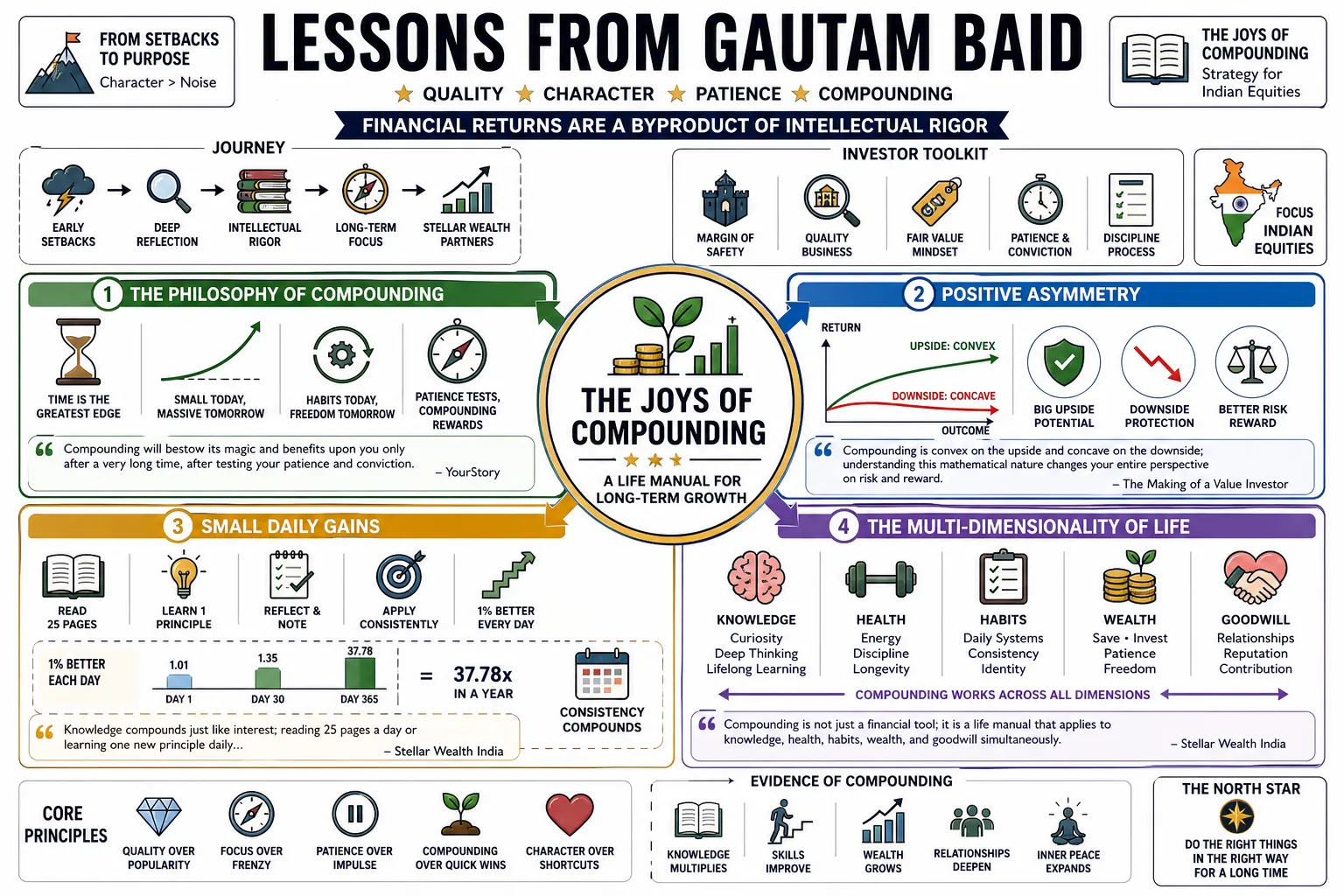
- On the Multi-Dimensionality of Life: "Compounding is not just a financial tool; it is a life manual that applies to knowledge, health, habits, wealth, and goodwill simultaneously." — Source: Stellar Wealth India
- On the Magic of Patience: "Compounding will bestow its magic and benefits upon you only after a very long time, after testing your patience and conviction to the fullest." — Source: YourStory
- On Positive Asymmetry: "Compounding is convex on the upside and concave on the downside; understanding this mathematical nature changes your entire perspective on risk and reward." — Source: The Making of a Value Investor (Book)
- On Small Daily Gains: "Knowledge compounds just like interest; reading 25 pages a day or learning one new principle daily creates massive net present value over a lifetime." — Source: Edelweiss Mutual Fund
- On Intellectual Compounding: "The more you learn, the more you'll earn, but the real prize is the mental database you build that allows you to spot patterns others miss." — Source: Steady Compounding
- On Goodwill as Capital: "Being genuinely helpful to others without expecting anything in return creates a reservoir of goodwill that compounds into social capital over decades." — Source: YouTube - Siddhartha Ahluwalia
- On the Scarcest Resource: "The ultimate status symbol is time; the goal of compounding wealth is not to buy more things, but to buy back your freedom." — Source: Sumit Badarkhe
- On Positive Thoughts: "Associating with high-quality minds and avoiding toxic environments is a form of emotional compounding that preserves your cognitive energy for what matters." — Source: Talking Billions Podcast
- On the Law of Nature: "Compounding is a law of nature; those who understand it earn it, and those who don't, pay it." — Source: Twitter - @Gautam__Baid
Part 2: Value Investing and Quality Business
- On Value vs. Valuation: "Value investing is not the same as valuation investing; focus on the underlying business value rather than just low price-to-earnings ratios." — Source: Capitalize Podcast
- On the Three Pillars of Growth: "A true compounding machine requires three things: high return on capital, a defensible moat, and a long reinvestment runway." — Source: YouTube - Aswini Bajaj
- On Quality over Price: "Mediocre businesses might rise in a bull market, but only high-quality businesses with resilient management survive a brutal bear market." — Source: Market Sentiment
- On Variant Perception: "Dedicating a small portion of the portfolio to situations where your view differs from the market consensus can provide alpha, provided the core is structural growth." — Source: YouTube - Wealth Desk
- On Management Track Records: "The best predictor of future performance is the past track record; check if the company has consistently grabbed market share from its competitors." — Source: YouTube - Complete Circle Wealth
- On Internal Accruals: "Prefer businesses that can fund their own growth through internal cash flows rather than constantly relying on external capital raises." — Source: Smallcase
- On Capital Allocation: "The market often correctly assigns a low multiple to a business because managers keep burning cash in bad projects with no prospect of stopping." — Source: Quartr
- On the Power of Simplicity: "You aren't paid for style points or complexity; simple, well-understood businesses often compound best over the long run." — Source: The Joys of Compounding (Book)
- On Business Dispassion: Baid urges investors to stay passionate about the underlying business while remaining emotionally detached from the stock's price swings. — Source: Goodreads
Part 3: Lifelong Learning and Reading
- On the Game of Life: "The game of life is the game of everlasting learning; those who keep learning will keep rising in life." — Source: Bookey
- On Vicarious Learning: "The best way to learn is to do it, but the next best way is to learn from the best minds, including dead people, through intensive reading." — Source: Medium
- On Self-Education: "The most talented people in any given field are almost always self-educated; they don't wait for a syllabus to define their knowledge." — Source: The Joys of Compounding (Book)
- On Reading Daily: "Read at least 25 pages every single day; it seems small, but over ten years, the cumulative knowledge is transformative." — Source: Scribd
- On History as a Guide: "Read history to understand the range of what can go wrong; our imagination is limited by our knowledge of what has already happened." — Source: Thread Reader App
- On the "Chapter" Approach: "Deep-dive into one subject for weeks at a time to move past surface-level information and achieve true understanding." — Source: YouTube - 100x Entrepreneur
- On Curiosity: "Curiosity is antifragile; it is magnified by attempts to satisfy it and remains the engine of all great investors." — Source: The Joys of Compounding (Book)
Part 4: Mental Models and Decision Making
- On the Latticework of Models: "Follow Charlie Munger’s advice and build a latticework of mental models from psychology, history, and biology to avoid the 'man with a hammer' syndrome." — Source: YouTube - Talking Billions
- On Probabilistic Thinking: "The future is a set of branching probability streams; focus on the consequences of being wrong rather than just the probability of being right." — Source: The Making of a Value Investor (Book)
- On Inversion: "To solve a difficult problem, invert it. List all the ways you could fail and then systematically avoid those behaviors." — Source: Sumit Badarkhe
- On the Circle of Competence: "Success comes from knowing what you don't know; specialization leads to mastery, while chasing every trend leads to ruin." — Source: YouTube - Planet MicroCap
- On Identifying Key Variables: "Investing is not about complex spreadsheets; it’s about identifying the two or three variables that truly move the needle for a business." — Source: Twitter - @Gautam__Baid
- On Avoiding Buzzing Stocks: "Do not blindly chase stocks with exciting stories but unproven track records; complexity is often a mask for a lack of profitability." — Source: The Joys of Compounding (Book)
- On Deterministic Bias: "The biggest mistake in decision making is thinking deterministically; always leave room for a margin of safety for when the unexpected occurs." — Source: YouTube - Complete Circle
- On Systems over Goals: "Focus on building a reliable process rather than fixating on a specific outcome; a good process eventually leads to good results." — Source: Stellar Wealth India
- On Intellectual Humility: "Intellectual humility is the dawning of wisdom; once you admit you don't know everything, you can finally begin to learn." — Source: Bookey
Part 5: Behavioral Edge and Psychology
- On Temperament as an Edge: "In an era of instant information, the only remaining edge for most investors is patience and temperament." — Source: Market Sentiment
- On Active Patience: "True patience is not lazy; it is the active process of verifying your thesis and doing nothing until something materially changes." — Source: The Making of a Value Investor (Book)
- On Emotional Biases: "Documenting your decisions in a journal helps separate luck from skill and prevents the hindsight bias that plagues most investors." — Source: YouTube - Siddhartha Ahluwalia
- On Bull Market Brains: "Never mistake brains for a bull market; true skill is only revealed during the gut-wrenching volatility of a bear market." — Source: Twitter - @Gautam__Baid
- On the Hedonic Treadmill: "The treadmill function is to move the goalpost of your financial dreams, extinguishing the joy you thought you would get from having more money." — Source: Bookey
- On Overconfidence: "The best cure for overconfidence is to remind yourself that you have experienced less than a tiny fraction of a percent of what has happened in the world." — Source: The Joys of Compounding (Book)
- On Delayed Gratification: "Delayed gratification is the ultimate superpower of compounding; most people fail because they interrupt the process too early." — Source: YouTube - Planet MicroCap
- On Sitting Quietly: "Most of humanity's problems stem from the inability to sit quietly in a room alone; learn to be happy doing nothing with your portfolio." — Source: Twitter - @Gautam__Baid
- On Behavioral Traps: "The market tests your conviction by falling 30% when you are most optimistic; your reaction in that moment determines your long-term returns." — Source: YouTube - Aswini Bajaj
- On Social Approval: "Living by the inner scorecard means prioritizing self-esteem over social approval; the crowd is rarely right at the extremes." — Source: Quartr
Part 6: Portfolio Management and Risk
- On Permanent Loss of Capital: "Risk is the probability of a permanent loss of capital, not the temporary volatility of stock prices shown on a screen." — Source: Stellar Wealth India
- On Concentration vs. Diversification: "Holding 20 to 25 stocks is the sweet spot where you capture diversification benefits while remaining focused enough to outperform." — Source: YouTube - Complete Circle
- On When Not to Average Down: "Never buy more of a falling stock in businesses facing technological obsolescence, fraud, or highly levered models like banks." — Source: The Making of a Value Investor (Book)
- On Checklists: "Use rigorous checklists to ensure discipline and filter out bad corporate governance before looking at a single financial metric." — Source: Smallcase
- On the Margin of Safety: "Always leave a wide margin for error in your calculations; if a thesis requires perfection to work, it is a bad thesis." — Source: The Joys of Compounding (Book)
- On Avoiding Fads: "Risk mitigation begins by avoiding leverage, short selling, and speculative fads that offer quick riches at the cost of total ruin." — Source: Stellar Wealth India
- On Bear Market Opportunity: "Bear markets make you a better investor; the biggest learnings come when the tide goes out and you see who has been swimming naked." — Source: Business Today
- On ROCE and Growth: "Multibaggers are created when a company grows its revenue while simultaneously improving its Return on Capital Employed." — Source: YouTube - Aswini Bajaj
- On Liquidity Risk: "Even the best investor will struggle if they are focused on small-caps during a cycle where liquidity is drying up." — Source: YouTube - Wealth Desk
- On Time Horizons: "Adopt a 10–15 year investment horizon; you are an owner of a business, not a trader of electronic tickets." — Source: Stellar Wealth India
Part 7: Character, Ethics, and The Inner Scorecard
- On the Equation of Ego: "Ego equals one divided by knowledge; the more you know, the smaller your ego becomes." — Source: Bookey
- On Reliability: "Eighty percent of success in life is just showing up and being reliable for the task entrusted to you." — Source: Sumit Badarkhe
- On Internal Principles: "Live life according to your inner scorecard; if you are satisfied with your actions, the external noise does not matter." — Source: Talking Billions Podcast
- On Siphoned Cash: "A business run by a crook may appear cheap on paper, but cash on the books is worthless if it is being siphoned off by the promoter." — Source: Quartr
- On Aligning Interests: "The best investment structures have zero management fees and are performance-linked, ensuring the manager only wins when the partners win." — Source: Stellar Wealth India
- On Minimalism: "Minimalism is an extension of simplicity; by getting rid of the unnecessary in life, you can focus on the few things that truly matter." — Source: The Making of a Value Investor (Book)
- On Being a Funnel: "Strive to be a funnel that shares knowledge with others, rather than a sponge that only absorbs it for personal gain." — Source: Twitter - @Gautam__Baid
- On Choosing Role Models: "Find giants who have already achieved what you desire and study their path; vicarious learning is the ultimate shortcut." — Source: YouTube - Siddhartha Ahluwalia
Part 8: Life Lessons and Personal Growth
- On Personal Compounding: "The best investment you can ever make is in your own personal compounding—health, knowledge, and character." — Source: Stellar Wealth India
- On Adversity as a Teacher: "Nothing teaches the biggest lessons of life like an empty wallet and an empty stomach; use your periods of struggle to build resilience." — Source: YourStory
- On Survival: "Success in the markets and in life is primarily about survival; you cannot win if you are forced out of the game." — Source: The Making of a Value Investor (Book)
- On the Admission Fee: "View your early losses in the market not as failures, but as the tuition fees required to learn how the world really works." — Source: Market Sentiment
- On Self-Sufficiency: "Wealth consists not in having great possessions, but in having few wants; self-sufficiency is the greatest of all riches." — Source: Bookey
- On Habits: "Small, positive daily habits create long-term momentum that eventually becomes unstoppable." — Source: YouTube - Complete Circle
- On Choosing the Right People: "Nothing matters as much as bringing the right people into your life; they will teach you everything you need to know through their example." — Source: The Joys of Compounding (Book)
- On Life as a Process: "Treat life as a continuous process of evolution; never stop updating your beliefs based on new evidence." — Source: Talking Billions Podcast
- On the Goal of Investing: "The ultimate goal of all your effort should be to buy back your time and use it to do exactly what you love with people you respect." — Source: Sumit Badarkhe