George Mumford is a world-renowned mindfulness and performance expert who has worked with legendary athletes and teams, including Michael Jordan, Kobe Bryant, and the Chicago Bulls and Los Angeles Lakers under coach Phil Jackson. His teachings blend Eastern contemplative traditions with Western psychology, focusing on helping individuals get out of their own way and perform at their peak.
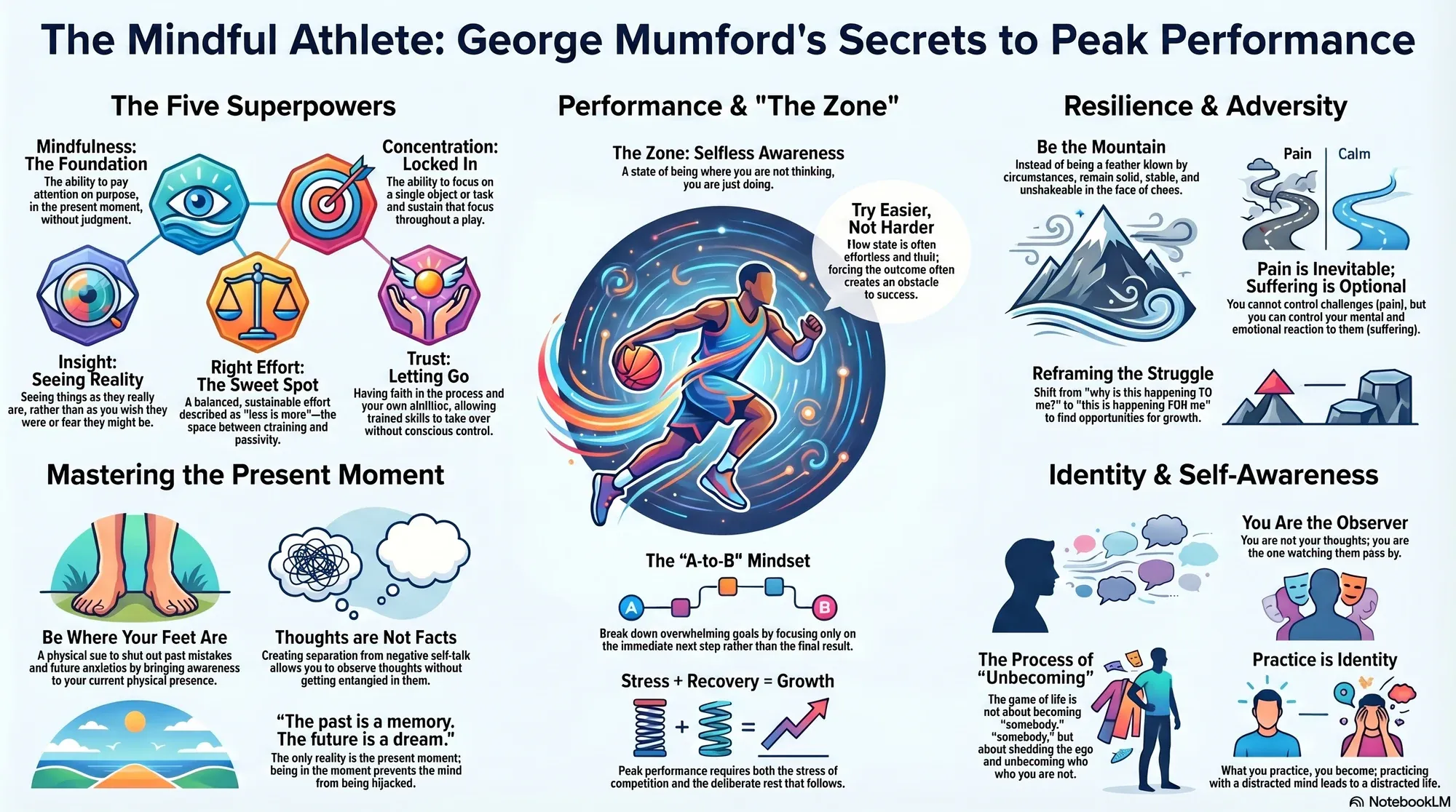
The Five Superpowers: Core Learnings
Mumford's philosophy is built around cultivating five "Superpowers" through mindfulness. These are foundational to his teachings.
- Learning: The Five Superpowers. He describes it this way in an HBX/Harbus interview: these five principles -- Mindfulness, Concentration, Insight, Right Effort, and Trust -- are his spin on Buddha's Eightfold Path, and they're like spokes in a wheel, where taking one away means the wheel doesn't turn. [1]
- Learning: Mindfulness. The ability to pay attention on purpose, in the present moment, without judgment. It's the foundation for all the other superpowers.
- Source: The Mindful Athlete: Secrets to Pure Performance
- Learning: Concentration. The ability to focus on a single object or task and sustain that focus. In sports, this is being locked in on the present play.
- Source: The Mindful Athlete: Secrets to Pure Performance
- Learning: Insight. Seeing things as they really are, not as you wish they were or fear they might be. It’s about clarity and understanding the nature of the moment.
- Source: The Mindful Athlete: Secrets to Pure Performance
- Learning: Right Effort. The sweet spot between straining and passivity. It's skillful, balanced, and sustainable effort, often described as "less is more."
- Source: The Mindful Athlete: Secrets to Pure Performance
- Learning: Trust. In a real Harbus interview, Mumford describes Trust as inseparable from the other four principles rather than defining it alone as faith in the process: Mindfulness, Concentration, Insight, Right Effort, and Trust are his own spin on Buddha's Eightfold Path, and he compares them to spokes in a wheel -- take one away, and the wheel doesn't turn. [2]
On Mindfulness and the Present Moment
- "Be where your feet are."
- Source: A common mantra in his teachings.
- Learning: This is a simple, powerful cue to bring your awareness back to your physical presence in the current moment, shutting out past mistakes and future anxieties.
- This book excerpt frames the practice as a choice between two responses to stimulus, not a standalone definition: we can react in knee-jerk ways -- anger, agitation, anxiety, fear, craving, doubt, guilt -- or we can respond by getting still, paying attention on purpose to what comes up without judgment, and acting from a center space of calm. [5]
- This book excerpt anchors the present-moment idea to a specific mechanism rather than a memory-dream formula: this calm center space is what anchors the mindful athlete in the present moment and facilitates high performance and flow. [8]
- “Whatever is happening, is happening. You have to be with what is, and you can’t be with what isn’t.”
- Source: 10% Happier Podcast with Dan Harris
- Link: YouTube
- "When we are in the moment, we are not allowing our minds to be hijacked by the past or the future."
- Source: The Mindful Athlete: Secrets to Pure Performance
- In the same Harbus interview, Mumford frames this as separating yourself from your mind rather than from your thoughts specifically: the most powerful way to avoid stress is to remind yourself that the mind is an exterior entity, not the person itself, and that distinction alone can create calm within the system. [4]
On Performance and "The Zone"
- “The zone is a state of selfless awareness. It’s a state of being where you’re not thinking, you’re just doing.”
- Source: The Mindful Athlete: Secrets to Pure Performance
- “When you’re in the zone, it’s almost as if the universe is conspiring to help you.”
- Source: Interview with Rich Roll
- Link: YouTube
- “Get out of your own way. The biggest obstacle to your success is usually yourself.”
- Source: A central tenet of his coaching.
- “It’s not about trying harder. It’s about trying easier.”
- Source: The Mindful Athlete: Secrets to Pure Performance
- Learning: This speaks to the principle of "Right Effort." Peak performance is often effortless and fluid, not forced.
- “Stress + Recovery = Growth. You can’t have one without the other.”
- Source: The Mindful Athlete: Secrets to Pure Performance
- Learning: Growth happens not just from the stress of practice and competition, but from the deliberate recovery and rest that follows.
- “You play how you practice. If you practice with a distracted mind, you’ll play with a distracted mind.”
- Source: His general coaching philosophy.
On Adversity and Resilience
- This book excerpt frames suffering as something to understand rather than as an optional reaction to inevitable pain: suffering is a part of life and there is no way of avoiding it, and to evolve as human beings, we have to understand the wisdom hidden in that suffering. [7]
- “The wound is the place where the Light enters you.”
- Source: Quoting the poet Rumi, a favorite of Mumford's.
- Learning: Our greatest challenges and vulnerabilities are often our greatest sources of strength and growth.
- “Everything that happens to you is for you, not to you.”
- Source: A key mindset shift he teaches.
- Learning: This reframes adversity from a personal attack into an opportunity for learning and development.
- In the same Harbus interview, Mumford gives this as a concrete technique rather than a general anchor metaphor: stop what you are doing and return to your breath, stay in the calm center, and respond from the center of the hurricane rather than reacting from the chaos of the story. [3]
- This book excerpt names a trainable skill rather than a dance metaphor: mentally, we can train ourselves to be comfortable with being uncomfortable, to feel calm in the midst of chaos, and to stay in the eye of the proverbial hurricane. [6]
- “Don’t be a feather in the wind, blown about by every circumstance. Be the mountain—solid, stable, and unshakeable.”
- Source: The Mindful Athlete: Secrets to Pure Performance
On Identity and Self-Awareness
- “You are not your thoughts. You are the observer of your thoughts.”
- Source: A fundamental mindfulness concept he emphasizes.
- “Who you are is more important than what you do.”
- Source: The Mindful Athlete: Secrets to Pure Performance
- Learning: Your character and inner state are the foundation from which your actions and achievements spring.
- “The game is not about becoming somebody. It’s about unbecoming who you are not.”
- Source: His teachings on shedding the ego.
- “You have to know thyself. The unexamined life is not worth living.”
- Source: Quoting Socrates, a cornerstone of his approach.
- "Our authentic self is our greatest gift."
- Source: The Mindful Athlete: Secrets to Pure Performance
Additional Quotes and Learnings
- “Love the game, not the outcome.”
- “When in doubt, breathe out.”
- “The mind is like water. When it’s turbulent, it’s difficult to see. When it’s calm, everything becomes clear.”
- Learning: The "A-to-B" Mindset. "Focus on getting from A (where you are) to B (your immediate next step), not all the way to Z." This breaks down overwhelming goals into manageable actions.
- “Let it go, let it be, let it flow.”
- “What you practice, you become.”
- “We are human beings, not human doings.” - A reminder to prioritize being present over constant, mindless action.
- “Comparison is the thief of joy.”
- “Your focus determines your reality.”
- Learning: The Inner Critic. "Make friends with your inner critic. Acknowledge it, but don't let it drive the bus."
- “The only moment we ever have is now.”
- “Be a warrior, not a worrier.”
- “Silence is the canvas upon which genius is painted.”
- Learning: One Breath, One Mind. A technique where a team breathes in unison to create a collective sense of calm and focus.
- “The journey is the reward.”
- “Stillness is the source of all action.”
- “Embrace the mystery. We don’t have to have all the answers.”
- “Respond, don’t react.” - A core mindfulness teaching about creating a space between stimulus and response.
- “We are all works in progress.”
- “Compassion is not a weakness, it's a strength.”
- “Just show up. That’s half the battle. Be present and engaged with whatever is in front of you.”
Learn more:
- The Mindful Athlete: An Interview with George Mumford (HBX/The Harbus)
- The Harbus (via HBS Online), "The Mindful Athlete: An Interview with George Mumford"
- The Harbus (via HBS Online), "The Mindful Athlete: An Interview with George Mumford"
- The Harbus (via HBS Online), "The Mindful Athlete: An Interview with George Mumford"
- YourWorkoutBook, "27 Key Lessons from The Mindful Athlete by George Mumford"
- YourWorkoutBook, "27 Key Lessons from The Mindful Athlete by George Mumford"
- YourWorkoutBook, "27 Key Lessons from The Mindful Athlete by George Mumford"
- YourWorkoutBook, "27 Key Lessons from The Mindful Athlete by George Mumford"