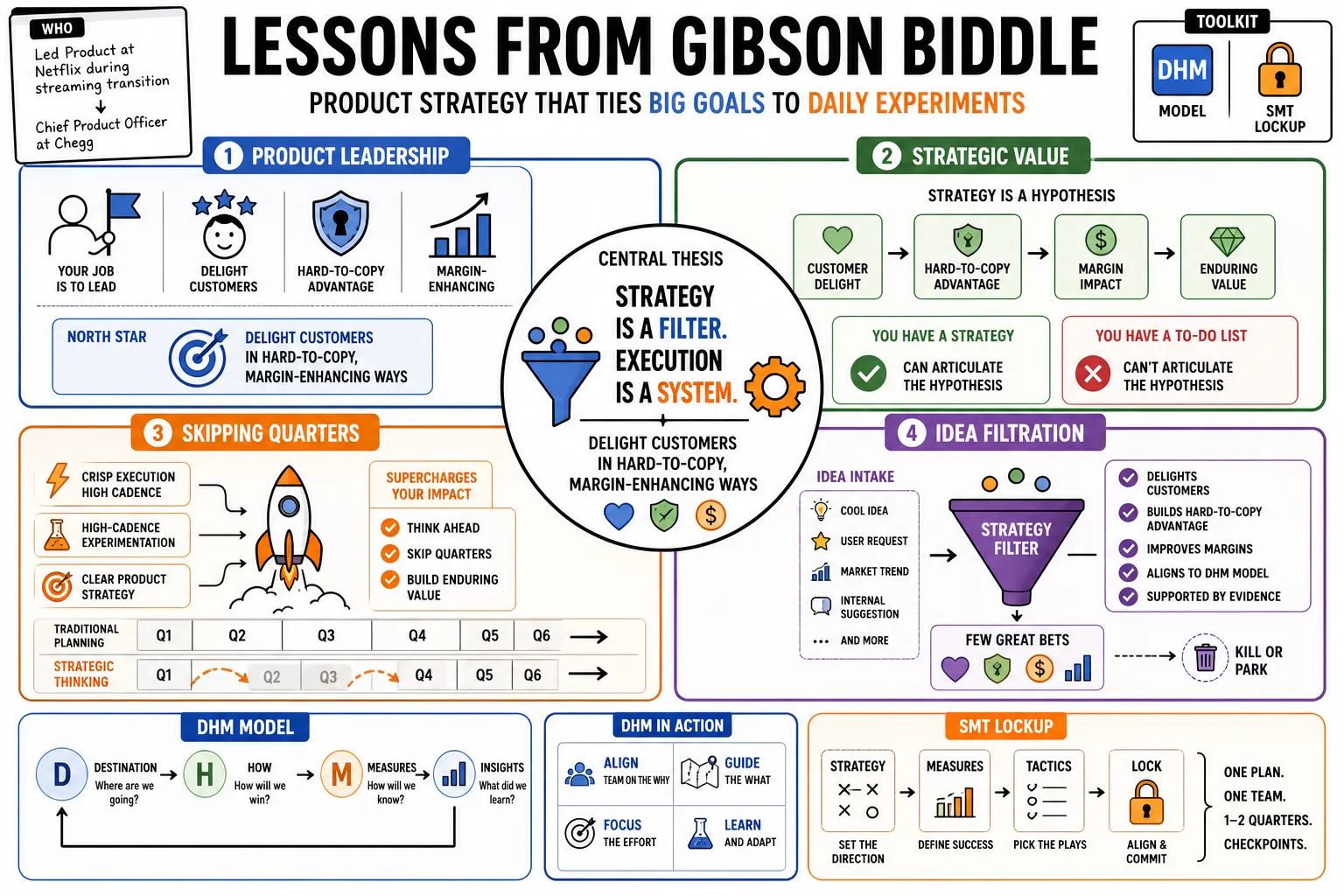
Lessons from Gibson Biddle
Gibson Biddle led product at Netflix during its streaming transition before becoming Chief Product Officer at Chegg. He relies on strict, acronym-heavy frameworks like the DHM model and SMT lockup to force teams to tie high-level business goals directly to daily feature experiments. His writing offers a blunt, operational guide for structuring strategy and prioritizing exactly what to build next.
Part 1: Product Strategy and the DHM Model
- On Product Leadership: "Your job is to delight customers in hard-to-copy, margin-enhancing ways." — Source: [Ask Gib Newsletter]
- On Strategic Value: "Strategy is a hypothesis about how you will delight customers in hard-to-copy, margin-enhancing ways. If you can't articulate that hypothesis, you don't have a strategy; you have a to-do list." — Source: [Lenny's Newsletter]
- On Skipping Quarters: "Crisp execution and high-cadence experimentation are critical, but having a clear product strategy supercharges your efforts. Strategic thinking enables you to think ahead, to effectively ‘skip quarters,’ and to build enduring value." — Source: [Medium]
- On Idea Filtration: "A great product strategy serves as a filter for ideas, ensuring that features don't just make users happy, but also build a sustainable, profitable business." — Source: [Airfocus]
- On Strategy Constraints: "Strategy is about determining what you will not do. It restricts the playing field so teams know where to focus their energy." — Source: [Productboard]
- On Decision Weight: "Most decisions by product leaders are low stakes, although they almost always believe the opposite." — Source: [Glasp]
- On Speed vs. Deliberation: "If the stakes are low and the decision is easy to reverse, decide quickly, then move on." — Source: [Ask Gib Newsletter]
- On Irreversible Choices: "For high stakes, hard-to-reverse decisions, give them plenty of time, consider them carefully, and gather as much data as possible." — Source: [Lenny's Newsletter]
- On Sunk Costs: "Don't let past investment inform future investment. Ask yourself, 'Given what we know today, how much should we invest going forward?'" — Source: [Glasp]
- On Daily Intent: "Begin with intent. Outline two to three critical tasks each morning to maintain strategic momentum over simple firefighting." — Source: [Maven]
Part 2: The Components of DHM
- On Defining Delight: "Delight focuses on the customer value proposition: how the product provides joy or solves a problem so well that customers choose it over alternatives." — Source: [Productboard]
- On Building Moats: "A 'hard-to-copy' advantage is your moat. It ensures that once you delight customers, competitors cannot easily replicate the experience and steal them." — Source: [Lenny's Newsletter]
- On Margin Reality: "While charging zero dollars would absolutely delight customers, it fails the margin test because the company couldn't afford to sustain the business or create new value." — Source: [Medium]
- On Brand Defensibility: "Building trust with customers takes years of delivering value with an absolute minimum of trust-busters." — Source: [Notion Capital]
- On Network Effects: "True network effects occur when the product actually becomes more valuable to every user as more people use it." — Source: [Lenny's Podcast]
- On Economies of Scale: "Scale gives you margin power. Netflix could spread a massive content budget over 200 million subscribers, lowering the unit cost far beyond what smaller competitors could match." — Source: [Kevin Yuan Blog]
- On Switching Costs: "You create hard-to-copy switching costs by making it painfully inconvenient for a customer to leave, like losing a deeply personalized watch history." — Source: [Airfocus]
- On Proprietary Technology: "Unique algorithms, such as Netflix's personalization engine, serve as a hard-to-copy technological advantage that continuously refines the user experience." — Source: [Productboard]
- On Counter-Positioning: "Adopt a new business model that incumbents can't mimic without fundamentally damaging their existing revenue streams." — Source: [Lenny's Newsletter]
- On Balancing the Triangle: "You have to balance customer delight with the absolute need for profit. They are not opposing forces if designed correctly; margin funds the next wave of delight." — Source: [Maven]
Part 3: Long-term Vision and the GLEe Model
- On Long-Term Thinking: "The GLEe model encourages teams to look ten to fifteen years ahead rather than just focusing on the next quarter's feature output." — Source: [Maven]
- On Sequential Focus: "You cannot do everything at once. A phased approach provides a roadmap for sequencing big bets over time." — Source: [Medium]
- On Vision Hypotheses: "The product vision does not have to be exactly right from day one. Each step is actually a working hypothesis." — Source: [Lenny's Newsletter]
- On Getting Big: "The first phase is to 'Get Big' on an initial core product that establishes a foothold, builds your brand, and gets the economic flywheel spinning." — Source: [Ask Gib Newsletter]
- On Leading the Market: "Once you have scale in your initial niche, you must anticipate the next technological shift and work to 'Lead' that broader market before competitors catch up." — Source: [Maven]
- On Expansion: "In the 'Expand' phase, a company leverages its leadership position to move into entirely new categories, international markets, or adjacent industries." — Source: [Medium]
- On Communicating Scale: "The GLEe framework helps align a big vision with employees and investors while explicitly keeping the immediate next step grounded and actionable." — Source: [Ask Gib Newsletter]
- On Platform Transitions: "Netflix getting big on DVDs-by-mail provided the subscriber base and brand permission necessary to safely jump to leading streaming." — Source: [Lenny's Podcast]
- On Denting the Universe: "Expansion is where the company truly dents the universe and achieves its ultimate, multi-decade scale." — Source: [Ask Gib Newsletter]
Part 4: Prioritization and the GEM Model
- On Forcing Alignment: "When teams are misaligned on what matters most in a given quarter, the GEM model forces a strict ranking of competing high-level goals." — Source: [Mews]
- On Growth vs. Engagement: "You cannot perfectly optimize growth, engagement, and monetization all at the exact same time; one must take priority based on the current business context." — Source: [Productboard]
- On Retention as North Star: "At Netflix, we often prioritized retention as our absolute North Star, because high engagement inherently drove both word-of-mouth growth and long-term lifetime value." — Source: [Lenny's Podcast]
- On Defining Growth: "Growth is the pure acquisition engine: year-over-year member increases and bringing new users through the front door." — Source: [Mews]
- On Defining Engagement: "Engagement is the behavioral proxy for product love, typically measured through monthly retention or daily active usage." — Source: [Ask Gib Newsletter]
- On Defining Monetization: "Monetization focuses on the unit economics, lifetime value, and profit margins that ensure the business is viable." — Source: [Productboard]
- On Shifting Priorities: "The priority between Growth, Engagement, and Monetization should shift dynamically as the company moves through different stages of the GLEe model." — Source: [Medium]
- On Cross-Functional Clarity: "Force-ranking GEM ensures that marketing, product, and finance are all aiming at the same immediate target rather than canceling each other's efforts out." — Source: [Ask Gib Newsletter]
- On Trade-offs: "If you prioritize monetization over engagement prematurely, you risk burning user trust for short-term revenue, creating a leaky bucket." — Source: [Maven]
Part 5: Execution and the SMT Lockup
- On Linking Goals to Work: "The Strategy/Metric/Tactic lockup is designed to create a clear, unbreakable link between high-level business hypotheses and day-to-day execution." — Source: [Go3 Consulting]
- On Hypothesis Translation: "Every strategy in the SMT lockup is a high-level hypothesis for how you will delight customers in a hard-to-copy, margin-enhancing way." — Source: [Medium]
- On Proxy Metrics: "Because high-level goals like revenue are lagging indicators and hard to move quickly, proxy metrics provide a sensitive, leading signal of success." — Source: [Glasp]
- On Defining Success Upfront: "The SMT lockup forces product teams to define exactly what mathematical success looks like before they write a single line of code." — Source: [Your Product Mentor]
- On Grounding Tactics: "Tactics are the specific projects or experiments the team will execute to move the designated proxy metric." — Source: [Medium]
- On Bottom-Up Strategy: "If a team is struggling to define their strategy, they can work backward: list all current projects, group them into buckets, and identify the strategy those buckets imply." — Source: [Ask Gib Newsletter]
- On Identifying Waste: "By locking strategy, metric, and tactic together, it becomes painfully clear when a project isn't actually serving the strategy." — Source: [Your Product Mentor]
- On Strategy Failures: "If you complete all your tactics and the proxy metric doesn't move, your strategy was flawed. If the metric moves but the business doesn't grow, your proxy metric was wrong." — Source: [Lenny's Newsletter]
- On Feature Factories: "The SMT framework ensures that product teams aren't just blindly building features, but are validating strategic hypotheses." — Source: [Productboard]
Part 6: Consumer Science and A/B Testing
- On the Scientific Method: "Consumer Science is the rigorous application of the scientific method to product development, replacing executive gut instinct with hard evidence." — Source: [Productboard]
- On Empathy and Evidence: "The ultimate goal of consumer research is to turn human empathy into empirical evidence." — Source: [Medium]
- On Words vs. Actions: "What customers say in focus groups doesn't always match their behavior. You need A/B testing to measure actual behavioral change." — Source: [Ask Gib Newsletter]
- On A/B Testing as Arbiter: "At scale, A/B testing is the most consistent and ruthless arbiter of truth regarding what customers actually value." — Source: [Product Evangelist]
- On Triangulating Data: "Never rely on one input. Use a mix of qualitative focus groups, surveys, historical data, and live A/B tests to get a complete picture." — Source: [Medium]
- On Customer 'Votes': "Don't rely heavily on internal expert opinions; use continuous testing to let your customers vote with their time and wallets." — Source: [Lenny's Podcast]
- On Measuring Margin Trade-offs: "A/B testing allows you to measure the exact cost of customer delight and determine if the long-term retention lift is worth the short-term margin hit." — Source: [Medium]
- On Sensitivity: "You must find proxy metrics that are highly sensitive to product changes so you can iterate quickly without waiting months for retention numbers to settle." — Source: [Glasp]
- On Customer Immersion: "Regularly engage in focus groups and usability sessions. Direct observation of customer frustration is a vital input for any product hypothesis." — Source: [Maven]
Part 7: Team Alignment and Culture
- On Culture's Function: "Culture helps us understand how, as humans, we can work well together and, most importantly, how we should behave when no one else is looking." — Source: [Notion Capital]
- On Context over Control: "A high-performance culture allows leadership to lead with broad context rather than micromanaging control." — Source: [Medium]
- On the Keeper Test: "Managers should continuously ask themselves: 'If this employee told me they were leaving, would I fight to keep them?' If not, give them generous severance now." — Source: [Productboard]
- On Decentralized Decisions: "When every team deeply understands the high-level strategy, they can be highly aligned but loosely coupled, moving fast without constant oversight." — Source: [Lenny's Podcast]
- On Teamwork Realities: "Teamwork is about knowing and playing your position to deliver results. What it's not: simply getting along with others or artificially building consensus." — Source: [Ask Gib Newsletter]
- On Motivation: "If you can give people absolute focus, the feeling they are working on hard problems, and the knowledge they are doing it with bright peers, you can achieve great things." — Source: [Notion Capital]
- On Asynchronous Problem Solving: "Minimize meetings. Handle issues asynchronously via tools like Slack or shared documents to protect deep thinking time." — Source: [Maven]
- On Taking Risks: "A strong culture doesn't punish failure; it empowers teams to take wicked hard risks as long as they apply rigorous consumer science to the outcomes." — Source: [Medium]
Part 8: Career Building and the Personal Board of Directors
- On Treating Career as Product: "Treat your career exactly like a product; iterate on yourself based on continuous feedback from a trusted group of advisors." — Source: [Mews]
- On the Personal Board: "A Personal Board of Directors is a small, curated group of peers and mentors whom you meet with regularly to identify blind spots." — Source: [Medium]
- On Brutal Honesty: "The primary value of your board is their ability to give you brutal, unfiltered honesty that your direct reports and immediate boss cannot provide." — Source: [Medium]
- On Refreshing Advisors: "As your career evolves and you transition into entirely new roles or industries, proactively refresh the members of your board to match your new trajectory." — Source: [Mind the Product]