Gino Wickman created the Entrepreneurial Operating System, a set of tools for aligning a leadership team around vision, people, data, issues, process and quarterly execution. His book Traction introduced the framework to a wider audience. — EOS Official Overview.
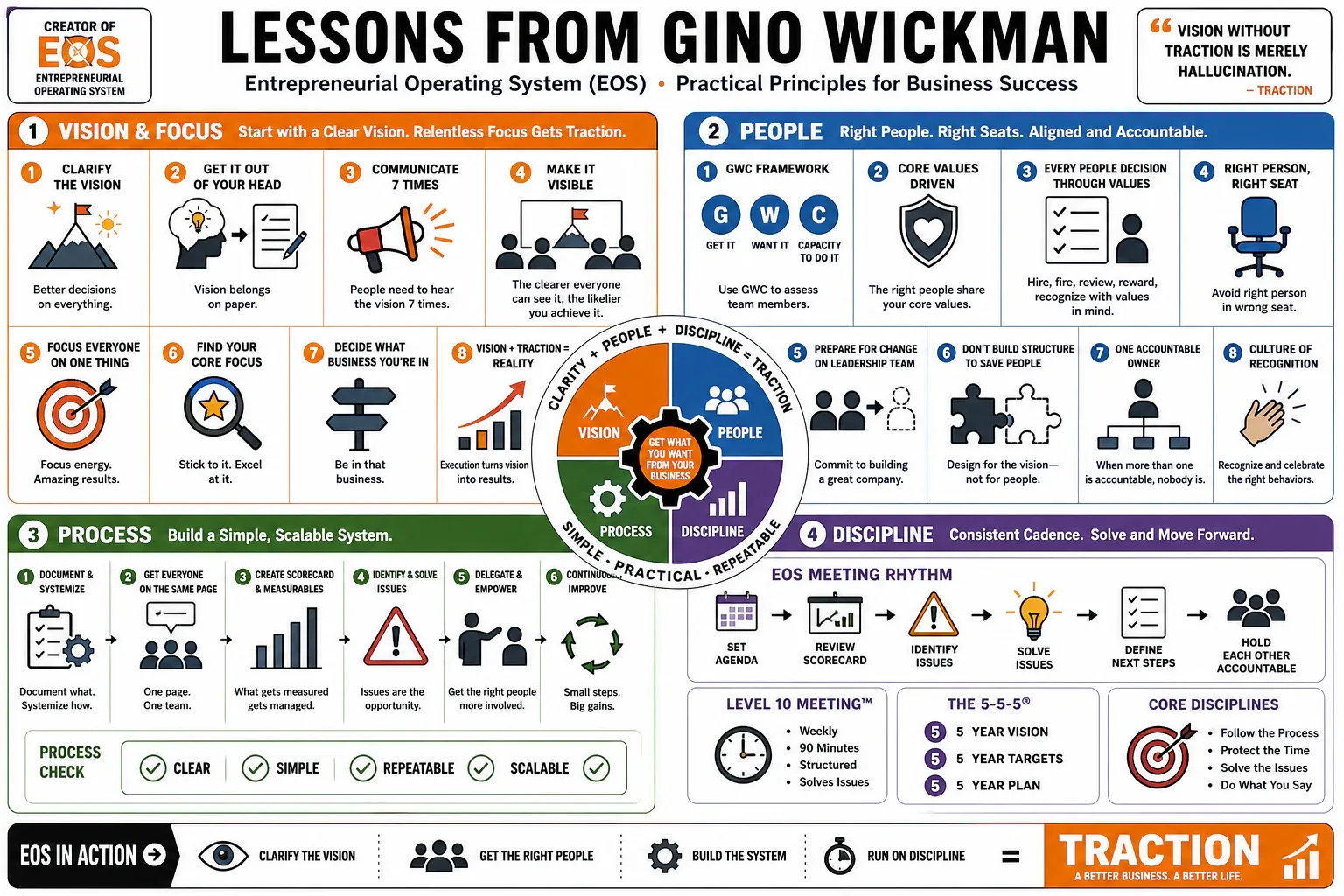
On Vision and Focus
EOS begins by writing down a vision that the leadership team can share and use in day-to-day decisions. — EOS Vision/Traction Organizer.
- Vision needs execution: Wickman presents vision without execution as incomplete: priorities, accountability and a meeting rhythm are needed to turn a plan into action. — EOS Traction Component.
- Clarify vision to improve decisions: In Traction, Wickman argues that a clear vision helps leaders make more consistent decisions about people, processes, finances, strategy and customers. — Traction Book Excerpt.
- Make the vision visible to the team: Wickman says a vision is more actionable when everyone can see where the business is going and how it plans to get there. — EOS Vision/Traction Organizer.
- Write the vision down: Wickman advises entrepreneurs to move the vision from their heads onto paper and share it with the organization. — Traction Book Excerpt.
- Repeat the vision: Traction recommends sharing the company vision repeatedly, including at quarterly state-of-the-company meetings, because one announcement may not be enough. — Traction Book Excerpt.
- Align effort around one direction: The EOS vision process seeks agreement on a single set of core values, focus and goals so the team is not pulling in different directions. — EOS Vision/Traction Organizer.
- Protect the core focus: Wickman urges leadership teams to define their purpose and niche, then resist attractive opportunities that pull the company away from that focus. — Traction Book Excerpt.
- Define the business you are in: EOS defines Core Focus through the organization’s purpose and niche: why it exists and what it does best. — EOS Vision/Traction Organizer.
On People
EOS separates values fit from role fit when assessing whether someone belongs in a particular seat. — EOS Official Toolbox.
- Test role fit with GWC: Wickman asks whether a person gets a role, wants it and has the capacity to do it before treating that person as the right fit for the seat. — Traction Book Excerpt.
- Hire for shared core values: Traction defines the “right people” as those who share a company’s core values and fit its culture. — Traction Book Excerpt.
- Use values in people decisions: Wickman recommends using core values when hiring, reviewing, rewarding, recognizing and, when necessary, parting with employees. — Traction Book Excerpt.
- Separate person fit from seat fit: A person can share the company’s values yet lack the abilities for a particular role; EOS evaluates both questions separately. — Traction Book Excerpt.
- Change seats when structure requires it: The Accountability Chart starts with the roles the business needs; leaders should then assess who fits those roles rather than preserve the current roster by default. — Traction Book Excerpt.
- Give each seat one accountable owner: The Rocket Fuel Accountability Chart calls for one name in each role box so responsibility does not dissolve among multiple people. — Rocket Fuel Book Excerpt.
On The Visionary and Integrator Relationship
EOS distinguishes the Visionary’s long-range ideas and relationships from the Integrator’s day-to-day coordination and accountability. — EOS Visionary–Integrator Guide.
- Pair vision with integration: EOS distinguishes the leader who generates ideas and stewards the vision from the leader who integrates functions and turns priorities into execution. — EOS Visionary–Integrator Guide.
- Define the Integrator’s work: The Integrator is accountable for coordinating major functions, running day-to-day operations and holding the leadership team to its commitments. — EOS Visionary–Integrator Guide.
- Make cross-functional coordination explicit: EOS places the Integrator across sales, operations and finance to resolve problems that no single function owns. — EOS Visionary–Integrator Guide.
- Separate roles as complexity grows: One person may hold both Visionary and Integrator seats in a small company; EOS recommends separating them as the workload and organization grow. — EOS Visionary–Integrator Guide.
On Process and Systems
Documenting and following a few core processes is meant to make recurring work more consistent as the organization grows. — EOS Process Component.
- Document core processes in three steps: Traction describes identifying core processes, simplifying and documenting the steps, then packaging them so people can follow a shared way of working. — Traction Book Excerpt.
- Reduce variation in recurring work: EOS argues that documented and followed core processes reduce inconsistent execution as more people perform the same work. — EOS Process Component.
- Use a common operating system: EOS combines vision, people, data, issues, process and traction tools so leaders use a shared cadence rather than disconnected management habits. — EOS Official Overview.
On Issues and Problem Solving
The Issues Solving Track asks a team to identify the root issue, discuss it openly and settle on a specific solution. — EOS IDS Guide.
- Find the underlying issue: The IDS method starts by separating the actual issue from visible symptoms before the team discusses and solves it. — EOS IDS Guide.
- Surface issues instead of hiding them: Traction compares neglected issues to mushrooms that multiply in dark conditions; its practical advice is to put issues on the list and work through them. — Traction Book Excerpt.
- Practice solving the real problems: Wickman argues that a company’s ability to resolve its recurring problems matters more than repeatedly discussing their symptoms. — Traction Book Excerpt.
On Data and Scorecards
The EOS Data Component replaces some subjective management debate with a small weekly Scorecard. — EOS Data Component.
- Use numbers to challenge hunches: EOS’s Data Component asks leaders to use a few objective weekly measures instead of relying only on opinions and lagging financial reports. — EOS Data Component.
- Review a small weekly Scorecard: The EOS Scorecard tracks a handful of numbers, each with one owner and target, for review at the weekly leadership meeting. — EOS Data Component.
On Rocks and Priorities
Quarterly Rocks force the leadership team to choose and own a few priorities for the next 90 days. — EOS Vision/Traction Organizer.
- Set three to seven quarterly Rocks: EOS uses three to seven most important priorities for a 90-day period so leaders can track whether the year’s plan is moving forward. — EOS Vision/Traction Organizer.
- Do not make every priority equal: The Rocks tool forces leaders to choose a few critical priorities instead of treating every task as equally important. — EOS Official Toolbox.
- Work in a 90-day rhythm: Traction sets quarterly planning and review because Wickman treats roughly 90 days as a workable focus horizon. — Traction Book Excerpt.
- Name an owner for each Rock: The V/TO connects each quarterly Rock to a responsible owner and reviews progress at the next quarterly session. — EOS Vision/Traction Organizer.
On the Entrepreneurial Mindset
Entrepreneurial Leap presents Wickman’s view of the traits and tradeoffs a would-be founder should examine before starting. — Entrepreneurial Leap Book Preview.
- Solve a problem for a customer: In Entrepreneurial Leap, Wickman links entrepreneurship to identifying problems people will pay to have solved. — Entrepreneurial Leap Book Preview.
- Treat risk as repeated decisions: Wickman’s entrepreneurial framework treats risk-taking as making consequential choices under uncertainty without confusing courage with recklessness. — Entrepreneurial Leap Traits Guide.
- Assess six entrepreneurial traits: Wickman’s model names vision, passion, problem-solving, drive, willingness to take risks and responsibility as six traits he considers important for entrepreneurs. — EOS Leader Interview.
- Treat the trait model as his view: Wickman argues that these entrepreneurial tendencies are largely innate; this is his framework, not a proven genetic test for who can succeed. — BiggerPockets Interview.
- Expect a long entrepreneurial path: Wickman describes founders spending five, ten or twenty years growing a business and then reassessing whether it fits the life they want. — EOS Leader Interview.
- Know your own fit: Entrepreneurial Leap asks would-be founders to examine their natural strengths and motivations before deciding whether to start a business. — Entrepreneurial Leap Book Preview.
- Passion does not remove difficulty: Wickman describes entrepreneurship as hard even for people who deeply want it; motivation does not eliminate setbacks or sacrifice. — Entrepreneurial Leap Book Preview.
- Do not equate busyness with value: Wickman recommends setting aside time to think about the business, not only filling the day with operational activity. — EOS Leader Interview.
- Protect creative thinking time: His Clarity Break practice reserves uninterrupted time for reflection so leaders return to daily work with clearer direction. — EOS Leader Interview.
On Leadership and Growth
The EOS Process gives leadership teams recurring time to work on the company, clarify responsibility and revisit their priorities. — EOS Implementation Process.
- Accept uncomfortable accountability work: EOS tools ask leaders to clarify responsibility, examine role fit and confront issues rather than avoid difficult conversations. — EOS Official Toolbox.
- Seek mentors while learning to lead: Wickman’s own path included informal learning from his father and structured conversations with mentor Sam Cupp. — Entrepreneurial Leap Mentor Guide.
- Define an ideal life more broadly: In a direct interview, Wickman describes an ideal life as work you love with people you love, meaningful impact, appropriate compensation and time for other passions. — BiggerPockets Interview.
Sources
- Traction: Get a Grip on Your Business — Author Excerpt
- Vision/Traction Organizer — EOS Worldwide
- Complete EOS Toolbox — EOS Worldwide
- Rocket Fuel: The One Essential Combination — Author Excerpt
- Entrepreneurial Leap — Author Book Preview
- EOS Leader Podcast: Gino Wickman Interview Transcript
- How to Find an Entrepreneurial Mentor — Entrepreneurial Leap
- Visionary vs. Integrator — EOS Worldwide
- The Data Component — EOS Worldwide
- IDS: Identify, Discuss, Solve — EOS Worldwide
- BiggerPockets Podcast: Gino Wickman on The EOS Life
- The EOS Process — EOS Worldwide
- The Process Component — EOS Worldwide
- The Six Essential Entrepreneurial Traits — Entrepreneurial Leap
- The Traction Component — EOS Worldwide
- What Is the Entrepreneurial Operating System? — EOS Worldwide