Lessons from Gordon Moore
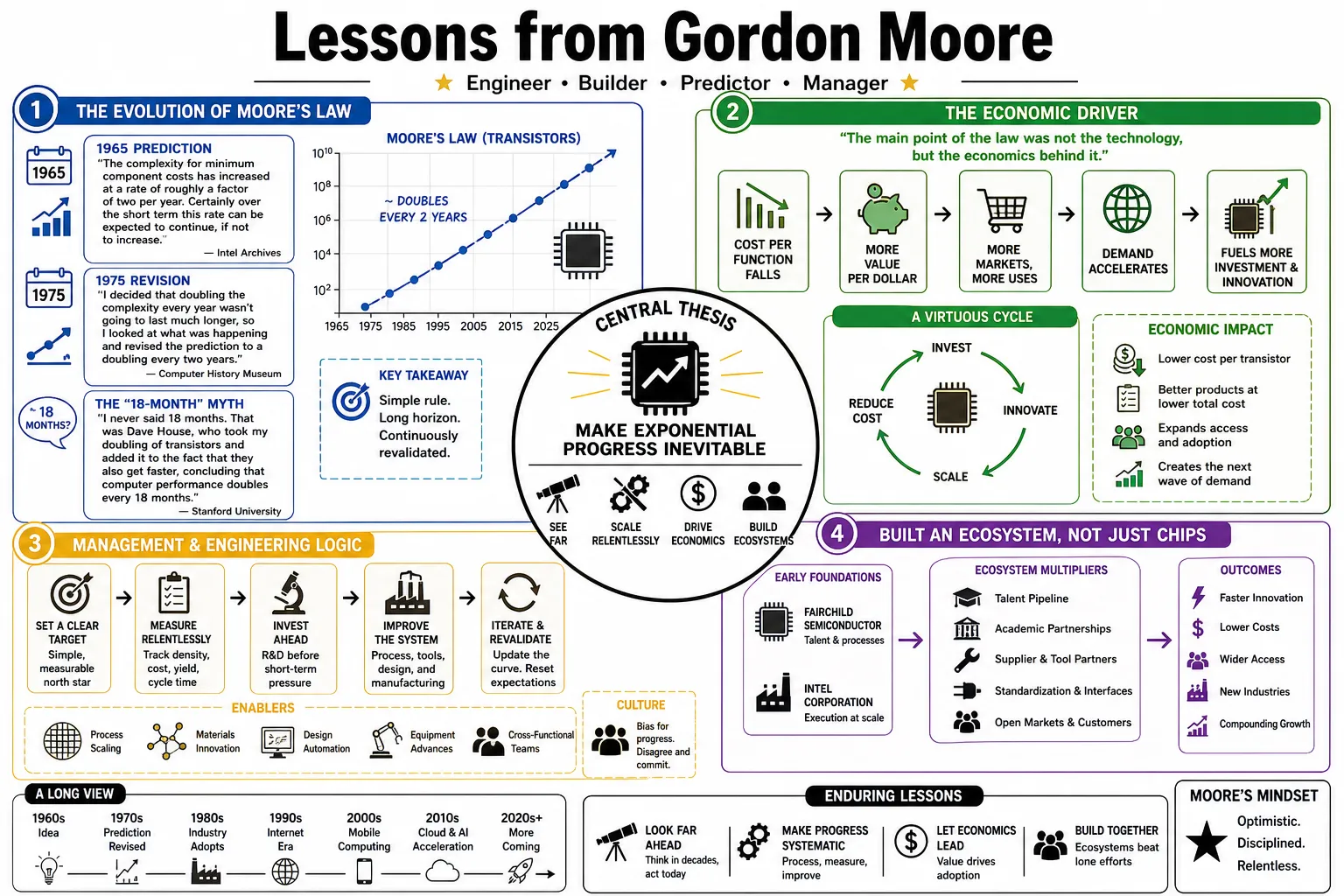
Gordon Moore co-founded Intel and Fairchild Semiconductor, anchoring the early Silicon Valley chip industry. His 1965 observation that chip density would double every two years became an industry mandate rather than just a prediction. This piece tracks the management and engineering logic he used to sustain that relentless pace.
Part 1: The Evolution of Moore’s Law
- On the 1965 Prediction: "The complexity for minimum component costs has increased at a rate of roughly a factor of two per year. Certainly over the short term this rate can be expected to continue, if not to increase." — Source: Intel Archives
- On the 1975 Revision: "I decided that doubling the complexity every year wasn't going to last much longer, so I looked at what was happening and revised the prediction to a doubling every two years." — Source: Computer History Museum
- On the "18-Month" Myth: "I never said 18 months. That was Dave House, who took my doubling of transistors and added it to the fact that they also get faster, concluding that computer performance doubles every 18 months." — Source: Stanford University
- On the Economic Driver: "The main point of the law was not the technology, but the economics; by making things smaller, you made the cost per component drop dramatically." — Source: Intel Newsroom
- On Self-Fulfilling Prophecies: "Once the industry accepted Moore's Law as a roadmap, it became a driver. If you didn't keep up with the law, you were falling behind and would eventually go out of business." — Source: Science History Institute
- On Physical Limits: "No physical quantity can continue to change exponentially forever. Your job as an engineer is delaying 'forever'." — Source: IEEE Spectrum
- On Early Data Points: "In 1965, I only had four or five points on the graph. It was a wild extrapolation of very little data that just happened to stay true for decades." — Source: Nobel Prize Interviews
- On the Power of Miniaturization: "By making things smaller, everything gets better simultaneously: they get faster, they take less power, and they become more reliable." — Source: Intel Editorial
- On the Utility of Complexity: "Integrated circuits will lead to such wonders as home computers—or at least terminals connected to a central computer—automatic controls for automobiles, and personal portable communications equipment." — Source: 1965 Electronics Magazine Article
- On "Insurmountable" Barriers: "We have run out of gas several times, but the engineers always find a new way to keep the curve going, like moving from 2D to 3D transistors." — Source: SEMI History
Part 2: The Fairchild Era and the Traitorous Eight
- On William Shockley: "Shockley was a genius at physics but a disaster at management. He was paranoid and once demanded lie-detector tests because of a minor laboratory incident." — Source: PBS Transcripts
- On Leaving Shockley: "We didn't set out to start a company; we set out to find a manager for Shockley’s lab. When that failed, we had no choice but to start our own." — Source: Encyclopedia Britannica
- On the "Traitorous Eight" Name: "Shockley branded us the 'Traitorous Eight' when we left, but we were really just looking for a place where we could actually build the silicon transistors we believed in." — Source: Computer History Museum
- On Manufacturing Scarcity: "In the beginning, there was no semiconductor equipment industry. We had to build our own diffusion furnaces and perform our own glass blowing for gas systems." — Source: Gordon Moore Oral History (CHM)
- On Jean Hoerni’s Planar Process: "Jean’s invention of the planar process was the real 'Big Bang.' It allowed us to print circuits chemically, making them reliable and cheap." — Source: National Inventors Hall of Fame
- On Building Equipment: "I spent my first years at Fairchild literally as an engineer-builder, designing the physical structures that would allow us to control the high-temperature diffusion of impurities into silicon." — Source: Science History Institute
- On Technical Risk: "We were trying to do things with silicon that the experts of the time said were impossible or at least economically foolish." — Source: Intel History
- On the Fairchild Culture: "Fairchild was the first place where the idea of equity for the founding employees really took hold, creating the model for everything that followed in Silicon Valley." — Source: Stanford Research Park
- On the Silicon Decision: "The industry was focused on germanium, but we chose silicon because of its superior temperature range and the stability of its oxide, which allowed for the planar process." — Source: IEEE Xplore
- On Founding Intel: "We left Fairchild because it had become too large and bureaucratic. We wanted to get back to the small-team environment where we could focus entirely on semiconductor memory." — Source: Computer History Museum Oral History
Part 3: Building Intel and the Trinity
- On the Intel Trinity: "The company succeeded because of the balance between Robert Noyce’s vision, Andy Grove’s execution, and my focus on the technology and manufacturing." — Source: Intel Museum
- On Semiconductor Memory: "At the time, memory was done with magnetic cores. I was convinced that the chemical printing process of semiconductors would eventually make them the cheapest way to store information." — Source: Intel History
- On the Shift to Microprocessors: "We started as a memory company, but when the Japanese companies entered the market with lower costs, we had to pivot or die. We bet the entire company on the microprocessor." — Source: Stanford University
- On Strategy vs. Planning: "Our strategy at Intel was often driven by the market forcing us out of things we liked and into things we were good at." — Source: Harvard Business Review
- On Competition: "Competition is a wonderful thing; it makes you do things you didn't think you could do, like moving to a new process node every two years without fail." — Source: Intel Archives
- On Mediating Conflict: "Noyce and Grove were both intense in different ways. My job was often to be the technical anchor who kept the peace so the company could move forward." — Source: CHM Oral History #102658233
- On the "Intel Inside" Era: "We realized that the microchip was becoming a consumer product, and we needed to make people care about what was inside the machine, not just the box." — Source: Intel Newsroom
- On Process Supremacy: "At Intel, the real secret sauce wasn't just the design, but our ability to copy-exactly a manufacturing process across multiple factories around the world." — Source: Intel Editorial
- On the Accidental CEO: "I never really wanted to be CEO; I was a chemist who wanted to run a lab. But as the company grew, the role became necessary to protect the technology." — Source: Science History Institute
- On Missing the PC: "I famously missed the PC as the driver for microprocessors in the early 1980s. I thought the computer was a tool for businesses, not every home." — Source: Computer World Interview
Part 4: Engineering as Chemistry
- On Being a Chemist First: "I always identified as a physical chemist. My engineering was just applying the principles of material transformations to silicon." — Source: Caltech Magazine
- On the Gallium Accident: "We once accidentally ran out of water vapor while diffusing gallium into silicon. The terrible-looking wafer actually produced the most ideal junctions we had ever seen." — Source: Science History Institute
- On "Flashes, Bangs, and Stinks": "What drew me to chemistry as a kid was the 'flashes, bangs, and stinks.' I loved the idea that you could mix two things and get something entirely different." — Source: Nobel Prize Biographical
- On Chemical Printing: "The semiconductor industry is essentially a chemical printing process. If you can control the chemistry on the surface of the wafer, you can control the world of computing." — Source: Intel News
- On Material Science: "Every time Moore's Law hits a wall, it’s not a physics problem; it’s a chemistry problem of finding a new material that can do what silicon alone cannot." — Source: IEEE Spectrum
- On his Ph.D. Research: "My doctoral work at Caltech on infrared spectroscopy taught me how to look at the invisible interactions between molecules, which is exactly what we do with silicon." — Source: Caltech Alumni News
- On the Liquid Gallium Discovery: "We discovered that liquid gallium could remove impurities from silicon, a process called gettering, which made the final devices significantly more reliable." — Source: CHM Oral History Transcript
- On Solid Rocket Propellants: "My first job at Johns Hopkins was researching the physical chemistry of solid rocket fuels. It taught me the precision required in hazardous manufacturing." — Source: Applied Physics Laboratory
- On Childhood Explosives: "I found that a couple of ounces of dynamite makes for a great firecracker. My backyard lab was my first experience with trial-and-error engineering." — Source: Presidential Medal of Freedom Ceremony
- On the Limits of Atoms: "We are approaching the size of atoms. When you are only a few atoms wide, the chemistry of the material changes completely, and traditional electronics break down." — Source: ISSCC Keynote 2003
Part 5: Management and Cultural Leadership
- On Removing the Stigma of Failure: "One thing a leader does is to remove the stigma of mistakes. If you aren't making mistakes, you aren't trying hard enough." — Source: Intel Management Quotes
- On "Inventory Rots": "In the chip business, inventory rots like fresh fruit. If you don't sell it immediately, it loses value as the next generation of technology replaces it." — Source: The Guardian
- On Price Recessions: "Semiconductor recessions are almost always price recessions. Demand stays high, but the competition is so fierce that the prices drop faster than we can reduce costs." — Source: IEEE Computer
- On Leading Experts: "Managing engineers is about giving them a clear, high-level goal and then getting out of the way so they can find the path to it." — Source: Management Today
- On Personal Modesty: "I've always been an accidental entrepreneur. I never had a grand plan for success; I just wanted to solve the technical problems in front of me." — Source: Intel Archives
- On the Value of Fundamentals: "Technical skills change so fast that they become obsolete in five years. The only thing that lasts are the fundamentals of how to solve problems." — Source: Caltech Commencement Address
- On Company Culture: "We wanted a culture where the data had the loudest voice in the room, regardless of who was presenting it." — Source: Science History Institute
- On the Importance of Focus: "The main difference between a successful company and a failure is often just the ability to say 'no' to a hundred good ideas to focus on the one great one." — Source: Stanford eCorner
- On Being a Mentor: "A leader's legacy isn't the product they built, but the people they trained to build the products that will follow." — Source: Intel Foundation
Part 6: Innovation, Failure, and Strategy
- On "Doing Critical Experiments": "The most productive researchers are those who jump right at the critical experiment that might tell if their whole approach is right or wrong." — Source: Caltech Oral History
- On Trial and Error: "Most of what I learned as an entrepreneur was through trial and error. You can't plan your way around the unknown; you have to experiment your way through it." — Source: Science History Institute
- On the Cost of Failure: "In high-tech, if everything you try works, you aren't taking enough risks to stay at the leading edge." — Source: Intel Museum Quotes
- On Abandoning the Past: "One of our hardest but best decisions was abandoning the memory chip market entirely to focus on processors. You can't let nostalgia for what made you successful kill your future." — Source: Stanford Graduate School of Business
- On Innovation as Survival: "In a downturn, you can never get well on old products. You have to innovate your way out by having the next, better thing ready when the market returns." — Source: IEEE Xplore
- On "Blowing Past" Barriers: "We have predicted the end of Moore's Law dozens of times, but we have consistently blown past every barrier we thought was insurmountable." — Source: Intel Newsroom
- On Missing the Internet: "I missed the Internet too. In the early 90s, I didn't see it as the primary driver for future computing power. It just goes to show how hard it is to predict the application of technology." — Source: Computer World Interview
- On the Role of Fortune: "I've been at the right place at the right time more than once. Being lucky is as important as being smart in this industry." — Source: Nobel Prize Biographical
- On the Future of AI: "We provided the processing power; what people do with it—whether it's AI or something else—is up to the next generation of engineers." — Source: Intel Editorial
Part 7: Science, Education, and Fundamental Truths
- On Lifelong Education: "The technology at the leading edge changes so rapidly that you have to keep current after you get out of school. You are never really done learning." — Source: Gordon and Betty Moore Foundation
- On "Good Fundamentals": "I think probably the most important thing for an engineer is having good fundamentals. Everything else can be learned on the job." — Source: Caltech Magazine
- On Multiple Careers: "Today's students have to look forward to the excitement of probably having three or four careers because the field moves so fast." — Source: Intel Newsroom Quotes
- On Scientific Discovery: "We should fund scientific research that is too high-risk for the government. If there's a 90% chance of failure, that’s exactly the kind of thing a foundation should fund." — Source: Moore Foundation Philosophy
- On Basic Research: "Fundamental research in the physical and life sciences is the foundation for everything we build. Without it, the engine of progress runs out of fuel." — Source: Science Magazine
- On the Value of Science Education: "Science is the cornerstone of a technologically advanced society. If we don't teach it well, we lose our future." — Source: Moore Foundation Education Initiative
- On Environmental Stewardship: "I want to preserve the character of the natural world for my grandchildren's grandchildren. That requires long-term, science-based conservation." — Source: Mongabay Interview
- On Scientific Rigor: "Applying scientific rigor to global problems like climate change or patient safety is the only way to get results that last." — Source: Moore Foundation Strategy
- On the 10,000-Year Vision: "I want our philanthropy to improve life not just now, but 10,000 years from now. This forces you to think about truly durable solutions." — Source: Philanthropy Roundtable
Part 8: Philanthropy and the Global Legacy
- On "Santa Claus Philanthropy": "In the early days, we just stuffed requests for help into a desk drawer and gave money at Christmas. We eventually realized we needed a more professional approach." — Source: Moore Foundation History
- On the Andes-Amazon Initiative: "Protecting the Amazon is not just about trees; it's about preserving a biological system that regulates the entire planet's atmosphere." — Source: Moore Foundation Conservation
- On the Thirty Meter Telescope: "To understand our place in the universe, we need to peer deeper into its history than ever before. This telescope is our eye into the deep past." — Source: Caltech Astronomy
- On Nursing and Patient Care: "Betty’s insight was that nurses are the front lines of patient safety. Improving their training is the most direct way to reduce medical errors." — Source: Betty Irene Moore School of Nursing
- On "Society's Venture Capital": "A foundation should act as venture capital for society, funding the high-risk projects that have the potential for massive positive impact." — Source: Moore Foundation Philanthropy
- On his Partnership with Betty: "Whatever I have achieved, Betty was there supporting me from the start. Our philanthropy is a joint reflection of our shared values." — Source: Stanford Research Park Tribute
- On Paying It Forward: "We were very fortunate to be part of the semiconductor revolution. It is only right that we use the wealth it created to tackle the world's most difficult problems." — Source: Intel Memorial Page
- On the Long View: "If we can make even a small, positive change that lasts for centuries, then the foundation will have done its job." — Source: Moore Foundation Mission Statement