Guy Laliberté moved from traveling street performance to building Cirque du Soleil, then founded One Drop and used a 2009 spaceflight to draw attention to water access. His interviews describe the creative risks behind those projects. — Tim Ferriss Show #700 Transcript.
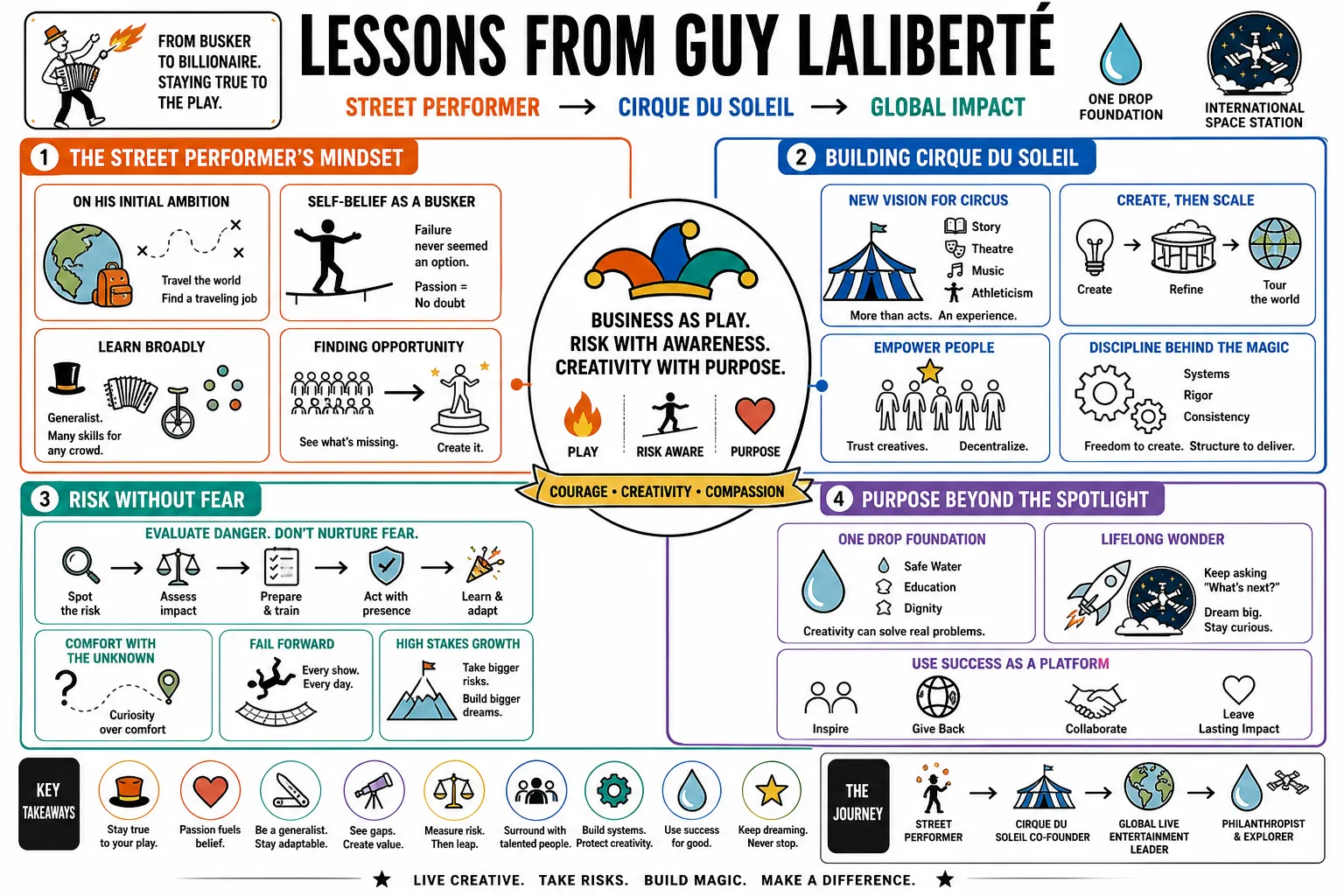
Part 1: The Street Performer's Mindset
- Travel through performance: He pursued street performance because earning a living while traveling matched his ambition to see the world. — Tim Ferriss Show #700 Transcript.
- Commit to the dream: His early street years depended on believing that a traveling life built around performance was possible. — Tim Ferriss Show #700 Transcript.
- Build a broad act: He describes himself as a generalist whose growing range of skills gave him more to offer a street audience. — Tim Ferriss Show #700 Transcript.
- Find another opening: When financiers doubted the circus, he looked for another route to make it happen rather than abandon it. — Inspire Me Today — Nurture Your Dreams.
- An interrupted dam job: He says a union strike began three days after he arrived for a lucrative dam job; the disruption sent him back toward the street-performance collective. He does not say he was fired. — Tim Ferriss Show #700 Transcript.
- Value independent work: Busking taught him to identify viable locations and earn directly from entertaining people while traveling. — Tim Ferriss Show #700 Transcript.
- Remember the Hyde Park bench: He later returned to a hotel overlooking Hyde Park, where he had slept on a bench as a young, poor accordionist; the contrast grounded his account of his trajectory. — The Independent — Guy Laliberté Interview.
- Carry Ibiza forward: He first reached Ibiza as a young busker, stilt walker and fire-eater, and later returned to build a creative retreat there. — W Magazine — From Street Performer to Boho Billionaire.
Part 2: Reimagining the Circus
- Redesign the circus experience: Cirque paired acrobatics with theatrical storytelling and avoided the traditional animal-centered format. — The Independent — Guy Laliberté Interview.
- Name a source of energy: He traced “Soleil” to Hawaiian sunsets and the sun’s symbolism of youth and energy. — Tim Ferriss Show #700 Transcript.
- Make performance travel: The team developed a circus concept that could cross language barriers and appeal internationally. — The Independent — Guy Laliberté Interview.
- Help adults play again: In a direct interview later paraphrased by the interviewer, he urged adults to recover a childlike capacity for play and surprise. — Inspire Me Today — Nurture Your Dreams.
- Protect the creative product: He emphasizes shows that move audiences emotionally, treating creative quality as central to the venture rather than quoting an untraced promise of profit. — Tim Ferriss Show #700 Transcript.
- Refine a troubled first tour: He recounts that Cirque’s first month included rain, a lost big top, conflict and a strike; performing in smaller towns let the team tighten the show. — Tim Ferriss Show #700 Transcript.
- Persist through early uncertainty: The first Cirque tour lost money at first but won audiences and press; he credits the team’s persistence through a messy launch. — Tim Ferriss Show #700 Transcript.
- Grow beyond one job: In the fledgling troupe, he took on touring, marketing and business functions as the collective became an enduring company. — Tim Ferriss Show #700 Transcript.
- Bring theatre to circus: He describes Cirque du Soleil’s contribution as bringing theatrical elements into circus arts. — Lune Rouge — Entertainment.
- Take the Los Angeles risk: He took Cirque to the 1987 Los Angeles festival at its own financial risk, securing opening-night promotion as a condition. — Tim Ferriss Show #700 Transcript.
Part 3: Business and Risk
- Evaluate danger, not fear: He urges entrepreneurs to assess concrete danger without allowing fear of losing success to dictate their choices. — Tim Ferriss Show #700 Transcript.
- Keep work enjoyable: He recalls that the early years demanded hard work, but the troupe kept traveling and entertaining in pursuit of its dream. — Inspire Me Today — Nurture Your Dreams.
- Risk a proven formula: He says that even after success he sought new artistic projects rather than treating the established show model as the only path. — Tim Ferriss Show #700 Transcript.
- Enter unfamiliar territory: He returned to making shows despite uncertainty, explicitly saying the new work had to differ from what he had built at Cirque. — Tim Ferriss Show #700 Transcript.
- Notice success-induced fear: He observed that financial rewards can make entrepreneurs preoccupied with protecting what they have. — Tim Ferriss Show #700 Transcript.
- Do not let loss aversion rule: He warns that fear of losing present success can change how entrepreneurs approach new decisions. — Tim Ferriss Show #700 Transcript.
- Make one event serve several aims: The inaugural Big One paired a high-stakes poker event with a structured contribution to One Drop from each entry. — WSOP — Big One for One Drop Results.
- Keep exploring original forms: When returning to live entertainment, he said he could not simply repeat Cirque and had to approach the artistic experience differently. — Tim Ferriss Show #700 Transcript.
- Plan for life after ownership: When selling his controlling stake, he said he did not want to make his children responsible for running Cirque; the decision also opened a new chapter for him. — W Magazine — From Street Performer to Boho Billionaire.
Part 4: The One Drop Foundation
- Choose water as a unifying issue: He chose water for One Drop because he saw access to it as tied to health, education and poverty. — Green Global Travel — One Drop Interview.
- Treat water as human dignity: In his founder letter, he describes safe drinking water as essential to the dignity and future of communities. — One Drop — 2008 Annual Report.
- Change human systems around water: He argues that the access crisis concerns people’s relationship to water, including how communities share and preserve it. — One Drop — 2008 Annual Report.
- Look beyond headline numbers: In a later interview, he said scale matters but the foundation must also seek sustainable results. — TheWrap — One Drop Gala Interview.
- Build change incrementally: His founder letter says many individual contributions can accumulate into a larger movement for safe water. — One Drop — 2008 Annual Report.
- Set a universal-water goal: One Drop’s founder letter invites support for a world in which safe water is accessible to all. — One Drop — 2008 Annual Report.
Part 5: The Poetic Social Mission
- Connect a childhood dream to purpose: His childhood fascination with the moon landing helped motivate a later spaceflight that he framed around water awareness. — Inspire Me Today — Nurture Your Dreams.
- Use the artist’s tools in space: He framed his ISS journey as a way to raise water awareness through art, not as a scientific expedition. — CBC — Cirque Founder Outlines Space Mission.
- Make the mission poetic: He planned a multi-city artistic event from orbit to communicate the urgency of water access. — CBC — Cirque Founder Outlines Space Mission.
- Tell a water story across continents: The event used a Yann Martel poetic tale with the moon, sun and a drop of water as characters. — CNET — Poetic Space Mission.
- Use the platform for urgency: The space mission connected a high-visibility artistic broadcast to concern over water access; the specific 25-year quote was not verified here. — CBC — Cirque Founder Outlines Space Mission.
- Invite many voices: The broadcast drew performers and public figures across several cities to a shared artistic appeal about water. — CNET — Poetic Space Mission.
- Keep the clown in orbit: NASA documented his clowning aboard the ISS, reflecting his performer identity during the mission. — NASA — Space Station Flight Participants.
- Speak for water from orbit: The mission culminated in a global broadcast advocating water access and awareness. — CNET — Poetic Space Mission.
- Use visibility for a cause: He used the unusual platform of an ISS flight and worldwide webcast to draw attention to One Drop’s water mission. — CBC — Cirque Founder Outlines Space Mission.
Part 6: High-Stakes Poker
- Make poker serve One Drop: The inaugural $1 million buy-in event directed $111,111 from each entry fee to the foundation. — WSOP — Big One for One Drop Results.
- Mobilize a poker community: The official event account records players, tournament organizers and sponsors raising millions for One Drop water projects. — WSOP — Big One for One Drop Results.
- Adjust the professional-amateur balance: He said the first Big One field was roughly half professionals and half recreational players, while the second was more professional-heavy. — PokerNews — Big One for One Drop Interview.
- Make space for recreational players: For a later invitational, he sought a more comfortable field for recreational players rather than one dominated by professionals. — PokerNews — Big One for One Drop Interview.
- Listen to reluctant participants: After discussing the event with recreational players, he changed the format because a professional-heavy field made them less interested in participating. — PokerNews — Big One for One Drop Interview.
- Correct the tournament payout: He finished fifth in the 2012 event and won $1,834,666. The verified charitable contribution was the amount taken from each entry fee; no direct evidence establishes that he donated his entire prize. — WSOP — Guy Laliberté Results.
- Make giving collective: The tournament’s donation structure allowed each entrant to help fund One Drop projects. — WSOP — Big One for One Drop Results.
Part 7: Lune Rouge and Technology
- Start another creative venture: He presented Lune Rouge Entertainment as an extension of his drive to invent unusual forms of art and entertainment. — Lune Rouge — Entertainment.
- Use an immersive pyramid: He described Through the Echoes at PY1 as a technological and emotional journey through life from the Big Bang onward. — Lune Rouge — PY1 Launch Announcement.
- Put the audience inside the work: Lune Rouge CEO Stéphane Mongeau—not Laliberté—said the audience would take center stage in PY1’s immersive production. — Lune Rouge — PY1 Launch Announcement.
- Combine technology and art: Lune Rouge’s PY1 concept surrounded audiences with projection, lasers, aerial scenery, effects and sound. — Lune Rouge — PY1 Launch Announcement.
- Renew creativity through talent: He calls creativity a resource that can be renewed by working with top talent and giving younger entrepreneurs a voice. — Lune Rouge — Guy Laliberté Joins C2 Montréal.
- Support emerging creators: He said encouraging entrepreneurs and creators was a reason he established Lune Rouge. — Lune Rouge — Guy Laliberté Joins C2 Montréal.
- Mix artistic disciplines: Lune Rouge describes entertainment worlds that combine technology, music, light, words and art. — Lune Rouge — Entertainment.
- Return to making shows: After years away from performing, he told an interviewer that he missed being an artist and wanted to create experiences again. — The Independent — Guy Laliberté Interview.
- Keep traveling and entertaining: He said he still wanted to travel, entertain and have fun even after Cirque’s success. — The Independent — Guy Laliberté Interview.
Part 8: Life, Wealth, and Legacy
- Remember basic privileges: He recalled learning gratitude for necessities such as three meals a day while traveling as a young man. — Inspire Me Today — Nurture Your Dreams.
- Let water inspire action: He describes water both as an artistic inspiration and as the reason he founded a foundation for safe access. — Green Global Travel — One Drop Interview.
- Tend ideas like a gardener: He describes planting ideas and tending them rather than assuming a creative project will grow unaided. — W Magazine — From Street Performer to Boho Billionaire.
- Keep music in the mix: His later creative work included DJing at PY1 events alongside dozens of Montreal DJs. — Montreal Gazette — PY1 Interview.
- Avoid copying an old success: He said a new entertainment venture needed a distinct form instead of simply recreating Cirque. — Montreal Gazette — PY1 Interview.
- Act while a platform exists: He used the time-limited ISS opportunity to convene artists and draw attention to water rather than wait for a conventional advocacy campaign. — CBC — Cirque Founder Outlines Space Mission.
- Preserve childlike play: In an interview paraphrased by its host, he encouraged adults to keep curiosity, surprise and play alive. — Inspire Me Today — Nurture Your Dreams.
- Make philanthropy durable: One Drop’s original program combined field projects, education and partnerships to pursue lasting access to water. — One Drop — 2008 Annual Report.
- Move people emotionally: He links street performance and later shows to creating moments of joy and emotional openness for audiences. — Tim Ferriss Show #700 Transcript.