Guy Spier manages Aquamarine Capital and wrote The Education of a Value Investor. He is known for applying behavioral psychology to fund management, most notably by relocating to Zurich to escape the physical noise of Wall Street. This document collects his specific rules on capital allocation, information filtering, and environmental design.
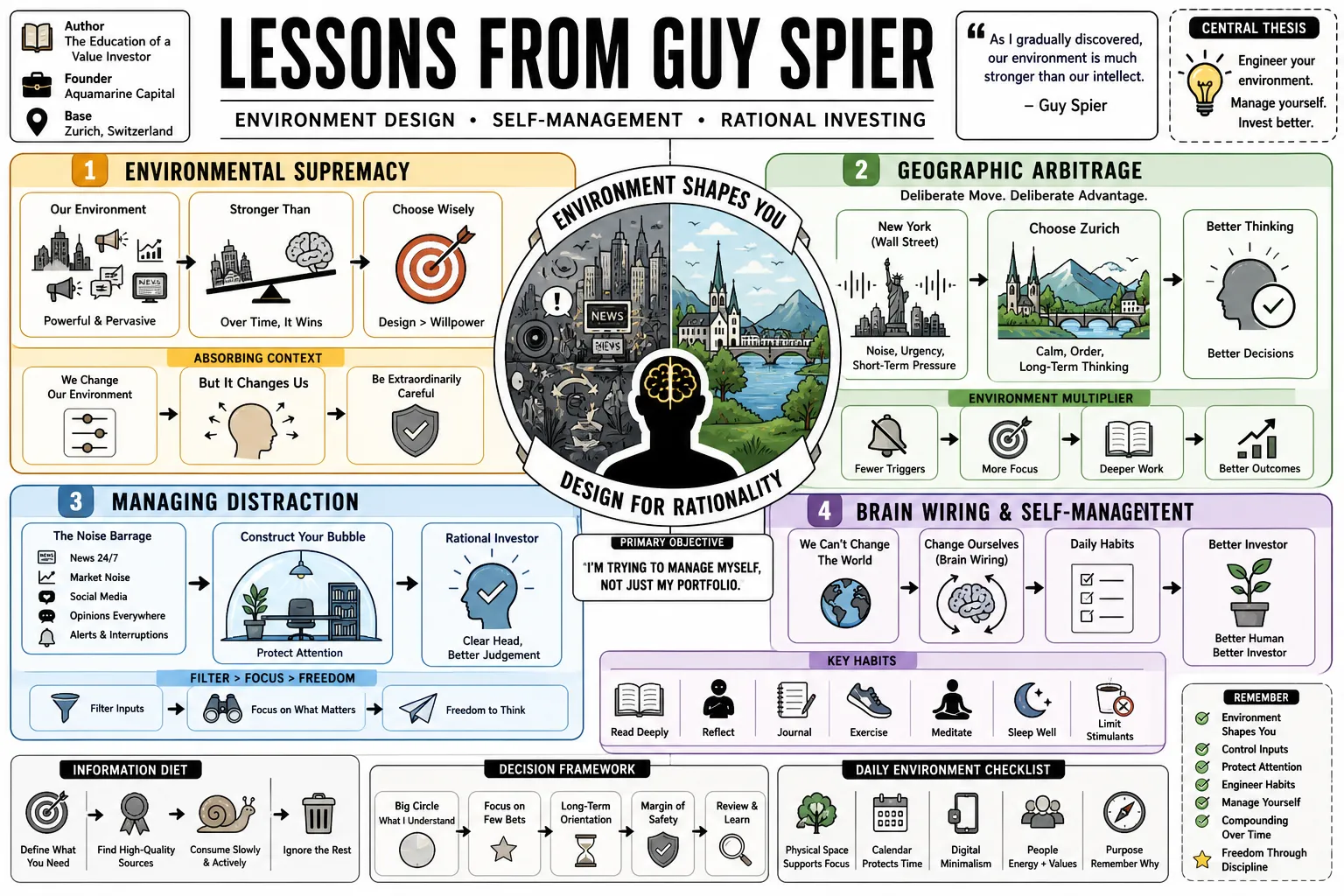
Part 1: Environment and Mental Architecture
- On Environmental Supremacy: "As I gradually discovered, our environment is much stronger than our intellect." — Source: [MOI Global]
- On Absorbing Context: "We like to think that we change our environment, but the truth is that it changes us. So we have to be extraordinarily careful to choose the right environment." — Source: [Goodreads]
- On Geographic Arbitrage: Moving away from New York to Zurich was a deliberate engineering of an environment suited to rational, long-term thinking. — Source: [The Education of a Value Investor]
- On Managing Distraction: To be a rational investor, you must construct an environment where your brain isn't subjected to a barrage of noise. — Source: [MOI Global]
- On the Primary Objective: "I’m trying to manage myself, not just my portfolio." — Source: [MOI Global]
- On Brain Wiring: "We can’t change the world. The only thing we can change is ourselves, by trying to get a better understanding of our own messed-up wiring." — Source: [Farnam Street]
- On Removing Terminals: Removing Bloomberg terminals from his desk was necessary to avoid the emotional triggers of blinking red and green lights. — Source: [The Education of a Value Investor]
- On Acknowledging Flaws: Being brutally honest about personal flaws, such as an inordinate fear of loss, is the first step to building structural defenses against them. — Source: [The Knowledge Project]
- On the Limits of Willpower: You cannot simply will yourself to make rational decisions in a toxic environment; you must physically remove yourself from the toxicity. — Source: [MOI Global]
Part 2: The Inner Scorecard and Authenticity
- On Self-Validation: "It’s very important always to live your life by an inner scorecard, not an outer scorecard." — Source: [Edelweiss Mutual Fund]
- On the Ultimate Prize: "The real reward of inner transformation is the gift of becoming the best person we can be. That is the ultimate prize." — Source: [Bookey]
- On Acceptance: "The real goal is not acceptance by others, but acceptance of oneself." — Source: [Bookey]
- On Contrarianism: "The entire pursuit of value investing requires you to see where the crowd is wrong so that you can profit from their misperceptions." — Source: [MOI Global]
- On Truth-Telling: Telling the truth about your own mistakes acts as a superpower that builds trust and radically simplifies life. — Source: [The Knowledge Project]
- On Authentic Paths: "The path to true success is through authenticity... investing is about much more than money." — Source: [Goodreads]
- On Expensive Flaws: "Envy and pride are expensive flaws." — Source: [J. Silva Blog]
- On Discarding Jealousy: Envy is a pure waste of time; recognizing this allowed him to cut negative influences out of his life completely. — Source: [Stock Unlock]
- On Standing Alone: Measuring success by the world's expectations guarantees average outcomes; outperformance requires measuring by your own standards. — Source: [MOI Global]
- On Being Yourself: "I didn't want to be the world's greatest investor. I wanted to be the best version of Guy Spier that I can be." — Source: [The Knowledge Project]
Part 3: Cloning and Modeling Success
- On Making Friends with the Dead: By constantly asking "What would Warren or Charlie do?", you can effectively borrow their mental frameworks. — Source: [The Education of a Value Investor]
- On the Value of Imitation: "If you truly apply this lesson [modeling heroes], I’m certain that you will have a much better life, even if you ignore everything else I write." — Source: [Bookey]
- On Sourcing Ideas: "Many of the best ideas are already out there for us to see; we just have to clone them." — Source: [Guy Spier Official]
- On the Art of Cloning: "There’s an art to cloning... if you copy the wrong things, you’re not actually cloning what you should be cloning." — Source: [Podscripts]
- On Selective Emulation: You could choose to wear the same clothes as Warren Buffett or drink Diet Coke, but that is entirely irrelevant to what makes him a great investor. — Source: [Podscripts]
- On Finding the Right Model: One of the most important skills in business is figuring out exactly what is relevant to clone in somebody and what should be ignored. — Source: [Compound with Rene]
- On Upgrading Your Circle: "Hang out with people better than you, and you cannot help but improve." — Source: [Farnam Street]
- On 13F Filings: Reviewing the SEC filings of superinvestors is a highly capital-efficient way to source new ideas without reinventing the wheel. — Source: [Masters Invest]
- On Cloning Alignment: To truly copy Buffett, one must adopt his business practices and fee structures, not just his stock picks. — Source: [Big Think]
Part 4: Investment Process and Checklists
- On Checking Prices: Check stock prices as infrequently as possible, as constant monitoring creates an emotional call to action. — Source: [MOI Global]
- On Avoiding Salesmen: "If someone tries to sell you something, don't buy it." — Source: [MarketScreener]
- On Talking to Management: Only speak to company management after conducting exhaustive independent research, otherwise their charisma will bias your objective analysis. — Source: [MOI Global]
- On Trading Hours: Never buy or sell when the market is open to avoid getting swept up in the madness of the crowd. — Source: [Begin To Invest]
- On the Circuit Breaker: "If a stock tumbles after you buy it, don't sell it for two years." — Source: [Begin To Invest]
- On Discussing Positions: Don't talk about your current investments publicly, as stating a thesis creates commitment bias that is hard to reverse. — Source: [MarketScreener]
- On Disinterested Advice: Only discuss investment ideas with people who have absolutely no personal stake in your decision. — Source: [Farnam Street]
- On Building Checklists: A checklist should not be used as a buy signal, but strictly as a filter built from your own and others' past mistakes. — Source: [MOI Global]
- On Evaluating Debt: One of the most critical checklist items is checking if a business relies on open capital markets just to fund its daily operations. — Source: [MOI Global]
- On Psychic Gains: Always ask if an investment offers a non-monetary psychic gain, such as prestige, which might be clouding rational judgment. — Source: [MOI Global]
Part 5: Decision Making and Avoiding Mistakes
- On Inactivity: "The evidence shows that the more you meddle, the less your returns are." — Source: [The Investor's Podcast]
- On Boring as a Feature: "Boring is good. As an investor, that’s exactly what I want." — Source: [MOI Global]
- On Active Errors: Mistakes of commission—buying a bad business or selling a great one in fear—are palpable because they result in a direct portfolio hit. — Source: [Mawer]
- On Passive Errors: Mistakes of omission—failing to buy an inevitable compounder—are invisible on the balance sheet but represent the greatest lost wealth. — Source: [Medium]
- On Asymmetry of Loss: A mistake of commission caps your loss at 100 percent, while a mistake of omission can cost you thousands of percent in future gains. — Source: [Medium]
- On Selling Too Early: Cutting a winner prematurely because the price has run up is a severe error that permanently truncates future compounding. — Source: [Stansberry Research]
- On Taking Responsibility: "If we take responsibility for our mistakes and failures, they offer priceless opportunities to learn about ourselves and how we need to improve." — Source: [Safal Niveshak]
- On Surviving the Game: "It’s not the fastest skier who wins—it’s the fastest who doesn’t get injured." — Source: [Substack]
- On Total Failure: Speed and high returns are entirely secondary to survival; losing all your capital is the ultimate failure, and it is always avoidable. — Source: [Musixmatch]
Part 6: Compounding and Time
- On Long-Term Waiting: A banner year in the stock market is almost always the result of decisions made years prior against prevailing wisdom, followed by intense waiting. — Source: [Danielle Town]
- On Realistic Math: "The most basic lesson in investing is to let your money grow over a long time... You don't need to double your money every year to be wealthy." — Source: [Stock Unlock]
- On Time-Friendly Businesses: The best investments are companies where time is your friend and the risk of permanent capital impairment is extraordinarily low. — Source: [Opalesque]
- On Binary Outcomes: Avoid investments with wide, uncertain ranges of outcomes; focus instead on businesses that reliably range from decent to superb. — Source: [Guy Spier Official]
- On the Vineyard Analogy: "Investing is like planting vineyards—not all vintages will be fantastic, but you’ll always have wine to drink." — Source: [Substack]
- On Letting Seasons Work: Plant the best vines you can find, and then step back to let the market cycles do the heavy lifting. — Source: [Musixmatch]
- On Endurance: "Investing is a marathon, not a sprint." — Source: [MOI Global]
- On Holding Periods: Spier’s default physical state for portfolio management is sitting perfectly still and holding stocks indefinitely. — Source: [The Investor's Podcast]
- On Allowing Growth: The primary reason most investors fail to compound capital over decades is their psychological inability to sit still. — Source: [YouTube]
Part 7: Information Diet and Research Habits
- On Filtering Noise: "The most critical question is how to systematically filter out the noise that derails intelligent thought." — Source: [Scribd]
- On Research Sequences: Gather research strictly in order of bias, reading SEC filings long before opening an analyst report or newspaper. — Source: [Shortform]
- On Reading the Raw Data: Start with 10-Ks and 10-Qs because they are the most objective, legally vetted information available on a public company. — Source: [Shortform]
- On Grandma's Rule for Data: Mandate the consumption of meat and potatoes like audited financials before allowing the sugar of qualitative stories. — Source: [Medium]
- On Financial Television: Daily financial news and real-time tickers act as informational junk food that purely triggers emotional responses. — Source: [Guy Spier Official]
- On Corporate Communications: Treat annual reports and management letters as inherently biased documents designed as corporate marketing. — Source: [Shortform]
- On Physical Media: Printing documents and taking notes by hand protects the mind from the endless distractions of browser tabs and hyperlinks. — Source: [Guy Spier Official]
- On Preserving Thought: Tearing articles out of magazines to read later ensures they are consumed in a deliberate state rather than a reactive one. — Source: [Guy Spier Official]
- On the Value of Books: "Books are a priceless source of wisdom. But people are the ultimate teachers, and there may be lessons that we can only learn from observing them." — Source: [Goodreads]
Part 8: Relationships, Giving, and Life Philosophy
- On Transforming to a Giver: Shifting from a mindset of extracting value to one of helping others paradoxically unlocks massive opportunities. — Source: [Boole Fund]
- On the ROI of Gratitude: Writing thousands of handwritten thank-you notes without expecting a return completely transformed his professional network. — Source: [John Livesay]
- On Real Wealth: "Success is not a number—it’s who shows up at your funeral." — Source: [Substack]
- On True Capital: "Nothing, nothing at all, matters as much as bringing the right people into your life. They will teach you everything you need to know." — Source: [Bookey]
- On the Fiduciary Gene: The best managers possess a deep-seated desire to be fair and maintain integrity, acting correctly regardless of the fee structure. — Source: [Opalesque]
- On Utilizing Natural Talents: "Whatever gifts nature gave you, use them. Don't have any shame... If you are smart, or good-looking, or good at math, use it." — Source: [Stock Unlock]
- On Urgency of Living: "Live your best life now: You don't know what will happen tomorrow. If there is something you want to do, do it." — Source: [Stock Unlock]
- On Re-evaluating Priorities: "I used to be on a quest for wealth, wisdom, and enlightenment. I am now on a quest for health, wisdom, and enlightenment—with wealth in fourth place, if at all." — Source: [Stock Unlock]
- On Concluding Gracefully: "It is far better to conclude a career on a high note than to risk a period of decline... that could lead to a loss of the trust we have spent decades building." — Source: [Substack]
- On Life's Real Purpose: The goal is a happy life, not just high returns; investing is merely the vehicle that allows you to spend time with people you admire. — Source: [Big Think]