Harley Finkelstein has been Shopify's president since 2020, after serving as chief operating officer. He co-founded Firebelly Tea and co-hosts the Big Shot podcast with David Segal. These lessons cover his views on entrepreneurship, leadership, personal growth and commerce. — NRF Big Show Bio.
On Entrepreneurship and Building a Business
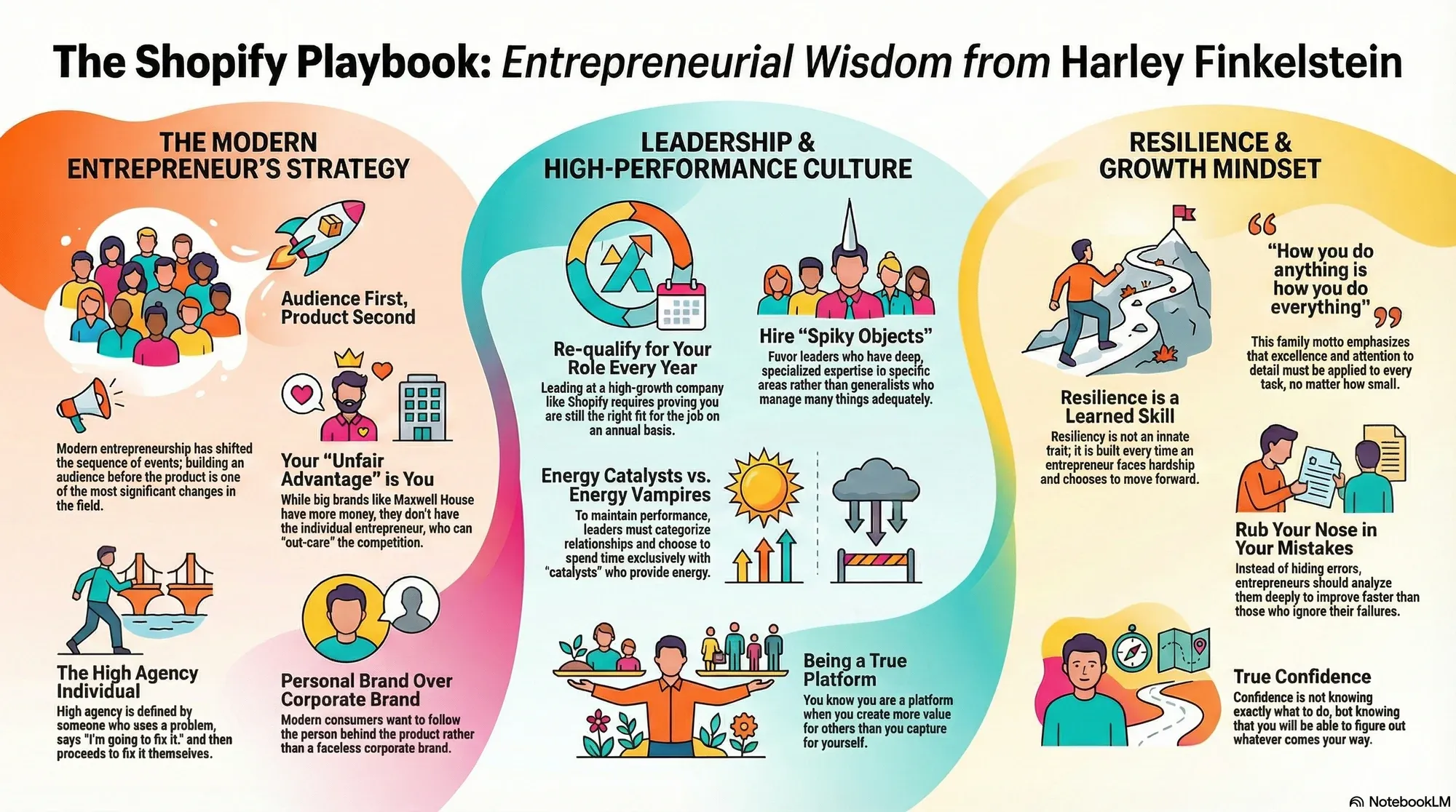
- On the Modern Age of Entrepreneurship: Finkelstein describes the present as an unusually good time to start a new business. — Rich Roll Podcast.
- On the Core Purpose of Entrepreneurship: Entrepreneurship lets people build something valuable and can provide a way to survive, or even thrive, during hard times. — Letter to Entrepreneurs.
- On the New Path to Market: Digital channels let founders build an audience before a product, reversing the traditional product-first sequence. — RBC Disruptors Interview.
- On the Entrepreneur's Unique Advantage: A small brand cannot outspend incumbents, but its founder can be the distinctive person behind the business. — Shopify Masters Interview.
- On Strategic Intentionality: In a tighter market, founders need to be more precise and thoughtful about what they build and how they spend. — Shopify Masters Interview.
- On Side Hustles: Not every hobby needs to become a company; a side project is worth exploring when a founder sees genuine demand. — Entrepreneurship Class.
- On Acquiring Unique Skills: A mentor encouraged Finkelstein to study law to sharpen skills that could distinguish him as an entrepreneur, not to prepare for a conventional legal career. — Finkelstein Interview.
- On Finding a Co-founder: Look beyond people with your own background when choosing a co-founder; complementary skills can make a stronger founding team. — Finkelstein Interview.
- On Modernizing Founder Infrastructure: Rules and support systems built for a different era can slow founders competing in a global market; modernize them to remove avoidable friction. — The Hub Interview.
- On Moving at Founder Speed: Entrepreneurship programs should respond to founders' needs quickly and be judged by whether they help companies move forward. — The Hub Interview.
- On Consultant Dependence as a Friction Test: If founders need consultants merely to navigate a government support program, that complexity is a sign the program needs redesign. — The Hub Interview.
- On Making Success Visible: Canada should study and celebrate companies such as Nortel and BlackBerry rather than treating their later difficulties as the whole story. — The Hub Interview.
- On Smaller Hubs as a Talent Advantage: A founder outside a major technology center may find strong local talent without competing with every global giant for the same hires. — The Hub Interview.
- On Normalizing Entrepreneurship Early: Give children concrete chances to make, brand and sell something so founding a business becomes an imaginable path. — The Hub Interview.
- On Widening Access to Entrepreneurship: Lower the money, time and specialist-knowledge barriers to trying an idea so entrepreneurship is possible for more people. — NRF Foundation Interview.
On Leadership and Company Culture
- On Re-qualifying for Your Job: At a fast-changing company, leaders need to keep earning the job they hold by growing with its demands. — The Knowledge Project Interview.
- On Vulnerability: Openly acknowledging uncertainty or fear can build a more honest leadership culture than maintaining an invulnerable facade. — CreativeLive Interview.
- On Maintaining a Startup Culture: As Shopify grew, Finkelstein wanted its culture to retain the ambition and entrepreneurial energy of a much smaller company. — CreativeLive Interview.
- On Specialized Leadership: A leadership team benefits from people with sharp, complementary areas of expertise rather than asking everyone to be a generalist. — Finkelstein on Leadership.
- On Hiring: Shopify seeks people who have built things themselves, including founders, because entrepreneurial judgment matters inside the company. — RBC Disruptors Interview.
- On Remote Work: Shopify's work-from-anywhere approach lets teams recruit beyond one office geography while still bringing colleagues together deliberately. — Cult MTL Interview.
- On Being a Platform: A platform creates opportunities for others to build value, rather than only capturing value for itself. — Entrepreneurship Class.
- On Empowering Employees: New hires should be able to shape how a growing company works, not merely inherit a culture treated as fixed. — CreativeLive Interview.
- On Impact Over Titles: Finkelstein's move from COO to president let him concentrate on work where he believed he could make a greater contribution. — The Knowledge Project.
- On Shopify's Core Mission: Shopify's mission is to equip independent entrepreneurs with tools that help them compete and succeed. — Letter to Entrepreneurs.
- On AI as Entrepreneurial Leverage: Finkelstein describes AI as a way for a data team to analyze and act faster, not as an automatic replacement for the people on that team. — 2026 Upfront Interview.
On Personal Growth and Mindset
- His Family Motto: Finkelstein returns to a family lesson about bringing the same care to small tasks as to larger ambitions. — Rich Roll Podcast.
- On Resilience: Resilience is not simply an inborn trait; Finkelstein argues that people can develop it by working through uncertainty. — Shopify Masters Interview.
- On Facing Hardship: Difficult periods can become practice for handling future uncertainty, even though no outcome is guaranteed. — Shopify Masters Interview.
- On True Confidence: Confidence is less about knowing every answer in advance than trusting your ability to work out what comes next. — Finkelstein on Confidence.
- On Anxiety: Finkelstein discusses learning to channel anxiety into useful energy rather than treating it only as a liability. — Rich Roll Podcast.
- On Focus and Excellence: Choose the capability you want to become world-class at and organize your work around it. — The Knowledge Project Interview.
- On Prioritization: Trying to do everything at once spreads effort thin; focus requires choosing what will matter most. — The Knowledge Project Interview.
- On Reframing Failure: A failed experiment can still produce useful information about an approach that does not work. — RBC Disruptors Interview.
- On Incremental Progress: Finkelstein's Everest-height climbing challenge reinforced the value of accumulating small steps toward a large goal. — Rich Roll Podcast.
- On Proactivity: High agency means taking responsibility for a problem and acting to fix it instead of waiting for someone else. — The Knowledge Project Interview.
- On Personal Growth: A leader at a rapidly growing company has to keep developing so their contribution keeps pace with the role. — The Knowledge Project.
- On Finding Your Life's Work: Finkelstein encourages people to look for meaningful overlap between their personal interests and professional mission. — Finkelstein on Life's Work.
- On Being Multi-dimensional: People can pursue several interests and identities; entrepreneurship does not require reducing yourself to a single role. — Entrepreneurship Class.
On Strategy, Competition, and The Market
- On Surviving Competition: Shopify has to keep reinventing itself as commerce changes; strength at one moment does not guarantee future relevance. — RBC Disruptors Interview.
- On Caring More: Finkelstein sees deep care for customers and the work as an advantage that competitors cannot simply buy. — The Knowledge Project Interview.
- On Multi-Channel Presence: Merchants should avoid dependence on a single sales channel, because customer attention and platforms can change. — Shopify Masters Interview.
- On Personal Branding: Customers often want to know the person behind a business, making the founder's story part of how a brand earns attention. — Finkelstein on Branding.
- On Authenticity in Branding: Finkelstein sees personal and professional identity as more intertwined than a strict work-life split suggests. — Finkelstein on Branding.
- On the Power of Enthusiasm: Visible enthusiasm can help a founder communicate why a product matters; Finkelstein describes that energy as part of Shopify's culture. — Finkelstein on Branding.
- On the Value of His Own Store: Running Firebelly Tea gave Finkelstein direct experience as a Shopify merchant and helped him lead with a better grasp of merchants' problems. — Finkelstein Interview.
- On Finding a Good Partner: Trusted partners can help a person raise their ambitions and do work they could not have done alone. — The Knowledge Project.
- On Managing Relationships: Finkelstein pays attention to whether relationships generate energy or drain it and makes time for people who help him think and act better. — The Knowledge Project Interview.
- On Storytelling as a Benchmark: He asks Shopify specialists to explain what makes their work distinctive, as if they had to deliver a keynote on it. — The Knowledge Project Interview.
- On Analyzing Mistakes: Finkelstein revisits earlier interviews and decisions to notice what he missed and improve his thinking over time. — The Knowledge Project.
- On the Scarcity Mindset: Finkelstein connects some of his drive to a family history that left him feeling he must keep doing and achieving more. — The Knowledge Project.
- On AI Agents as a New Front Door: AI shopping assistants can become another route by which customers discover products and complete purchases. — 2026 Upfront Interview.
- On Expanding the Commerce Market: Finkelstein thinks a simpler AI-assisted buying experience could bring additional customers into online commerce. — 2026 Upfront Interview.
- On Merit-Based Discovery: He argues that recommendation quality should depend on how well a product fits a shopper, giving distinctive smaller brands a chance to be found. — 2026 Upfront Interview.
- On Making Product Data Agent-Ready: Merchants need clear, accurate product information so shopping agents can understand and recommend their catalogs. — Shopify NRF 2026 Recap.
- On Open Commerce Protocols: Shopify's Universal Commerce Protocol is designed to carry merchant rules such as discounts and subscriptions into AI-assisted checkout. — Shopify NRF 2026 Recap.
- On Trust as the Durable Checkout Moat: As agents help customers buy, Finkelstein sees established trust in a payment identity such as Shop Pay as a lasting advantage. — 2026 Upfront Interview.
- On Compressing Customer Intelligence: He describes using AI to consolidate support complaints so product teams can see recurring issues faster. — 2026 Upfront Interview.
- On Platform-Scale Leverage: Pooling many independent merchants gives Shopify enough collective scale to build infrastructure that few stores could justify alone. — 2026 Upfront Interview.
Learn more:
- Rich Roll Podcast: Harley Finkelstein on the Entrepreneurial Mindset
- Shopify: A Letter to Entrepreneurs, by Harley Finkelstein
- NRF Big Show: Harley Finkelstein Speaker Biography
- RBC Disruptors: Building Global from Canada—Shopify's Entrepreneurial Ambition
- Entrepreneurship Class: Harley Finkelstein on Ecommerce
- Harley Finkelstein on Skills, Co-Founders and Firebelly Tea
- Cult MTL: Interview with Shopify President Harley Finkelstein
- CreativeLive: Finding Your Life's Work with Harley Finkelstein
- The Knowledge Project #236: Harley Finkelstein on Requalifying for Your Role
- The Knowledge Project: Harley Finkelstein Interview Video
- Harley Finkelstein on True Confidence
- Harley Finkelstein on Founder Branding
- Shopify Masters: How Entrepreneurs Can Win in a Time of Uncertainty
- The Hub: Harley Finkelstein on Canada's Founder Nation
- NRF Foundation: 20 Questions with Harley Finkelstein
- Shopify: NRF 2026 Commerce and Universal Commerce Protocol Recap
- Harley Finkelstein on Evolving Leadership
- 2026 Upfront Summit: Harley Finkelstein on AI Agents and Commerce
- Harley Finkelstein on Life's Work and Work-Life Integration