Lessons from Henry Ward
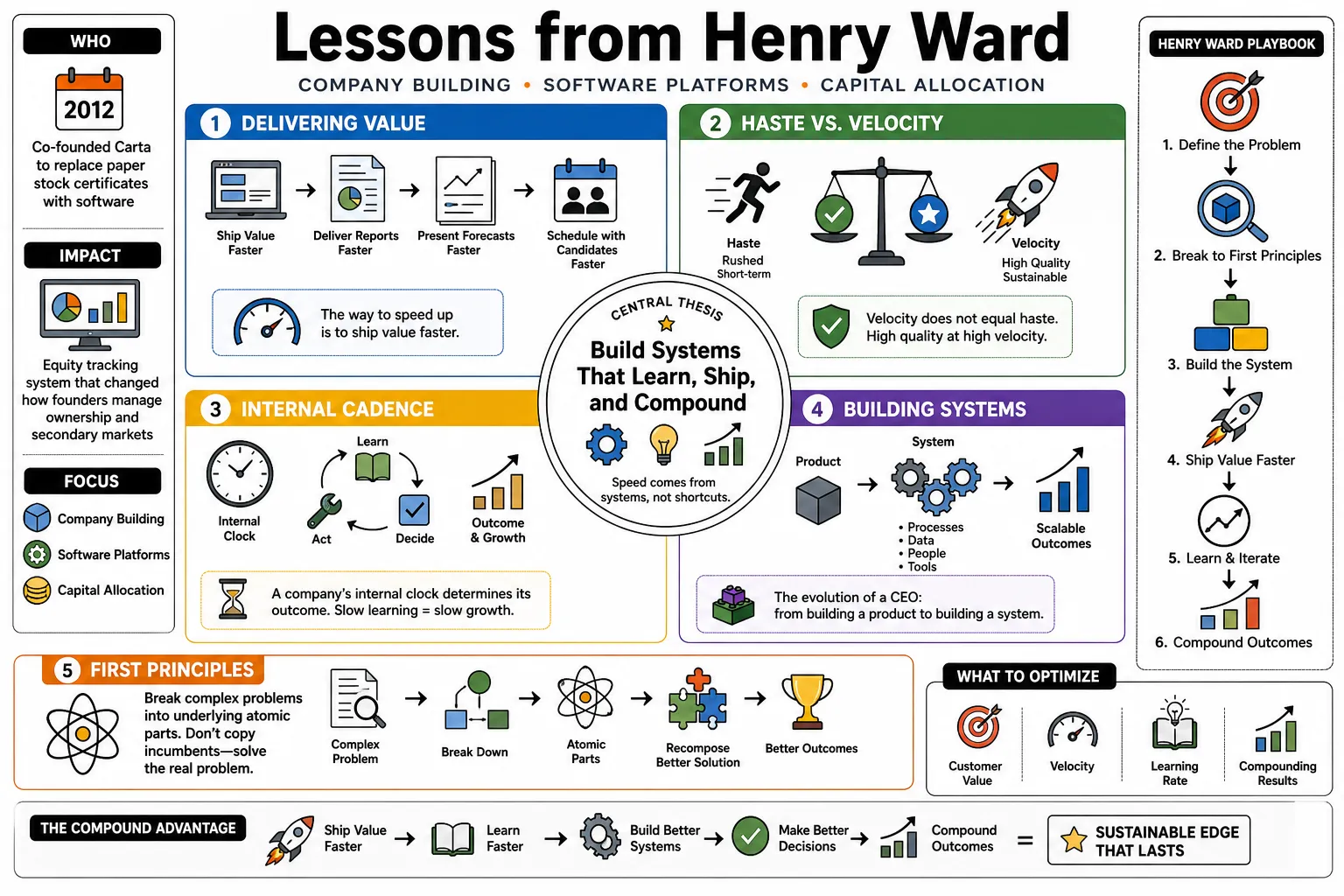
Henry Ward co-founded Carta in 2012 to replace paper stock certificates with software. He built an equity tracking system that changed how founders manage ownership and secondary markets. This profile breaks down his playbook for company building, software platforms, and capital allocation.
Part 1: Company Building and Velocity
- On Delivering Value: "The way to speed up is to ship value faster. This is true whether we are building product, delivering a strategy report, presenting financial forecasts, or scheduling time with candidates." — Source: [Medium]
- On Haste vs. Velocity: "Velocity does not equal haste. It is possible to deliver high quality work at high velocity." — Source: [Medium]
- On Internal Cadence: "A company's internal clock determines its outcome. If you slow down the rate at which you learn, you inevitably slow down the rate at which you grow." — Source: [20 Minute VC]
- On Building Systems: "The evolution of a CEO: from building a product to building a system." — Source: [a16z Podcast]
- On First Principles: "When solving complex regulatory or financial problems, you have to break them down into their underlying atomic parts rather than relying on how incumbents currently operate." — Source: [Masters in Business]
- On Defining Constraints: "Capital rarely bounds startup growth. Instead, it is constrained by the founder's ability to clearly define constraints for their engineering and go-to-market teams." — Source: [Founders Project]
- On Early Stage Focus: "In the earliest days, nothing matters except finding a group of users who desperately need your solution and making sure they actually use it." — Source: [How I Invest]
- On Scaling Empathy: "As you grow past 100 employees, you can no longer rely on personal relationships to maintain culture. You have to build systems that scale empathy and expectations." — Source: [Invested at Work]
- On Operational Debt: "Just as companies accumulate technical debt, they accumulate operational debt. You have to periodically wipe the slate clean and redesign your internal processes." — Source: [The IO Podcast]
- On Capital Allocation: "Post product-market fit, a CEO transitions from building the product to allocating capital and talent toward the highest return opportunities." — Source: [Medium]
Part 2: Leadership and The Wartime CEO
- On Wartime Leadership: "There are two types of CEOs. There are wartime CEOs and there are peacetime CEOs, and I am very much a wartime CEO." — Source: [Business Insider]
- On Making Enemies: "If you are building something truly transformational, you will inevitably anger incumbents and make enemies. This is a sign you are on the right path." — Source: [20 Minute VC]
- On Navigating Crises: "When a crisis hits, transparency is the only viable strategy. Trying to manage the narrative through spin will only destroy trust faster." — Source: [Medium]
- On Admitting Failure: "My greatest failure and disappointment was allowing the secondary trading business to compromise the trust of our core cap table customers." — Source: [Business Insider]
- On CEO Psychology: "The psychological burden of being a founder is managing your own psychology while absorbing the anxiety of your entire organization." — Source: [How I Invest]
- On Direct Communication: "Sugarcoating bad news is a disservice to your employees. They can handle the truth better than they can handle ambiguity." — Source: [Carta Blog]
- On Executive Hiring: "When hiring executives, look for people who have already solved the specific scaling problems you are about to face, rather than merely people with impressive logos on their resume." — Source: [Founders Project]
- On Delegation: "A CEO must delegate everything except the things only they can do: setting the vision, capitalizing the business, and hiring the executive team." — Source: [Masters in Business]
- On Founder Authority: "Founders have a unique moral authority in their companies that hired CEOs do not. This allows them to make unpopular but necessary long term decisions." — Source: [a16z Podcast]
- On Resilience: "The difference between a successful company and a failed one is often the founder's stubborn refusal to quit when everyone else would." — Source: [Invested at Work]
Part 3: Equity, Ownership, and Transparency
- On Employee Respect: "Even if your equity offer is light, employees will respect you for being upfront about what their stock options could be worth." — Source: [Index Ventures]
- On Over-Promising: "Tread carefully. Nothing erodes employee trust more than over-promising on rewards that may never materialize." — Source: [Index Ventures]
- On Financial Literacy: "We expect employees to act like owners, yet we rarely teach them how to read a cap table or understand the difference between preferred and common stock." — Source: [Medium]
- On Paper Wealth: "Being paper rich and cash poor is a uniquely Silicon Valley problem that traps employees in companies longer than they want to stay." — Source: [Masters in Business]
- On the 409A System: "The 409A valuation was originally meant as a compliance exercise, yet it has evolved into a fundamental mechanism for how private companies price their equity for talent." — Source: [Carta Blog]
- On Democratizing Ownership: "If we want to solve wealth inequality, we need to create more owners. Salary alone will never close the gap. Equity is the engine of wealth creation." — Source: [Founders Project]
- On Vesting Schedules: "The standard four-year vest with a one-year cliff is an archaic model inherited from a different era of tech. Companies need to experiment with continuous vesting to align incentives." — Source: [The IO Podcast]
- On Option Exercising: "Forcing departing employees to exercise their options within 90 days is a punitive tax on talent that prevents mobility in the ecosystem." — Source: [Medium]
- On Equity as Currency: "Startups compete against large tech companies with the upside potential of their equity. Transparency is how you make that currency credible." — Source: [20 Minute VC]
- On Information Asymmetry: "The private markets suffer from massive information asymmetry between founders, investors, and employees. Carta was built to level that playing field." — Source: [How I Invest]
Part 4: Markets and "N of One" Strategy
- On Competition: "Competition is for losers. The goal of a startup should be to find an n of one market where you are the sole provider of a completely new solution." — Source: [Medium]
- On Market Size: "Transformational companies often create new markets that by definition seem small or non-existent at first." — Source: [Substack]
- On Monopoly Mechanics: "If you successfully digitize a fundamental system of record like the cap table, you naturally become the central node through which all adjacent transactions must flow." — Source: [Invested at Work]
- On Replacing Services: "The best software businesses often start by replacing expensive human services, like law firms managing paper stock certificates, with scalable code." — Source: [How I Invest]
- On Defensive Moats: "A true moat is more than having better software. It is being so deeply embedded in the infrastructure of your industry that removing you would require rewriting the rules." — Source: [a16z Podcast]
- On Pricing Power: "When you create a category, you earn the right to capture the value you create. You must balance monetization with ubiquity to avoid incentivizing upstarts." — Source: [Masters in Business]
- On Network Effects: "A single player tool is useful, but a multi player network, where adding a new investor benefits every founder on the platform, is deeply defensible." — Source: [20 Minute VC]
- On Category Creation: "You disrupt a market by changing the fundamental architecture of how the work is done, rather than building a slightly cheaper version of an existing product." — Source: [Founders Project]
- On Strategic Patience: "It can take years to establish dominance in a niche market before you earn the right to expand into adjacent financial services." — Source: [The IO Podcast]
Part 5: Product Evolution and Platforms
- On Platform Evolution: "Somewhere along the way, there was a fundamental shift in the problems we were solving for our customers. Carta became a platform rather than a product." — Source: [Medium]
- On Frictionless Transactions: "Because Carta was already the central registry of ownership, we were able to build liquidity solutions to transfer ownership with the click of a button rather than a stack of legal documents." — Source: [Medium]
- On Solving Boring Problems: "The most valuable companies often solve the most boring, tedious administrative problems that nobody else wants to touch." — Source: [Carta Blog]
- On Product Debt: "When you build for the edge cases too early, you create a complex product that is hostile to the average user. Build for the eighty percent first." — Source: [Founders Project]
- On Building Trust: "In financial software, trust is your actual product. If the cap table is wrong, the slickness of the user interface does not matter." — Source: [Invested at Work]
- On The API Economy: "Eventually, every system of record must become an application programming interface so that an ecosystem of specialized tools can be built on top of your underlying data." — Source: [a16z Podcast]
- On Customer Empathy: "Watch how customers use spreadsheets to hack together solutions, and build software that replaces those spreadsheets directly." — Source: [How I Invest]
- On Feature Bloat: "A platform is far more than a collection of features. It is a unified data model that allows different stakeholders to interact seamlessly." — Source: [Masters in Business]
- On Vertical Integration: "To truly fix equity, you must integrate valuations, fund administration, and brokerage services into a single stack instead of relying on a thin software layer." — Source: [20 Minute VC]
Part 6: Venture Capital and Fundraising
- On Filtering Investors: "Fundraising is an exercise in filtering rather than a popularity contest. The key to success is finding investors who care about the problem you are going to solve." — Source: [YouTube]
- On Venture Economics: "Venture capital is a hits business. Investors are looking for companies that can return the entire fund if they succeed, rather than safe bets." — Source: [Medium]
- On Board Dynamics: "A board member's job is to ensure the CEO is the right person to run the company and to help them see around corners, rather than running the company themselves." — Source: [The IO Podcast]
- On Valuation Optics: "Optimizing for the highest possible valuation in a seed round sets an impossibly high bar for the next round and creates unnecessary pressure." — Source: [20 Minute VC]
- On Pitching: "The best pitches sell a specific, inevitable vision of the future where the startup is the missing piece of infrastructure, rather than merely selling a product." — Source: [How I Invest]
- On Cap Table Hygiene: "A messy cap table with too many deadweight early investors is a red flag for late stage funds. It signals poor governance and misaligned incentives." — Source: [Founders Project]
- On Secondary Sales for Founders: "Allowing founders to take a little bit of liquidity off the table early on aligns them with the long term, reducing the temptation to sell the company prematurely." — Source: [a16z Podcast]
- On Capital as a Commodity: "In a bull market, capital is commoditized. An investor differentiates themselves by their ability to help you recruit executives and close early enterprise customers." — Source: [Invested at Work]
- On Investor Rejection: "Every pass from a venture capitalist is a data point. If they pass because they misunderstand the market, you are early. If they pass because they doubt your execution, you have a real problem." — Source: [Masters in Business]
Part 7: Culture and Internal Dynamics
- On Creative Destruction: "Nobody at Carta does the same thing everyday. Everyone is working to put themselves out of a job. This is our creative destruction that drives us to evolve, grow, and adapt." — Source: [Medium]
- On Anti-Entitlement: "Startups die when employees begin to feel entitled to success rather than realizing that survival must be earned every single quarter." — Source: [Carta Blog]
- On Remote Work: "Distributed teams require a completely different operational architecture based on rigorous written documentation rather than oral tradition." — Source: [20 Minute VC]
- On Organizational Design: "A company's organizational chart is a product in itself. It must be constantly refactored to align with the shifting realities of the market." — Source: [The IO Podcast]
- On Hiring Mavericks: "You need people who are willing to question the fundamental premises of your business model. Consensus driven cultures rarely produce breakthrough innovations." — Source: [Founders Project]
- On Performance Management: "Tolerating low performers is unfair to your high performers. They will eventually leave if they feel they are carrying the weight of the organization." — Source: [How I Invest]
- On Intellectual Honesty: "A strong culture allows anyone in the company, regardless of rank, to point out that a strategy is failing, provided they have the data to prove it." — Source: [Masters in Business]
- On The 101 Onboarding: "The onboarding process should be an intensive alignment of values, far beyond a simple IT setup. It is the moment you calibrate new hires to your speed and standards." — Source: [Carta Blog]
- On Managing Attrition: "As a company scales from fifty to five thousand employees, different stages require entirely different personality types and skill sets. Turnover is a natural part of that evolution." — Source: [Invested at Work]
Part 8: Liquidity and the Future of Private Markets
- On The Private Market Illusion: "We call them private markets, but they are increasingly acting like public markets with worse infrastructure, longer lockups, and massive illiquidity discounts." — Source: [Masters in Business]
- On Continuous Liquidity: "The future of private equity is continuous liquidity, where shares can be traded in structured, company sponsored secondary events, instead of waiting ten years for an initial public offering." — Source: [Medium]
- On The IPO Crisis: "Companies are staying private longer because the regulatory burden of going public has vastly outweighed the benefits of public capital." — Source: [a16z Podcast]
- On Retail Access: "The current regulatory framework prevents retail investors from participating in the highest growth phase of technology companies, effectively reserving wealth creation for institutional funds." — Source: [20 Minute VC]
- On Settlement Times: "Moving private shares currently takes weeks of legal back and forth. It should happen instantaneously, exactly like clearing a transaction on the public exchanges." — Source: [How I Invest]
- On Pricing Private Assets: "Without regular liquidity events, private market valuations become theoretical exercises detached from the actual supply and demand of the underlying shares." — Source: [The IO Podcast]
- On Fund Administration: "Venture capital funds operate on archaic accounting systems. Digitizing fund administration is the necessary precursor to building a true secondary exchange." — Source: [Carta Blog]
- On Regulatory Overhaul: "To modernize private markets, better software is insufficient without regulators understanding that technology has solved the systemic risks they originally targeted." — Source: [Invested at Work]
- On The Final Vision: "Ultimately, the distinction between public and private markets will blur, replaced by a spectrum of liquidity tailored to the maturity and needs of each individual company." — Source: [Founders Project]