Howard Yu is a professor of management and innovation at IMD who studies how companies prepare for disruption. His work on future readiness examines how organizations can keep performing today while developing capabilities for tomorrow. — IMD — Is Your Organization Ready for the Future?.
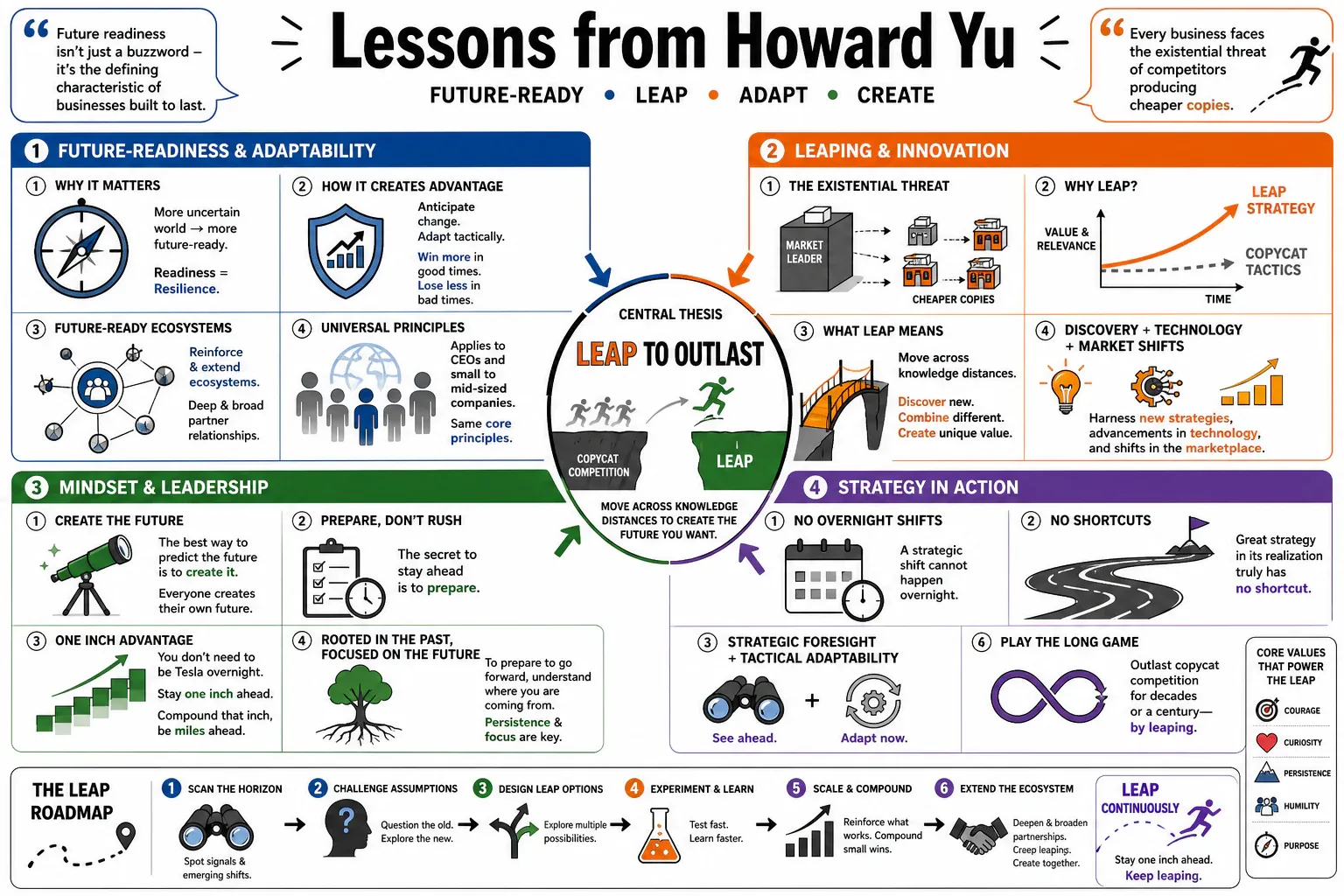
On Future-Readiness and Adaptability
- On defining future readiness: Yu describes future readiness as maintaining current performance while building capabilities that let a company adapt when its market changes. It is an operating discipline, not a label that makes longevity automatic. — IMD — Is Your Organization Ready for the Future?.
- On readiness as resilience: Yu argues that preparing relevant capabilities before a shock can make an organization more resilient during uncertainty and better placed to find growth when conditions improve. — Howard Yu — What Makes a Company Future-Ready?.
- On foresight paired with adaptation: Yu distinguishes strategic foresight from tactical adaptability: future-ready firms anticipate external change, adjust their operations and scale capabilities before competitors do. — IMD — Is Your Organization Ready for the Future?.
- On learning from industry history: In his Oslo Business Forum talk, Yu urged leaders to understand how their industry reached its present position before choosing a path forward. He paired that historical perspective with persistence and focus. — Oslo Business Forum — Howard Yu on Future-Proofing.
- On ecosystem relationships: Yu and his coauthor describe ecosystem businesses as drawing adaptability from partners, alliances and autonomous ventures. During a crisis, they advise companies to reconnect with partners instead of turning entirely inward. — Howard Yu — Ecosystem Advantage in a Crisis.
- On preparation before speed: Yu’s research emphasizes scaling up useful capabilities before a disruption forces a hurried response. Being prepared matters more than merely reacting fast after the market shifts. — IMD — Is Your Organization Ready for the Future?.
- On compounding small advances: Yu told the Oslo Business Forum that organizations need not become a Tesla overnight. His “one inch ahead” example is about repeatedly developing a modest advantage until the gains compound. — Oslo Business Forum — Howard Yu on Future-Proofing.
- On applying strategy beyond large companies: Yu writes that principles he studies in large corporations can also help small teams and solo entrepreneurs. The application changes with scale, but the need for clarity in leadership does not disappear. — One Inch Ahead — About Howard Yu.
- On shaping the future rather than predicting it: Yu says people beyond the CEO can help shape what comes next. On his own publication, he frames future readiness as an active responsibility for individuals as well as organizations. — One Inch Ahead — About Howard Yu.
- On the long lead time of a strategic shift: Yu uses Disney’s streaming transition to argue that a major shift requires years of preparation. A strategy cannot be realized by announcing it at the moment a competitor becomes threatening. — Howard Yu — What Makes a Company Future-Ready?.
On Leaping and Innovation
- On the exposure to copycat competition: Yu warns that patents, market position and resources do not make a company immune to imitation. A pioneer must keep learning because a follower may reproduce today’s offering at lower cost. — Howard Yu — Leap Book Page.
- On leaping before a pioneer is caught: Yu’s leap framework argues that companies endure by moving into new knowledge and capabilities before their current advantage is copied away. Repetition of today’s formula is not a long-term defense. — IMD — Four Principles for Surviving Disruption.
- On combining old and new capabilities: Yu argues that a company must master its existing business while discovering new strategies and technologies. A leap does not mean discarding everything it already knows; the old and new capabilities have to work together. — IMD — Leap: How to Thrive in a World Where Everything Can Be Copied.
- On crossing knowledge frontiers: In Yu’s examples, industries can shift from one underlying discipline to another. Incumbents need to recognize such changes and acquire the next body of know-how rather than rely solely on their original expertise. — Strategy+Business — Howard Yu Interview.
- On looking outside direct rivals: Yu advises leaders to look beyond peer benchmarking. Observing practices in other industries can reveal the next capability their company needs before its current rivals make the shift. — IMD — Four Principles for Surviving Disruption.
- On pruning experiments that fail: Yu says experimentation requires a willingness to end projects when evidence shows they are not working. Without that discipline, failing initiatives consume resources that could support the next opportunity. — Strategy+Business — Howard Yu Interview.
- On updating the measures of success: Yu warns that historic metrics can trap a company as it develops new capabilities. Once experiments show promise, leaders need different KPIs to measure the new business and decide where to commit resources. — IMD — Four Principles for Surviving Disruption.
- On opening the innovation funnel: Yu argues that ideas from customers, suppliers and outsiders can help a company solve problems its internal team has viewed through the same lens for too long. — Strategy+Business — Howard Yu Interview.
- On experimenting before a crisis: Yu warns that organizations that do not test new business ideas early may be forced to place one large bet during a crisis. Smaller experiments reveal which opportunities deserve more investment. — Strategy+Business — Howard Yu Interview.
- On advantages that expire as knowledge spreads: Yu says an early pioneer can lose its lead when the underlying know-how stays unchanged and imitators catch up. Leaders must identify when their industry’s knowledge base is shifting and build capabilities for the next one. — Strategy+Business — Howard Yu Interview.
On Strategy and Transformation
- On performing while transforming: Yu and Lei describe successful future-ready organizations as operating on two horizons at once: they improve today’s business while preparing new capabilities for tomorrow. — IMD — Being Future-Ready Isn’t a Luxury.
- On funding tomorrow with today’s business: Yu and Lei argue that healthy current performance and cash flow give companies resources to build the next product pipeline. Transformation needs funding from the business that exists now. — IMD — Being Future-Ready Isn’t a Luxury.
- On turning strategy into operating choices: Yu says leaders need to move beyond a shared future narrative by identifying promising experiments, changing KPIs and shifting resources toward the ideas gaining traction. That makes an abstract strategy a series of measurable choices. — IMD — Four Principles for Surviving Disruption.
- On the pace of change: Yu argues that ubiquitous connectivity and smart machines let new entrants scale faster than earlier challengers. That shorter window makes it important for incumbents to build new capabilities before a threat is fully visible. — Strategy+Business — Howard Yu Interview.
- On building resilience before a shock: Yu’s pandemic-era research argues that companies which had developed relevant capabilities in advance were more able to adapt when conditions changed suddenly. Waiting until a crisis to start the shift leaves less room to maneuver. — IMD — Questions to Test Future Readiness.
- On the danger of shortcut growth: Yu cautions that strategic transitions take preparation; attempts to take an easy path to growth can produce a later setback. His own newsletter pairs Disney’s long streaming preparation with a warning about shortcuts. — Howard Yu — What Makes a Company Future-Ready?.
On Leadership and Culture
- On inviting productive disagreement: Yu argues that leaders should welcome task-focused debate rather than encourage surface harmony. Teams need space to challenge assumptions and examine trade-offs before committing to a strategy. — Howard Yu — Productive Leadership Conflict.
- On trust as the boundary for conflict: Yu says teams make better decisions when they can argue hard about tasks while keeping personal conflict low. Mutual trust lets members challenge an idea without treating disagreement as an attack on the person. — Howard Yu — Productive Leadership Conflict.
- On interventions only senior leaders can make: Yu and Joseph Bower argue that some strategic changes require a top leader to engage directly with a project’s objectives and implementation. That intervention can cross routines and resource boundaries a midlevel manager cannot readily change. — Harvard Business School — Taking a Deep Dive.
- On cutting through hype: Yu says he wants his writing to help readers focus on what matters in their work and act with greater clarity. The useful principle is to make research practical rather than add to the noise around innovation. — One Inch Ahead — About Howard Yu.
- On leaders learning as organizations change: Yu’s teaching page argues that leaders need to develop alongside their organizations. He presents personal growth and exposure to new cases as preparation for driving change, not as a one-time qualification. — Howard Yu — Teaching and Leadership Development.
- On taking a brief pause for clarity: In a personal newsletter, Yu suggests that short, light-hearted breaks can help a person regain clarity amid persistent worries. This is a personal practice he recommends, not a claim that rest substitutes for strategic work. — Howard Yu — What Makes a Company Future-Ready?.
On Diversity and Collaboration
- On the value of combining weaker models: Yu uses an ensemble of algorithms to illustrate how combining varied judgments can outperform relying on a single model. His comparison is an analogy for collective thinking, not proof that every diverse human group makes better decisions. — IMD — What AI Can Teach Us About Human Bias.
- On actively building a varied leadership view: Yu argues that companies need people with different backgrounds in leadership to challenge entrenched industry assumptions. Diversity is a deliberate capability-building choice, not something a company can assume will emerge on its own. — Howard Yu — Diversity and Future Capabilities.
- On seeking perspectives outside the familiar: Yu says productive disagreement draws on differing points of view and helps a team avoid groupthink. Leaders should seek out such perspectives while keeping the debate directed at the task rather than personal identity. — Howard Yu — Productive Leadership Conflict.
- On aligning the top team before scaling: Yu argues that leaders need a shared view of the future and of which experiments deserve more resources. Without agreement on priorities, promising new capabilities are less likely to scale. — IMD — Four Principles for Surviving Disruption.
Learn more:
- IMD — Is Your Organization Ready for the Future?
- IMD — Being Future-Ready Isn’t a Luxury
- Howard Yu — What Makes a Company Future-Ready?
- Oslo Business Forum — Howard Yu on Future-Proofing
- One Inch Ahead — About Howard Yu
- Howard Yu — Ecosystem Advantage in a Crisis
- IMD — Four Principles for Surviving Disruption
- IMD — Leap: How to Thrive in a World Where Everything Can Be Copied
- Howard Yu — Leap Book Page
- Strategy+Business — Howard Yu Interview
- Howard Yu — Productive Leadership Conflict
- IMD — Questions to Test Future Readiness
- Howard Yu — Teaching and Leadership Development
- Howard Yu — Diversity and Future Capabilities
- IMD — What AI Can Teach Us About Human Bias
- Harvard Business School — Taking a Deep Dive