Ian Murray and his brother Shep walked away from corporate desk jobs in 1998 to start Vineyard Vines, initially funding a necktie business entirely through credit card debt. They built the company into a near-billion-dollar preppy apparel brand without ever taking outside equity. This profile details their methods for bootstrapping retail growth, maintaining operational discipline, and selling a lifestyle identity rather than just clothing.
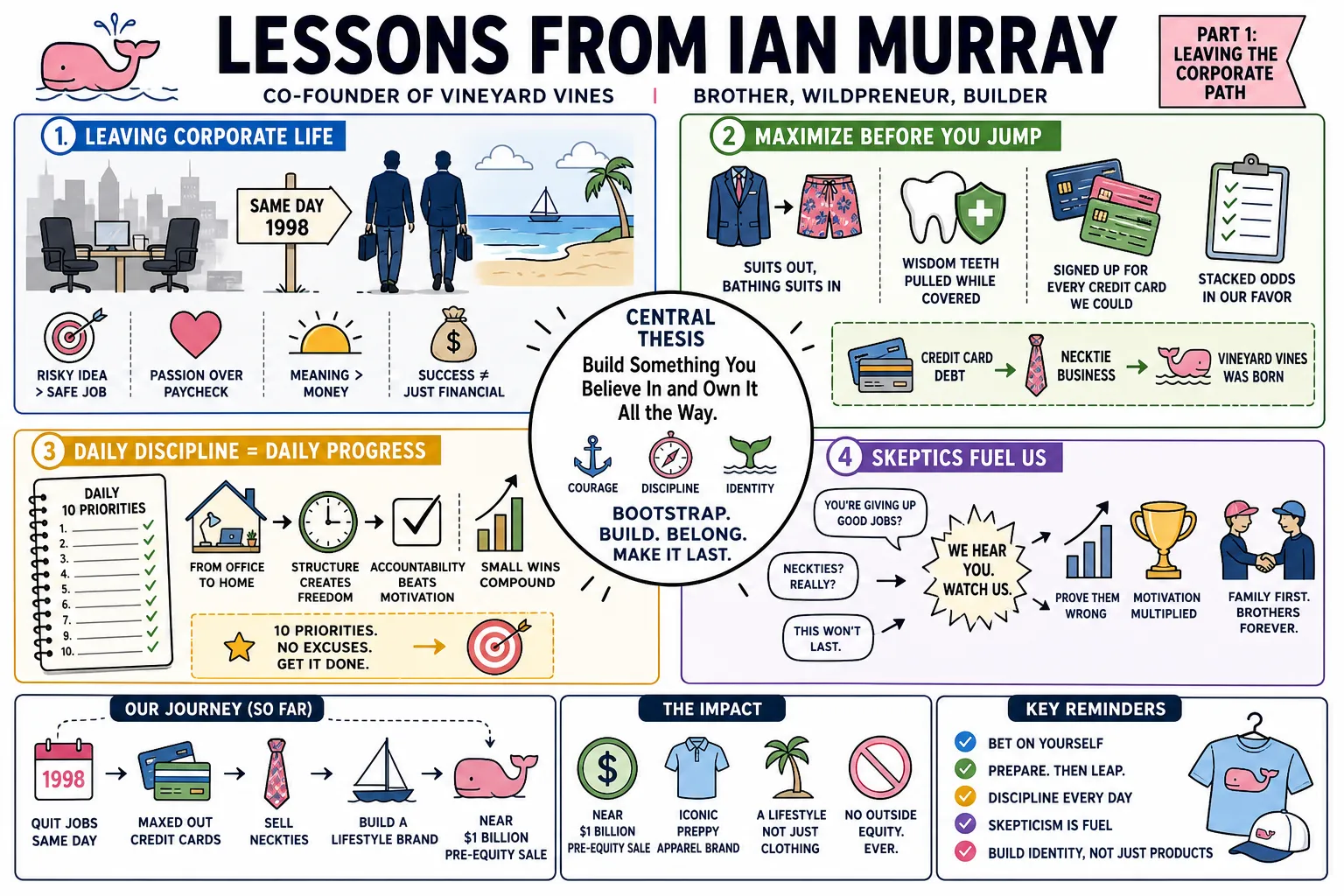
Part 1: Leaving the Corporate Path
- On leaving corporate life: Ian and his brother quit their comfortable communications and public relations jobs on the same day in 1998, deciding that attempting a risky business idea was better than accepting a stable but unfulfilling career. — Reference: Brothers Who Founded Vineyard Vines Reveal Why They Quit Their Jobs
- On maximizing benefits before quitting: "We tossed out business suits for bathing suits, got our wisdom teeth pulled while we still had coverage and signed up for every credit card we could." — Source: Vineyard Vines: Brothers and Wildpreneurs
- On daily discipline: Transitioning from a structured office to working from home, they kept themselves accountable by writing a daily list of ten priorities they had to accomplish. — Reference: Brothers Who Founded Vineyard Vines Reveal Why They Quit Their Jobs
- On quality of life: They prioritized pursuing their passion over chasing high-paying jobs, believing that measuring success purely financially doesn't necessarily lead to a happy or productive life. — Reference: Brothers Who Founded Vineyard Vines Reveal Why They Quit Their Jobs
- On facing skeptics: Even though friends and family questioned their choice to abandon respectable positions to sell neckties, the brothers treated the constant skepticism as a motivational challenge. — Reference: Brothers Who Founded Vineyard Vines Reveal Why They Quit Their Jobs
Part 2: Scrappy Funding and Early Hustle
- On funding the business: Instead of seeking outside investors, they bought old vehicles with their final paychecks and used cash advances from newly opened credit cards to pay for their initial inventory of 800 ties. — Reference: Brothers Who Founded Vineyard Vines Reveal Why They Quit Their Jobs
- On early hustle: They built their early customer base by couch surfing, carrying backpacks full of ties, and selling directly to people on beaches, at Junior League fairs, and in church bazaars. — Reference: Brothers Who Founded Vineyard Vines Reveal Why They Quit Their Jobs
- On early catalogs: Lacking a marketing budget, they printed their initial catalogs at Kinkos by placing their ties directly onto the glass of photocopiers. — Reference: Vineyard Vines: Prep rally
- On learning the ropes: Entering the apparel industry with zero fashion experience, they chose to humble themselves by hanging around stores, helping stock shelves, and learning the retail business directly from shop owners. — Reference: How Shep & Ian Murray Turned Vineyard Vines Into a $500M Lifesty…
Part 3: Redefining the Product and Category
- On contrarian market entry: They launched a necktie business at a time when workplaces were adopting casual wear, capitalizing on the reality that when men did wear ties, they wanted them to make a specific statement. — Reference: Vineyard Vines: Prep rally
- On selling a feeling: Realizing they were competing in a declining tie market, they shifted their focus to creating a self-expression product that represented Martha's Vineyard nostalgia, summer freedom, and an aspirational lifestyle. — Reference: How Shep & Ian Murray Turned Vineyard Vines Into a $500M Lifesty…
- On conversation starters: They designed their early ties with whimsical, colourful patterns so the product could spark conversations and allow wearers to display their personalities. — Reference: Brothers Who Founded Vineyard Vines Reveal Why They Quit Their Jobs
- On non-verbal communication: Neckties function as an immediate signalling device, communicating a person's values and identity before they even speak. — Reference: Brothers Who Founded Vineyard Vines Reveal Why They Quit Their Jobs
- On practical product choices: In addition to their expressive qualities, neckties offered high profit margins and completely sidestepped the inventory complications of clothing sizes. — Reference: Vineyard Vines: Prep rally
Part 4: Guerrilla Marketing and Brand Identity
- On avoiding industry tropes: The company actively shunned standard fashion industry practices like hiring celebrity models or participating in fashion weeks, preferring an approachable beach bar atmosphere and photographing friends for their campaigns. — Reference: Vineyard Vines: Prep rally
- On being walking billboards: To build the brand locally, they integrated it entirely into their lives by branding their boat and Jeep, and wearing ties with shorts on the beach. — Reference: How Shep & Ian Murray Turned Vineyard Vines Into a $500M Lifesty…
- On finding early credibility: During a late-1990s political scandal, Ian executed a guerrilla public relations stunt by pitching their ties to the media as a gift for the president, securing massive nationwide exposure for free. — Reference: How Shep & Ian Murray Turned Vineyard Vines Into a $500M Lifesty…
- On building a tribe: Customers connected with the brand because wearing the products made them feel like insiders belonging to a specific, in-the-know group. — Reference: How Shep & Ian Murray Turned Vineyard Vines Into a $500M Lifesty…
Part 5: Customer Connection and Lifestyle Focus
- On predictive analytics in retail: The company partnered with analytics firms to gather real-time sentiment and pricing data, allowing them to optimize product margins and inventory turnover by listening directly to their consumers. — Reference: vineyard vines® Partners with First Insight
- On customer-guided strategy: Having consumers weigh in on early concept ideas and pricing structures aligns product development directly with the needs of a distinct customer base, directly increasing online conversions and full-price sales. — Reference: vineyard vines® Partners with First Insight
- On protecting brand equity: The founders ceased most discounts and promotional sales, choosing to intentionally slow their sales growth in order to protect profit margins and preserve the exclusivity of the brand. — Reference: Vineyard Vines: Prep rally
- On community identity: The products are designed not just as apparel, but as identifiers that signal membership in a laid-back, preppy community. — Reference: Vineyard Vines: Prep rally
Part 6: Operational Discipline and Strategic Growth
- On early constraints: They adhered to strict advice from a mentor to avoid expanding into other clothing categories until they successfully reached $5 million in necktie sales, enforcing operational discipline. — Reference: How Shep & Ian Murray Turned Vineyard Vines Into a $500M Lifesty…
- On surviving recessions: When the 2008 financial crisis hit, they were forced to modernize their inventory, implement data systems, and renegotiate supply deals, using the economic downturn to build a much more efficient business. — Reference: Vineyard Vines: Prep rally
- On strategic brick-and-mortar: Unlike competitors abandoning physical retail, they aggressively expanded stand-alone stores because establishing a physical presence dramatically increases their online sales in that specific region. — Reference: Vineyard Vines: Prep rally
- On data-driven real estate: The company utilizes online order data to map out new store locations, successfully identifying non-coastal markets like St. Louis and Kansas City for retail expansion. — Reference: Vineyard Vines: Prep rally
- On controlling quality and speed: By keeping their tie manufacturing domestic with a partner in New York, they maintained strict quality control and were able to rapidly turn around massive custom corporate orders. — Reference: Vineyard Vines: Prep rally
- On seizing corporate opportunities: When a major insurance company requested a custom duck mascot tie, they quickly mocked it up and fulfilled a massive $400,000 order by bribing friends with pizza and beer to help box the inventory. — Reference: Vineyard Vines: Prep rally
Part 7: Leadership and Independence
- On avoiding venture capital: They grew their apparel brand to nearly a billion-dollar valuation without giving up any equity, operating on the belief that giving founders outside money simply encourages them to spend it unnecessarily. — Reference: How Shep & Ian Murray Turned Vineyard Vines Into a $500M Lifesty…
- On complementary partnerships: The brothers effectively split responsibilities based on their differing backgrounds—Ian bringing public relations skills and Shep bringing advertising knowledge—while relying on each other for support during difficult early stages. — Reference: Brothers Who Founded Vineyard Vines Reveal Why They Quit Their Jobs
- On delegating operational tasks: Recognizing their own limits as visionaries, the founders appointed a trusted president to handle the unglamorous day-to-day operations and organizational machinery they did not want to manage themselves. — Reference: Alum Mike Gaumer Coaches vineyard vines to Victory
- On the advantage of total ownership: Retaining 100 percent ownership of the company gave the founders the nimbleness to experiment with brick-and-mortar retail and make long-term decisions without investor interference. — Reference: Vineyard Vines: Prep rally
- On structural foundations: Poor execution of leadership transitions or stepping back from the CEO role can damage company culture if the brand and operational structures aren't thoroughly established first. — Reference: Shep and Ian Murray: Vineyard … - How I Built This with Guy Raz