Ilkka Paananen is the co-founder and CEO of Supercell, the Finnish mobile games giant behind global hits like Clash of Clans, Hay Day, and Brawl Stars. He is widely admired for creating one of the most unique and successful corporate cultures in the world, built on a foundation of trust, independence, and a "least powerful CEO" philosophy.
His learnings offer a radical and inspiring blueprint for how to build a creative organization that is both highly successful and deeply human.
On Company Culture & Organization
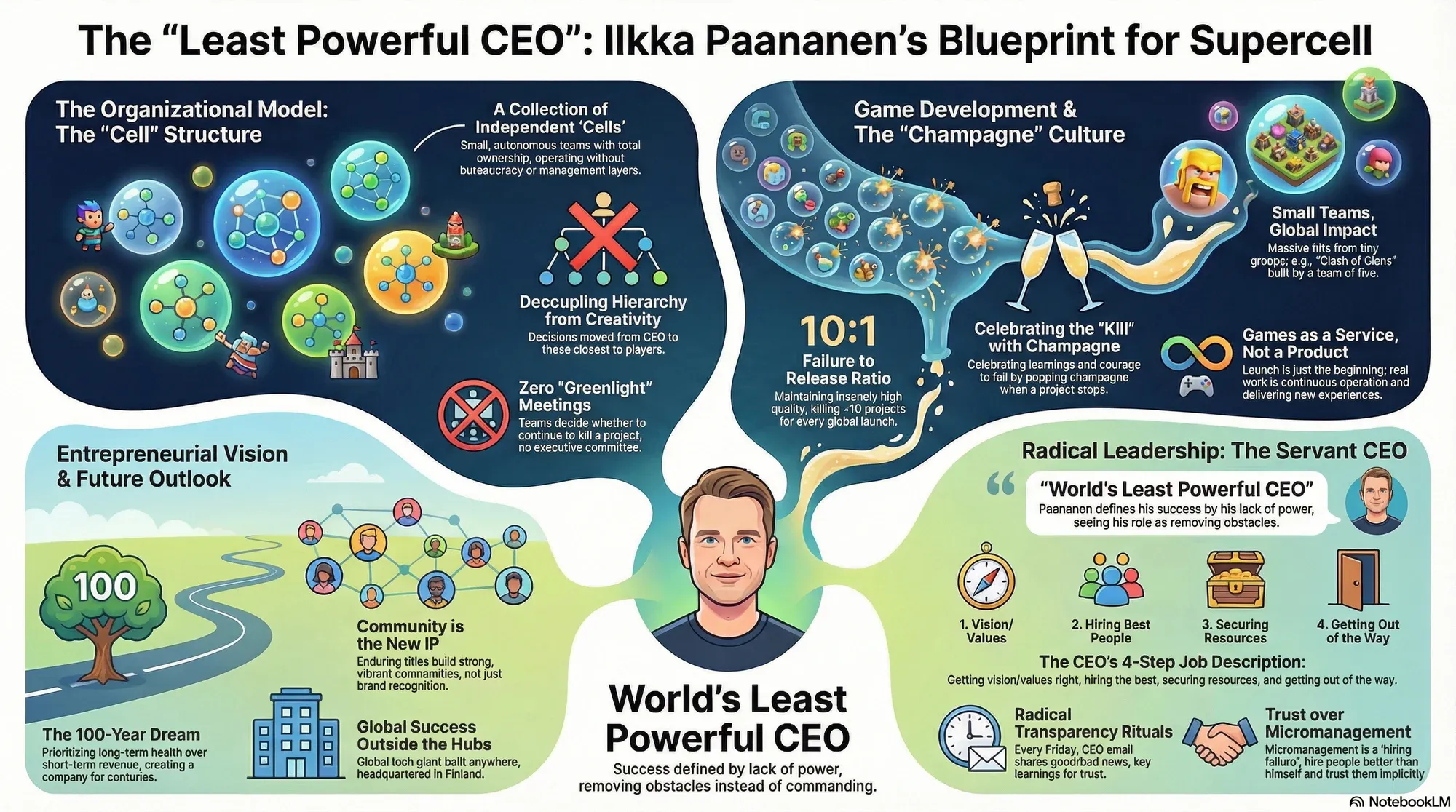
- On the least powerful CEO: Paananen told WIRED in 2013: "My goal is to become the least powerful CEO in the world." WIRED reported that he cannot kill a game even if he wanted to, sits at the same size table as everyone else and carries no more than one vote. — WIRED: Supercell's CEO reveals the culture he built (2013).
- On the best people: "The best people make the best games," Paananen said. "It sounds simple and perhaps naive, but if you truly believe it then the only thing that matters is getting those people and creating the best possible environment so they stay." — WIRED: Supercell's CEO reveals the culture he built (2013).
- On cells: Paananen says the idea was to build teams "as individual companies within the greater company," and someone suggested calling them cells; "hence the name Supercell – a collection of individual game development cells." — Accel Secrets to Scaling: Ilkka Paananen on defining the culture of Supercell (2021).
- On minimizing bureaucracy: The first of his four factors for getting the most from people is to minimise bureaucracy: "It maximises the time people can spend on their work... individual designers can make decisions and optimise for speed and create sense of ownership within the games." — WIRED: Supercell's CEO reveals the culture he built (2013).
- On hiring smarter people: On Silicon Valley's "founder mode," Paananen said Supercell still believes in "just hiring people who are smarter and better than you and then trusting those people 100% and delegating it to them and empowering those people and also empowering those teams." — PocketGamer.biz: Full Slush 2024 transcript, Ilkka Paananen.
- On the best environment: "I've never worked for money. I just want to make great games," Paananen said. "As long as Supercell is the best possible environment to make games then why should people leave?" — WIRED: Supercell's CEO reveals the culture he built (2013).
- On a safe place to fail: Paananen said the aim was to "create an environment where it's completely safe to fail," because "if there is no failures, you're not taking enough risks." — Ilkka Paananen of Supercell: Celebrate learnings from failures (Marten Mickos interview, 2015).
- On who decides: Paananen explained that in the months of development "it's only the team that can decide whether a game will get killed or whether we'll continue development," but once a game reaches soft launch and metrics arrive, "the power shifts from the team to the players." — GamesBeat: Supercell CEO thrives on trusting the instincts of game developers (2018).
- On removing fear: "You have to eliminate the fear of failure," Paananen said. "You need to take risks to succeed and for that you must take fear away from that risk." — WIRED: Supercell's CEO reveals the culture he built (2013).
- On decisions close to the work: Of being the least powerful CEO, Paananen said decisions "get made a lot lot quicker; there's no approval loops or anything like that and it's quite likely that those decisions are also better because they are made by the people who are closest to whatever it is that they are working on." — Ilkka Paananen's BAFTA Games Lecture (2016, transcript).
- On a need for control: Paananen said his industrial-engineering background pushed him to want "a very organized, logical, well thought out system for every single thing in the company, including the creative process," which looked great on paper at his earlier company but slowed it down. — Ilkka Paananen's BAFTA Games Lecture (2016, transcript)
- On design by committee: At his earlier company the green-light process required a long document and approval stamps from sales, marketing and finance; Paananen said this "leads to be a design by committee" that "doesn't encourage any kind of risk-taking." — Ilkka Paananen's BAFTA Games Lecture (2016, transcript)
- On the cost of review meetings: He realized one team was spending at least one week of every month preparing for the monthly product review, so they were not building the game; he said that kind of hierarchical model "belongs to sort of manufacturing industries, like assembly lines." — Ilkka Paananen's BAFTA Games Lecture (2016, transcript)
- On hiring instead of adding process: He recalled a Netflix culture deck whose message was that "instead of trying to manage complexity by introducing process, manage complexity by hiring better people and then trust those people," and that the company should be a sports team, not a family. — Ilkka Paananen's BAFTA Games Lecture (2016, transcript)
- On the best teams, not the best individuals: Paananen said the founders changed their slogan from the best individuals to the best teams: "you may have like five amazing, amazing developers but for some reason these five just don't work very well together. But then you change maybe two out of the five members of the team and all of a sudden you have an amazing team." — Ilkka Paananen's BAFTA Games Lecture (2016, transcript)
- On leaders everywhere: Paananen said the more time has gone by "the less I believe in this concept of these like 'hero' CEOs," and that he would like to think that at Supercell "we have 200 leaders, 200 entrepreneurs... people who don't need to be told what to do." — Ilkka Paananen's BAFTA Games Lecture (2016, transcript)
- On learning about decisions late: He said his best days at Supercell are when "I actually learn about something great, much much later than it has been decided," because "that proves that the model is working." — Ilkka Paananen's BAFTA Games Lecture (2016, transcript)
- On the myth of the happy family: Paananen said the big misconception is that Supercell is "just like this fun, happy family where everybody can do exactly what they want"; the company sets the quality bar "extremely high" and "we don't really tolerate average at all." — Ilkka Paananen's BAFTA Games Lecture (2016, transcript)
- On no excuses: He said one of his best days was when a newcomer described Supercell as the first company "where he has no excuses. You can't really blame processes or you can't management for the simple reason that there is no management and there is no process." — Ilkka Paananen's BAFTA Games Lecture (2016, transcript)
- On who the model is not for: Paananen said the environment is "not really for everybody": little guidance and high transparency can be stressful for people who want the feeling of control that gives safety, and the people around the game teams cannot be control freaks or have a big ego. — Ilkka Paananen's BAFTA Games Lecture (2016, transcript)
- On hiring generalists: Because teams are small, he said, "you obviously need people who can do almost everything," and some teams may not even have a game designer because the whole team contributes to the game design. — Ilkka Paananen's BAFTA Games Lecture (2016, transcript)
- On interviewing everyone: Paananen said Supercell's hiring takes between 10 and 15 interviews per candidate, by design slow, and that he still interviews every person who joins: "I do want to keep my finger on the pulse of the type of people joining us." — Accel Secrets to Scaling: Ilkka Paananen on defining the culture of Supercell (2021)
- On not shortcutting recruiting: He said the number one lesson of recruiting is not to shortcut the process: every time Supercell tried, "it has come back to bite us." — Invest Like the Best, Founder's Field Guide Ep. 17: Superpowering Teams (2021, auto transcript)
- On raising the average: He said the best recruiting advice he got is to imagine the average quality of a person at the company and ask whether the new candidate, "is she or he going to, like, raise the average quality of the company." — Invest Like the Best, Founder's Field Guide Ep. 17: Superpowering Teams (2021, auto transcript)
- On sending the culture memo: Before he interviews a candidate, Paananen sends a written culture memo and asks about it, wanting to be sure the candidate wants to join "such a type of company," since some people need safety controls and managers who give guidance. — Invest Like the Best, Founder's Field Guide Ep. 17: Superpowering Teams (2021, auto transcript)
- On a passion for excellence: Paananen said the most important quality he looks for is "a passion for excellence", seen in people who set their own high bar and reach it without anyone telling them to; he thinks of Supercell as a company of 340 entrepreneurs. — Accel Secrets to Scaling: Ilkka Paananen on defining the culture of Supercell (2021)
- On writing culture down early: He said it took two years to formalise Supercell's culture in writing, and that he'd advise every founder to "talk about their company's culture from day one, and put it in writing"; he then met every employee one-on-one to find out what the culture actually was. — Accel Secrets to Scaling: Ilkka Paananen on defining the culture of Supercell (2021)
- On culture that changes: Paananen said "the culture should evolve and it should change all the time" for the better: "As our games need to get better every single week, so does our culture." — PocketGamer.biz: Full Slush 2024 transcript, Ilkka Paananen
- On greenlighting teams, not ideas: Paananen said "we actually don't greenlight or approve game ideas, that's not what we do, we greenlight and approve teams. But once they are a team at Supercell, or cell as we call them, we trust them 100%." — PocketGamer.biz: Full Slush 2024 transcript, Ilkka Paananen
- On trusting an unpopular game: He described how three recent games faced internal opposition, and said the company chose to let the teams release them: "the culture is the most important thing in the company. It's far more important than the short term business goal." — Invest Like the Best, Founder's Field Guide Ep. 17: Superpowering Teams (2021, auto transcript)
On Game Development & Failure
- On celebrating the learnings: Paananen said Supercell does not celebrate the failure itself: when a game is killed the team tells the company what went right and wrong and "they toast... not the failure itself, but whatever we have learned from that failure" with champagne. — Ilkka Paananen of Supercell: Celebrate learnings from failures (Marten Mickos interview, 2015).
- On killing more than launching: In his 2023 annual letter Paananen wrote: "We have launched 5 hit games but we have killed 30+, by my latest count," adding that "This approach isn't flawless." — Supercell: Next Chapter (Ilkka's annual letter, 2023).
- On teams killing their own games: On how a project gets killed, Paananen said "it's not me or anybody from a leadership team... It's the team and ultimately the lead of the team who can make that call." — Ilkka Paananen on autonomy, trust and AI (conference transcript).
- On a low bar for beta and a high one for launch: Paananen said: "ideally our threshold for releasing anything to beta should be low, but our bar for releasing anything globally should be high." — GamesBeat: Supercell CEO thrives on trusting the instincts of game developers (2018).
- On magic formulas: Paananen said the founders decided to "forget this idea that there would be some kind of magic formula or process or strategy about creating hit games" and to focus all their effort on the environment. — Ilkka Paananen's BAFTA Games Lecture (2016, transcript).
- On playing it safe: Paananen said one of his colleagues says "the only way to grow is to take bigger risks. The worst mistake is to play it safe." — Accel Secrets to Scaling: Ilkka Paananen on defining the culture of Supercell (2021).
- On renewing yourself: Paananen said: "The challenge is finding ways to renew yourself and apply a beginner's mindset to everything you do so you don't get stuck in the past." — Accel Secrets to Scaling: Ilkka Paananen on defining the culture of Supercell (2021).
- On games as services: WIRED reported that Paananen talks about games as services that should be regularly updated to become better "week by week," and gives Nintendo as the example of what he wants players to feel. — WIRED: Supercell's CEO reveals the culture he built (2013).
- On intuition over data: Among Supercell's approaches Paananen lists "trusting developer intuition, experience, interest and passion over data": "Data can certainly help & inform, but we've never believed that following the data will lead to outlier successes." — Supercell: Next Chapter (Ilkka's annual letter, 2023).
- On small teams: WIRED reported that Clash of Clans and Hay Day were each developed by teams of just five developers; Paananen said "we say 'get big by thinking small', we value the speed of small teams and keeping things simple." — WIRED: Supercell's CEO reveals the culture he built (2013).
- On a sauna decision: Paananen told how the Smash Land team went to a sauna, honestly asked whether it was the one game they would make for the next few years, decided it wasn't and killed it: "they didn't even bother to consult me, which is great, that's how Supercell should work." — Ilkka Paananen's BAFTA Games Lecture (2016, transcript)
- On quality worth killing for: He said Supercell kills games to keep quality high and the company small: "we believe that quality is worth killing for." — Ilkka Paananen's BAFTA Games Lecture (2016, transcript)
- On celebrating learnings, not failure: Paananen said "we actually don't" celebrate the failure: "We celebrate the learnings from this failure, and we sort of think that they are so valuable that they are worth celebrating with champagne"; and he adds: "we are not trying to pretend that failing is fun. Because it sucks." — Ilkka Paananen's BAFTA Games Lecture (2016, transcript)
- On champagne for successes too: Paananen said Supercell now also drinks champagne for successes, because "you can also learn from the successes. It's important to have it both ways." — Ilkka Paananen of Supercell: Celebrate learnings from failures (Marten Mickos interview, 2015)
- On failure as a nightmare scenario: He said one of his worst nightmares would be waking up and being unable to name a failure from the last year, because "what it would tell me is that we are not taking enough risks, we are not being brave enough, we are not trying new things." — Ilkka Paananen's BAFTA Games Lecture (2016, transcript)
- On targets set before the beta: Before a game goes to beta Supercell sets numerical targets on retention, engagement and monetization and tells everyone in the company; if the game doesn't hit them it is killed, "no matter how much me personally would love the game." — Ilkka Paananen's BAFTA Games Lecture (2016, transcript)
- On retention before monetization: On kill or scale decisions, Paananen said retention and engagement matter most and monetization is secondary: "if you are able to create something that is fun for people to play... they can figure out how to monetize that experience. But you can't do it the other way around." — Ilkka Paananen on autonomy, trust and AI (conference transcript)
- On a portfolio of different cells: Paananen said new-game cells are like bets in a venture portfolio, and "one of our biggest sources of strength... is the diversity between the ways of working of these sort of cells." — Ilkka Paananen on autonomy, trust and AI (conference transcript)
- On the hardest part of repeating success: Paananen wrote that "creating a hit game is really, really hard," but "what is even harder is repeating this success," and that he has sometimes thought it would be easier to develop new games with no past successes. — Supercell: Next Chapter (Ilkka's annual letter, 2023)
- On two challenges at once: He framed Supercell's mission as two simultaneous challenges: always creating another great new game, and making the first live game "better every day, week, month, and year…forever." — Supercell: Next Chapter (Ilkka's annual letter, 2023)
- On the Gunshine decision: Paananen said the team saw that what they were building with Gunshine "wasn't working," killed it and pivoted to tablet-first and later mobile-first; his investors told him they "hadn't invested in Gunshine, but in the team and the new type of company we were trying to build." — Accel Secrets to Scaling: Ilkka Paananen on defining the culture of Supercell (2021)
- On Squad Busters: After Squad Busters became Supercell's first killed game after global launch, Paananen shared lessons including: "Don't build a massive marketing push before the product vision is deeply validated," and that the team believes it should have run a third, longer beta. — Supercell: The Best Games Haven't Been Made Yet (Ilkka's annual letter, 2026)
- On AI and prototyping speed: Paananen said AI can cut the time from idea to something playable from "at least a few weeks" to "literally like hours," so many more ideas can be tried with real players, and that the human creator stays "front and center." — Ilkka Paananen on autonomy, trust and AI (conference transcript)
On Leadership & Management
- On getting out of the way: Paananen described the sole mission of the founders and management as: "Get the best players, or developers in this case. Create the best possible environment for them and then just get out of their way." — Ilkka Paananen's BAFTA Games Lecture (2016, transcript).
- On trust: Asked what leadership looks like, Paananen said: "at least in our culture, the most important element is trust," adding that the goal is to hire the best people, form the best teams and create a culture where they can have the biggest impact. — Ilkka Paananen on autonomy, trust and AI (conference transcript).
- On a daily email for everyone: "We send a daily email with all key performance indicators to everyone in the company," Paananen said. "It isn't restricted to executives, it is the same information released at the same time so we can all figure out on our own what is needed." — WIRED: Supercell's CEO reveals the culture he built (2013).
- On leaders as coaches: Paananen likens the role of a leader to a coach: "it's not the coach that gets on the ice and scores the goals. But they can create an environment where their players can be successful." — Accel Secrets to Scaling: Ilkka Paananen on defining the culture of Supercell (2021).
- On what happens with the right team: Paananen said: "When you have the right team in place, magic will happen. You don't need to do all that much. In fact, I've never told anyone what to do – things just happen." — Accel Secrets to Scaling: Ilkka Paananen on defining the culture of Supercell (2021).
- On not copying a culture: Paananen was "not keen to press" his ideals on other industries: "Every industry needs to work out their own model for success. But as a general rule I think our model gives more ownership to employees and a greater feeling of freedom and belonging." — WIRED: Supercell's CEO reveals the culture he built (2013).
- On how he spends his time: Paananen said he spends time with the people he leads and on recruiting, and that one of his favorite questions to team leads is: "What's slowing your team down? How can I help?" — Invest Like the Best, Founder's Field Guide Ep. 17: Superpowering Teams (2021, auto transcript).
- On the CEO's product: Paananen said that none of Supercell's hit games were his ideas: "My product, what I focus on, is actually the organisation, it's the culture." — PocketGamer.biz: Full Slush 2024 transcript, Ilkka Paananen
- On success as a danger: Paananen said "it's one thing to be successful but the really hard thing is to repeat success. And success can be a dangerous thing because oftentimes you start to look to the past and what has made you successful." — PocketGamer.biz: Full Slush 2024 transcript, Ilkka Paananen
- On facing the truth and starting with himself: Ahead of the 2023 offsite he showed the company a timeline of Supercell dropping out of the top ten, took a sip of champagne on stage and said that when it came to change, "change has to start from me": "all of this ultimately was my fault." — PocketGamer.biz: Full Slush 2024 transcript, Ilkka Paananen
- On good structure and process: He said Supercell used to think of structure as negative, but "there's also such a thing as a good structure and good process, and what that means is that a good structure actually enables people to focus on what's the most important thing, which is the work." — PocketGamer.biz: Full Slush 2024 transcript, Ilkka Paananen
- On putting players ahead of comfort: Paananen admitted that staying with small cosy live-game teams meant "we had put our own interests ahead of our players' interest," and that Supercell decided to place players first even if that meant "the uncomfortable zone." — PocketGamer.biz: Full Slush 2024 transcript, Ilkka Paananen
- On results as an outcome: Paananen said results, including financial results, "are just an outcome," so focus on the inputs: "you control the type of people you have in the organisation, you can control what type of teams you're building, you can certainly control the culture." — PocketGamer.biz: Full Slush 2024 transcript, Ilkka Paananen
- On focusing on the one thing: On making a big change, he said that rather than dwell on the million things that could go wrong, "let's focus on that one thing that will make this great." — PocketGamer.biz: Full Slush 2024 transcript, Ilkka Paananen
- On founder mode: Asked about "founder mode," Paananen said: "I have mixed feelings about the founder mode thing," and that Supercell leadership feels "the complete opposite": hire people who are smarter and trust them. — PocketGamer.biz: Full Slush 2024 transcript, Ilkka Paananen
- On luck, teams and culture: He said that to succeed in games "you need to be lucky" but luck can't be controlled, so the two things that can be controlled are "what type of teams do you have and what type of culture you have." — PocketGamer.biz: Full Slush 2024 transcript, Ilkka Paananen
- On financials as a mirror: Paananen wrote that Supercell views financial performance "as an outcome" and that financial results "are somewhat of a mirror. They don't tell us how to improve. They just reflect back to us that we can improve." — Supercell: Next Chapter (Ilkka's annual letter, 2023)
- On an apology: After readers reacted to his Clash Royale section, Paananen added a note to the 2026 post: "I failed to acknowledge the role that creators, pro players, and the broader community played in Clash Royale's resurgence. That was my mistake — no one else's... I am sorry." — Supercell: The Best Games Haven't Been Made Yet (Ilkka's annual letter, 2026)
- On the loneliness of the job: Asked how he copes with the CEO role, Paananen said the biggest stress reliever is having great people inside the company to talk to, plus a couple of outside entrepreneurs for perspective. — Accel Secrets to Scaling: Ilkka Paananen on defining the culture of Supercell (2021)
On Entrepreneurship & Vision
- On wanting to be remembered like Nintendo: Paananen said: "In 30, 40, 50 years time we want people to look back and feel the same way [about Supercell] as people now feel about Nintendo." He took the SoftBank deal in part because Masayoshi Son has a 300-year vision. — IBTimes UK: Supercell CEO Ilkka Paananen, building a company to last (2013).
- On not making games for money: "I have never worked for money," Paananen told IBTimes. "We have never made these games to make money. Because we have never made games for money, I don't see anything changing." — IBTimes UK: Supercell CEO Ilkka Paananen, building a company to last (2013).
- On a community that shares: Paananen wrote that "for more than 25 years now, people in our community have believed that if one studio succeeds, it benefits everyone else too," noting that Rovio's success with Angry Birds made it easier for Supercell to raise money. — Supercell: The Best Games Haven't Been Made Yet (Ilkka's annual letter, 2026).
- On burning people out: "The games industry is guilty of burning out people," Paananen said. "You can't be productive working 18 hours a day for a year. We want to make history and you can't burn out all your employees in three years and hope to make history." — WIRED: Supercell's CEO reveals the culture he built (2013).
- On investors who protect independence: In the Q&A Paananen said Supercell has never needed to raise money from people who were not aligned, and that with SoftBank and now Tencent "we've also made sure that they have protected our interests in contractual terms as well," with founders keeping control of the company. — Ilkka Paananen's BAFTA Games Lecture (2016, transcript).
- Ilkka Paananen has written that many Supercell employees benefited from Finland's free education and healthcare, and that the company is proud to contribute back to Finnish society through the corporate taxes it pays. Supercell: The Best Games Haven't Been Made Yet (annual letter, 2026)
- On making history: Asked what he wants to achieve, Paananen tapped the last slide of his presentation, which read: "The Dream? To make history." — IBTimes UK: Supercell CEO Ilkka Paananen, building a company to last (2013).
- On learning management by doing: Paananen said he became CEO at 22 after the founders could not pay a salary and gave him the title for credibility: "I had no experience of running a company - I'd just read about it in books." — Accel Secrets to Scaling: Ilkka Paananen on defining the culture of Supercell (2021)
- On an MBA in entrepreneurship: He calls his almost six years at Digital Chocolate "my MBA in entrepreneurship and business management," learning from people much smarter and more experienced. — Accel Secrets to Scaling: Ilkka Paananen on defining the culture of Supercell (2021)
- On over-planning: One thing he got wrong, he said, was trying to be too thoughtful about strategy and portfolio planning: "What I didn't appreciate is that gaming is fundamentally a creative industry. A company's success is driven by its creative talent." — Accel Secrets to Scaling: Ilkka Paananen on defining the culture of Supercell (2021)
- On not knowing it is impossible: Paananen said: "Being young and not knowing anything about anything means you're not afraid. When you don't know that something's impossible, then everything's possible." — Accel Secrets to Scaling: Ilkka Paananen on defining the culture of Supercell (2021)
- On success getting harder: He said he used to think that once you 'make it' things get easier, "but it's the other way round. As your company grows more successful, things get harder." — Accel Secrets to Scaling: Ilkka Paananen on defining the culture of Supercell (2021)
- On luck and unsung founders: Paananen said luck played a big part in his success, and that the entrepreneurs he respects most are the "unsung heroes" who start a company, fail, "but get up and start another company." — Accel Secrets to Scaling: Ilkka Paananen on defining the culture of Supercell (2021)
- On changing the mission or the company: Describing the 2023 realization that Supercell was losing share, Paananen said the choice was to either change the mission "or we somehow change something about the company in order to get to better results." — PocketGamer.biz: Full Slush 2024 transcript, Ilkka Paananen
- On hunger over years of experience: In 2023 Paananen wrote that Supercell would hire more diverse and younger talent, emphasizing "the level of raw talent, hunger and passion than mere years of experience," while stressing the bar would not be lower. — Supercell: Next Chapter (Ilkka's annual letter, 2023)
- On being different from Helsinki: His message to the new Shanghai and North American teams: "take big risks and be different from our Helsinki Studio. Don't try to be the 2nd best version of Helsinki." — Supercell: Next Chapter (Ilkka's annual letter, 2023)
On the Future of Gaming
- On predicting the future of games: Asked about the future of games, Paananen said "no one knows", that forecasting is "extremely hard", and that what a leader can do is "create the conditions which can maximize the probability for those accidents to happen." — Ilkka Paananen on autonomy, trust and AI (conference transcript).
- On the reach of mobile: Paananen wrote in 2023: "I imagine mobile will remain our most important platform for the foreseeable future, due to its reach," while asking whether thinking exclusively about mobile is too limiting. — Supercell: Next Chapter (Ilkka's annual letter, 2023).
- On looking beyond mobile: "Supercell is known today for its mobile games, but perhaps thinking exclusively about mobile is too limiting?" Paananen wrote. "We want to make the best new games, period." — Supercell: Next Chapter (Ilkka's annual letter, 2023).
- On a games-creation platform: Paananen highlights Supercell's investment in HypeHype, "making a no-code, mobile-first, games creation/sharing platform unlike anything out there." — Supercell: Next Chapter (Ilkka's annual letter, 2023).
- On a coasting industry: Paananen wrote that mobile games have grown about 3% a year over five years and "that's not an industry thriving. It's an industry coasting," asking whether the industry will keep optimizing or be brave enough to dream bigger. — Supercell: The Best Games Haven't Been Made Yet (Ilkka's annual letter, 2026)
- On where billion-dollar games come from: Citing an internal analysis, he wrote that of roughly 53,000 mobile games launched since 2020 only 22 grossed $1 billion or more, and 20 of those came from developers in China, Japan and South Korea. — Supercell: The Best Games Haven't Been Made Yet (Ilkka's annual letter, 2026)
- On optimizing versus innovating: He wrote that "live game excellence alone doesn't grow an industry. It maintains one," and that growth requires bringing in new players with "new genres. New ways to play." — Supercell: The Best Games Haven't Been Made Yet (Ilkka's annual letter, 2026)
- On doubling the bet on new games: Paananen wrote that in 2025 Supercell "literally doubled our investment in new games and innovation compared to the prior year" and expected to roughly double it again. — Supercell: The Best Games Haven't Been Made Yet (Ilkka's annual letter, 2026)
- On the trust test of the AI era: Asked what is hardest to maintain as content explodes, Paananen said: "I probably would say trust... it's also very binary in nature. You either have it or you don't." — Ilkka Paananen on autonomy, trust and AI (conference transcript)
- On revisiting structure: He said that given how fast things change, leaders should revisit and challenge team structure and decision-making "all the time." — Ilkka Paananen on autonomy, trust and AI (conference transcript)
- On organic growth: Paananen wrote that "more than 90% of our new users come in organically/unattributed vs. heavy reliance on advertising/UA." — Supercell: Next Chapter (Ilkka's annual letter, 2023)
Learn more: