Lessons from Jacques D'Amours
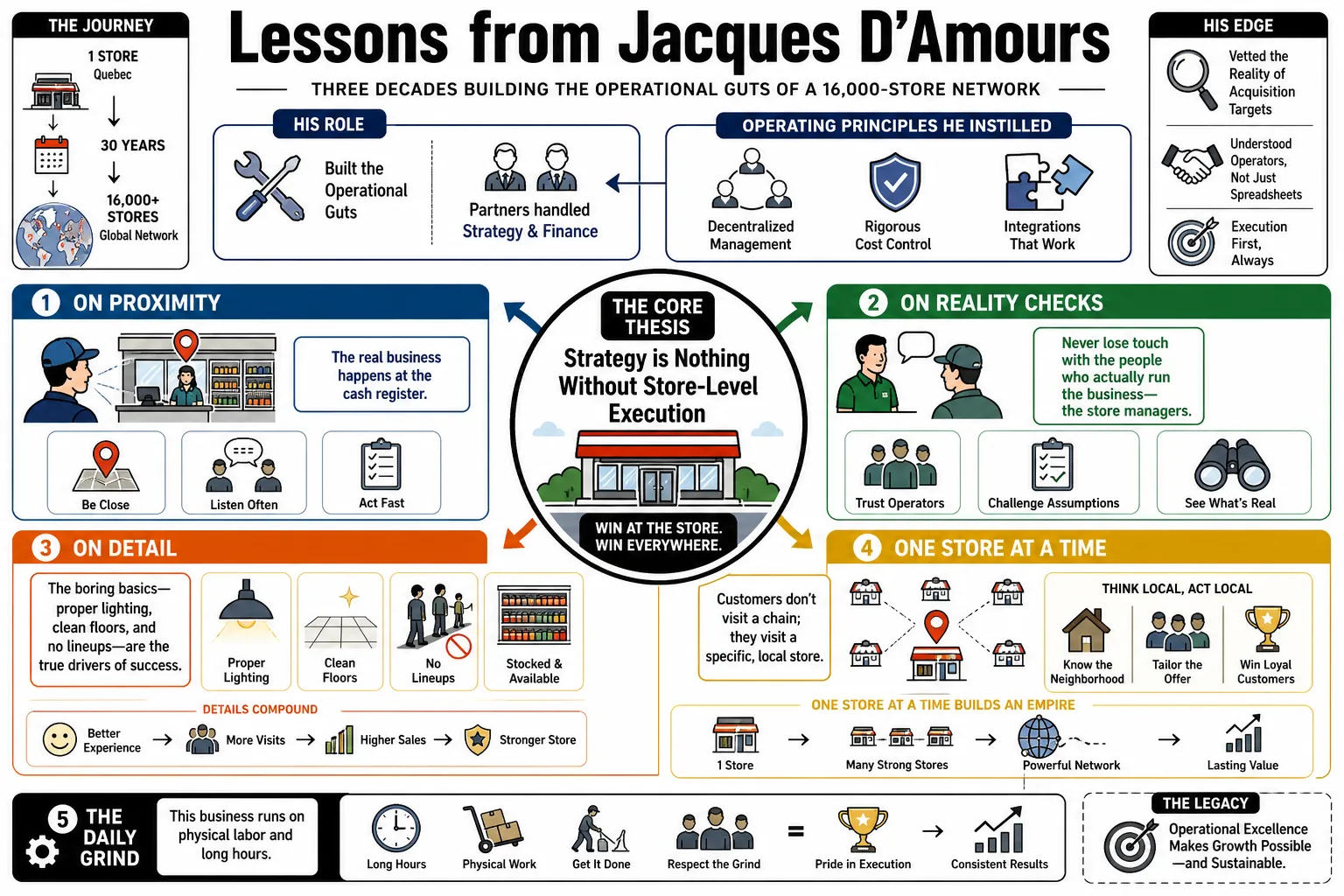
Jacques D'Amours spent three decades building the operational guts of Alimentation Couche-Tard, helping grow a single Quebec convenience store into a 16,000-location network. While his partners handled strategy and finance, D'Amours ran the unglamorous side of the business by enforcing store-level discipline and vetting the reality of acquisition targets. He built a culture of decentralized management and rigorous cost control that made their massive post-merger integrations actually work.
Part 1: The Store Level & The Front Line
- On Proximity: "Strategy is worthless without perfect execution at the store level; the real business happens at the cash register." — Source: [HEC Montréal Case Study]
- On Reality Checks: "Never lose touch with the people who actually run the business—the store managers." — Source: [Daring to Succeed]
- On Detail: "The boring basics—proper lighting, clean floors, and no lineups—are the true drivers of success." — Source: [Les Affaires]
- On One Store at a Time: "No matter how large a retail empire becomes, customers don't visit a chain; they visit a specific, local store." — Source: [Daring to Succeed]
- On the Daily Grind: "The convenience store business is built on physical labor and long hours, a reality founders must never forget." — Source: [The Globe and Mail]
- On Technical Guts: "A store's success relies as much on its unseen infrastructure—fuel systems and efficient layouts—as its branding." — Source: [Alimentation Couche-Tard Corporate History]
- On Customer Experience: "The environment of the store must be welcoming enough to offset the transactional nature of convenience retail." — Source: [Daring to Succeed]
- On Operational Humility: "The best corporate insights come from walking the aisles, not analyzing spreadsheets in head office." — Source: [HEC Montréal Case Study]
- On Standardization vs. Localization: "Standardize the backend technical systems, but localize the front-end product mix." — Source: [Harvard Business School]
- On Immediate Results: "In retail, you know by the end of the day if your strategy worked based on the receipts." — Source: [Les Affaires]
Part 2: Operational Discipline & Consistency
- On Scaling: "You cannot multiply a business model globally until you have perfected the operational DNA of a single location." — Source: [HEC Montréal Case Study]
- On Administrative Overhead: "Eliminate useless corporate jobs; every layer between the CEO and the cashier is a risk to efficiency." — Source: [Daring to Succeed]
- On Process: "Meticulousness is a competitive advantage when replicated across thousands of stores." — Source: [Les Affaires]
- On IT Infrastructure: "Scalability requires technical systems that can absorb massive growth without operational collapse." — Source: [Alimentation Couche-Tard Corporate History]
- On Supply Chain: "Optimizing distribution routes is where the hidden margins of convenience retail are found." — Source: [The Globe and Mail]
- On Trouble-Shooting: "The role of operations is to anticipate friction points in the supply chain before the store manager ever notices them." — Source: [Daring to Succeed]
- On Discipline: "A rapid growth strategy is only viable if the operational discipline is rigid enough to support it." — Source: [HEC Montréal Case Study]
- On Leases and Real Estate: "Favorable lease agreements are the invisible foundation of long-term retail profitability." — Source: [Les Affaires]
- On Backroom Realities: "The neatness of a store’s backroom is a direct indicator of the manager’s competence and the store’s health." — Source: [Daring to Succeed]
- On Execution Speed: "The faster an administrative decision can be implemented on the shop floor, the stronger the company." — Source: [Alimentation Couche-Tard Corporate History]
Part 3: Decentralization & Autonomy
- On Local Knowledge: "It is the local manager who knows the customer best, not the executives sitting at head office." — Source: [Harvard Business School]
- On the Store CEO: "Treat every store manager as the CEO of their own business, complete with P&L responsibility." — Source: [HEC Montréal Case Study]
- On Product Mix: "Allow local staff to dictate inventory; a store in Texas should not stock the same snacks as a store in Quebec." — Source: [Daring to Succeed]
- On Corporate Mandates: "HQ should provide data and procurement advantages, but must avoid top-down mandates that stifle local intuition." — Source: [The Globe and Mail]
- On Agility: "A flat hierarchy with minimal layers allows local stores to react instantly to neighborhood changes or crises." — Source: [Les Affaires]
- On Accountability: "With high local autonomy comes the strict accountability of managing your own budget and local marketing." — Source: [HEC Montréal Case Study]
- On Bureaucracy: "A massive global footprint does not require a massive, slow-moving corporate bureaucracy." — Source: [Harvard Business School]
- On Chains of One: "Treat a network of 16,000 locations as 16,000 individual businesses rather than one monolithic entity." — Source: [HEC Montréal Case Study]
- On Frontline Empowerment: "If a manager sees a sudden local demand, they must have the authority to act on it without waiting for corporate permission." — Source: [Daring to Succeed]
Part 4: Realities of Retail & Margin Control
- On Margins: "Convenience retail is a business of pennies, not a business of dollars; every fraction of a cent matters." — Source: [Daring to Succeed]
- On Frugality: "Corporate expenses should be kept low because it is ultimately the shareholders who foot the bill for luxury." — Source: [Les Affaires]
- On Fuel Economics: "Gasoline gets the customer onto the lot, but the operational efficiency of the transaction determines the profit." — Source: [Harvard Business School]
- On Hidden Costs: "Unchecked administrative bloat will quickly erode the razor-thin margins of the convenience model." — Source: [HEC Montréal Case Study]
- On Vendor Relationships: "The ability to negotiate at scale while delivering locally is the core economic engine of the business." — Source: [Alimentation Couche-Tard Corporate History]
- On Financial Realism: "Do not let the scale of global revenues blind you to the micro-economics of selling a single cup of coffee." — Source: [The Globe and Mail]
- On Cost Control: "Obsessive cost control is not about being cheap; it is about preserving the capital needed for aggressive expansion." — Source: [Daring to Succeed]
- On Profit Centers: "The layout of the store must subtly guide the customer from low-margin necessities to high-margin impulse buys." — Source: [Les Affaires]
- On Capital Allocation: "Every dollar spent at head office is a dollar taken away from improving the customer experience at the store level." — Source: [HEC Montréal Case Study]
Part 5: M&A Diligence & "Kicking the Tires"
- On Due Diligence: "Never trust the books without physically visiting the stores and kicking the tires yourself." — Source: [Daring to Succeed]
- On Assessing Value: "The true value of an acquisition is often found in the condition of their backrooms and the attitude of their night staff." — Source: [The Globe and Mail]
- On Emotional Deals: "You can fall in love with an acquisition, overpay, and put the entire enterprise at risk if you lack discipline." — Source: [Daring to Succeed]
- On Operational Synergy: "A merger only makes sense if the acquiring company can export its operational efficiencies to the new stores." — Source: [Harvard Business School]
- On the Integration Blueprint: "Have a meticulous, technical plan for reshuffling and integrating stores the day after the deal closes." — Source: [HEC Montréal Case Study]
- On Spotting Weakness: "Bloated middle management in a target company is an immediate indicator of hidden value waiting to be unlocked." — Source: [Les Affaires]
- On Patience: "Be willing to walk away from a deal if the operational realities on the ground do not match the financial projections." — Source: [Alimentation Couche-Tard Corporate History]
- On the Target's Infrastructure: "Assessing the technical debt of a target's IT and fuel systems is as critical as evaluating their real estate." — Source: [HEC Montréal Case Study]
- On Stealth Strategy: "Act like a night owl—patient, observant, and ready to strike quietly when the perfect acquisition appears." — Source: [Daring to Succeed]
Part 6: Post-Merger Integration & Cultural Alignment
- On the First 48 Hours: "The immediate priority post-acquisition is the choreography of leadership touring the new facilities to reassure staff." — Source: [Daring to Succeed]
- On Talent Retention: "The smartest acquisitions involve learning from the acquired talent rather than firing them and replacing them with HQ staff." — Source: [HEC Montréal Case Study]
- On Cultural Imperialism: "Do not impose a rigid home-office culture on a foreign market; respect the local operational nuances." — Source: [Harvard Business School]
- On Blending Best Practices: "If an acquired company does something better, adopt it globally rather than forcing them to conform to your old standard." — Source: [The Globe and Mail]
- On Anxiety Reduction: "Clear, immediate communication on the shop floor prevents the operational paralysis that usually follows a buyout." — Source: [Les Affaires]
- On Systems Migration: "The integration of back-office and technical systems must be invisible to the daily customer." — Source: [Alimentation Couche-Tard Corporate History]
- On Respect: "Treat the managers of the acquired stores with the same entrepreneurial respect as your veteran employees." — Source: [Daring to Succeed]
- On Earning Trust: "You do not buy loyalty with a merger; you earn it by providing the acquired managers with better tools to do their jobs." — Source: [HEC Montréal Case Study]
- On Brand Transition: "Rebranding a store is a delicate psychological shift for the local neighborhood; it must be executed with operational precision." — Source: [Les Affaires]
- On the Trojan Horse: "Entering a new global market via acquisition is only the first step; the real work is integrating the operational DNA." — Source: [Daring to Succeed]
Part 7: Partnership & "The Power of Four"
- On Shared Decision Making: "No major strategic move should advance without the unanimous agreement of all core partners." — Source: [Daring to Succeed]
- On Ego: "A successful partnership requires a strict no-ego rule; let the results speak, not the individuals." — Source: [The Globe and Mail]
- On Complementary Skills: "A visionary needs an operational architect; growth ambitions must be counterbalanced by administrative rigor." — Source: [HEC Montréal Case Study]
- On Stability: "The longevity of a company is directly tied to the ability of its founders to resolve conflicts privately and present a united front." — Source: [Les Affaires]
- On Knowing Your Role: "True operational excellence requires accepting the role of the silent partner while others take the public spotlight." — Source: [Alimentation Couche-Tard Corporate History]
- On Mutual Respect: "The bond between partners is forged by literally building the first stores with your own hands together." — Source: [Daring to Succeed]
- On Retreats: "Regular, isolated strategic retreats are necessary to cut through the daily noise and realign the founders' vision." — Source: [The Globe and Mail]
- On Delegation: "Trust your partners implicitly in their domain of expertise; do not micromanage the areas you do not own." — Source: [Harvard Business School]
- On the Pact: "A commitment to the partnership must outweigh any individual desire for credit or control." — Source: [Daring to Succeed]
Part 8: Long-Term Horizon & Legacy
- On the Long Game: "True builders operate as if they have fixed their retirement at 100 years old." — Source: [Les Affaires]
- On Protecting the Culture: "The greatest threat to a massive retail empire is the dilution of its original, gritty entrepreneurial culture." — Source: [HEC Montréal Case Study]
- On Succession: "Passing the torch requires ensuring that the operational discipline survives the departure of the founders." — Source: [The Globe and Mail]
- On Quiet Success: "It is infinitely more valuable to build a stealthy, highly profitable giant than a loud, fragile one." — Source: [Daring to Succeed]
- On Governance: "Board structures should be designed to protect the long-term vision against the short-term pressures of public markets." — Source: [Les Affaires]
- On Staying Grounded: "Never let the trappings of corporate success make you forget what it takes to mop a store floor at 2 AM." — Source: [Alimentation Couche-Tard Corporate History]
- On Generational Wealth: "The goal is not a quick exit, but building an enduring institution that creates value for decades." — Source: [The Globe and Mail]
- On Institutional Memory: "The DNA of how the first stores were run must be codified into the training of the newest managers." — Source: [HEC Montréal Case Study]
- On Ultimate Impact: "The legacy of a great operator is found not in press releases, but in the seamless daily execution of thousands of stores." — Source: [Daring to Succeed]