Lessons from Mark Manson
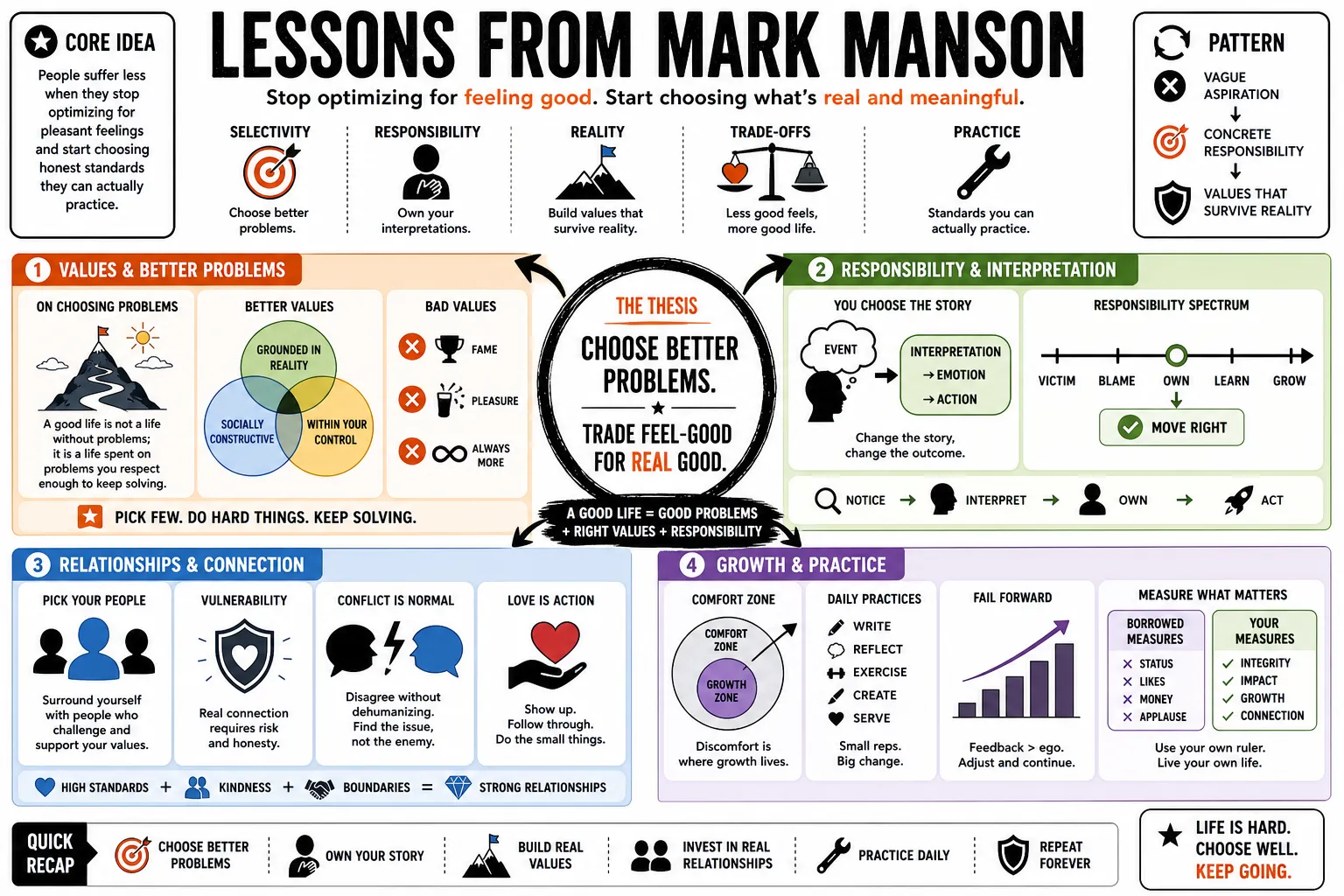
Mark Manson built a large audience by attacking the empty cheerleading of modern self-help. His work is blunt, but the useful core is not cynicism. It is selectivity. Stop trying to feel good about everything. Choose better problems. Take responsibility for your interpretations. Build values that survive contact with reality. This profile distills his writing into practical lessons on attention, values, responsibility, relationships, and growth. The recurring pattern is simple: people suffer less when they stop optimizing for pleasant feelings and start choosing honest standards they can actually practice. Manson's best work keeps returning to the same demand: trade vague aspiration for concrete responsibility, and trade borrowed measures of success for values that still make sense when life becomes uncomfortable.
Part 1: Values and Better Problems
- On choosing problems: A good life is not a life without problems; it is a life spent on problems you respect enough to keep solving. — Source: [The Subtle Art]
- On better values: Values are useful when they are grounded in reality, socially constructive, and within your control. — Source: [Personal Values]
- On bad values: Fame, pleasure, and always being right are brittle values because they depend on outside validation or distorted measurement. — Source: [Personal Values]
- On metrics: The question is not only what you value, but how you measure whether you are living it. Bad metrics quietly ruin good intentions. — Source: [The Subtle Art]
- On tradeoffs: Every meaningful choice rejects something else. Trying to avoid the rejection is how people drift into lives they did not choose. — Source: [The Most Important Question of Your Life]
- On struggle: Pain is not automatically meaningful. The point is to find pain attached to something worth becoming. — Source: [The Most Important Question of Your Life]
- On entitlement: Entitlement can look like superiority or victimhood; both put the self at the center of every story. — Source: [The Subtle Art]
- On ordinary discipline: Accepting that you are not special is freeing because it moves attention back to practice, choices, and responsibility. — Source: [The Subtle Art]
Part 2: Responsibility and Emotional Reality
- On responsibility: You may not control what happens to you, but you are still responsible for the meanings and responses you build from it. — Source: [Responsibility/Fault Fallacy]
- On fault versus response: Blame looks backward; responsibility looks at what can be done now. Confusing the two keeps people stuck. — Source: [Responsibility/Fault Fallacy]
- On negative emotions: Bad feelings are not failures. They are signals that something needs attention, interpretation, or action. — Source: [The Feedback Loop from Hell]
- On meta-anxiety: People often suffer twice: first from the feeling, then from judging themselves for having the feeling. — Source: [The Feedback Loop from Hell]
- On acceptance: Accepting discomfort is not resignation. It is the first step toward responding without panic or denial. — Source: [The Feedback Loop from Hell]
- On certainty: Certainty feels safe, but growth usually begins by admitting that your current story might be wrong. — Source: [The Subtle Art]
- On identity: The tighter you cling to an identity, the harder it becomes to notice evidence that asks you to change. — Source: [How to Grow Up]
- On maturity: Maturity is not emotional numbness. It is feeling clearly without letting every feeling become a command. — Source: [Emotional Intelligence]
Part 3: Attention and Modern Life
- On attention: Attention is a moral resource. What you repeatedly notice becomes what your life is organized around. — Source: [The Attention Diet]
- On information: A poor information diet makes the mind reactive, scattered, and easier to manipulate. — Source: [The Attention Diet]
- On digital restraint: The answer to noisy technology is not total withdrawal; it is designing friction around low-value consumption. — Source: [The Attention Diet]
- On comparison: Constant comparison turns other people's highlight reels into your private measuring stick. — Source: [The Disease of More]
- On enough: The desire for more has no natural stopping point unless you define what enough looks like. — Source: [The Disease of More]
- On ambition: Ambition is useful when it serves chosen values; it becomes destructive when it tries to outrun insecurity. — Source: [The Disease of More]
- On productivity: Productivity hacks are downstream of values. Without a clear hierarchy of care, efficiency only accelerates confusion. — Source: [Personal Values]
- On boredom: A life with no boredom usually has no room for reflection. Constant stimulation blocks the discomfort that produces clarity. — Source: [The Attention Diet]
Part 4: Relationships and Boundaries
- On boundaries: Healthy relationships require people to own their own emotions rather than outsourcing them to someone else. — Source: [Boundaries]
- On resentment: Resentment is often a sign that a boundary was not stated, defended, or respected. — Source: [Boundaries]
- On trust: Trust grows when people can tell each other uncomfortable truths without turning the conversation into punishment. — Source: [Healthy Relationships]
- On neediness: Neediness asks someone else to stabilize your identity. Love works better when each person can stand alone. — Source: [Neediness]
- On compatibility: Chemistry is not compatibility. A relationship also needs aligned values, tolerable conflicts, and mutual respect. — Source: [Relationship Advice]
- On conflict: Avoiding conflict is not peace. It often stores the truth until it returns as contempt. — Source: [Healthy Relationships]
- On honesty: Honesty is not saying every thought without care; it is refusing to build intimacy on performance. — Source: [Healthy Relationships]
- On self-respect: People with weak self-respect often confuse being needed with being loved. — Source: [Boundaries]
Part 5: Growth, Meaning, and Death
- On growth: Growth usually feels like losing an old self before the new one has proven useful. — Source: [How to Grow Up]
- On humility: Humility is not thinking less of yourself; it is becoming less invested in protecting a flattering self-image. — Source: [The Subtle Art]
- On courage: Courage is not confidence before action. It is action taken while confidence is still missing. — Source: [Courage]
- On failure: Failure gives better feedback than fantasy because it forces contact with the actual world. — Source: [How to Grow Up]
- On meaning: Meaning comes from commitments that ask something of you over time, not from constant positive emotion. — Source: [The Most Important Question of Your Life]
- On mortality: Remembering that time is limited clarifies which problems are worth carrying and which performances can be dropped. — Source: [The Subtle Art]
- On hope: Hope is strongest when it is attached to responsibility, not rescue fantasies. — Source: [Everything Is Fcked]*
- On the practical lesson: The center of Manson's work is not apathy. It is caring deliberately, with fewer illusions and better standards. — Source: [Mark Manson Articles]