James Clear is a writer and speaker focused on habits, decision-making, and continuous improvement. He is best known as the author of the #1 New York Times bestseller Atomic Habits, which has sold more than 30 million copies worldwide, and for his weekly 3-2-1 newsletter. His work offers practical frameworks for making small changes that compound into remarkable results.
Quotes from James Clear
These quotations are retained only where the exact wording appears on James Clear's own site.
- “Habits are the compound interest of self-improvement.” — James Clear — official quote page
- “You do not rise to the level of your goals. You fall to the level of your systems.” — James Clear — official quote page
- “Every action you take is a vote for the type of person you wish to become.” — James Clear — official quote page
- “Goals are good for setting a direction, but systems are best for making progress.” — James Clear — official quote page
- “The purpose of setting goals is to win the game. The purpose of building systems is to continue playing the game.” — James Clear — official quote page
- “Be the designer of your world and not merely the consumer of it.” — James Clear — official quote page
- “Good habits make time your ally. Bad habits make time your enemy.” — James Clear — official quote page
- “The first mistake is never the one that ruins you. It is the spiral of repeated mistakes that follows.” — James Clear — official quote page
- “Success is the product of daily habits—not once-in-a-lifetime transformations.” — James Clear — official quote page
- “You should be far more concerned with your current trajectory than with your current results.” — James Clear — official quote page
- “The greatest threat to success is not failure but boredom.” — James Clear — official quote page
- “It is easy to get bogged down trying to find the optimal plan for change: the fastest way to lose weight, the best program to build muscle, the perfect idea for a side hustle.” — James Clear — official quote page
- “We are so focused on figuring out the best approach that we never get around to taking action.” — James Clear — official quote page
- “The work that hurts you less than it hurts others is the work you were made to do.” — James Clear — official quote page
- “Master the art of showing up.” — James Clear — official quote page
- “The most practical way to change who you are is to change what you do.” — James Clear — official article
- “What you crave is not the habit itself but the change in state it delivers.” — James Clear — official article
- “The ultimate form of intrinsic motivation is when a habit becomes part of your identity.” — James Clear — official quote page
- “Some people spend their entire lives waiting for the time to be right to make an improvement.” — James Clear — official quote page
- “Your actions reveal how badly you want something.” — James Clear — official quote page
- “The goal is not to read a book, the goal is to become a reader.” — James Clear — 3-2-1 newsletter
- “Once your pride gets involved, you'll fight tooth and nail to maintain your habits.” — James Clear — official quote page
- “Many people think they lack motivation when what they really lack is clarity.” — James Clear — official article
- “Patience is a competitive advantage.” — James Clear — official quote page
- On Taking action for luck: "You can't get lucky if you don't take action. The best opportunity in the world is just a missed opportunity if you don't grab it." — 3-2-1: On living with lightness, emphasizing what works, and the simple way to gain clarity
- On Clinging to comforts: "Plenty of growth can be found in removing your vices, but the real leaps are unlocked when you stop clinging to your comforts." — 3-2-1: On leisure vs. luxury, unlocking growth, and the many versions of a good life
- On Wanting less: "If you always want more, then you'll find the most you can have will always be too little." — 3-2-1: On the magic of wanting less, changing inch by inch, and building a sense of hope
- On Difficult conversations: "Delaying a conversation doesn't make it easier." — 3-2-1: On being a good neighbor, deciding what to read, and being a lifelong learner
- On Creating Valuable Work: "The ultimate thing that drives book sales is creating something that is actually genuinely valuable to people. And it has to be so good that people will talk about it." — The Tim Ferriss Show
- On The True Meaning of Consistency: "Consistency is adaptability. Don't have enough time? Do the short version. Don't have enough energy? Do the easy version. Find a way to show up and not put up a zero for that day, because doing something is almost always infinitely better than doing nothing" — Huberman Lab Podcast Transcript
Learnings from James Clear
These practical frameworks are linked to first-party James Clear articles or a transcript containing the supporting passage.
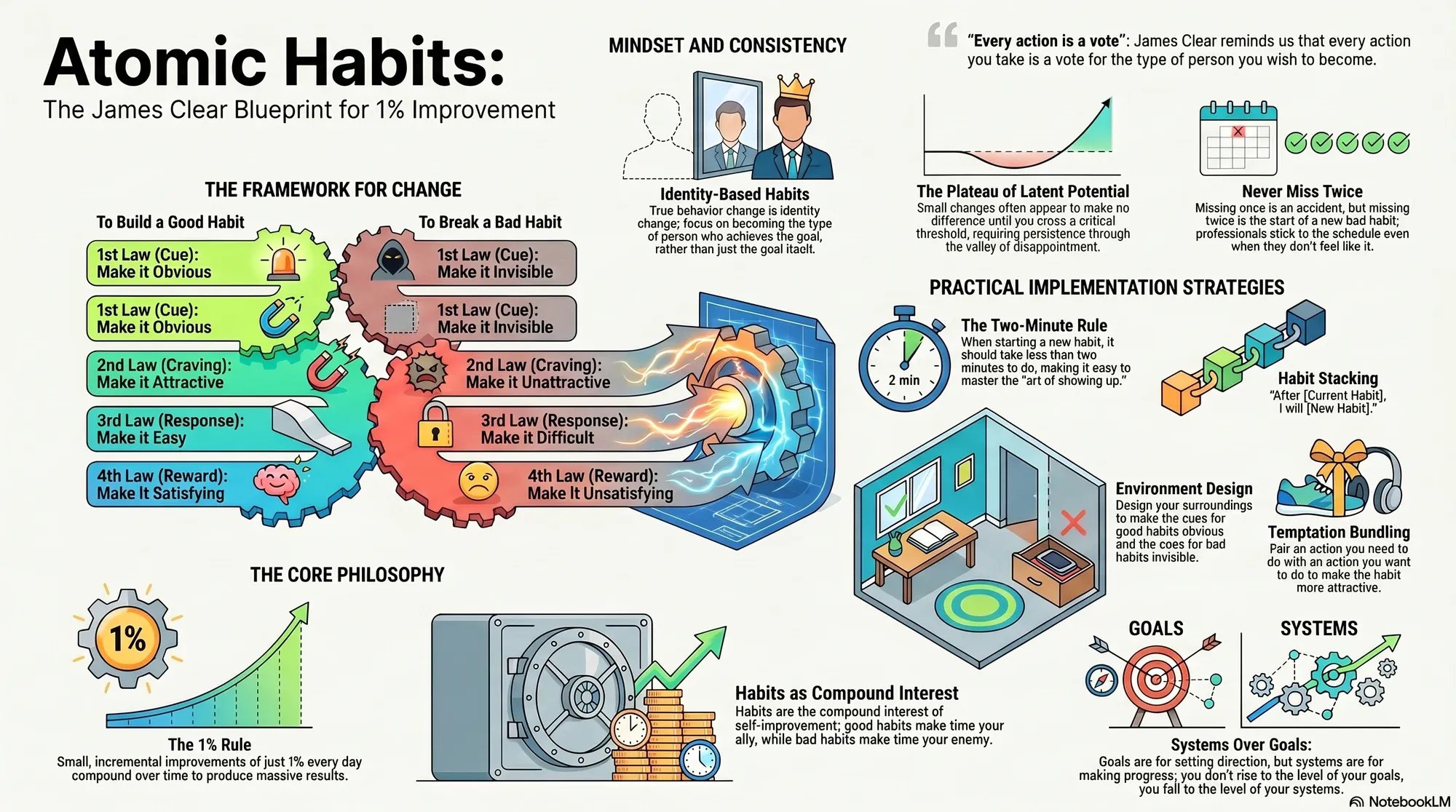
- The 1% Rule: Focus on getting 1% better every day. Small, incremental improvements compound over time to produce remarkable results. — James Clear — official article
- Identity-Based Habits: True behavior change is identity change. To make habits stick, they must become part of your identity. Focus on becoming the type of person who would achieve the goals you desire. — James Clear — official article
- The Four Laws of Behavior Change: To build a good habit, make it obvious, attractive, easy, and satisfying. — James Clear — official article
- Invert the Four Laws to Break Bad Habits: To break a bad habit, make it invisible, unattractive, difficult, and unsatisfying. — James Clear — official article
- Habit Stacking: A powerful strategy to build new habits is to link them to an existing habit. The formula is: "After [CURRENT HABIT], I will [NEW HABIT]." — James Clear — official article
- Environment Design: Your environment plays a significant role in shaping your behavior. Design your surroundings to make good habits easier and bad habits harder. — James Clear — official article
- The Two-Minute Rule: When starting a new habit, make it take less than two minutes to do. This makes it easy to start and build momentum. — James Clear — official article
- The Importance of Systems over Goals: Goals provide direction, but systems are what drive progress. Focusing on your systems ensures you continue to make progress over the long term. — James Clear — official article
- Overcoming a Lack of Motivation: Often, what appears to be a lack of motivation is actually a lack of clarity. Having a clear plan of when and where to act increases the likelihood of following through. — James Clear — official article
- Track Your Progress: Tracking your habits provides immediate feedback and can be a source of motivation. The simple act of tracking can make you more likely to stick with a habit. — James Clear — official article
- Never Miss Twice: A key to maintaining consistency is the rule to never miss a habit twice in a row. Missing once is an accident, but missing twice is the start of a new (undesirable) habit. — James Clear — official article
- Temptation Bundling: To make a habit more attractive, pair an action you want to do with an action you need to do. — James Clear — official article
- Motion vs. Action: Being in motion (planning, strategizing) can feel like progress, but it's not the same as taking action. It's crucial to move from planning to doing. — James Clear — official article
- The Cardinal Rule of Behavior Change: What is immediately rewarded is repeated. What is immediately punished is avoided. To make a habit stick, find a way to feel successful right away. — James Clear — official quote page
- Professionals Stick to the Schedule: Amateurs let life get in the way. Professionals show up and do the work even when they don't feel like it. — James Clear — official article
- Start with an Incredibly Small Habit: Make new habits so easy that you can't say no. The goal is to master the art of showing up. — James Clear — 3-2-1 newsletter
- Action Relieves Anxiety: If you're feeling anxious about something, taking action, no matter how small, can help alleviate that anxiety. — James Clear — official quote page
- Choose Your Information Diet Wisely: The information you consume shapes your thoughts and beliefs. Be intentional about what you read and watch to foster a positive and growth-oriented mindset. — The Tim Ferriss Show transcript
- On Knowing your next step: Instead of worrying about what you want to do with your life, focus on gaining clarity about what you want to do this week. Figuring it all out isn't necessary; just knowing the next step is enough. — 3-2-1: On living with lightness, emphasizing what works, and the simple way to gain clarity
- On Failure versus lessons: Whether you are on a good path or a bad one determines if continuing or stopping is a failure or a lesson. On a good path, stopping is a failure and continuing is a lesson; on a bad path, continuing is a failure and stopping is a lesson. — 3-2-1: On living with lightness, emphasizing what works, and the simple way to gain clarity
- On Replacing vs. Eliminating Bad Habits: When trying to break a bad habit, substituting it with a different behavior is often more effective than trying to eliminate it entirely. By finding a healthier alternative that satisfies the same underlying craving or sensation, you make the transition much easier. — The Tim Ferriss Show
- On Making Habits Sustainable: When building a new habit, focus on designing it so you actually look forward to the activity. Asking yourself what the behavior would look like if it were easy helps ensure the habit feels like a natural part of your lifestyle rather than a burdensome chore. — The Tim Ferriss Show
- On Habits as Inherited Solutions: Many of our current habits are simply adopted "solutions" to recurring problems that we inherited from our environment or role models. Recognizing this allows you to intentionally upgrade those behaviors with better solutions. — Huberman Lab Podcast Transcript