Jean-Michel Lemieux is an Executive Individual Contributor at Spellbook and the former CTO of Shopify. His focus on leadership and management centers the relationship between direction, people, and execution. The productive question is how leaders translate intent into coordinated action while preserving the judgment and agency of others.
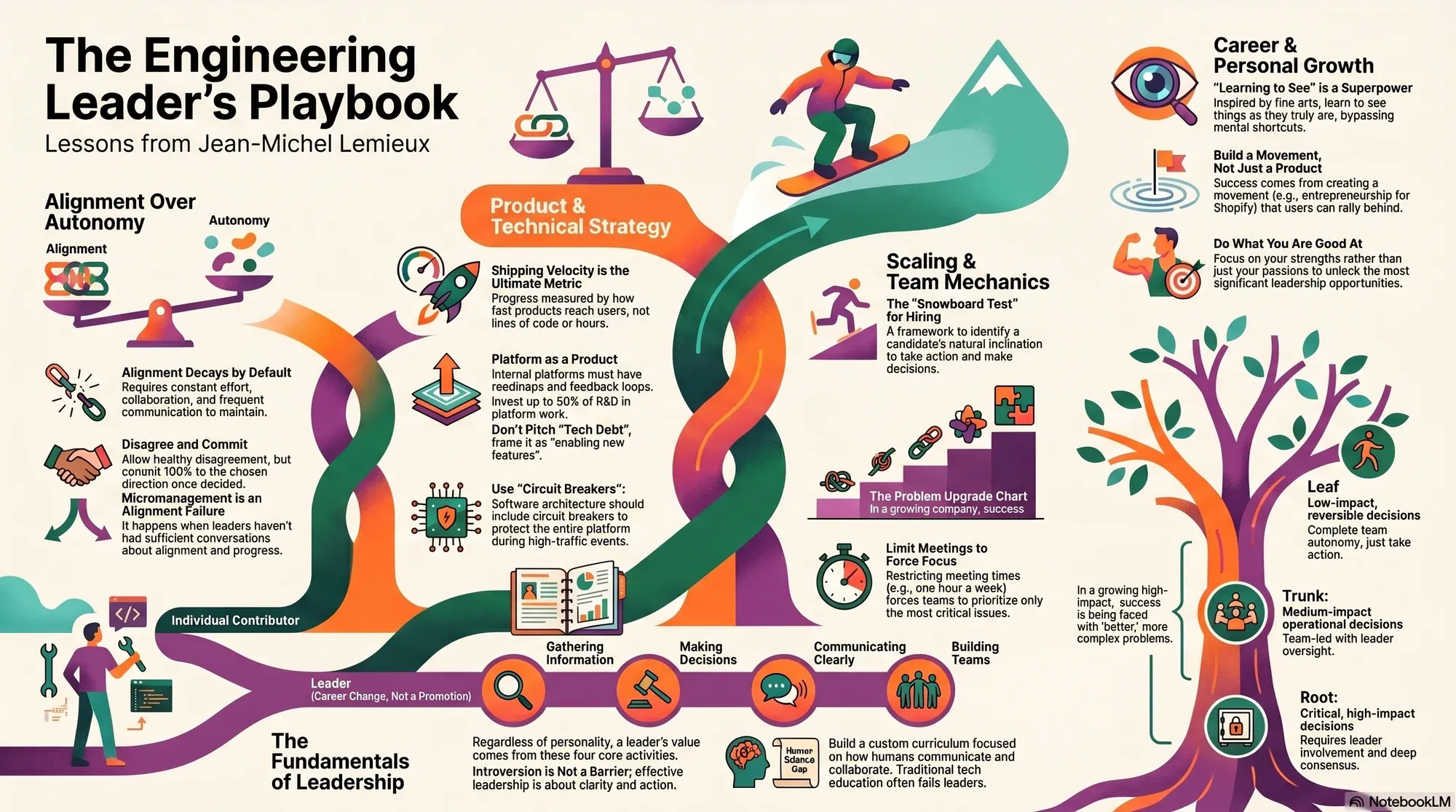
On Leadership and Management
- The Four Core Activities of a Leader: Good leaders focus on four main activities: gathering information, making decisions, communicating very clearly, and building great teams. This is irrespective of personality type. [1]
- Management is a Career Change, Not a Promotion: Viewing the transition to management as a career change, rather than a promotion, sets the right mindset for leaning into the new role and its unique challenges. [2]
- Leaders Don't Need to Be Extroverts: Lemieux, an introvert himself, learned from Peter Drucker that leadership is not about being a "slick back salesman." Effective leaders can be introverts or extroverts. [1]
- Embrace a Beginner's Mindset in Leadership: Approaching leadership with the mindset of a beginner allows you to absorb more and avoid stumbling. [1]
- The Hardest Part of Building Companies is Alignment: While autonomy is a deeply ingrained value, the real challenge in a company is achieving alignment—deciding what to do, how to do it, and how to adjust in real-time. [3]
- Alignment Over Autonomy: In his career, Lemieux learned that alignment is more crucial than autonomy for a company to effectively focus on its strategy and make progress. [4]
- Alignment Decays and Requires Continuous Effort: Maintaining alignment is an ongoing challenge that requires constant effort from leadership teams through collaboration and frequent communication. [4]
- Disagree and Commit: A useful tool for teams is the principle of "disagree and commit." It's important to allow for disagreement but then commit as a team to the chosen direction. [3]
- Micromanagement Stems from a Lack of Alignment Conversations: Leaders who micromanage often do so because they aren't having the right conversations about alignment and progress. [3]
- Treat Your Team as a "Connected Network of Brains": This approach emphasizes collaboration and collective intelligence over individual silos. [2]
- Progress is the Fuel of a Team: Alignment conversations should focus on understanding if the team's work is good, if options have been explored sufficiently, and if progress is being made. [3]
- Trust and Empower Your Team: Avoid micromanaging by trusting your team to make decisions and take action. [5]
- Use a Decision Tree for Prioritization: Employ a framework like Susan Scott's decision tree to categorize decisions as root (important), trunk (medium), or leaf (unimportant) to focus the team's energy. [5]
- Leadership Requires Understanding Humans: Lemieux notes that his education didn't equip him for leadership because it lacked focus on human sciences and how people work. [2]
- Build Your Own Leadership Curriculum: He had to create his own curriculum to understand how people communicate, collaborate, and get things done. [2]
- On Put the right skills on the right projects: "You had one job as a manager… put the right skills on the right projects. Period." — Layerinitis - Build Right Side
On Product and Technical Strategy
- Focus on Shipping Velocity: The ultimate measure of a team's progress is the velocity of shipping products, not lines of code or time in meetings. [5]
- Build and Run Software Together: Software teams should prioritize building and running software collaboratively over adhering to rigid processes like Scrum or TDD, which can be wasteful. [5]
- Platform as a Product: It's crucial to view your internal platforms as products with their own roadmaps and feedback loops to ensure they effectively serve developers. [6]
- Invest in Your Platform: Lemieux advocates for investing a significant portion of R&D spending (even up to 50%) in platform work to enable future product development and maintain velocity. [7]
- Having a Separate Platform Team Can Be an Anti-Pattern: He suggests that every team has a platform component to what they do, and siloing it can be detrimental. [7]
- Don't Just Pitch "Fixing Tech Debt": To get support for platform work, frame it in terms of enabling new features and capabilities, not just as a cost of doing business. [7]
- Use Circuit Breakers in Your Systems: Similar to an electrical system, software architecture should have circuit breakers to protect the integrity of the overall platform during high-stress events. [8]
- High-Traffic Events Force You to Get Better, Faster: The intense traffic from events like sneaker drops forced Shopify to improve its architecture and operations more quickly than they otherwise would have. [8]
- Computers as Tools for Creativity: Lemieux's interest in technology began by using computers for creative pursuits in fine arts and music, not just programming. [5]
- The Risky Path Isn't Always as Risky as it Seems: He emphasizes that what appears to be the safe career or product path may not be, and vice versa. [5]
- Focus on a Narrow Target Market Initially: In the early stages, companies should concentrate on a specific customer base to build loyalty before expanding. [5]
- Avoid Pleasing Everyone with Too Many Ideas: Trying to cater to everyone with a multitude of features can lead to failure. [5]
- Balance Speed and Quality: In the first three years, founders must focus on both the speed of execution and building the right product. [5]
- Every Language Teaches You Something: Each programming language has a specific goal and is good at a certain set of things; the key is the ability to solve problems, not mastery of one language. [10]
- On Prototype to learn: Replacing prototypes with roadmaps prevents teams from building to learn, leading to empty roadmaps without substance. — Layerinitis - Build Right Side
- On Reduce decision friction: "Building shared standards and platforms to reduce decision friction is how you go fast slowly." — Going fast slowly - Build Right Side
- On Architecture as strategy: Engineers own much of the roadmap’s what and how; architecture is therefore part of strategy. — Problem solving vs problem planning - Build Right Side
- On Problem solving over problem planning: "Planning is important, but most planning is wasted time. Focus on building a problem solving culture and not a problem planning one." — Problem solving vs problem planning - Build Right Side
- On Contracts as real-world APIs: "Contracts are the APIs of the real world – every transaction runs on them – so by making legal workflows frictionless, Spellbook is accelerating the agreements that underpin the global economy" — BNN Bloomberg: Spellbook Welcomes Former Shopify CTO
On Scaling and Team Building
- Steal from Operating Systems to Scale Your Team: Lemieux has given talks on applying concepts from operating systems to the challenge of scaling engineering teams. [11][12]
- Hire for the "Snowboard Test": This is a way to determine a candidate's natural inclination to take action and make decisions. [5]
- You Can't Just Hire Great People and Step Aside: This is a flawed approach because alignment is still necessary to ensure everyone is working towards the same goals. [13]
- Structure Teams for Developer Happiness and Productivity: Organizational design should be intentional about creating an environment where developers can be successful. [6]
- How to Stay Fast as You Scale: A key challenge for growing companies is maintaining their initial speed, a problem Lemieux has focused on in his writing and post-Shopify work. [15]
- Limit Meetings to Force Focus: By restricting team meetings to a short, fixed time (e.g., one hour a week), you force the conversation to focus on the most critical, immediate issues. [13]
- Build a "Backpack Full of Knowledge": This gives you a competitive edge in problem-solving. [16]
- Pair Programming in Leadership: Lemieux advocates for "micro alignments" and regular communication, akin to pair programming, to stay in sync with other leaders and CEOs. [13]
- Information is Often Hidden: As companies scale, critical information gets buried in spreadsheets, Slack threads, and other places. It's important to have systems to bring this information into a central view. [15]
- On Put code where it belongs: Layerinitis appears when teams place code where they feel most comfortable for short-term speed instead of where it belongs in the long-term system. — Layerinitis - Build Right Side
- On Fast fast versus fast slowly: "Autonomy is great. But as you scale, the speed impact of only investing in getting fast fast will in fact slow you to a crawl. It’s like eating a snickers bar mid-afternoon. The sugar rush is nice, but it doesn’t last long." — Going fast slowly - Build Right Side
- On Overplanning grows bureaucracy: Years of overplanning increase the ratio of non-builders to builders, producing more planning, more distraction, and less building. — Problem solving vs problem planning - Build Right Side
On Career and Personal Growth
- Do Something You Are Good At: Rather than solely focusing on what you love, doing what you are good at can lead to significant leadership opportunities. [5]
- Build a Movement, Not Just a Product: Companies like Shopify and Atlassian succeed by creating movements around their products—entrepreneurship for Shopify and open-source for Atlassian. [5]
- Our Education System Doesn't Train Good Leaders: Lemieux is critical of traditional education for not teaching enough about how humans work, which is essential for leadership. [2]
- You Have Control Over Building Something That Matters: While you can't control your company's valuation, you have 100% control over whether people use your product and if it improves their lives. [15]
- Leaving a High-Profile Role Can Be a "Second Wind": Departing from Shopify was "scary," but it allowed him to find a new wave of motivation and fun in a new venture. [15]
- Follow Your Guidance Counselor's Advice (Sometimes): His guidance counselor pointed out his aptitude for computers, which set him on his career path despite his parents' initial reservations about the new field of computer science. [10]
- It's Never Too Late to Start: He felt intimidated in his first year of university computer science because many of his peers had been programming for years, but he caught up. [10]
- On Staying close to the game: "I'm in these board meetings, and it feels like I'm a coach of a pro team, but I can't see them play the game" — Business Insider: Why tech leaders are writing code again
Learn more:
- Good leaders do these 4 things | Jean-Michel Lemieux - YouTube
- Interview with Jean-Michel Lemieux, CTO at Shopify | Management is a Career Change
- Autonomy vs Alignment, with Jean-Michel Lemieux - YouTube
- Articles Written by Jean-Michel Lemieux - Practica
- Jean-Michel Lemieux: Three Product Decisions Every Team Needs to Make | E1129 - Recall
- Episode 45: Jean-Michel Lemieux - Flow Framework
- How much Shopify and Atlassian invest in platform work - DX
- Episode 48: Jean-Michel Lemieux, ex-CTO of Shopify - YouTube
- Shopify - Wikipedia
- Bot Devs Confront SHOPIFY CTO - Jean-Michel Lemieux | Worlds Collide - YouTube
- Stealing from operating systems to scale your team - CTO Connection
- Jean-michel Lemieux. About the speaker - CTO Connection
- Jean-Michel Lemieux: Three Product Decisions Every Team Needs to Make | E1129
- Engineering Leadership, the hard parts — by Jean-Michel Lemieux
- Life after Shopify giving Ottawa entrepreneur Jean-Michel Lemieux a 'second wind'
- 167 Jean-Michel Lemieux -CTO at Shopify
- Shopify CTO Jean-Michel Lemieux one of three execs to depart company | BetaKit
- Jean-Michel Lemieux - Wikipedia